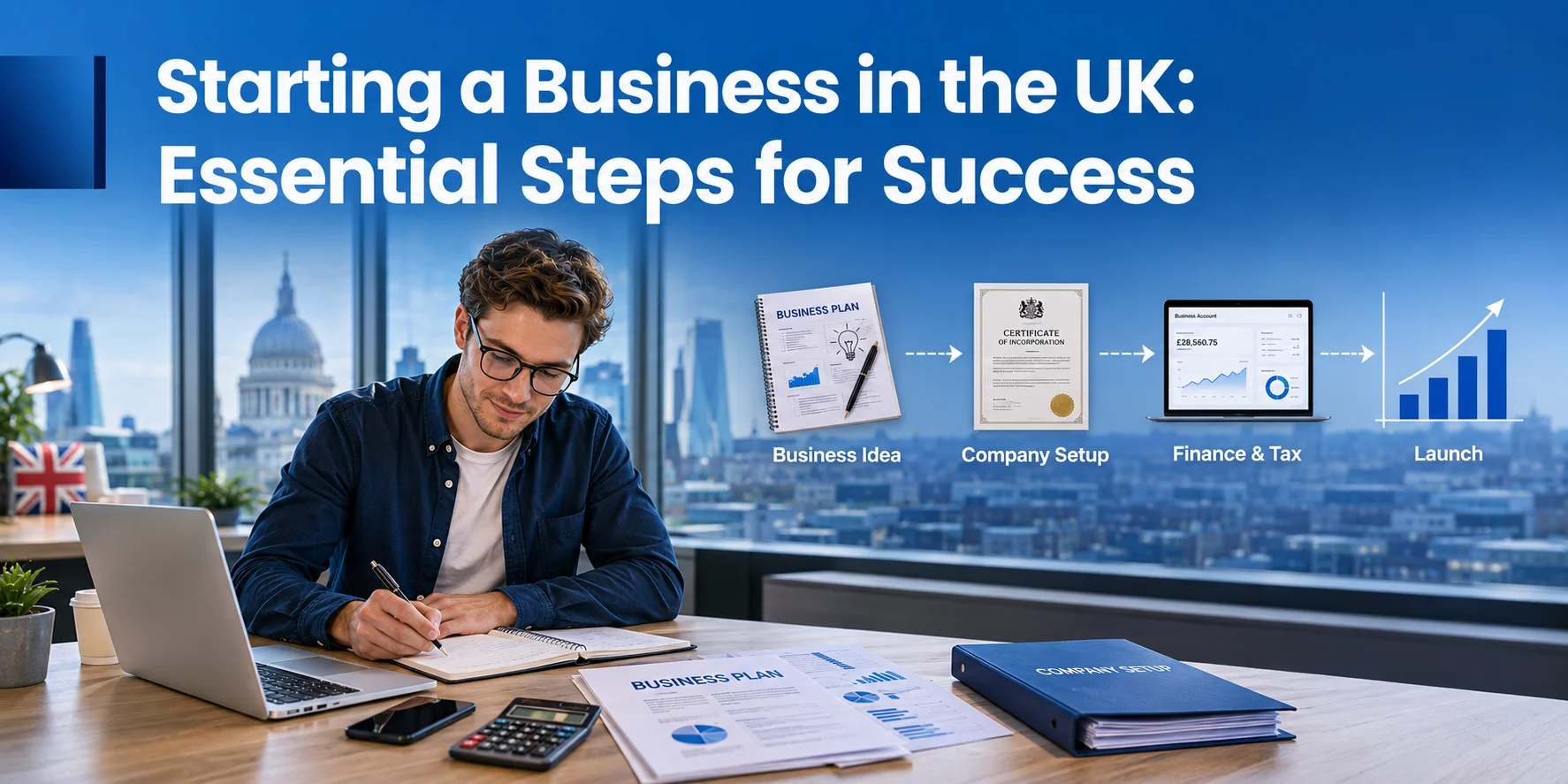
Turning an idea into a real business feels exciting, right up to the moment the paperwork shows up. Swiftly, you have structures to choose, forms to file, and taxes you have never heard of. Most founders do not fail because their ideas are weak. Besides, they trip up because a deadline slipped, a threshold crept past them, or the wrong structure left them paying more tax than they needed to.

This guide walks you through the key steps in the order they matter. Essentially, you start with how to trade and end with staying on the right side of HMRC once the money comes in. Furthermore, get these basics right, and everything else feels much easier.
Which UK Business Structure Is Right for You?
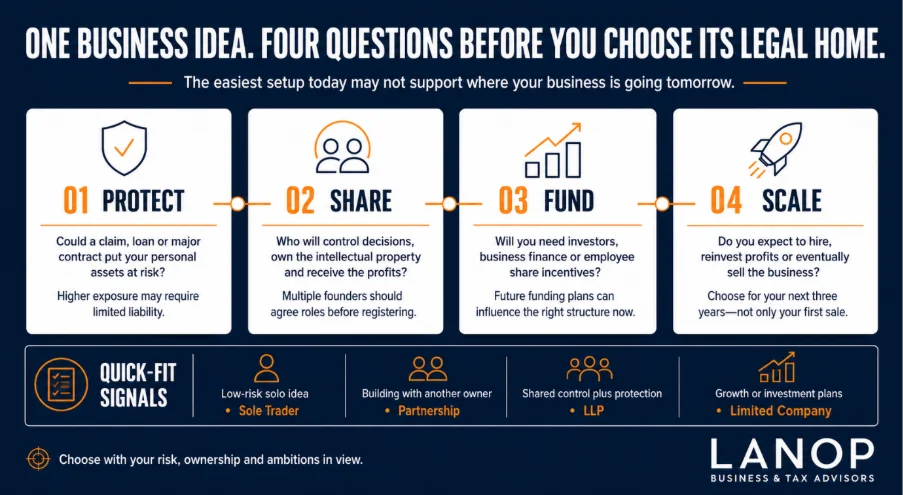
Your structure shapes your tax, your legal risk, and how much admin you carry. That makes it worth real thought before anything else. Four options cover almost every new business.
A sole trader setup is the simplest. You and the business count as the same person in law, so your personal savings and assets are at risk if things go wrong. An ordinary partnership works the same way for two or more people who share the profits and the risk.
A limited liability partnership keeps that shared-profit setup but protects each partner’s personal assets. A private limited company is a separate legal body. Your liability is usually limited to what you put in, and profits are taxed differently.
Weighing Up the Trade-Offs
The choice comes down to a simple balance. More protection and tax flexibility usually mean more paperwork and more public information about your business. A sole trader files one tax returns a year. A limited company files accounts, confirmation statement and a Company Tax Return.
Think ahead, too. As the government’s own guidance on setting up a business points out, a company often fits better if you plan to raise money, hire staff or sell up one day. Some founders pick up a company because it sounds impressive, then find the extra admin costs more than it is worth at their profit level. The right choice comes down to your numbers, not how it sounds.
How to Register Your Business the Right Way
Registration is not one single job. It is a set of steps that depend on your structure and what you do.
Sole traders and partners register for Self Assessment with HMRC once trading income passes the £1,000 trading allowance, which HMRC sets each year. Below that amount, you usually do not need to declare the income at all.
A limited company is registered with Companies House. After that, HMRC gives you three months to tell them the company is active for Corporation Tax.
Extra Steps to Check
Companies House have been conducting identity checks on new directors and people with significant control since 18 November 2025. Moreover, you might also have to register for VAT, PAYE, and any licenses required for your trade. Furthermore, check the rules for your line of work early, because some approvals take time.
How to Fund and Budget for Your Business
Running out of cash is one of the quietest reasons new businesses fail. So, build a realistic budget before you trade. Start by separating your one-off startup costs, such as equipment and registration, from the monthly running costs.
Then map out your income and spending across the first 12 months. This shows you when cash lands, not just when you send an invoice. Add your own living costs to that picture and keep an emergency buffer, because most businesses take time to make a profit.
Money can come from savings, loans, grants, crowdfunding, or investors. The government-backed Start Up Loan scheme is worth a look at smaller amounts. Do not forget pre-trading costs either, as many things you paid for before launch can still be claimed. Finally, open a separate business bank account and set aside money for taxes from your very first sale.
What Taxes Will Your Business Pay?
Your tax bill depends on your structure. So, it helps to know the main numbers from day one.
Tax for Sole Traders
When trading as a sole trader, they pay Income Tax and Class 4 National Insurance on their trading profit. Income Tax is charged on income above the Personal Allowance of £12,570 at HMRC’s 26/27 rates. You then pay 20% up to £50,270, 40% up to £125,140 and 45% above that. HMRC also sets Class 4 National Insurance, which is 6% of profits earned between £12,570 and £50,270, with 2% on profits over £50,270.
Tax for Limited Companies
A limited company pays Corporation Tax instead. The small profits rate for HMRC is 19% up to £50,000. It increases from £250,000 to £25%, with a Marginal Relief in between. Between £50,000 and £250,000, each extra pound of profit is taxed at about 26.5%, which catches a lot of new directors out.
Directors who take dividends pay dividend tax on top of that. HMRC’s current rates are 10.75%, 35.75% or 39.35% by band, after a £500 dividend allowance. Hire staff, and you also take on PAYE and employer National Insurance. Work from business premises and, as GOV.UK explains, you may face business rates too.
When Do You Need to Register for VAT?
VAT surprises more new businesses than any other tax. That is because the trigger is your turnover, not your profit.
HMRC says you must register once your taxable turnover passes £90,000 in any rolling 12-month period. This is not tied to your accounting year. You check the last 12 months at the end of every month, and you have 30 days to tell HMRC once you go over.
A second test also applies. If you expect to pass £90,000 in the next 30 days alone, you must register straight away. A single large contract can be enough to trigger it.
Should You Register Early
Keep in mind that taxable turnover includes zero-rated sales, not just standard-rated ones. It leaves an exempt income. Some businesses register before they hit the threshold to reclaim VAT on costs, or to appear more established to larger clients. Whether that pays off depends on your customers and whether they can reclaim the VAT you charge.
The Filing and Payment Deadlines That Matter
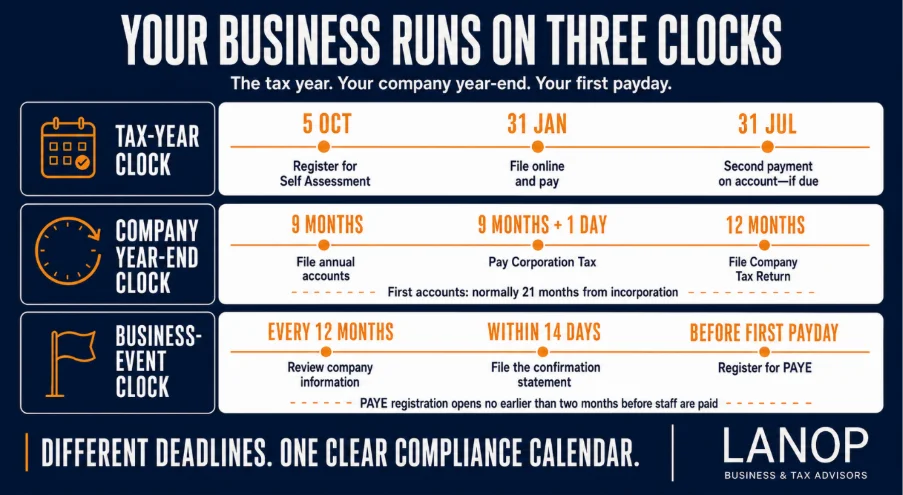
Deadlines are where good intentions meet HMRC’s calendar. Missing one gets expensive fast, so keep these dates in plain sight.
If you file a Self-Assessment, HMRC asks you to register by 5 October after the end of the tax year. Your online return and any tax you owe must reach them by 31 January, along with your first payment on account, if applicable.
Limited companies follow a different rhythm. As HMRC sets out, Corporation Tax is due 9 months and 1 day after your accounting period ends, and the Company Tax Return is due within 12 months. Moreover, you also file annual accounts and a yearly confirmation statement with Companies House, and you must register as an employer before your first payday.
What Happens If You Miss a Deadline?
The penalties accumulate rapidly and are numerous, even if you’re not legally responsible for taxes. Being familiar with them is the least expensive coverage you can have. Late filing of the Self-Assessment incurs an automatic £100 fine from HMRC.
Miss the Self-Assessment deadline, and HMRC charges an automatic £100. After three months, that grows by £10 a day up to £900, with more charges at six and twelve months. Pay late, and you face separate charges of 5% of the unpaid tax at 30 days, six months and twelve months, plus daily interest.
Businesses are not out of the woods. From 1 April 2026, the first penalty to be paid for late filing of a Company Tax Return has been doubled to £200, according to HMRC. Delaying VAT registration only increases costs, as it is calculated as a percentage of the tax that should have been collected. You may appeal if you have a legitimate, reasonable excuse, or if the number of dates will outnumber the number of appeals.
The Most Common Mistake New Owners Make
The biggest slip is mixing turnover and profit when watching the VAT threshold. A business can pass £90,000 in sales while making very little profit, yet it still must register.
Founders also treat registration as one neat task rather than several separate ones. Many mix personal and business money from day one as well. Each of these creates cost and stress you can easily avoid with a little planning.
What Changed for New Businesses in 2026
A lot has changed in the rules in a year and a half, and it’s the new founders who feel it.
The Making Tax Digital for Income Tax has been delayed to 6 April 2026. HMRC is now using it for sole traders and landlords with a gross income over £50,000 who maintain digital records and report quarterly. This changes from April 2027 to £30,000 and from April 2028 to £20,000; therefore, many smaller businesses will be joining soon.
New Rules at Companies House
Companies House made identity checks compulsory from 18 November 2025, and its fees went up on 1 February 2026. Digital incorporation now costs £100 and the confirmation statement £50.
There is better news if you plan to raise money. From 6 April 2026, HMRC confirmed that all EIS and VCT company limits and EMI thresholds increased, which is good news, as it means both funding rounds and the breadth of employee share schemes have increased. No matter where you are, this is the easiest piece of advice. Don’t wait until you’re in a rush to implement digital record-keeping as part of your systems.
How Lanop Helps You Start Well
Starting well is far easier with someone who has done it many times. At Lanop, we compare business structures against your real situation, then handle company setup and every tax registration for you. We build realistic forecasts, support funding and bank account applications, and set up bookkeeping that is ready for Making Tax Digital. From there, we manage your VAT, payroll and Corporation Tax, and we keep every Companies House and HMRC deadline in view.
Conclusion
Indeed, with the right sequence of steps, starting a business in the UK is quite feasible. Select an appropriate structure, use the appropriate register, become knowledgeable about your taxes, and meet tax deadlines. Once that’s done, you can concentrate on the things that really build the business. The rules are constantly changing, but you don’t have to keep track of all of them yourself. Talk to Lanop Business & Tax Advisors today and get our team on your side for a confident and compliant launch, while availing yourself of the free consultation.
Can I start a business while working full-time?
Yes, if your employment contract allows it. You report the extra income through Self-Assessment and pay tax on it in addition to your salary.
Do I need a separate business bank account?
Sole traders do not need one, but it makes bookkeeping much cleaner. A limited company must keep its money separate, so a dedicated account is a must.
Can I claim costs I paid before I started trading?
Often yes, since many pre-trading costs bought purely for the business count as allowable expenses. Keep every receipt so you can back up the claim.
Can I use a virtual registered-office address?
Yes, and many founders do so to keep their home address off the public register. It just needs to be a real place where official posts can be received.
How much should I set aside for tax from each payment?
As a rough guide, putting away 25% to 30% of profit suits most sole traders, though higher earners should save more. A separate pot stops a nasty shock in January.
Do I need an accountant before I start trading?
It is not required, but early advice on structure and registration often saves far more than it costs. It also stops small errors from turning into expensive ones later.