
Why UK Limited Companies Are Switching to Electric Vehicles in 2026
The number of UK limited companies converting their fleets to electric vehicles in the last two years has outpaced that of the last decade, and here’s why. The UK tax system is now heavily weighted in favour of electric vehicles (EVs), supported by commitments to Net Zero, increased government incentives, and the pace of technological change in the vehicle sector.
The aftermath is even stronger for 2026. An intricate combination of tax relief, allowances, grants, and salary sacrifice advantages offers real savings for both employers and employees. Yet some of these benefits are due to be restricted or reduced over the next two tax periods, so timing is crucial this year.
If you are a business owner and you want to save money, reduce your tax burden, and prepare for the future, there’s no time like the present. In this article, we explore all the 2026 benefits of what they mean for businesses, and how to capture those savings before the changes take effect.
How Company Car Tax Has Shifted for EVs
The big moment for electric company cars was April 2020, when the Benefit-in-Kind (BIK) rate dropped to 0%. That kicked off a wave of business EV buying that has only grown since.
Rates have risen slowly each year, but they are still very low compared to petrol and diesel. For the 2026/27 tax year, the BIK rate for fully electric cars is 4%, up from 3% in 2025/26. It will rise to 5% in 2027/28, 7% in 2028/29 and 9% in 2029/30. Petrol and diesel cars, by contrast, can sit anywhere between 25% and 39%, depending on emissions.
That gap matters. A £40,000 electric car at 4% BIK creates a taxable benefit of £1,600 a year. A similar petrol car with an estimated BIK of around 30% would generate a taxable benefit of £ 12,000. The difference is shown in your employees’ pay every single month.
So even with the small yearly increases, EVs remain by far the cheapest company cars to tax. The government has also confirmed rates through 2029/30, which gives you sufficient planning time when picking cars for your fleet.
Why the Government Still Pushes EVs
The UK has a legal target of net zero greenhouse gas emissions by 2050. Transport is the biggest emitter in the country, so the pressure to switch away from petrol and diesel is not going away.
That is why the tax breaks for electric company cars have stayed generous, even as some of the early grants for private buyers have been pulled. The government wants businesses to lead the change, and the numbers reflect that.
For limited companies, this lines up neatly with the bottom line. You get lower tax bills, your team gets cheaper company cars, and the business builds a greener image. Few tax decisions tick that many boxes at once.
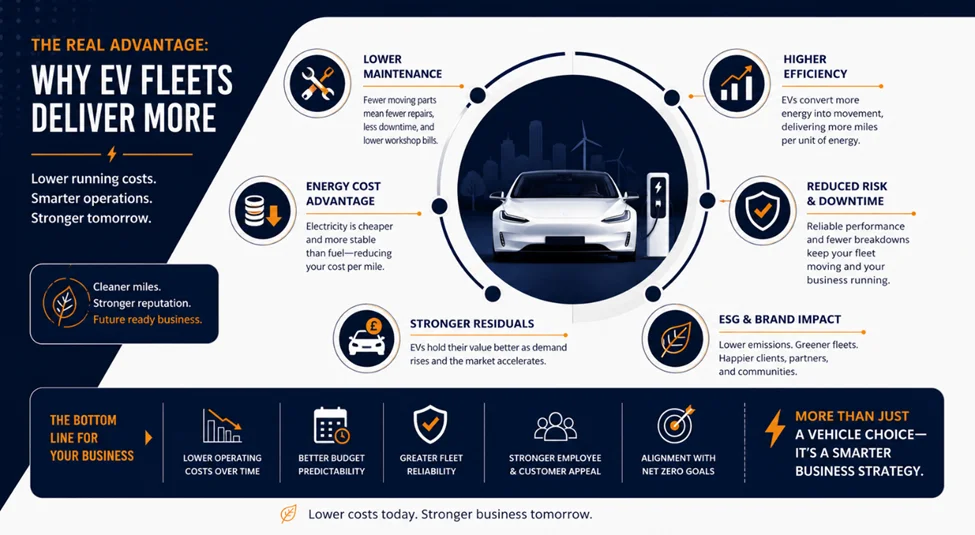
More than Tax, Total Cost of Ownership Benefits of EV Fleets
The Main Tax Reliefs Available in 2026
Several tax reliefs still make EVs the smart pick for limited companies this year. Here is what is on the table.
First-Year Capital Allowances
Buy a brand-new fully electric car through your limited company, and you can claim a 100% First-Year Allowance against your corporation tax bill. This applies whether you buy outright or through a hire purchase deal.
The relief lets you write off the full cost of the car in the year you buy it. For a £40,000 EV with corporation tax at 25%, that is a £10,000 saving in year one. Petrol and diesel cars do not get this allowance at all.
One thing to flag: this allowance has been extended to 31 March 2027 for corporation tax. After that date, it expires, so if you are thinking about buying, the next 12 months are key.
Corporation Tax on Leased EVs
Leasing is the other popular route. Monthly lease payments go through your profit and loss account as a business expense, which lowers your taxable profit and your corporation tax bill at the same time.
This works well for businesses that prefer steady monthly costs over a big upfront spend. It also means you can swap into a newer model every few years without worrying about resale values.
Hire Purchase Savings
A Hire Purchase agreement gives you the best of both worlds. You still get the 100% First-Year Allowance on the car’s value, and the monthly interest payments are deductible too.
This route works best when you want to own the car at the end and spread the cost across several years.
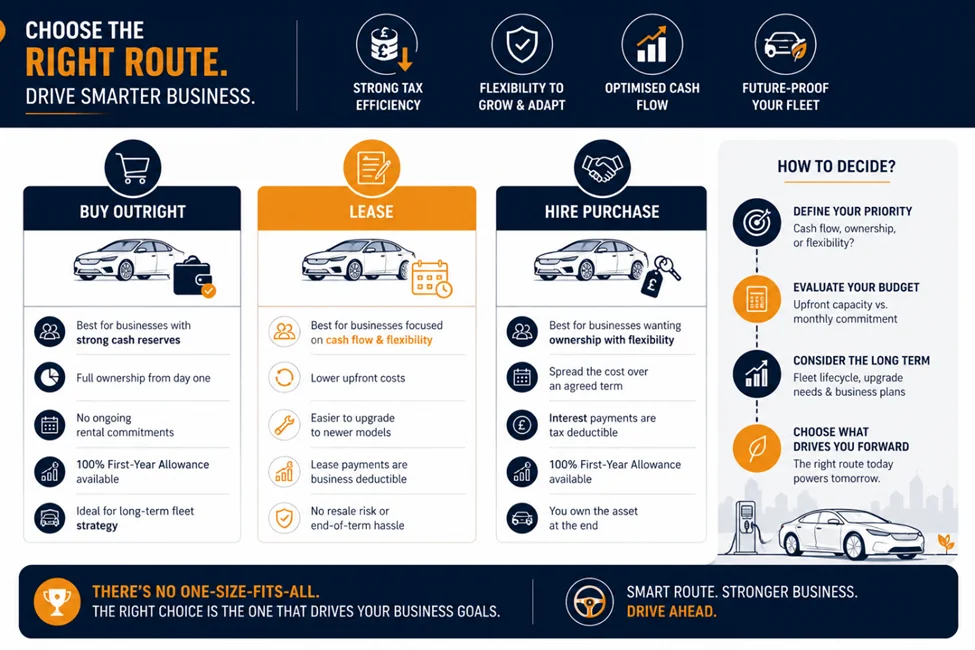
What’s the right course for your business?
The decision between buying outright, hiring or leasing relies heavily upon cash availability, desire to own, and the relevant tax treatment:
Reclaiming VAT on Your EV
VAT is one area where EVs follow the same rules as other company cars, but the planning is worth doing properly.
To reclaim 100% of the VAT on the purchase price of an EV, the car must be used only for business. Any personal use, even a school run, blocks the full reclaim. Most company cars do see some private use, so this rule catches a lot of businesses out.
For leased EVs, the rules are more flexible. You can reclaim 50% of the VAT on lease payments even when there is some private use. That is a meaningful saving spread across the life of the lease.
If the car is for charging or maintenance services, you can usually reclaim the VAT on those running costs in full where they relate to business use.
Benefit-in-Kind in Real Numbers
When an employee uses a company car for personal trips, the BIK tax applies. For 2026/27, the BIK rate for fully electric cars is 4% of the car’s list price.
Take a £40,000 electric car as an example. The taxable benefit is £1,600 a year. A basic-rate taxpayer (20%) pays £320 a year, and a higher-rate taxpayer (40%) pays £640. That is roughly £27 to £53 a month.
Compare that to a similar petrol car. A 40% taxpayer driving a £40,000 BMW 3 Series can pay over £450 a month in BIK. The EV saves the employee around £400 every single month, which is the kind of number that makes salary sacrifice schemes so popular right now.
Charging and Electricity Costs
Charging a company car for business use is fully tax-deductible. It does not count as a benefit in kind, which keeps payroll simple.
If your business installs charging points at the office, those installation costs also qualify for a 100% First-Year Allowance until 31 March 2027. That includes the cost of the charge point plus the wiring and groundwork.
The Workplace Charging Scheme from OZEV is still running for businesses, charities and public bodies. It contributes up to £350 per socket, with a limit of 40 sockets across all your sites. For a business installing eight chargers, that is up to £2,800 off the bill before you factor in the tax relief.
Some of the older charge point grants for flats, renters, and landlords moved to a new platform in April 2026, with claim windows closing in May. If you have any pending applications, check the dates carefully.
What About Grants for the Cars Themselves
The original Plug-In Car Grant for private buyers ended back in 2022, so that one is off the table.
However, in 2025, the government launched a new Electric Car Grant of up to £3,750 off the price of a new EV under £37,000. The amount you get depends on the car’s environmental rating at the time of manufacture. Models from Renault, Citroen, Skoda, and a few others qualify for the full discount, while others get £1,500 off.
This grant works alongside the tax reliefs above, so a limited company buying a qualifying EV can stack the savings.
Salary Sacrifice as an Alternative
One option that has exploded in popularity since 2023 is the salary sacrifice EV scheme. Your employees give up a slice of pre-tax salary in exchange for an electric car, and they save 20% to 50% on the cost of leasing a new EV.
For the business, the admin is light, the National Insurance savings are real, and you offer a benefit that staff genuinely want. It is now one of the most-asked-about perks in the UK hiring market.
The tax mechanics work because the BIK on EVs is so low. The salary sacrificed reduces the employee’s income tax and National Insurance, and the BIK they pay back is a small fraction of those savings. The math’s only works this well for electric cars.
What Is Coming Down the Road
A few changes are worth flagging so you can plan.
From April 2025, electric vehicles started paying Vehicle Excise Duty (road tax). For 2026/27, a new EV pays £10 in the first year and £200 a year from the second year onwards. That is the same standard rate as petrol and diesel cars.
The Expensive Car Supplement also changed in April 2026. The threshold for EVs jumped from £40,000 to £50,000, so most mid-priced electric cars now avoid the £440-a-year supplement that is used to catch them. Petrol and diesel cars still face the £40,000 threshold.
Looking further ahead, the government has proposed a new Electric Vehicle Excise Duty, charged per mile, to take effect from April 2028. EV drivers would pay roughly half the equivalent fuel duty rate, in addition to the standard VED. Plug-in hybrids would pay half of that again. The consultation closed in March 2026, and final details are expected before the 2028 launch.
None of these changes the basic story. Even with rising BIK rates, road tax, and the proposed mileage charge, electric cars are still cheaper to run and taxes for limited companies than petrol or diesel cars.
Key Takeaways
The conclusion for limited companies in the UK in 2026 is clear. Electric cars are good for the environment, your wallet, and the numbers show it. A 4% BIK rate compared to 30% or more for conventional vehicles. A 100% First-Year Allowance to eliminate corporation tax on the purchase. VAT relief on leases. A 50% salary sacrifice for your employees. And guaranteed rates until 2029/30 for complete peace of mind.
If you are considering a fleet renewal, a car for the boss, or new employee benefits, an electric vehicle (EV) should be at the top of the list this year. The longer you wait, the shorter the timeframe on the First-Year Allowance (until 31 Mar 2027) and the higher the opportunity cost of waiting every quarter. The smart thing to do now is to shortlist a couple of models, choose whether to buy, lease, or hire-purchase, and lock in the deal that works for you. If you do it right, you save money in the first year and go forward, and your fleet will help the UK transition to a more sustainable future.

FAQs
Can a company buy a second-hand electric car for capital allowances in 2026?
No, only new fully electric cars purchased directly by the company are eligible for the 100% First Year Allowance (FYA). Used EVs are subject to the lower main-pool allowances.
Are company EVs with home charging tax-efficient?
Yes. Power used to charge a company EV at home or for business trips is not an assessable benefit if the company doesn’t cover the home power costs.
Will company EVs cause me to breach the National Minimum Wage?
Only if you provide the car via salary sacrifice, you still need to pay enough in cash to comply with the National Minimum Wage for lower-paid workers.
Will company EVs be charged for congestion / ULEZ in 2026?
In 2026, most pure EVs are still exempt from London ULEZ and other clean-air zones, but plug-in hybrid EVs may be liable for partial congestion charges (depending on emissions and the zone).
Can a limited company claim EV tax relief for vans?
Yes, new zero-emission vans purchased by a limited company are also eligible for 100% First-Year Allowance, making them a good choice for fleets and delivery services. For wider tax-saving ideas, browse our free business and tax guides.
Need More Help?
Your business is different to everyone else’s, with different aspirations and cash flow cycles. So general advice doesn’t go far. The magic happens when you have a plan customised to your business numbers, your team, and your vision for the business over the next 3-5 years.
Looking for chartered accountants and tax advisors in Putney, southwest London? Lanop Business and Tax Advisors are XERO tax and business advisors for Wandsworth Borough and beyond.
We are in southwest London and central London, but provide online advice via Zoom to the rest of the UK. Put simply, wherever you live, book a free consultation today to see how we can help you save on tax, remain compliant and plan for the year ahead with ongoing support.