By 2026, we will be in a new era. HMRC watches your data around the clock, and the rules are strict. HMRC now cross-checks your VAT records against data from banks, marketplaces, and suppliers.
This happens fast. Most VAT penalties hit businesses that think they are compliant. They miss one digital record or one deadline, and the fine follows. In my experience, the problem is rarely fraud. It is usually a broken digital link or an incorrect reverse charge entry that triggers an alert.
The VAT compliance checklist 2026 is not just about correct figures. It is about the process that produced those figures. The MTD VAT requirements are now fully in force, and the new penalty points system leaves little room for error. Staying on top of compliance is the only way to avoid the costs and damage of an HMRC probe.
UK VAT Compliance Checklist (2026 Edition)
To stay ahead of HMRC’s systems, your business needs a clear process. This VAT compliance checklist is your starting point.
A. Registration and Monitoring
The VAT threshold is £90,000. Check your rolling 12-month turnover every month, not just at year-end. If you expect to hit the threshold in the next 30 days, register straight away. For non-UK businesses that sell to UK customers via online markets, the threshold is usually £0.
Late registration is risky. HMRC uses bank data to find unregistered businesses, and penalties can reach 100% of the VAT due. The system is automated and offers little flexibility.
B. Filing and MTD Standards
Know whether you file monthly or on a staggered quarterly cycle. Check that your software is still on HMRC’s approved list. Older versions often lose their API link without warning. When you file your return, it must go through a full digital check. Manual edits in the HMRC portal break your audit trail and are not allowed.
C. Payment and Cash Flow
VAT payment deadlines fall 1 month and 7 days after the end of the period. When you pay VAT online, use the “Approve via Bank” or Direct Debit option. This links the payment to your 9-digit VAT Registration Number (VRN). If you use Direct Debit, make sure funds clear three days before the due date. A failed payment earns you a penalty point.
D. Special Situations
If your work falls under CIS, check whether the Domestic Reverse Charge (DRC) applies. For imports, match your Monthly Postponed Import VAT Statements (MPIVS) before you file. If you have both exempt and taxable sales, run the de minimis test each quarter to see if you count as partially exempt.
How Do You File a VAT Return Under MTD?
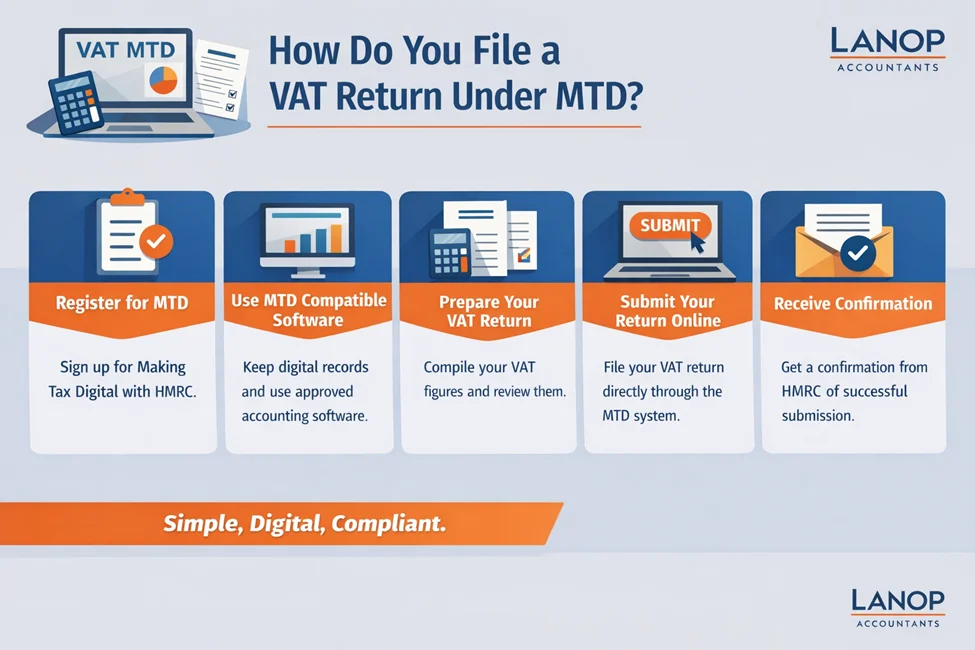
Filing a VAT return has changed. You no longer type nine numbers into a web page. Under the current MTD VAT rules, the digital link is the key part of the process. A digital link is an electronic data transfer between software tools. No manual copying. No retyping of numbers.
Step 1: Digital Record Capture
Enter all invoices and receipts into MTD software such as Xero, QuickBooks, or your ERP system. This is the basis for maintaining correct digital VAT records.
Step 2: Digital Linking
If you use a spreadsheet for partial exemption, link it to your filing software. Copying and pasting figures by hand is a breach, even if the numbers are right.
Step 3: Reconciliation
Match your sales ledger to your bank feed. HMRC’s systems are good at finding missing sales where bank deposits do not match Box 6 (Total Sales). This mismatch is one of the top triggers for a compliance check.
Step 4: API Submission
Your software sends the return to HMRC. You do not log in to the portal to do this. MTD businesses are not allowed to file that way.
Step 5: Save Your Receipt
Once you submit, download the HMRC Receipt ID. Keep it safe. It is your main proof if a VAT reclaim is ever challenged.
7 Checks to Run Before You Submit
Go through this list before every return:
- Does Box 1 include any Domestic Reverse Charge sales? It should not.
- Have you added Postponed VAT Accounting (PVA) to both Box 1 and Box 4?
- Is Box 6 (Net Sales) in line with past quarters?
- Are there any double entries in Box 4 (Input Tax)?
- Have you left out non-deductible items, such as business entertainment?
- Is the digital link chain intact from source to submission?
- Does the payment match the liability in your software?
This check takes ten minutes and can save you thousands.
What Are the VAT Payment Deadlines and Penalty Rules in 2026?
Late VAT payment penalties now follow a points-based system. It is lenient for one-off mistakes but tough on repeat offenders.
The Points System
Each late return earns you one point. When you hit the threshold, a £200 fine is added. The thresholds are: annual filers (2 points), quarterly filers (4 points), and monthly filers (5 points). Points expire after a period of good filing, typically 12 months for quarterly filers. All late returns must be filed before the points can reset.
Financial Fines for Late Payment
Miss a VAT payment deadline, and the costs build fast:
- Days 1 to 15: No fine if you pay in full.
- Days 16 to 30: 2% of the VAT owed.
- Day 31 onwards: 4% of the amount still owed at Day 30, plus daily interest at Bank of England Base Rate plus 2.5%.
You can pay VAT online through the HMRC app or Government Gateway. A Direct Debit gives you three extra days for the payment to clear while still meeting the deadline. For businesses with tight cash flow, this buffer is worth using.
What Are the VAT Record-Keeping Rules in 2026?
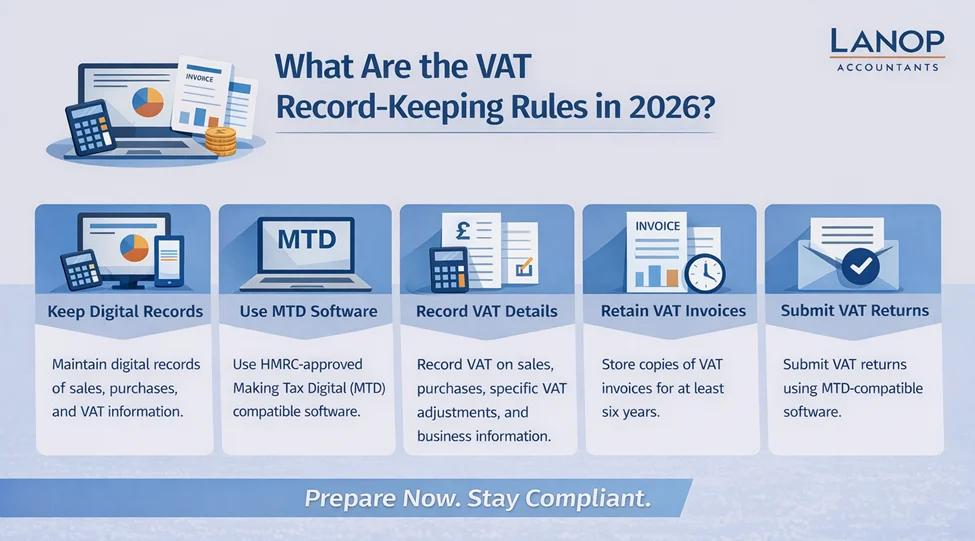
Good records are the basis of any HMRC VAT compliance check. In 2026, saying “I lost the receipt” will not save you from a fine.
Under the VAT record-keeping rules, you must keep: a digital VAT account that links your records to your return, copies of all invoices sent and received (a scanned copy is fine), notes of any partial exemption workings, and import VAT records such as C79 forms or PVA statements.
What Evidence Do You Need to Reclaim VAT?
To claim VAT in Box 4, you need a valid VAT invoice. It must show the supplier’s VRN, a unique invoice number, and the correct VAT rate. Businesses lose VAT claims not because the claims are wrong, but because the proof is weak. If HMRC asks for the invoice behind a large purchase and you cannot show a digital copy, they will reject the claim and charge interest.
Good records do not have to be complex. Cloud tools like Xero and QuickBooks handle most of this for you when set up well. Our VAT return service includes a records review to keep your files ready for any inspection.
Special VAT Scenarios That Catch Businesses Out
Domestic Reverse Charge UK
The domestic reverse charge is a known problem for the construction sector. It applies to construction work under CIS where the client is VAT-registered. If you are a subcontractor, you do not add VAT to your invoice. If you charge it by mistake, your client cannot reclaim it, and you become liable for the error at audit.
This rule trips up many businesses because charging VAT seems like the safe choice. It makes the invoice invalid for your client.
Import VAT and Customs
Since Brexit, handling import VAT has become a daily task for many UK retailers and importers. Most now use Postponed VAT Accounting (PVA). This lets you declare and recover import VAT on the same return, which is cash-neutral if you are fully taxable. The main risk is failing to download your Monthly Postponed Import VAT Statement (MPIVS). Without this file, you have no proof for the entries in Box 1 and Box 4, so HMRC can reject both sides of the entry.
VAT Partial Exemption Rules
If your business earns exempt income, such as from the rental of homes or some financial services, and also earns taxable income, you are classed as partly exempt. You cannot reclaim all your input VAT.
You must use the standard method based on turnover, or a special method agreed with HMRC. The most common error is skipping the Annual Adjustment at the end of the VAT year. This can lead to both underpayment and overpayment across the year.
VAT Schemes: Which One Suits You?
The right VAT scheme can cut your admin time or help your cash flow. Here is a simple guide:
| Scheme | Best For | Main Benefit |
| Flat Rate Scheme | Small firms with low costs | Less record keeping |
| Cash Accounting | Firms with slow-paying clients | Pay VAT when you get paid |
| Annual Accounting | Firms that want one to return a year | Simpler cash flow planning |
Review your scheme at least once a year. What worked at £150,000 turnover may not be the best fit at £400,000.
This is more common than most firms know. If you work in construction, our specialist service for architecture and construction businesses includes full DRC and CIS support.
What Happens During an HMRC VAT Compliance Check?
An HMRC VAT compliance check in 2026 is rarely a random event. It is usually a targeted desk review set off by a data mismatch.
A Big Repayment Claim
If you normally pay £5,000 but then claim a £20,000 refund, the system flags it. The claim may be correct, but you need to back it up with proof.
Cross-Matching Errors
Your Box 6 (Sales) figure does not match the data HMRC receives from payment providers such as Stripe or SumUp. These feeds go to HMRC automatically, before you even think about filing.
Unusual Input-Output Ratio
Your VAT recovery rate is significantly lower than your industry average. If most firms in your sector reclaim 30% of output tax and you are claiming 60%, expect questions.
How to Prepare
Keep a digital audit trail. Every entry in Box 4 should link back to a digital invoice. Have your 12 most recent MPIVS statements saved and ready. Keep a compliance folder with your VAT checklist, past returns, and any notes on why you treated a specific item as zero-rated or exempt.
Firms that clear checks fast are the ones that can pull clean, organised records within 24 hours. The ones that struggle are still hunting for receipts when the letter arrives.
When Must Your Business Register for VAT in the UK?
The VAT threshold is £90,000. At the end of each month, look back at the past 12 months. If the total is over £90,000, you have 30 days to tell HMRC. If you land a contract that will push you past £90,000 in the next 30 days alone, you must register right away.
For a full breakdown of how the rolling check works and what counts as taxable turnover, our guide to the UK VAT threshold for self-employed businesses has the details you need.
Voluntary registration is also worth a look. You can sign up even if your turnover is £10,000. This is often a smart move if you sell mainly to other VAT-registered businesses and want to reclaim your startup costs from day one.
Common VAT Mistakes That Lead to Fines
Late Registration. Many businesses miss that the threshold uses a rolling 12-month window, not the tax year. By the time they notice, they owe back-VAT plus interest.
Broken Digital Links. Using bridging software but typing numbers into a spreadsheet by hand breaks the MTD digital link rule. The figures may be right, but the method is still a breach.
Reverse Charge Errors. Failing to report the reverse charge on services bought from abroad, such as Google Ads or software tools, is a common slip-up. These go in Box 1 and Box 4 at the same time.
Import VAT Duplication. Claiming VAT using both a C79 form and the PVA statement for the same shipment. HMRC matches these records, and it will spot the double claim.
Skipping the Annual Partial Exemption Adjustment. Missing this step at the end of the VAT year may result in your input tax figures being incorrect for the whole year.
How Lanop Supports Your VAT Compliance in 2026
At Lanop, we do not just file returns. We act as your guide in a tough digital compliance world. Our job is to deal with risks before HMRC ever gets in touch.
Our VAT Health Check examines your digital links and records to identify gaps before HMRC does. We help businesses move legacy systems into a clean, API-based setup that meets all MTD VAT rules. For construction firms, we provide DRC and CIS support to ensure your invoices remain valid. For partly exempt businesses, we handle the input tax workings that often trip firms up.
If HMRC opens a check, we handle all letters, data requests, and technical points on your behalf. To see how we can help, get in touch today.
By the time an HMRC letter arrives, penalty points may already be stacking up. Our pre-submission review keeps your VAT compliance checklist clean each quarter.
Conclusion
In 2026, UK VAT compliance is a digital discipline. It is not a paper task you do once a quarter. The points-based fine system and the full rollout of MTD VAT rules mean good intentions are no defense against fines. HMRC’s systems run continuously, and your processes need to keep up.
By using this VAT compliance checklist, keeping a clear digital audit trail, and knowing the domestic reverse charge and import VAT rules, you can avoid costs that are easy to prevent. Whether you handle compliance in-house or use an adviser, checking your digital links before every return is the habit that keeps you safe.
To make sure your MTD setup has no gaps, our VAT return service and MTD software guide are good places to start.
Frequently Asked Questions
You must keep digital records of all sales and purchases, a VAT account, and proof such as invoices and import forms (C79 or PVA) for at least 6 years. All records must be in digital format and linked in a chain from source to submission.
Use MTD software to send your return to HMRC via an API link. You cannot type figures into the HMRC portal. Any spreadsheet you use must be digitally linked to your filing tool.
The due date is 1 month and 7 days after the end of the period. Fines follow a points system for late filing and a percentage system for late payment, starting at 2% after Day 15 and rising to 4% plus daily interest after Day 30.
A valid VAT invoice from the supplier is required. It must show the supplier’s VRN, a unique invoice number, and the correct VAT rate. For imports, you need the MPIVS or a C79 form.
Errors under £10,000, or up to 1% of the Box 6 total (max £50,000), can be fixed on the next return. Bigger errors must be sent to HMRC on form VAT652.
Invoices must show a unique number, the supplier’s name, address and VRN, the tax point date, the buyer’s name and address, a description of the goods or services, and the VAT rate and amount.
Under Postponed VAT Accounting (PVA), you put the import VAT in both Box 1 (output) and Box 4 (input) of the same return. This has no cash impact if you are fully taxable, but only works if you have the MPIVS on file.
When your taxable turnover tops £90,000 in a rolling 12-month period, or when you expect it to do so in the next 30 days. Voluntary registration is open below the threshold and worth considering for B2B businesses.
The client accounts for the VAT, not the supplier. The supplier sends an invoice without VAT, and the client enters both output and input tax on their own return. This applies to construction work under CIS where the client is VAT-registered.
Records must be digital. Any separate software used to build the return must be digitally linked to the return. You cannot move data between systems by hand, including copy-and-paste.