Getting a penalty notice from HMRC can be worrying. It usually happens after a missed deadline. The fine can feel unfair, especially when the delay was not your fault.
This guide breaks the process into simple steps. It helps you decide if an appeal is worth it. You will also see how to complete the HMRC SA370 appeal form and what evidence can support your claim.
By the end, you will know how to submit the SA370 appeal form online or by post. You will also understand how to deal with the issue in a calm and clear way.
What is SA370 Appeal Form and When to Use It
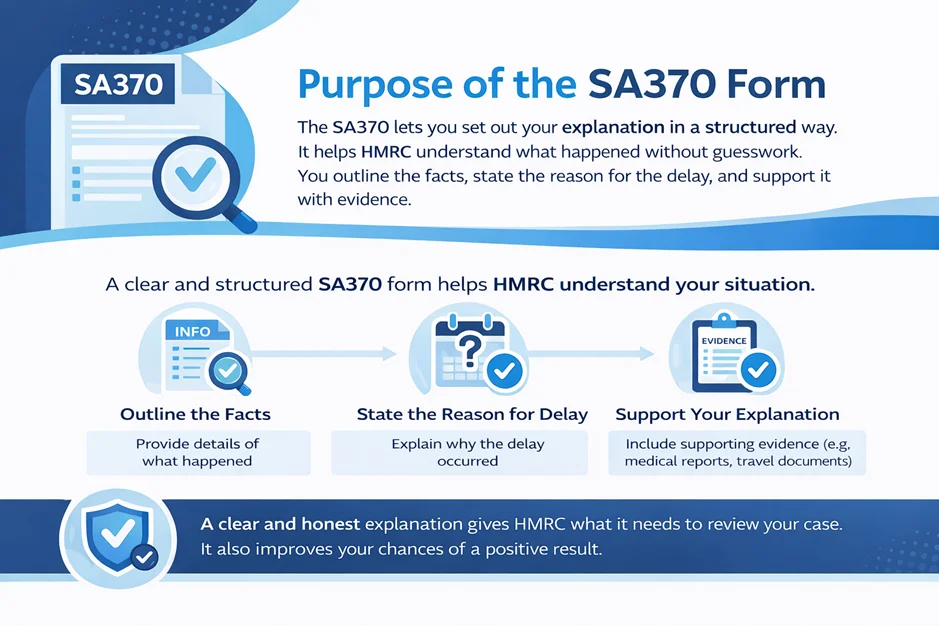
The SA370 appeal form is for challenging Self-Assessment penalties. HMRC issues these when you miss a filing or payment deadline. If you are not already familiar with the Self-Assessment tax return process, it is worth understanding how it works before you attempt an appeal. The form gives you a clear way to explain your situation and ask for a review.
You may need this form when a penalty feels unjust. It also applies when something outside your control caused the late submission.
Types of Penalties You Can Appeal
You can use the SA370 to challenge several types of charges. Most relate to late filing or late payment. Common examples include:
- A fixed £100 penalty for filing up to three months late
- Daily charges of £10 for delays lasting up to six months
- Higher penalties for delays beyond six months
- Surcharges added for late tax payments
You can appeal an HMRC penalty when you have a valid reason and the evidence to back it up.
SA370 vs Online HMRC Appeal
There are two ways to appeal. You can fill in the paper SA370 form or use the online option. The online route is faster and creates a clear submission record. It suits simple, straightforward cases.
The paper form works better when your case is complex or when you need to include physical documents. HMRC accepts both and reviews them in the same way.
When It Is Worth Appealing an HMRC Penalty
Not every penalty deserves a challenge. You need a genuine and well-supported reason to appeal. HMRC looks at many appeals each year, so weak cases rarely succeed.
Situations Where Appeals Are Likely to Succeed
Appeals tend to work when an unexpected event caused the delay. HMRC accepts cases where something serious stopped you from acting. Strong examples include:
- A serious illness that prevented you from managing your tax affairs
- A fire or flood that destroyed your financial records
- A technical failure in HMRC systems when you tried to submit
In each case, you need to show clear proof. You also need to show that you acted quickly once the problem was resolved.
Cases Where Appeals Are Usually Rejected
HMRC does not accept most common excuses. Everyday mistakes rarely lead to a successful appeal. Examples that typically fail include:
- Forgetting the deadline
- Not knowing how the tax process works
- Finding the forms too hard to complete
Lack of funds is also rarely accepted. It may only help your case if a sudden and unexpected event caused the financial problem.
HMRC Appeal Deadlines and Late Appeals
Timing plays a key role in any tax dispute. HMRC follows strict deadlines for every appeal. Missing a deadline can lead to rejection without review.
Standard 30-Day Deadline
The penalty appeal deadline in the UK is 30 days from the notice date. This is not based on when you receive the letter. It starts from the date shown on the notice itself.
You must submit your SA370 appeal form within this time. Late submission can reduce your chances of success. This deadline applies whether you are self-employed, a landlord, or a company director, anyone required to file a Self-Assessment tax return must act promptly.
Appealing After the Deadline
You can still try to appeal penalty after deadline in some cases. However, the process becomes more difficult.
You must explain two things clearly. First, why your original filing was late. Second, why your appeal was not submitted on time.
HMRC reviews late appeals more strictly, so your explanation must be strong.
Exceptional Circumstances HMRC May Accept
HMRC may accept a late appeal in serious situations. These usually involve cases where you could not manage your affairs.
Examples may include:
- Severe illness that affected your ability to act
- Situations where you were physically unable to respond
- Long-term conditions that delayed your actions
How to Complete and Submit the SA370 Form
Completing the SA370 appeal form requires care and accuracy. Small errors in your details can delay or reject your appeal.
Key Information Required Before Starting
Before you begin the SA370 online submission, gather all key details. This helps you avoid mistakes during the process.
You will need:
- Your Unique Taxpayer Reference UTR
- Your National Insurance number
- The penalty reference number from your notice
- Exact dates linked to the delay
Having this information ready makes the process smoother and faster. If you are self-employed or work as a sole trader, your UTR can typically be found on any previous HMRC correspondence or your online Government Gateway account.
Submission Methods and Next Steps
You can submit the SA370 online or by post. Both are accepted by HMRC. Online submission gives you a confirmation number straightaway. Save it as proof of your filing date.
If you send the form by post, use recorded delivery. This gives you evidence that your appeal arrived before the deadline.
SA370 Appeal Checklist
Run through this checklist before you submit:
- Penalty notice details are correct and match your own records
- Your explanation clearly states a reasonable excuse
- Supporting evidence is attached where needed
- All dates related to the issue are clearly mentioned
A complete and accurate form gives your appeal the best chance of success.
Reasonable Excuse: What HMRC Accepts and Rejects
The strength of your appeal rests on whether you can show a reasonable excuse. HMRC defines this as an unexpected event that stopped you from meeting a tax obligation despite taking reasonable care.
Accepted Reasons with Examples
HMRC has a published list of excuses it generally accepts. These include:
- The recent death of a partner or close relative
- An unexpected and serious hospital stay
- A computer or software failure just before the submission deadline
- HMRC online services being unavailable at the time of filing
- Postal delays that could not have been foreseen
Common Excuses That Fail
Many people appeal using reasons that HMRC specifically does not accept. These include:
- Your accountant or tax adviser failed to file on time
- You found the HMRC website hard to use
- You did not receive a reminder letter
- You did not have enough money to pay the tax bill
Evidence Requirements for an SA370 Appeal
Evidence is what makes or breaks an appeal. Without it, your case is little more than a claim. HMRC needs physical or digital proof before it will agree to cancel a penalty.
Types of Supporting Documents That Work
The right documents depend on your excuse. Useful examples include:
- Medical records: a GP letter or a hospital discharge summary
- Death certificates: for cases involving bereavement
- Technical logs: screenshots of error messages or emails from software providers
- Police reports: if records were stolen or destroyed in a crime
- Insurance claims: to confirm damage to property or business premises
Writing an Effective SA370 Appeal Letter
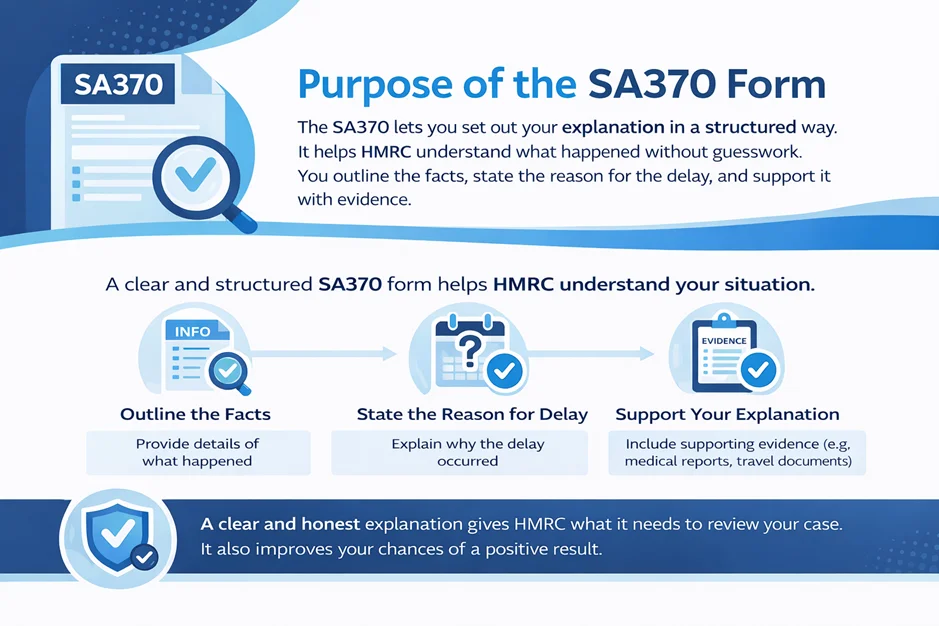
The SA370 form has set sections for your response. In complex cases, a short covering letter can add clarity and context. A well-written letter helps HMRC review your case faster.
Recommended Structure
Keep your letter short and organised. Use this structure as a guide:
- Header: your name, address, UTR, and penalty reference number
- Opening: state that you are appealing a specific penalty
- The excuse: explain the event that caused the delay
- The impact: show how the event prevented you from acting
- The resolution: state when the issue ended and what you did next
- Closing: ask for cancellation based on your evidence
Mistakes to Avoid
Keep your tone calm and professional throughout. Frustration rarely helps. Avoid adding details that do not relate to your delay. Every sentence should support your case. Irrelevant information weakens your argument.
HMRC Response Time and What to Expect
After you send your SA370 form, you will need to wait. Knowing what to expect helps reduce the uncertainty.
Factors That Delay Decisions
Several things can slow down a review. These include:
- Missing or incomplete evidence
- High volumes of cases during peak tax periods
- Complex appeals covering more than one tax year
- Delays caused by postal or regional handling
A thorough and well-organised submission is the best way to avoid unnecessary delays.
What to Do If Your Appeal Is Rejected
A rejected appeal is not the end of the road. You have further options and HMRC is required to explain its decision.
Understanding Rejection Reasons
Read the rejection letter carefully. HMRC sets out why your appeal was not accepted. Common findings are that you did not act quickly enough or that your evidence was too thin. Use this feedback to plan your next step.
Requesting a Statutory Review
You can ask for a statutory review. This is a free internal process where a different HMRC officer looks at your case from scratch. That officer was not involved in the original decision. The review is usually faster than going to tribunal.
Escalating to a Tax Tribunal
If the review still goes against you, you can take the matter to an independent tax tribunal. Costs are low for most standard cases. A judge hears both sides and makes the final decision.
Appealing Late Payment Surcharges and Interest
Late filing penalties and payment surcharges are not the same. You can use the sa370 appeal form to challenge both, but the rules differ.
Difference Between Penalties and Surcharges
A penalty applies when you miss a deadline. A surcharge is added when tax remains unpaid. It increases at set stages such as 30 days, 6 months, and 12 months.
Both can be challenged if you have a valid reason for the delay.
When Surcharges Can Be Appealed
You can appeal a surcharge when an event outside your control caused the late payment. A major banking failure, for example, may support your case. If your appeal is accepted, HMRC will refund any surcharge you have already paid.
Limits on Challenging Interest
Interest charges are harder to remove. HMRC treats interest as a natural cost of paying late, not as a penalty. Even when penalties are cancelled, interest usually stays in place. It may only be waived when HMRC itself caused the delay. Proactive tax planning is often the most effective way to avoid reaching this situation in the first place.
Common SA370 Appeal Mistakes to Avoid
Most failed appeals come down to poor preparation rather than a weak case. Knowing the common mistakes helps you avoid them.
Missing Deadlines
The 30-day window is firm. Act as soon as you receive the penalty notice. Every day you delay reduces your options.
Weak or Unclear Explanations
Vague statements rarely work. HMRC needs specifics. State clearly what happened, when it happened, and how it stopped you from meeting the deadline. Precise details make your case far stronger.
Lack of Supporting Evidence
HMRC expects proof for every claim you make. An appeal without evidence is just an opinion. Always include documents that directly support your explanation.
Using the Wrong Appeal Method
Check that you are using the current version of the SA370 form. Send it to the correct HMRC address. Using an outdated version or the wrong address can cost you the deadline and delay your appeal.
How Lanop Can Support Your HMRC Appeal
Dealing with an HMRC penalty takes time, care, and a clear head. At Lanop, we guide you through the full SA370 appeal process from start to finish.
Case Review and Strategy
We begin by looking at your case carefully. We check whether your reason meets HMRC’s standard for a reasonable excuse. We then build a clear strategy around:
- Excuses that HMRC has a track record of accepting
- A well-organised timeline supported by facts
- A submission plan built to improve your chances
Strong Submission Support
We help you complete the SA370, whether you are filing online or by post. We make sure:
- Your explanation is factual, direct, and easy to follow
- All required details are included and correct
- The right supporting documents are attached
We Handle HMRC for You
You do not have to manage HMRC on your own. We take over the process and handle it for you. This includes:
- Managing all letters and official responses
- Following up and keeping you updated throughout
- Supporting you through a statutory review if your first appeal is rejected
Conclusion
HMRC penalties can be challenged with the right approach. Use the SA370 appeal form correctly and act within the penalty appeal deadline in the UK.
Focus on clear explanation, strong evidence, and quick action.
If you feel unsure, Lanop can help. Whether you need support with your Self-Assessment tax return or expert guidance on an active penalty dispute, get in touch with our team today and resolve your tax issue with confidence.
Frequently Asked Questions
You have 30 days from the date printed on your penalty notice. The deadline does not start from when the letter arrives. Submit your SA370 within this period to protect your case.
You can submit the form online through HMRC services or send it by post. Online is faster and provides instant confirmation. Postal submission works better for complex cases with extra documentation.
You need clear and relevant proof that supports your stated reason. This might include medical records, bank statements, or official correspondence. Your evidence must match your explanation and the dates involved.
A reasonable excuse is something unexpected and outside your control that directly caused the delay. Common examples include serious illness, technical system failures, or bereavement. HMRC checks whether the event genuinely prevented you from acting on time.
Yes, but it is considerably harder. You need to explain both why the payment was late and why the appeal was submitted after the deadline. HMRC only accepts this in genuine exceptional cases.
Most appeals are processed within 30 to 45 days. In peak periods it can stretch to 90 days. If you have not heard back after 10 weeks, contact HMRC directly.
In most cases, HMRC pauses collection activity while reviewing your appeal. This is not guaranteed though. Check directly with HMRC to confirm the position in your case.
Attach any documents that support your reason for the delay. These might include medical notes, financial records, or official letters. Evidence that is clear and directly relevant makes the biggest difference.
Be factual and concise. Explain what happened, when it happened, and why it caused the delay. Avoid emotional language and stay focused on the facts. Attach supporting evidence to back up every claim.
It is not required, but it can make a real difference. A professional builds a structured argument and presents it clearly. This matters most in complex or high-value cases.
Most standard appeals involve little or no cost to file. Legal support for complex cases adds to the expense. Your total costs depend on the level of help you need.
The SA370 form is specifically for appealing Self-Assessment penalties. SA371 covers a different type of tax request entirely. Check which form applies to your situation before you submit.
Yes. If HMRC accepts your appeal, the charge is cancelled. Any amount you have already paid will be refunded.
The most common issues are missing the deadline, providing a vague explanation, and including no supporting evidence. Using an incorrect form version or sending it to the wrong office also causes problems.
Start by requesting a statutory review from HMRC. If that decision also goes against you, take the case to an independent tax tribunal. Both routes are available to you free of charge at the initial stage.