Introduction
Finding an HMRC penalty letter in your post is enough to ruin your day. It usually feels like an automated “tax” on a simple mistake.
The good news is that if the penalty is unfair, or if something happened that was out of your control, you can fight it. This guide gives you a clear path to challenge HMRC and keep your money in your business.
What Is a VAT Surcharge?
A VAT surcharge is a penalty HMRC issues when your business misses a filing or payment deadline. Miss once, and HMRC puts you in a “surcharge period.” Miss again within twelve months, and the financial penalties begin.
The simplest way to avoid reaching this point is staying on top of your obligations. A professional VAT return service takes this pressure off your plate entirely.
How the latest Penalty Trap Works
The surcharge system punishes repeat offenders. Each missed deadline makes the next one more expensive.
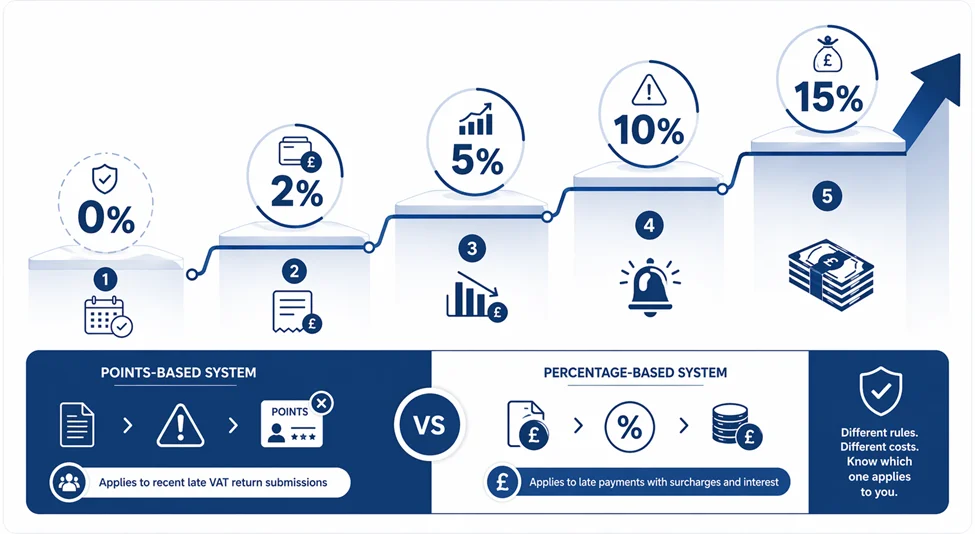
- 0% surcharge. Issued on a first default if your turnover is under £150,000. No money leaves your account yet. But you are now inside the surcharge period.
- 2% surcharge. The first real financial hit. Miss again within twelve months, and HMRC charges 2% of your unpaid VAT.
- 5% surcharge. A third default within the period. This starts to hurt, especially for businesses with large quarterly VAT bills.
- 10% surcharge. By this point, HMRC treats the pattern as deliberate rather than accidental.
- 15% surcharge. The ceiling. On a £50,000 VAT bill, a 15% surcharge adds £7,500 overnight.
The old percentage system runs alongside a newer points-based approach. HMRC now uses penalty points for late VAT returns for recent defaults. Late payments still carry percentage fines and interest.
Which Penalty Are You Facing?
The April 2026 rules introduced a 15-day grace period on payments and changed the interest rate. Use this table to identify what you are dealing with.
| Your Mistake | The Penalty or Interest |
|---|---|
| Old VAT return (pre-2023) | 2% to 15% of the tax owed |
| New VAT return (2023 to 2026) | 1 point per late return. A £200 fine at 4 points for quarterly filers |
| Late payment (0 to 15 days) | No penalty. Pay in full or request Time to Pay before a fine applies |
| Late payment (16 or more days) | Interest at 7.75% plus a 3% penalty from day 16, increasing again at day 31 |
As of March 2026, the Bank of England base rate sits at 3.75%. That makes HMRC’s late payment rate 7.75%. Interest runs daily. Even if you avoid the surcharge, the interest bill grows fast.
The New Points-Based System (2026)
Four points is the number that matters for quarterly filers. Each late return adds one point. Hit four points and HMRC issues a £200 fine. Every late return after that triggers another £200.
To reset your points you need a clean compliance period. For quarterly filers, that means every return filed on time for a full year, plus all outstanding returns from the previous 24 months submitted. It is fairer than the old ladder. But it takes real discipline to pull off.
Working with a VAT compliance specialist before you hit that fourth point is far cheaper than dealing with a fine after.
How to Appeal a VAT Surcharge: Step by Step
Step 1: Read the surcharge notice carefully
Check every detail. HMRC makes mistakes. Payments get missed in the system. Returns get filed to the wrong period. A simple clerical error is the easiest win in any appeal.
Look for:
- The date HMRC claims the return was received versus when you sent it
- Your VAT Registration Number (make sure it matches)
- Any payments you made that were not credited to the right period
Step 2: Note the 30-day deadline
You have exactly one month from the date on that letter to act. HMRC doesn’t do “fashionably late”, if you hit day 31, you’re technically out. But if you did miss it, don’t panic just yet. You can still try, you’ll just need a rock-solid reason for the delay.
Just include a clear section titled “Reason for Late Appeal.” Life happens; for instance, being in the hospital is a valid reason to miss the cutoff.
Step 3: Identify your reasonable excuse
HMRC only cancels a surcharge if you had a genuine hurdle. Ask yourself: “Could a sensible person have avoided this?”
Being busy or simply forgetting won’t pass. Your excuse needs to be specific, serious, and the direct cause of the delay.
Step 4: Gather your evidence
This is where most appeals win or lose. A story without proof is usually rejected. Think like a pro:
- Internet issues? Get an outage report or service ticket.
- Health crisis? Attach a doctor’s note or hospital record.
- Tech glitch? Use a timestamped screenshot of the error.
Proof turns your explanation into a fact they can’t ignore.
Good bookkeeping records throughout the year make gathering this evidence much faster when a penalty does arrive.
Step 5: Write and send the appeal
You’ve got two choices: the online portal or Form WT1 in the mail. Go with the portal. It’s way faster, and more importantly, you get a receipt immediately. Having that digital paper trail means they can’t claim they never got it.
Your letter needs these sections:
- Header. Your name, business name, VAT Registration Number, and the surcharge reference from the letter.
- Opening. State clearly that you are appealing the surcharge for the period shown on the notice.
- The facts. Explain what happened and when. Be specific with dates.
- The excuse. Explain why this qualifies as a reasonable excuse. Keep it factual.
- The evidence. List every document attached.
- Closing. Ask for the surcharge to be cancelled.
Send written appeals to: BT VAT, HMRC, BX9 1AS. Always double check the address on your original notice.
Step 6: Ask for an internal review if rejected
If HMRC says no, do not stop there. You can request an internal review. A different officer looks at your case from scratch. Many penalties get overturned at this stage. The first officer often works through an automated checklist. The review officer has more discretion to consider the full picture.
Step 7: Watch the clock on the response
HMRC usually gets back to you within 45 days. If it hits day 50 and you’ve heard nothing, give the VAT helpline a ring. Scribble down the date, who you spoke to, and the reference number for every single call. If your case ever goes to a tribunal, that log is gold.
Step 8: Take it to tribunal if needed
If the internal review fails, you can go to the First-tier Tribunal (Tax). A judge makes the final decision. This is independent of HMRC entirely. Many hearings are now held over video link. You do not need a barrister, but a professional tax adviser representing you makes a real difference to the outcome.
What Counts as a Reasonable Excuse?
A VAT surcharge with reasonable excuse is the core of your argument. HMRC defines this as an event that was unexpected and outside your control.
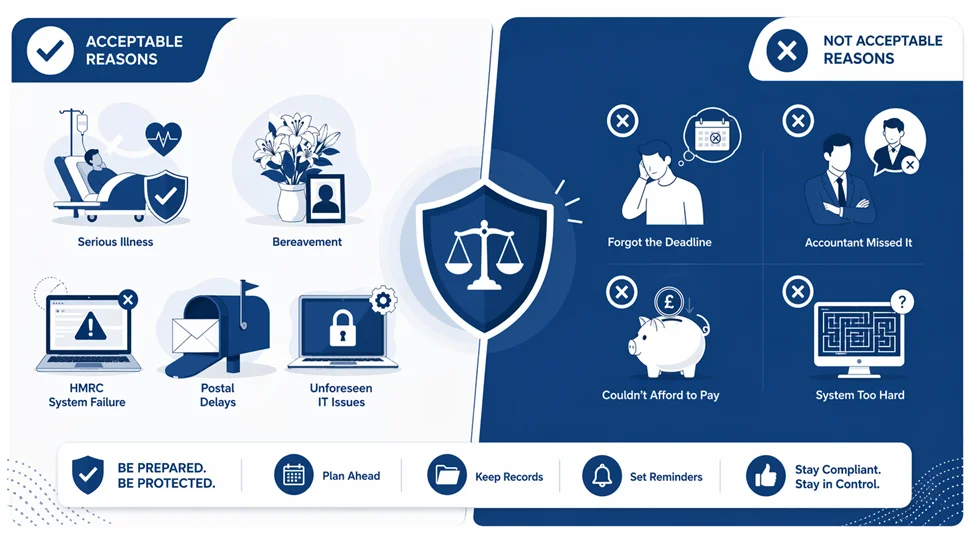
Valid Excuses (The “Yes” List)
- Serious Illness: This applies when health issues make focus impossible. While a cold won’t count, a sudden surgery or a mental health crisis is seen as a genuine barrier.
- Bereavement: Grieving is hard enough without tax deadlines. Losing a partner, parent, or child right before the cutoff is almost always accepted. It’s one of the few times HMRC shows real heart and treats the delay with the empathy it deserves.
- HMRC System Failure: If the site crashed on the final day and you caught a screenshot of the error, you’re covered. Their tech glitch is your solid defense.
- Postal Delays: If you can prove you posted your return in time for it to arrive by the deadline (using registered post), but a strike or unforeseen delay occurred, this counts.
- Unforeseen IT Issues: This includes a ransomware attack or a total hardware failure where your local backups were also compromised.
Invalid Excuses (The “No” List)
- “I forgot.” HMRC expects you to have a diary.
- “My accountant missed it.” You are legally responsible for your own tax affairs. If your accountant failed, your claim is against them, not HMRC. Using a trusted VAT accountant who gives you proper deadlines in advance prevents this entirely.
- “I could not afford to pay.” Lack of funds is not an excuse unless caused by something catastrophic, like a major client going into administration while owing you a large sum.
- “The system is too hard.” Not knowing how the portal works is not a defence.
Valid vs. Invalid Appeal Example
Scenario A (The Rejection): Sarah owns a boutique. She missed her VAT payment by three days because she was busy with a summer sale. She appeals, saying she “lost track of time.” HMRC rejects this immediately because “being busy” is a normal part of business life.
Scenario B (The Success): Mark runs a landscaping company. His office was flooded two days before the VAT deadline, destroying his laptop and router. He provides photos of the damage and an insurance claim number. HMRC accepts this as a “reasonable excuse” and cancels his 5% surcharge.
Dealing with the 30-Day Deadline
You have exactly 30 days from the date on your letter to start your appeal. This 30-day window is non-negotiable in the eyes of the computer system.
If you wait longer, HMRC will likely ignore you unless you have a very strong reason for being late with the appeal itself.
The Strategy: Don’t hang around waiting for the perfect file. Even if your proof isn’t ready yet, fire off a “protective appeal.” This is just a letter saying you intend to appeal and why, with a note that evidence is coming. This effectively pauses the timer and keeps you in the clear.
Where to Send Your VAT Appeal
You should always check your surcharge notice for the specific appeal VAT surcharge address. Generally, appeals are sent to:
BT VAT HMRC BX9 1AS
Many businesses now prefer the HMRC online appeal portal. It is faster and gives you an immediate acknowledgement, which is vital for your records. If you use a professional service to handle your VAT compliance, your agent will typically use their dedicated HMRC portal to submit on your behalf. This digital trail is much harder for HMRC to “lose” than a physical letter.
The True Costs of Appealing a VAT Surcharge
Fortunately, appealing directly to HMRC or requesting an internal review is free. HMRC does not charge you a fee to process an appeal.
If you decide to take the case to a First-tier Tribunal, there is still no court fee for the business owner. However, you will likely want professional representation to give yourself the best chance of winning. While hiring an expert carries a cost, it is often much lower than the 10% or 15% penalty you are trying to avoid.
Sometimes it pays to get help. If you’re staring down a £4,000 fine and a pro can make it go away for £800, you’re still £3,200 better off. If the penalty is huge, paying for an expert is just smart business, not a wasted cost.
What Are Your Chances of Success?
The VAT penalty appeal success rate is higher than many business owners realize, provided you have clear evidence. HMRC is significantly more likely to settle during the review stage if your evidence is undeniable.
The key is showing that you acted in good faith and tried to rectify the delay as soon as the excuse ended. If your internet went down for 24 hours, but you didn’t file the return for another three weeks after it was fixed, HMRC will argue that the “excuse” only covers the first 24 hours. You must act with “reasonable speed” once the problem is resolved.
Common Mistakes to Avoid
- Delayed Action: Waiting until day 29 to start researching how to appeal your VAT surcharge. This leaves no room for errors or postal delays.
- Weak Documentation: Sending a letter without supporting evidence. HMRC’s default position is to say “No” unless the evidence forces them to say “Yes.”
- Ignoring the Debt: Even if you appeal, interest can still accrue at that high 7.75% rate. Sometimes it is safer to pay the penalty and have it refunded later if you win. This prevents the interest bill from growing while you wait for a decision.
- Using Aggressive Language: Being angry with the HMRC officer won’t help. A calm, factual, and polite letter that references specific tax laws or “reasonable excuses” is much more effective.
Some Special Cases
Late Returns vs. Late Payments
Under the 2026 rules, HMRC is slightly more lenient with speed than debt. You now have a 15-day window from the due date to settle your bill or arrange a payment plan before the first 3% penalty is triggered. However, interest starts from Day 1, no exception.
If you can’t pay the full amount, getting a “Time to Pay” (TTP) agreement within those first 15 days is the ultimate “get out of jail free” card. A TTP agreement essentially pauses the penalty process as long as you keep up with the agreed installments.
Recurring Penalties
If you’ve missed deadlines three or four times in a row, HMRC is going to stop being nice. They’ll see constant appeals as a game to avoid paying. If you actually messed up, stop fighting and just ask for a “Time to Pay” plan. It’s better to be honest than to look like you’re stalling.
VAT Surcharge Appeal Checklist
Use this checklist to ensure you haven’t missed a single step in the process:
- Spot the errors: Are the dates and totals on the notice actually right?
- Set an alarm: Count exactly 30 days from the date on the letter.
- The “Why”: Is your excuse specific and truly unavoidable?
- The Receipts: Have you got the notes, photos, or files to back up your claim?
- Download Form WT1: Or prepare your formal letter if you prefer the postal route.
- Verify the address: Check the notice for the specific HMRC office handling your case.
- Submit and track: Use the online portal or “Signed For” post.
- Keep a log: Note down every phone call, name, and reference number.
Strategy: Should I use an accountant for this appeal?
While the cost of a VAT penalty appeal is zero in terms of HMRC fees, using a specialist is highly recommended for high-value penalties (10%–15% Surcharges).
An expert understands the technical “manuals” HMRC uses (such as the Compliance Handbook) and can help you avoid common phrasing errors that trigger automatic rejections.
For instance, a specialist knows exactly how to phrase a “reasonable excuse” to align with previous tribunal rulings, giving your appeal much more legal weight.
Final Thoughts: Is It Worth It?
One wrong phrase can get your appeal binned. Before you waste your afternoon on this, run your case through these three questions:
- Was it really an accident? Did something actually happen that was totally out of your control?
- Can you prove it? Do you have the physical receipts, emails, or screenshots to back your talk?
- Did you fix it fast? Did you pay up the second you were able to?
If the answer to all three is yes, you have a very strong chance of a successful outcome.
Expert Support from Lanop!
Working through HMRC’s manuals and figuring out what qualifies as a reasonable excuse takes time most business owners simply do not have. Our team at Lanop acts as your professional advocate from start to finish.
We review your notice, find the strongest grounds for your case, and draft an appeal that meets every standard HMRC expects. Whether you need a single appeal handled quickly or want to hand off your VAT returns completely so you never face this again, we are here.
Contact Lanop today for a professional review of your notice. Let us deal with HMRC so you can get back to running your business.