

Introduction
Good cash flow is essential to SMEs and other businesses in the UK. It makes the owners ready to handle problems such as liquidation, VAT bills, slow growth, and late payments, among other unforeseen expenses that pressurise them. This article identifies most pitfalls and their remedies, such as practical financial infrastructures, real-time insights into smart treasury management, and exercising smarter control over cash flow to get better business visibility.
Why is a business profitable on paper but constantly short on cash?
The critical difference between profit and cash flow
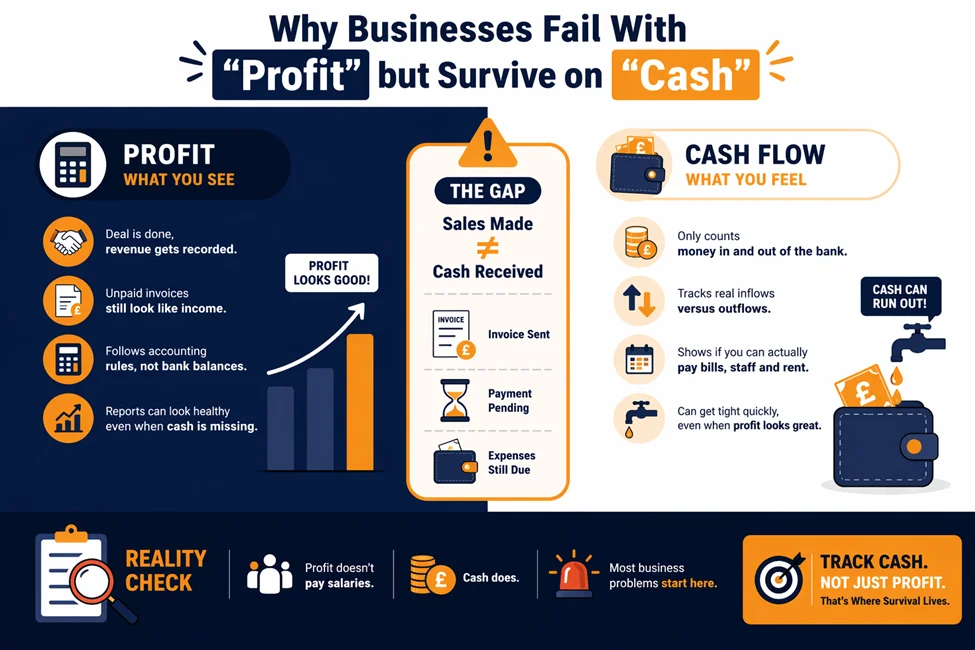
Profit is an accounting concept, while cash is a physical reality. The profit and loss account records income when earned and expenses when incurred, not when money moves. As any ACA or ACCA qualified accountant will confirm, this distinction between accrual-based profit and actual cash movement is one of the most misunderstood concepts in business finance.
Until a customer pays their invoice, that revenue exists only on paper, and the gap between these two worlds is where most SME cash crises originate. Net cash flow, meaning total inflows with minus outflows over a given period, is the starting point for any meaningful cash flow analysis.
Working Capital Cycle and Cash Gaps
The working capital cycle, a core concept in both ACCA Financial Management and ICAEW Business Finance, describes the time required to convert inputs into cash receipts. Shortening is one of the most effective ways to improve liquidity without external financing. If a business purchases materials in January, manufactures in February, invoices in March, and the customer pays in May, it has funded four months of activity before a single penny returns. The shorter the cycle, the less cash is tied up at any one time.
Real Example of a Profitable but Cash Poor Business
Consider a UK construction subcontractor with a £2.4 million turnover. Their accounts show a profit of £180,000, but they carry £220,000 in unpaid invoices (some 90 days overdue), hold £95,000 in materials for upcoming projects, and face a £68,000 VAT bill due in three weeks.
The profit is real. The cash to cover that VAT bill does not exist yet. This is the profitable but broke trap, and it catches well run businesses as readily as poorly managed ones.
What are Cash Flow Problems in UK SMEs
Late Payments and the Growth Trap
Late payment is endemic in UK commerce. The Federation of Small Businesses estimates the average SME is owed around £22,000 at any given time, making debtor days one of the most telling metrics in management accounts. Reducing it by just 15 days can release tens of thousands in working capital. Growth compounds this further.
Winning new contracts means funding wages, materials, and overheads before revenue arrives, and businesses that take on more activity than their working capital can support risk overtrading. Growth without adequate financing is one of the leading causes of SME insolvency in the UK.
Poor Tax Planning, Overstocked Shelves and Hidden Spending
Many businesses treat VAT as available cash, but it belongs to HMRC, and those without a dedicated reserve face a painful reckoning when the return falls due. The same applies to Corporation Tax, which lands a single lump sum nine months after the accounting period ends.
The problem is rarely the tax itself, but the absence of planning. Businesses that over order or hold slow moving stock tie up working capital unnecessarily. A systematic audit of recurring outgoings, including unused subscriptions and auto renewing contracts, frequently uncovers several thousand pounds of avoidable spend.
How to Identify Cash Flow Problems Early
Key Warning Signs and Liquidity Ratios
Cash flow warning signs rarely appear overnight they build over weeks or months. Consistently drawing on an overdraft at month-end, a growing gap between invoiced revenue and cash receipts, and payroll anxiety are early signals demanding immediate attention. Monthly management accounts provide the visibility to act before small problems escalate, as relying solely on year-end accounts is the equivalent of driving whilst looking only in the rear-view mirror.
A useful companion metric is the quick ratio, also known as the acid test ratio and a core liquidity measure in financial analysis recognised across ACCA and CFA frameworks, calculated as .
A reading below 1.0 indicates the business cannot cover current liabilities from liquid assets alone, and a declining trend over three to six months is a dependable early warning of deteriorating liquidity.
Cash Flow Health Check (Quick self-audit, score yours!):
| Warning Sign | Healthy Target |
|---|---|
| Debtor days | < 30 days |
| Quick ratio | > 1.2 |
| Cash buffer | 2–3 months costs |
| Burn rate coverage | > 6 months runway |
The Importance of Rolling Forecasts and Burn Rate Tracking for SMEs
A rolling 12-month cash flow forecast is the single most important financial tool available to an SME owner. Updated monthly as actuals replace projections and a new month is added at the far end, it prevents a static forecast from becoming irrelevant and allows cash shortfalls to be spotted six to nine months in advance. Equally important is burn rate when monthly outgoings consistently exceed receipts, and reserves are depleted at a measurable pace. A business with £80,000 in the bank and a £20,000 monthly burn rate has four months to change course.
Struggling to build one? Lanop’s Virtual Finance Directors set this up in a 1-hour session, schedule a free consult.
How can a business fix cash flow problems sustainably?
Managing Cash Inflows, Debtor Days, Supplier Terms and Overhead Costs
The most immediate lever is asking for payment sooner. Review terms, issue invoices immediately, and send automated reminders before, on, and after the due date. Clear debtor ledger ownership, consistent chasing, and deposits from high value customers reduce debtor days and improve the cash conversion cycle.
On the outflows side, negotiating 30 to 60 day supplier terms, aligning payment runs with receipt cycles, and a structured overhead review, with unused subscriptions the most common finding, meaningfully reduces structural cash drain. Robust bookkeeping services that track money in and money out in real time are essential to keeping this discipline in place month after month.
Creating a cash reserve buffer
A cash reserve held outside day-to-day operations provides the single most effective protection against unexpected shortfalls. For most SMEs, two to three months of fixed costs is the right target, though the exact size depends on the cost base, revenue predictability, and risk appetite. A separate designated account with a monthly transfer treated as a non-negotiable overhead is the most practical way to build it.
Financing Options for Cash Flow Gaps
Invoice financing vs business overdrafts
Invoice financing, which includes both invoice factoring and invoice discounting, allows a business to release a portion of the value of outstanding invoices before customers pay. The facility scales with the debtor ledger, making it well-suited to businesses with strong revenue but slow-paying customers. According to the British Business Bank, costs typically involve a service charge of 0.5 to 3% of invoice value plus interest on funds drawn.
A business overdraft is a flexible facility for covering short-term gaps, but it is typically more expensive than invoice financing for recurring working capital needs and does not scale as quickly with revenue. An overdraft is best reserved for genuinely unpredictable, short-duration shortfalls rather than a persistent structural gap.
When to consider a business loan vs internal cash optimisation
External financing should follow, not replace, internal cash optimisation. A business still carrying late-paying customers, excess stock, or poor supplier terms is borrowing to fund inefficiency. Once internal levers are exhausted, a term loan may suit a specific, quantifiable investment, but borrowing to cover an ill-defined working capital shortfall adds debt without fixing the underlying problem.
Risks of over-reliance on external financing
External financing creates obligations, including repayment schedules, interest costs, covenants, and personal guarantees. Businesses dependent on rolling credit facilities are vulnerable to changes in lenders’ appetite or market conditions. Financing is a tool, not a solution. The underlying cash flow must ultimately be self-sustaining.
How Can SMEs Handle Taxes with Limited Cash?
How to Set Tax Reserves and Manage Deadline Costs
VAT belongs to HMRC, not the business. Transferring the net amount into a separate account each time an invoice is raised ensures funds are ring-fenced when the return falls due. Corporation Tax requires the same discipline. Setting aside one-twelfth of the estimated annual liability each month eliminates the year-end shock.
Missing either deadline carries real consequences. Late VAT triggers HMRC’s penalty points system with interest at the Bank of England base rate plus 2.5 percent, whilst Corporation Tax interest runs from the day after the due date. Persistent non-payment escalates to debt collection, distraint on assets, and winding-up petitions.
Time to Pay Arrangements and Capital Allowance Changes
VAT belongs to HMRC, not the business. Transferring the net amount into a separate account each time an invoice is raised ensures funds are ring-fenced when the return falls due. Corporation Tax requires the same discipline. Setting aside one-twelfth of the estimated annual liability each month eliminates the year-end shock.
Missing either deadline carries real consequences. Late VAT triggers HMRC’s penalty points system with interest at the Bank of England base rate plus 2.5 percent, whilst Corporation Tax interest runs from the day after the due date. Persistent non-payment escalates to debt collection, distraint on assets, and winding-up petitions.
Where Do UK Business Owners Go Wrong with Cash Flow?
Ignoring Cash Flow, Late Payments and Compliance
The most expensive cash flow mistake is treating cash management as an afterthought rather than a defined strategic discipline. Many business owners review their cash position only when a problem has already crystallised. Strong cash positions are maintained not by the most profitable businesses but by those that treat liquidity management as a priority on par with revenue growth.
This extends to regulatory obligations that directly impact cash. Under the Late Payment of Commercial Debts Interest Act 1998, businesses can charge statutory interest of 8 percent above the Bank of England base rate on overdue B2B invoices plus a recovery charge of £40 to £100, yet most small business owners leave these sums unrecovered.
Similarly, Companies House now requires iXBRL digital filing for certain company types from Autumn 2024 under the Economic Crime and Corporate Transparency Act 2023. Businesses yet to upgrade to compatible accounting software face additional compliance costs and filing delays that should be factored into operational budgets. Limited company directors in particular should ensure they are prepared for these requirements.
Managing MTD and DLA Cash Flow Risks
Making Tax Digital for Income Tax Self-Assessment, live from April 2026 for qualifying income above £50,000 and extending to £30,000 and £20,000 in subsequent years per HMRC guidance, requires quarterly reporting through compatible software. This gives businesses near-real-time tax visibility and eliminates the risk of a large, unexpected January self-assessment bill.
A specific overlooked risk is the Director’s Loan Account. If a director’s loan balance remains outstanding nine months after the accounting year-end, the company faces a Section 455 charge of 33.75 percent of the outstanding balance. This is repayable once cleared, but creates a significant short-term cash cost. DLA balances should be reviewed at least quarterly.
How to Ensure Long-Term Cash Flow Stability
Building a Rolling Cash Flow Forecast
A practical rolling cash flow forecast does not require sophisticated software. A well-structured spreadsheet will serve the purpose. It should capture projected receipts, anticipated new sales with probability weighting, fixed and variable outgoings, and all known tax and compliance payment dates, reviewed at every management meeting.
Critically, the forecast becomes significantly more useful when it separates operating, investing, and financing cash flows, mirroring the statement of cash flows under IAS 7, as recognised in both ACCA Financial Reporting and ICAEW Corporate Reporting. The direct method tracks actual cash receipts and payments the indirect method adjusts net profit for non-cash items and working capital movements. Both reveal whether the business generates cash from core trading or relies on financing to stay solvent.
Liquidity and Cash-Based Growth Strategy for SMEs
A minimum cash balance of one to three months of fixed overheads is a fundamental discipline, absorbing natural volatility whilst providing time to act when the forecast signals a future breach. Tracking retained cash flow alongside this buffer gives a clearer picture of long-term financial resilience. Every growth commitment must be tested against this if an initiative takes twice as long to generate returns as projected and the business cannot absorb the additional drain, it should be phased, financed differently, or deferred.
Our financial planning services are designed specifically to help SMEs build and stress-test this kind of long-term liquidity strategy.
Who really fixes cash flow, a virtual FD or an Accountant?
Reporting the past vs engineering the future
A traditional accountant’s core function is compliance. Accurate annual accounts, tax returns filed on time, and statutory obligations met. This foundational work tells a business owner where they have been, not where they are heading.
A Virtual Finance Director operates in a different mode. Forward-looking by design, building forecasts, identifying emerging risks, and providing strategic financial analysis. Where a traditional accountant closes the books, a Virtual CFO opens the conversation about what comes next. To understand the full scope of what this role involves, read our guide on what a Finance Director actually does for a business.

Scenario modelling and “what-if” cash planning
One of the most valuable VFD contributions is scenario modelling. A well-constructed model contains at minimum three scenarios. Base case, downside where a key client delays or sales underperform by 20%, and recovery case.
Scenario modelling transforms cash management from a reactive exercise into a strategic one. When an adverse event occurs, options have already been analysed. Decisions are faster, better informed, and less reactive.
Cost-benefit comparison for SMEs (£1m to £5m turnover)
For businesses with turnover between £1 million and £5 million, a full-time Finance Director, typically costing £80,000 to £130,000 in salary plus employer’s National Insurance per HMRC’s employer contributions guidance, is rarely justifiable.
A VFD service on a fractional basis delivers the same strategic capability at £1,500 to £4,000 per month, with the improvement in cash flow visibility and decision quality almost invariably generating a return that exceeds the cost.
How Lanop Improves Cash Flow for UK Businesses?
Lanop’s VFD-led cash flow strategy approach
Lanop’s VFD-led strategy is built on one central premise that every business decision has a cash-flow consequence that should be understood before it is made. Acting as a remote Finance Director to founder-led businesses and SMEs across London and the wider UK, Lanop embeds on a flexible, fractional basis delivering forward-looking forecasting, clear visibility over cash runway, and scenario planning that stress-tests risk before decisions are made.
MTD-Aligned Forecasting and Tax Planning for Liquidity
With MTD for Income Tax now operational, Lanop supports clients in implementing compatible accounting software and establishing quarterly reporting rhythms that serve both compliance and strategic cash planning, consistent with forward-looking financial management principles endorsed by qualified finance professionals.
This infrastructure extends to proactive tax planning, calculating VAT reserves, modelling Corporation Tax liabilities on a rolling basis, identifying capital allowance opportunities, and advising on TTP negotiations before deadlines are missed, because the cost of proactive planning is always lower than the cost of crisis management.
Managing Cash Leaks with Strong Financial Oversight
Lanop’s cash flow audit examines the full picture, including debtor days, creditor terms, stock turn, recurring expenditure, tax reserve discipline, and Director’s Loan Account balances, quantifying the cash impact of every inefficiency identified.
Ongoing monthly monitoring, supported by our bookkeeping and real-time financial reporting, tracks performance against the forecast with escalation protocols when a developing problem is signalled. The decisions remain with the client. Lanop ensures they are made with the right information at the right time.
Conclusion
The most successful businesses are not necessarily the most profitable but the readiest. A keen planning, rigorous projections, and instant cash visibility is what distinguishes the businesses that grow with confidence and those that scramble to pay their employees. As HMRC demands increase and financial control mounts pressure in 2026, working capital is not a luxury, basically it is a leadership necessity.
The Virtual Finance Director service provided by Lanop offers UK SMEs strategic advice, or bespoke forecasting systems as well as proactive HMRC planning that allows the company to cease the reactive cash management approach and adopt organised, confident financial management without the expense of a full time Finance Director.
Ready to fix your cash flow? Book a free audit today.
Frequently Asked Questions
Typically, a buffer of 3-6 months of operating cost is recommended. A CFO finds your exact Cash Runway, by looking at your payment cycles and future tax payment (VAT/Corporation Tax) so that you are neither over-leveraged nor have idle cash
A CFO conducts a Go-No-Go stress test before proceeding with new premises or staffing. We construct forecasts that model the situation in which the investment doubles the time to give a payout. The only expansion should be done when the core operating cash flow is able to absorb the drain without violating a safe runway buffer.
These what-if tools are used by the CFOs to stress-test your business. Sensitivity Analysis focuses on one variable at a time and Scenario Analysis represents and modelling of complex conditions such as a 20% decline in revenue. This creates a Crisis Playbook, when a shock occurs, the Fractional CFO switches to weekly monitoring, finds cash lifelines, and sets priorities on essential payments and proactively opens Time to Pay conversations with HMRC before the situation gets worse.
Future cash holds more value than turnover to investors. Large, unsurprising Free Cash Flow is good, whereas weak cash collection is bad and lowers the sale price in due diligence. Discounted Cash Flow is also used by CFOs when analyzing investments and acquisitions, since the future cash should always be assessed in the present day, taking into consideration inflation and risk.
When you just look at historical information, you have a bookkeeper. A Fractional CFO at Lanop offers proactive management with the help of the latest technologies, such as Xero or QuickBooks, combined with state-of-the-art forecasting applications and offers high-level strategy and growth planning at a small fraction of the price of a full-time Finance Director.
Depreciation decreases reported profit, but does not require any cash outlay, so your bank account balance is usually greater than your P&L account indicates. In the meantime, money held in unpaid bills or sluggish inventory has a true Opportunity Cost, all the tied-up pounds are not earning interest or financing expansion. A CFO balances the two to demonstrate their real Operating Cash Flow and reduce the Operating Cycle.
A budget establishes the goals of the profits and a forecast keeps track of cash flows. It is a survival resource. In case of import export business, the exchange rate can vary the real cost of supplier payment or foreign receipt within a day. Forward contracts stabilize the rates and this unpredictability is taken out of your forecast and your budget planning.
Special challenges in construction, such as retention clauses, extended payment terms, and initial material costs, are present. The main instruments that should be under the supervision of a CFO who has a vision of how a JCT contract should be built are stage payment schedules, invoice financing based on certified valuations, and narrow monitoring of debtor days.