
Introduction
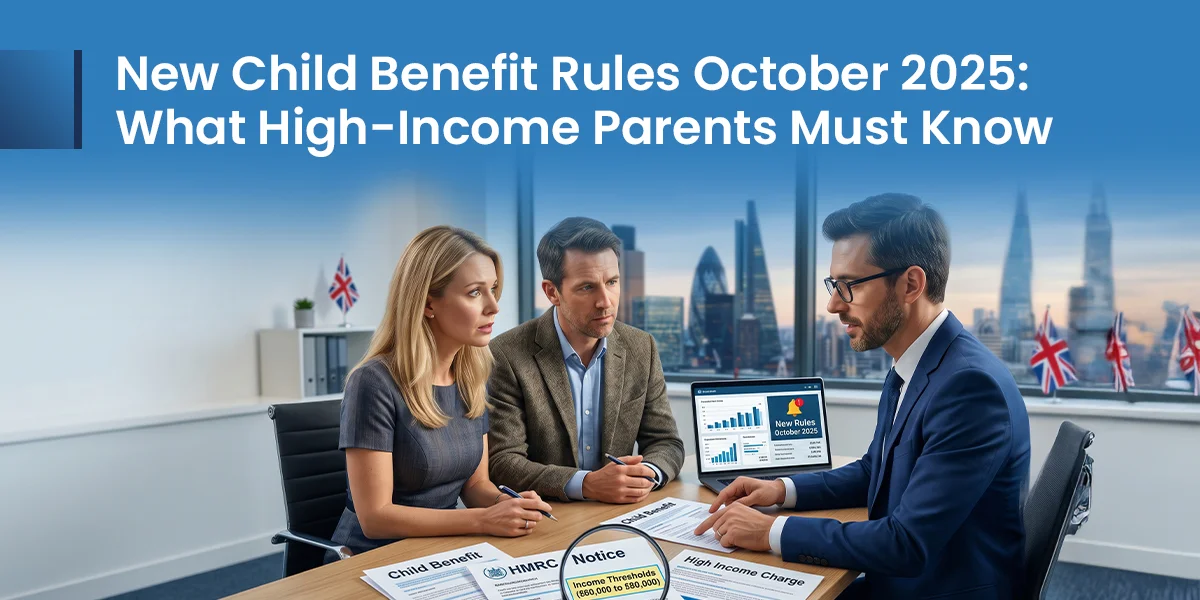
The British tax system is complex. Few areas have caused as much trouble for professional families as the High-Income Child Benefit Charge (HICBC). Passing through the 2025/26 tax year, however, things have transformed utterly. The New Child Benefit Rules October 2025 will be the last stage of a larger reform. This reform streamlines the process by which the charge is made. They are introducing these set dates as HMRC is starting to move away from the Self-Assessment way of doing things towards a more automated process.
For rich parents, being informed always means more than knowing the thresholds. You have to know how HMRC interacts with your monthly pay packet. The high cost of living continues to be a key issue for UK households. Claiming back the Child Benefit you should be getting can provide a valuable financial buffer. This report presents a detailed examination of the amendments made in October 2025. It provides the strategic depth you need to figure your way through these updates with confidence.”
The new Child Benefit rules (October 2025 update)
The real headline reform in Child Benefit has been among the most hotly discussed fiscal reforms of recent years. Historically, the HICBC was criticized as a “tax on aspiration.” Families reaching the £50,000 threshold were suddenly hit with steep benefit cuts. The New Child Benefit Rules October 2025 are the result of efforts to smooth this transition. They reduce the “cliff-edge” effect that discouraged many parents from seeking pay rises or taking on extra hours.
Key Changes at a Glance
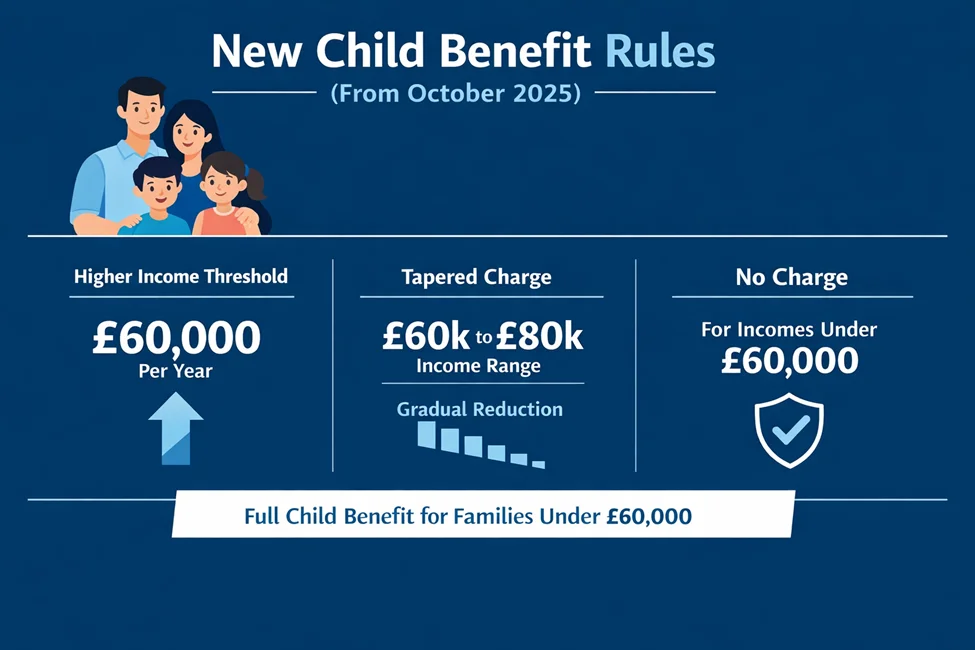
The most fundamental change is the expansion of the taper band. The threshold where the charge begins has been raised to £60,000. The point where the benefit is fully withdrawn has been extended to £80,000. These £20,000 “taper zones” is significantly more generous than the previous £10,000 window. It effectively halves the rate at which the benefit is clawed back. The cost is PS1 per PS200 of income that is greater than PS60,000.
The schedule of the changes that are in progress (2024 = 2025= 2026)
In order to do this, it is necessary to take a step back and observe the course of these changes. The rules had not changed for a decade prior to when they did in 2024. If wages grew as inflation increased The PS50,000 threshold was the culprit in catching increasing numbers of families because of the fiscal drag. It was not until April 2024 that authorities to increase this limit to PS60,000. This brought relief immediately. The deadline for the milestone to be reached in October 2025 is specifically referring to the implementation of the PAYE method of collection.
What Is the High-Income Child Benefit Charge (HICBC)?
Despite the more favorable thresholds, the core logic of the High-Income Child Benefit Charge UK remains the same. It is a tax charge that applies if you or your partner receive Child Benefit and one of you has an “Adjusted Net Income” over a certain limit. This is not a benefit of “cutting.” It is a tax collected after the benefit has been paid.
What Is HICBC?
The HICBC serves as a mechanism to ensure that Child Benefit is targeted toward those who need it most. Its execution has been controversial. The charge applies to the partner with the highest income, regardless of who actually makes the claim or receives the money. This “highest earner” rule often leads to confusion in modern households where incomes fluctuate.
How Much Is the High-Income Child Benefit Charge?
Calculating the exact liability is essential for family budgeting. Because the taper now stretches over a £20,000 range (£60k to £80k), the “tax bite” is less severe at every stage compared to the old system. The 1% per £200 rule ensures a gradual climb.
For example, a parent earning £65,000 is £5,000 over the threshold. Since there are twenty-five £200 increments in £5,000, their charge is 25% of the total benefit received.
If that same parent earned £70,000, they would be £10,000 over the limit. This results in a 50% charge. At the top end of the scale, an income of £80,000 triggers a 100% charge. This means the tax owed is exactly equal to the benefit received.
What Are the Income Thresholds for 2025/26?
The 2025/26 thresholds are the most generous in the history of the charge. By moving the starting point to £60,000, the government has removed hundreds of thousands of families from the “tax trap.”
For those still within the bracket, the wider taper means the effective marginal tax rate is much lower. This is the amount of tax you pay on each extra pound earned. Under the old £50k-£60k rules, a parent with three children could face a marginal tax rate of over 60%. This included Income Tax, National Insurance, and the HICBC. Under the 2025 rules, pressure is substantially reduced.
HMRC Changes: PAYE vs Self-Assessment (Big 2025 Shift)
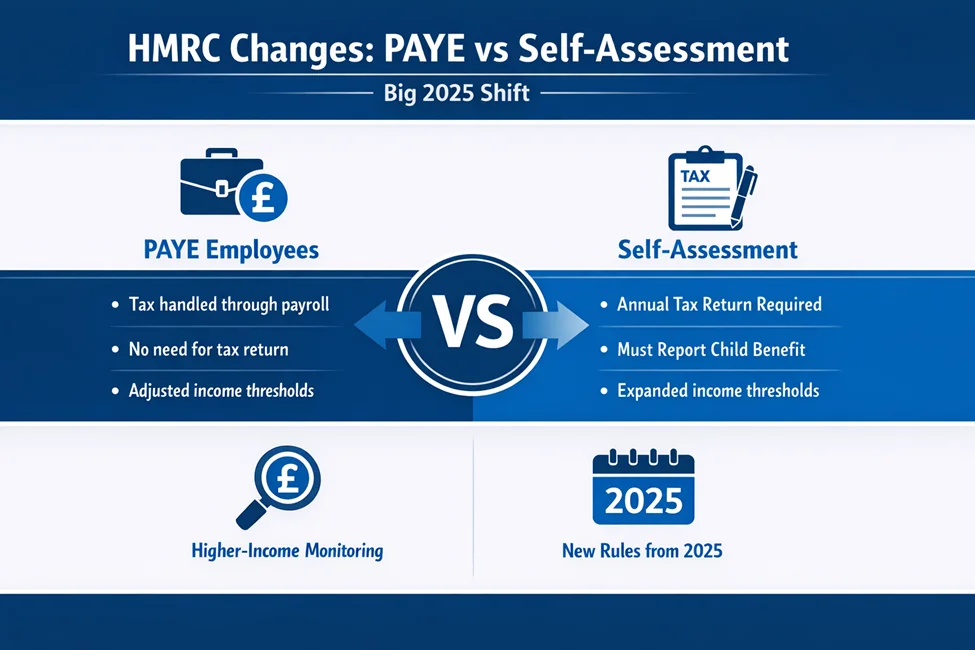
One of the most frequent complaints about the HICBC was the administrative burden of the Self-Assessment system. Many high earners are employees with simple tax affairs. They would otherwise never need to file a tax return. The HMRC changes child benefit payment method for high-income parents in October 2025 aim to modernize this relationship.
What Changed in October 2025?
The October 2025 update allows HMRC to collect the HICBC directly through your tax code. If you are an employee, HMRC can now automatically calculate your estimated liability. They adjust your “Personal Allowance” accordingly. This means the tax is deducted in smaller, manageable increments from your monthly salary throughout the year. You no longer need to pay a large lump sum by the following January. This is a massive improvement for household cash flow management. It prevents the “January shock” that many families faced when they realized they owed several thousand pounds in back-dated tax.
Do You Still Need to Register for Self Assessment HICBC?
While the PAYE option is a welcome relief, it is not a universal solution. You are still required to file a Self Assessment tax return if your tax affairs are more complex. This includes individuals who are self-employed. It also includes those with an annual income exceeding £150,000. Anyone who receives significant income from rental properties or investments must also file.
How Does Paying Back Child Benefit Through Tax Code Work?
When you opt for the PAYE collection method, you will notice your tax code change. For instance, a standard code of 1257L might be reduced. This signifies that more of your income is being taxed to cover the HICBC. While this is convenient, it requires vigilant monitoring. If your circumstances change, you must notify HMRC immediately. For example, you might stop receiving Child Benefit or your income might drop below the threshold. You need to ensure your tax code is updated. Failure to do so could result in you overpaying tax throughout the year. This would mean you need to claim a refund later.
Should You Claim Child Benefit as a Higher Earner?
The decision to claim Child Benefit is no longer a simple “yes” or “no” for high earners. It is a strategic choice about how you want to manage your household’s finances and long-term state entitlements.
Claim vs Opt Out: What’s Better?
Choosing to receive the payments (“Claiming and Paying the Charge”) is generally the best route for families who need the monthly cash flow. It works well if you are comfortable with a slightly higher monthly tax deduction or filing a tax return. On the other hand, “Opting Out of Payments” (while keeping the claim live) is often preferred by those earning well over £80,000. These parents do not want to deal with the money going out and coming back in via HMRC. The key is to never ignore the benefit entirely. Even an “Opted Out” claim has massive secondary benefits.
Why You Should Still Claim (Even If You Repay)
This is perhaps the most important piece of advice for high-income parents: always file the claim form. Even if you earn £200,000 and will repay every penny of the benefit, the act of claiming is what triggers National Insurance (NI) credits for the parent who stays at home or earns a lower income. These credits are essential for building the 35 qualifying years needed for a full State Pension. If you do not claim, and the non-earning parent is not working, they could end up with a massive gap in their pension record. This could cost tens of thousands of pounds to “buy back” later in life.
When Does It Make Sense to Stop Child Benefit Payments UK?
If you find yourself in a position where your income is consistently and significantly above £80,000, you may choose to stop Child Benefit payments UK to simplify your life. This stops the cash from hitting your bank account but maintains the “underlying entitlement.” This means you still get NI credits for your partner. Your child still gets their National Insurance number automatically at age 16. It is the “admin-light” version of the benefit for truly high earners.
Practical Compliance Guide (Step-by-Step)
HMRC has become increasingly efficient at using data to find parents who are receiving Child Benefit but not paying the HICBC. Compliance is not optional. The penalties for “Failure to Notify” can be severe.
How to Register for Self-Assessment HICBC
If the new PAYE system does not cover your situation, you must register for Self Assessment. The deadline for registration is October 5th following the end of the tax year. For the 2025/26 tax year, you would need to be registered by October 5, 2026. The process is done online through the Government Gateway. It requires your National Insurance number and details of your income.
What Is the Child Benefit Tax Charge Deadline UK?
The primary deadline to remember is January 31st. This is when your tax return must be filed. Any balancing payment for the HICBC must be in HMRC’s bank account by this date. If you are using the PAYE method introduced in October 2025, you still need to ensure that the total collected over the year matches your actual liability. If you underpay via PAYE, you may still need to make a one-off payment by this deadline.
What Are the Penalties for Not Declaring HICBC UK?
HMRC issues penalties based on the amount of tax “lost” due to the failure to declare. These penalties are categorized as “Careless,” “Deliberate but not concealed,” or “Deliberate and concealed.” Even a simple oversight can lead to a penalty of 30% of the tax owed. Furthermore, interest is charged daily on any unpaid tax from the January 31st deadline. In recent years, HMRC has sent thousands of “nudge letters” to high earners. These letters give them a window to come forward before formal investigations begin.
How Do You Amend Tax Return Child Benefit UK?
If you realize you have made a mistake on a previous return, you should seek to amend tax return child benefit UK immediately. Perhaps you forgot to include a bonus that pushed you into a higher taper bracket. You usually have 12 months from the original filing deadline to make corrections. Making a voluntary amendment is always looked upon more favorably by HMRC than waiting for them to find the error.
Advanced Tax Strategies (High-Value Section)
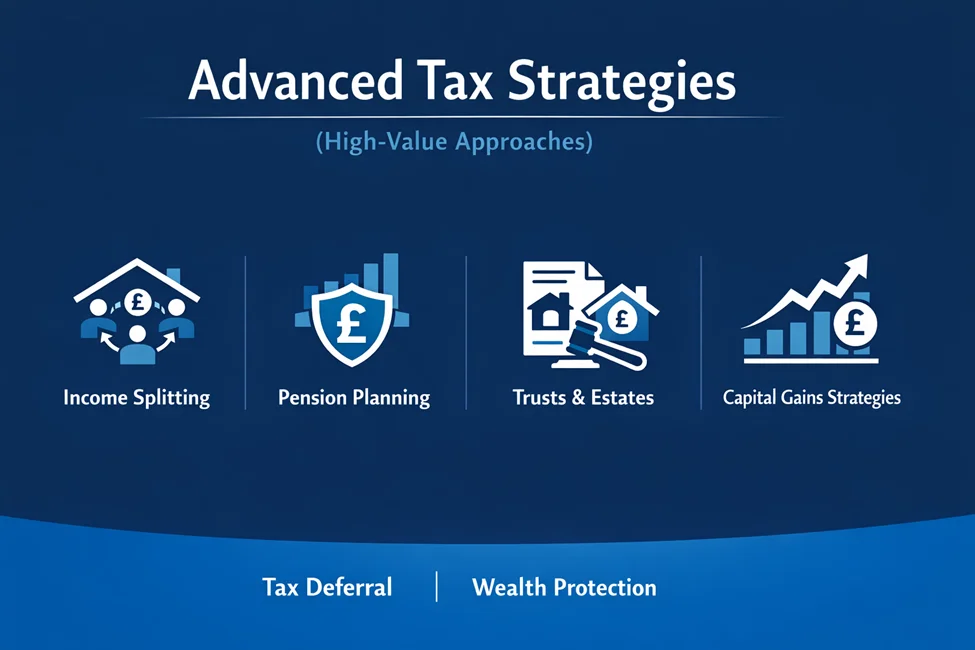
For the proactive high-income parent, the New Child Benefit Rules October 2025 offer several opportunities to minimize the HICBC through legitimate tax planning. The goal is to reduce your “Adjusted Net Income” (ANI).
What Is the Salary Sacrifice Impact on Child Benefit UK?
Salary sacrifice is the most powerful tool in your arsenal. You agree to “sacrifice” a portion of your gross salary in exchange for a non-cash benefit. The most common options are a pension contribution or an electric car. This lowers your ANI.
For example, if you earn £63,000, you are £3,000 into the taper zone. You will lose roughly 15% of your Child Benefit. If you sacrifice £3,001 into your pension, your ANI becomes £59,999. This move completely eliminates the HICBC. You keep 100% of the benefit and get the full tax relief on your pension contribution.
How Can You Use Income Planning to Reduce HICBC?
Beyond pensions, other deductions can help. Gift Aid donations to charity are “grossed up” and deducted from your income when calculating the HICBC. If you are close to the £60,000 or £80,000 thresholds, a well-timed charitable donation can pull you down into a lower taper bracket. Similarly, for business owners and contractors, the timing of dividend payments is crucial. Delaying a dividend until the following tax year could keep your ANI below the threshold for the current year. This can save you thousands in HICBC.
Dual-Income Strategy Insight
The current individual-based system creates a disparity. A household where one parent earns £85,000 loses all Child Benefit. Meanwhile, a household where two parents earn £55,000 each (£110,000 total) keeps it all. Until the household-based assessment is potentially introduced in 2026, high-earning couples should look at income-splitting where possible. For those with their own limited companies, ensuring both partners are paid a salary or dividend that keeps them both below the £60,000 mark is the ultimate strategy. This maximizes family take-home pay.
What Is the Backdating & Eligibility Rules?
If you have avoided claiming Child Benefit because you thought you weren’t eligible under the old rules, it is time to act.
What Are the Backdating Rules?
Child Benefit claims can only be backdated for a maximum of three months. This means if you became eligible when the thresholds changed or when a new child was born, you must apply promptly. You cannot go back several years and claim the money you “missed out on” under the old £50k limit.
What About Special Cases?
The rules can be more complex for blended families. If you move in with a partner who receives Child Benefit and your income is higher than theirs, you become liable for the HICBC. This applies even if the children are not biologically yours. Conversely, if you separate, the responsibility for the charge shifts to the parent with the higher income in the new household setup. Always update HMRC on changes to your living situation. This helps you avoid falling foul of the 2025 compliance checks.
How Lanop Can Help
Navigating the complexities of the New Child Benefit Rules October 2025 is a task that often requires professional oversight. At Lanop Business and Tax Advisors, we provide the expertise needed to turn tax compliance into tax efficiency.
Expert HICBC Guidance
Our team provides a bespoke assessment of your household income. We identify the exact point where the HICBC begins to bite. We do not just look at your salary. We analyze your total taxable footprint to ensure you are not paying a penny more than you legally owe.
Self-Assessment & PAYE Support
Whether you are transitioning to the new PAYE collection system or need to file a complex Self Assessment return, we handle the technical details. We act as your agent with HMRC. We ensure that your tax code is correct and that your filings are submitted on time, every time.
Tax Planning to Reduce HICBC
We specialize in advanced tax planning strategies. These include salary sacrifice and pension optimization. We also help with intelligent income-splitting for business owners. Our goal is to legally lower your Adjusted Net Income. This can save you thousands in both Income Tax and Child Benefit repayments.
Error Correction & Compliance
If you have realized that you have missed HICBC declarations in the past, do not panic. We help you make voluntary disclosures to HMRC. We often secure lower penalties and more favorable payment terms than if the tax office had contacted you first.
Ongoing Advisory for Families
Tax rules change, and so does your income. We provide annual reviews for our clients to ensure their Child Benefit strategy remains optimal. This applies as they receive pay rises, change jobs, or welcome new children into the family.
For the 2025/26 tax year, the HICBC starts when the highest-earning partner in a household reaches an “Adjusted Net Income” of £60,000. Between £60,000 and £80,000, the benefit is gradually withdrawn through a tax charge.
The calculation is based on 1% of the total Child Benefit amount for every £200 earned above the £60,000 threshold. For example, if you earn £70,000, you are £10,000 over the limit. Dividing £10,000 by £200 gives you 50. This means your tax charge will be 50% of the total Child Benefit you received during that tax year.
Yes, if your Adjusted Net Income exceeds £60,000, you are legally required to repay a portion of the benefit via the HICBC. If you earn over £80,000, you must repay the full amount. However, even if you are required to repay 100%, it is often advisable to technically “claim” the benefit but opt out of the actual payments.
Opting out of receiving payments is a strategic choice for those earning significantly over £80,000. These parents want to avoid the administrative burden of Self-Assessment or PAYE code adjustments. By “claiming but opting out,” you protect your National Insurance credits. You do this without receiving cash that you would simply have to pay back to HMRC later.
The most effective way to legally avoid or reduce the HICBC is by lowering your “Adjusted Net Income.” This can be achieved through salary sacrifice schemes, such as increasing your workplace pension contributions. For instance, if you earn £62,000, contributing £2,001 into your pension reduces your taxable income to below £60,000. This exempts you from the charge entirely.
Historically, anyone subject to the HICBC had to file a Self-Assessment tax return. However, starting in October 2025, many employees can opt to pay the charge through their PAYE tax code. You still MUST file a tax return if you are self-employed, have an income over £150,000, or have other complex tax affairs like rental income or significant dividends.
When completing your Self-Assessment return, there is a specific section dedicated to the High-Income Child Benefit Charge. You must enter the total amount of Child Benefit received by you or your partner during the tax year (from April 6th to April 5th). You also need to provide the number of children you are claiming for.
The charge is based on “Adjusted Net Income.” This is your total taxable income (salary, bonuses, dividends, rental income, interest) minus specific deductions. These deductions include pension contributions (made from pre-tax pay or grossed up), Gift Aid donations, and certain business expenses.
No, only one person can receive Child Benefit for a child. If both parents live together, the person with a higher income is responsible for paying the HICBC. This applies regardless of who actually receives the money in their bank account.
Failing to declare the HICBC can lead to significant financial penalties. HMRC uses data matching to identify households receiving Child Benefit where a parent earns over the threshold. If you fail to notify them of your liability, you will be required to pay the back-dated tax plus interest.
If you have received more Child Benefit than you were entitled to, you can repay the overpayment through your Self-Assessment tax return. Perhaps your income rose unexpectedly. You can also contact the Child Benefit Office directly to arrange a voluntary repayment.
Yes, salary sacrifice is one of the most effective legal methods to reduce or eliminate HICBC. By sacrificing a portion of your salary for benefits like pension contributions or a cycle-to-work scheme, you lower your “Adjusted Net Income.”
Penalties for incorrect claims or failure to declare the HICBC vary based on the nature of the error. A “careless” mistake typically results in a penalty between 0% and 30% of the tax owed. A “deliberate but not concealed” error carries a penalty of 20% to 70%. A “deliberate and concealed” error can result in penalties up to 100% of the tax due. This includes lying about your income level.
You can stop or restart your Child Benefit payments at any time by using the HMRC online service or the HMRC app. To stop payments (for example, because your income has exceeded £80,000), you select the option to “Opt Out of Payments.” This keeps your claim active for National Insurance credits.
Conclusion
The New Child Benefit Rules October 2025 are a welcome step toward a more modern, user-friendly tax system. For high-income parents, the increased thresholds and PAYE integration provide a significant opportunity to boost the family budget with less administrative effort. However, the system still rewards those who are proactive. By understanding the nuances of Adjusted Net Income, you can master the HICBC. Utilize strategies like salary sacrifice. Ensure that you never miss out on vital National Insurance credits. These steps help you take control rather than being controlled by the system. If you would like expert guidance on optimizing your position, our team at Lanop is here to help with comprehensive financial planning and tax advisory services tailored to your family’s needs.