
Dealing with the death of a parent is incredibly difficult. When the second parent dies, families often face a new challenge: inheritance tax (IHT). You may have heard that no tax was due when the first parent passed away. This is common in the UK. However, the second death usually triggers the final tax bill for the entire family estate.
At Lanop Business & Tax Advisors, we help UK business owners, executors, and families navigate these complex rules. Understanding inheritance tax when the second parent dies is vital to protecting your family’s wealth. This guide explains the current rules, how to calculate the bill, and how to legally reduce it.
What happens to inheritance tax when the second parent dies in the UK?
When one spouse dies, assets usually pass tax-free. This is called the spouse exemption under UK inheritance tax rules. As a result, no tax is paid on the first death. The surviving partner now owns the full estate.
When the second parent dies, everything changes. HMRC reviews the total estate value at that point. This is when the inheritance tax is calculated upon the second parent’s death in the UK.
Why is no inheritance tax usually paid on the first death?
UK law allows unlimited transfers between spouses. This applies to married couples and civil partners.
Most couples leave everything to each other. So, no tax is charged at the first death. It also means the first person’s allowance is unused. This is part of the nil-rate-band transfer rules in the UK. That unused allowance can later reduce tax on the second death.
How does the second death trigger the full tax calculation?
The second death is where tax risk starts. There is no spouse exemption at this stage. Assets now pass to children or other beneficiaries. So HMRC assesses the full estate.
This includes:
- Property and the family home
- Savings and bank accounts
- Investments and pensions (in some cases)
- Business assets
If the value exceeds available allowances, tax applies. The standard inheritance tax rate in the UK for 2026 is 40%. Only the amount above the threshold is taxed.
What does HMRC look at when valuing the full estate?
HMRC requires a full valuation of the deceased’s estate. This includes:
- The family home and any other UK property.
- Bank accounts, ISAs, and stocks.
- Personal items like cars, jewellery, and art.
- Business assets and private company shares.
- Gifts made within the last seven years.
How do the spouse exemption and transferred allowances apply in practice?
The UK spouse exemption rule saves the first estate from tax. Therefore, no tax is due on the transfer to the spouse. This also means the first allowance is not used. It does not get lost. It can be transferred later. This is the UK’s nil-rate band transfer rule. A full transfer is when the whole estate is transferred to the surviving parent. So, the allowance can double. The tax-free threshold can rise from £325,000 to £650,000. This can halve the inheritance tax liability.
How to calculate inheritance tax when the second parent dies?
Calculating the bill requires a clear step-by-step approach. You must be precise to avoid overpaying or facing HMRC penalties.
Step 1: Work out the total estate value
List everything the parent owned. This includes the home, savings, and investments.
Use proper values for property and business assets. Add any gift with reservation items. These are assets given away but still used. This provides the basis for the inheritance tax when the second parent dies calculator.
Step 2: Apply the nil-rate band and transferred allowance
The standard allowance is £325,000. This follows the nil-rate-band transfer rules in the UK. If the first parent used none, you can add it. This brings the total to £650,000. This reduces the taxable estate.
Step 3: Apply residence nil-rate band (RNRB) rules
If the home goes to children, extra relief applies. This is the residence nil-rate band. Each parent gets £175,000. It can also transfer between spouses. So, up to £350,000 can protect the home.
Step 4: Deduct liabilities, reliefs, and exemptions
Subtract all debts and costs first. This includes mortgages and funeral costs. Then apply reliefs. The UK inheritance tax reliefs list includes BPR.
This can reduce the value of business assets. So, less tax is due.
Step 5: Apply the 40% inheritance tax rate
Now look at how much is left after the allowances are applied. This is what will be taxed. In the UK in 2026, the inheritance tax rate is 40%. It is only charged on the additional part.
How to avoid or minimise inheritance tax after the second death?
Tax planning can reduce the tax. It’s best to do this while the surviving parent is alive.
Using the spouse exemption and full allowance transfer correctly
Ensure the executor claims the transferable nil-rate band using form IHT402. This does not happen automatically. Missing this step is a common and expensive error.
How does gifting work, and what is a simple explanation of the 7-year rule?
The 7-year rule is a great resource. Generally, gifts made more than seven years before death will be tax-exempt. However, if the death occurs within seven years, the gifts may be taxed, but taper relief will likely help reduce the tax liability.
How can someone use the family home allowance without losing relief?
The residence nil-rate band only applies if the house is bequeathed to direct descendants (children or grandchildren). If the house is given to a sibling or friend instead, the entire £175,000 allowance is lost.
When trusts help and when they increase tax
Trusts can move assets out of an estate. However, they are complex. Some trusts trigger entry charges or periodic charges. At Lanop, we review your goals to see if a trust is right for you.
Business and agricultural reliefs (BPR/APR) explained
Business Property Relief can provide 100% relief on trading company shares. This is vital for SME owners. From April 2026, new caps apply, so planning now is essential.
Real client strategies that reduced tax liability
We recently helped a family with a £1.2 million estate. By restructuring their business assets and setting up regular annual gifting, they reduced their potential tax bill by over £120,000.
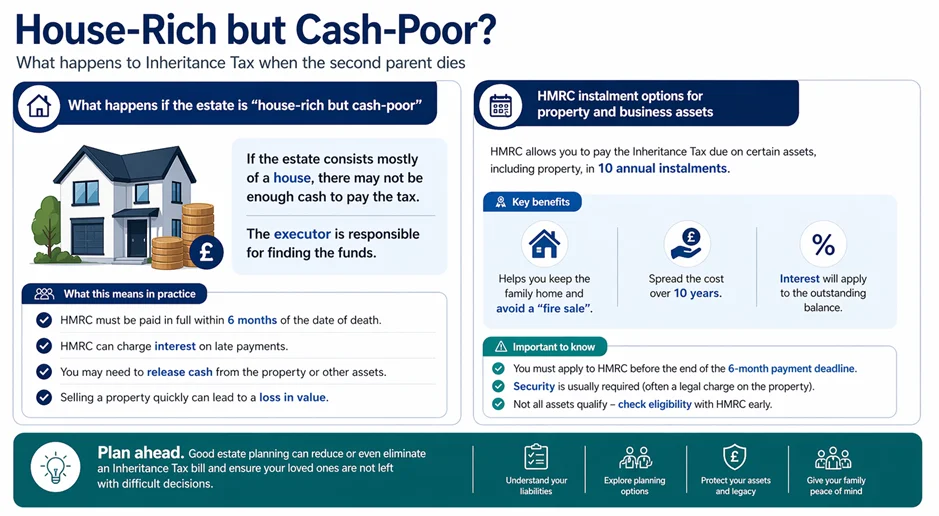
Do you need to sell the family home to pay inheritance tax?
This is a major fear for many families. HMRC understands that property is not liquid cash.
Can you delay payment until assets are sold?
You generally cannot get probate until you pay at least some of the tax. Most banks will release funds from the deceased’s accounts directly to HMRC to cover the first payment.
Real executor decisions and outcomes
One executor we advised used a “Grant on Credit” from HMRC. This allowed them to sell the house before paying the full tax bill, as the estate had no other liquid funds.
What is the most common inheritance tax mistake UK families make?
Mistakes often happen because families do not seek professional advice early enough.
Failing to claim the transferable nil-rate band correctly
Many executors assume HMRC just knows about the first parent’s unused allowance. You must actively claim it. Failing to do so can cost an estate £130,000 in unnecessary tax.
Misunderstanding the residence nil-rate band rules
This allowance tapers away if the estate is worth more than £2 million. Many families forget to account for this when asset values rise.
Gifting assets but still benefiting from them (gift with reservation)
If a parent gives the house to a child but continues to live there rent-free, HMRC ignores the gift. It stays part of the estate for tax purposes.
Missing deadlines or submitting incorrect HMRC forms
Deadlines are strict. Errors on the IHT400 form can lead to heavy penalties and long probate delays. If you are facing an HMRC tax investigation, professional representation is essential.
What HMRC forms, deadlines, and penalties do you need to know?
The paperwork for inheritance tax is detailed and time-sensitive.
Key forms: IHT400, IHT402 and when they are required
- IHT400: The main inheritance tax account. Required if tax is due or the estate is complex.
- IHT402: Used to claim the transferred allowance from the first parent.
When must the inheritance tax be reported and paid?
You must pay the tax by the end of the sixth month after the death. You must submit the forms within 12 months.
Interest and penalties for late payment
If you miss the 6-month payment deadline, HMRC charges interest daily. Penalties for “careless” or “deliberate” errors on forms can be up to 100% of the tax due.
How does inheritance tax affect business owners and company assets?
For UK business owners, inheritance tax planning is a core part of business succession.
What happens to shares in a limited company on the second death?
Shares are valued as part of the estate. If the company is a “trading” business, it may qualify for Business Property Relief.
How does Business Property Relief (BPR) work in practice?
BPR can reduce the taxable value of business assets by 50% or 100%. This ensures a family business does not have to be broken up to pay HMRC.
Risks for directors, partnerships, and family businesses
If a business holds too much “investment” (like rental property), it may lose its trading status. This would make the shares fully taxable at 40%.
What recent HMRC and legislative changes affect inheritance tax in 2025–2027?
The landscape is changing. Recent budgets have introduced major reforms.
Threshold freeze until 2030 and its long-term impact
The nil-rate band is frozen at £325,000 until at least 2030. As property prices rise, more families are “dragged” into the tax net.
Pension inclusion in inheritance tax from April 2027
Currently, most pensions are tax-free on death. From April 2027, unused pension funds will be included in the inheritance tax calculation. This is a massive change for retirement planning. Speak to our financial planning team about how to restructure your pension strategy now.
Updates to APR/BPR relief rules from April 2026
From April 2026, there will be a £1 million cap on 100% relief for business and agricultural assets. Values above this will only get 50% relief. This effectively introduces a 20% tax on large family farms and firms.
How does inheritance tax work if the first parent died many years ago?
Even if the first death was decades ago, you can still benefit.
Can you still claim unused allowances decades later?
Yes. The transferable nil-rate band applies even if the first spouse died before the current rules were introduced in 2007.
What records and evidence do HMRC require?
You will need the first parent’s:
- Death certificate.
- Marriage certificate.
- Will or Grant of Probate.
Common issues when documentation is missing
If you cannot find the old Will, you may struggle to prove the allowance was unused. Lanop can help you search records and reconstruct the necessary evidence.
How can Lanop Business & Tax Advisors help you?
Inheritance tax is not just about numbers but about your family’s future.
Reviewing estate structure and identifying tax exposure
We analyse your current assets to find tax traps. We look at property, pensions, and business assets to see where you stand. This forms part of our broader estate planning service.
Handling HMRC forms, calculations, and compliance
Our team takes the pressure off executors. We handle the complex IHT400 and IHT402 filings to ensure everything is accurate and on time.
Advising on gifting, trusts, and business relief strategies
We provide practical advice on how to pass wealth down legally. Whether it is using the 7-year rule or qualifying for BPR, we guide you every step of the way. This is an integral part of our succession planning service.
FAQs:
No tax is usually paid on the first death. On the second death, HMRC reviews the full estate. If the value exceeds allowances, tax may apply.
Add up all assets in the estate. Subtract allowances and reliefs. Tax is charged on the remaining amount.
Each person has a £325,000 allowance. This can transfer between spouses. So, couples may get up to £650,000 tax-free.
If the first parent used none of their allowance, it transfers. The second estate can claim both allowances. This reduces inheritance tax when the second parent dies in the UK.
It provides additional relief for the family home. It applies when the home passes to children. It can reduce inheritance tax on the family home in the UK.
The estate pays the tax, not the beneficiaries. Tax applies at 40% above allowances. The exact amount depends on the estate value.
You can reduce tax by:
- Using allowances fully
- Making gifts early
- Using reliefs
Good planning lowers the tax bill.
Yes, gifts can be taxed if made within 7 years. This follows the seven-year rule before death in the UK. Some gifts may still be exempt.
HMRC includes all assets owned at death:
- Property
- Savings
- Investments
- Business assets
This forms the taxable estate.
Tax is usually due within 6 months. After this, interest may apply.
HMRC may charge interest on late payments. Delays can increase the total tax bill.
The home is part of the estate. It may be subject to tax if it exceeds the above thresholds. Relief may apply if passed to children. Our inheritance tax planning team can guide you on how to protect the family home and use the residence nil-rate band effectively.
Executors value the estate first. Then they report to HMRC and apply for probate. Tax must be handled before assets are released.
Yes, in some cases, like property or business assets. Payments can be spread over time. This helps when cash is limited.
Final thoughts
Inheritance tax on the death of the second parent is not always a tax matter. It is an estate planning and succession issue. The best solution depends not only on exemptions and concessions but also on timing, implementation, and anticipation.
Consider three things:
- Periodically update your estate considering changing valuations and tax rules.
- Ensure business succession, estate planning and inheritance tax strategies work together.
- Be proactive, as prevention is better than a cure.
Planning is better than reactionary measures. Lanop Business & Tax Advisors helps families, executors and business owners understand their risks, implement tax planning, and apply HMRC rules. Speak to an inheritance tax specialist at Lanop today to secure your family’s future.