
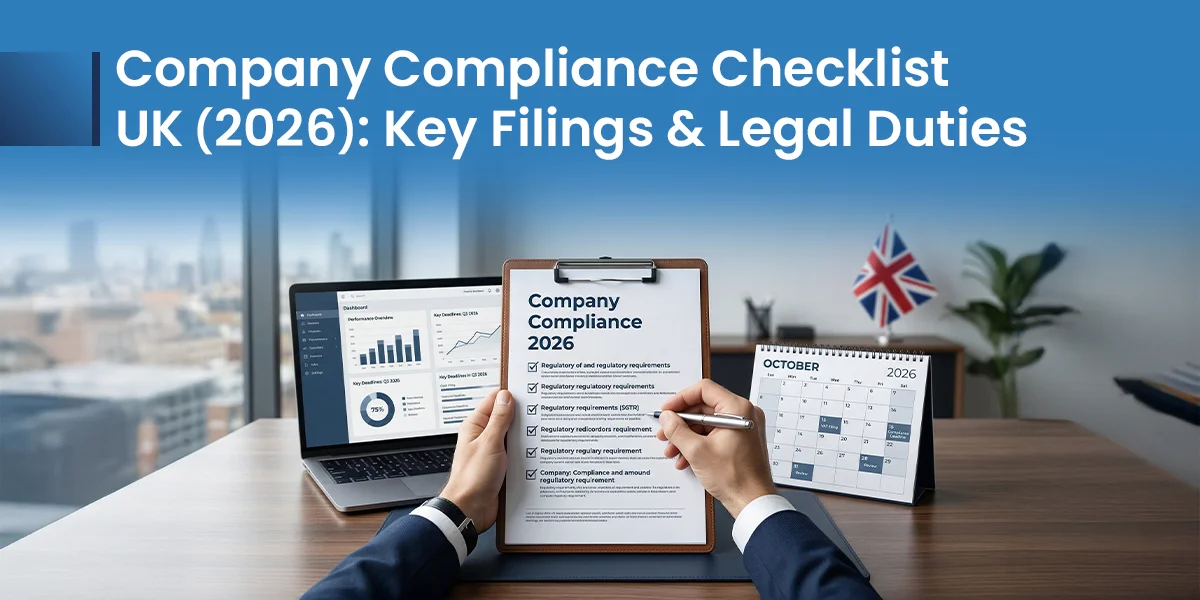
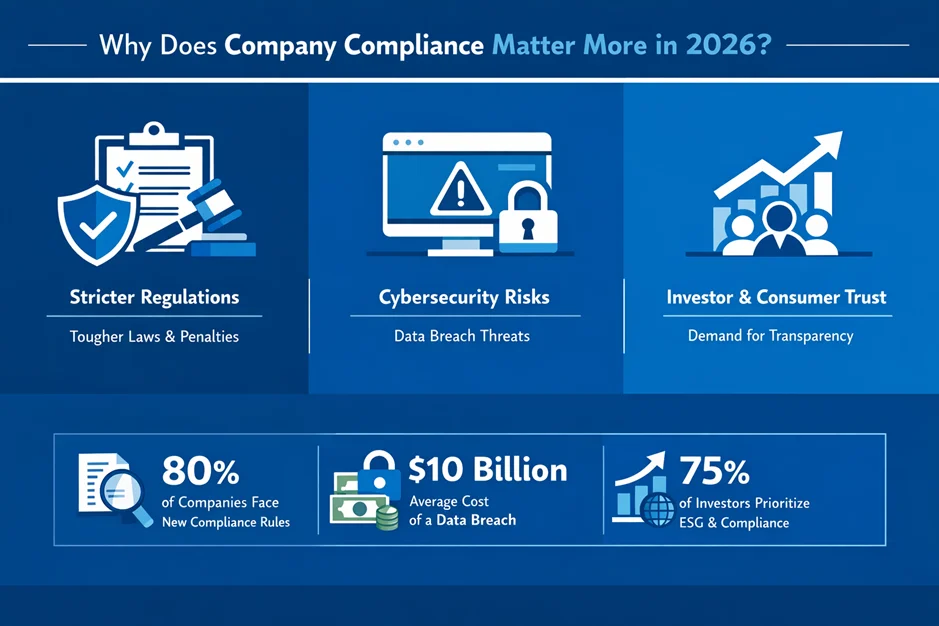
Why Does Company Compliance Matter More in 2026?
UK company law has changed. The Companies Act 2006 sets the rules. New reforms have changed how firms are run. This checklist helps directors stay on track. It covers every legal duty in one place.
Compliance now matters more than ever. The UK government has linked corporate openness to national safety. Banks and investors flag non-compliant firms fast. This can freeze credit lines or end key contracts. The risks are real and they move quickly.
A UK company compliance checklist lists the rules a business must meet to stay active. This applies to all private limited companies, big or small. The law treats every director the same. Getting your limited company accounting right from the start helps you avoid fines. It also keeps your firm free from legal red flags.
What Is Company Compliance in the UK?
Company compliance starts with the Companies Act. This law covers everything from setting up a firm to closing it down. A company law compliance checklist begins with one key fact. A limited company is its own legal person. It has rights and duties under the law.
This protects the owners. But in return, the law demands openness. You must keep accurate records and file regular reports. Two bodies oversee this in the UK. These are Companies House and HMRC.
Companies House holds the public record of each firm. It tracks the firm’s owners, directors, and its structure. HMRC focuses on money and tax. A private limited company compliance checklist must cover both. The income you report to HMRC must match the data at Companies House.
Private limited companies must file records within strict legal windows. This includes address changes and the issue of new shares.
Directors’ Statutory Duties
Being a director in 2026 comes with big legal duties. The Companies Act sets these out to stop abuse of company structures. Directors must act in the best interest of the firm and its members. They must use their own judgment. They must also avoid conflicts of interest.
In 2026, directors also have a duty to keep digital filings safe. All data sent to the Registrar must be honest and correct.
Many directors think they can hand compliance over to an accountant. This is a common mistake. A director can pass on the task of filing accounts. But they cannot pass on the legal duty. If an accountant misses a key deadline, the director is still at fault. In 2026, ID checks are now required by law. This makes the link between directors and their firm’s legal standing stronger than ever. Directors must review all filings before they go in. Firms that treat limited company accounting as a core business function, not an afterthought, stay ahead of these risks.
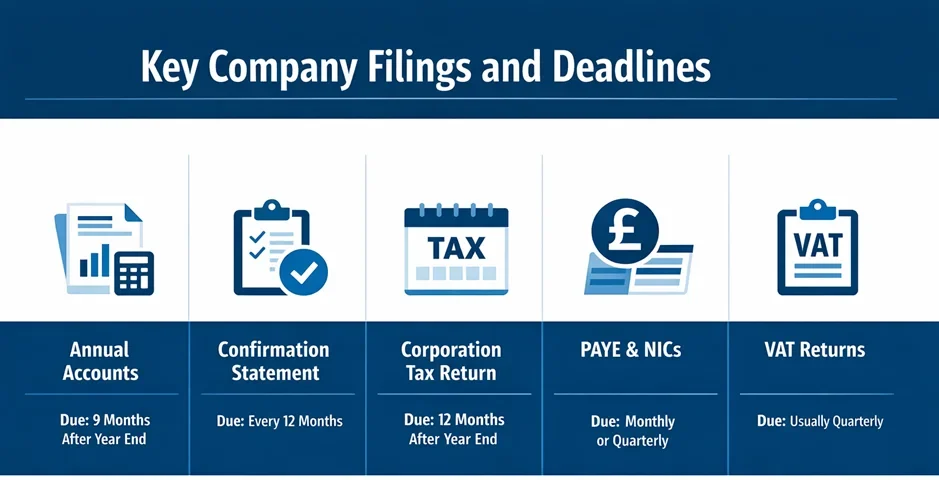
Key Company Filings and Deadlines
How and When Must Annual Accounts Be Filed?
Filing annual accounts is the most important duty for any UK firm. These records show the health of the business. HMRC, suppliers, and investors all use them. Accounts must follow UK accounting rules. These are either FRS 102 or FRS 105, based on the size of the firm.
In 2026, the deadline remains nine months after the end of the financial year. New business owners often get caught by the First Filing rule. If you set up your firm recently, your first accounts are due 21 months from the date you registered. This rarely lines up with a standard calendar year.
The 2026 rules also require digital-only filing. Paper accounts are no longer valid for most firms. Every data point must use iXBRL tags. This lets Companies House and HMRC cross-check the figures.
What Is the Confirmation Statement Deadline?
The confirmation statement, Form CS01, is a yearly check-in with Companies House. It does not cover money or tax. Instead, it confirms that key details are still correct. These include your address, directors, share capital, and PSC details.
In 2026, you must file every 12 months. The form is due within 14 days of your review period ending. This filing also confirms your firm acted within its lawful purpose during the past year. You can use it to report small changes in shareholder details or SIC codes.
Big changes, such as adding a new director, must be reported when they happen. The confirmation statement just checks the record is now correct.
What Are the Corporation Tax Deadlines?
Every firm must sign up for Corporation Tax within three months of starting to trade. The corporation tax filing deadline in the UK is 12 months after the end of the accounting period. But the corporation tax payment timeline is much shorter. Most firms must pay nine months and one day after the period ends.
This means you must know your tax figure well before the filing deadline. In 2026, HMRC’s Making Tax Digital for Corporation Tax has grown. It now needs more frequent digital updates. Your software must link with the HMRC portal. Missing these dates leads to interest charges, even if you file on time. Proactive tax planning throughout the year is the best way to avoid this trap.
What Other Filings Does a Company Need?
If your taxable turnover passes £90,000, you must file VAT returns. In 2026, VAT is fully digital. Most firms submit returns every quarter. LANOP’s VAT return services help businesses stay on top of MTD rules and avoid penalty interest.
If you have staff, PAYE and payroll filings are due monthly or weekly. Real-Time Information means HMRC is told about every payment to an employee the moment it is made. Our payroll accountants manage RTI submissions so you never miss a deadline.
Directors must also track dividend payments and director loan accounts. Both are under close review in 2026. Directors who take dividends must also file a Self Assessment tax return each year. HMRC is working hard to stop tax loss in these areas.
What Statutory Records Must a Company Keep?
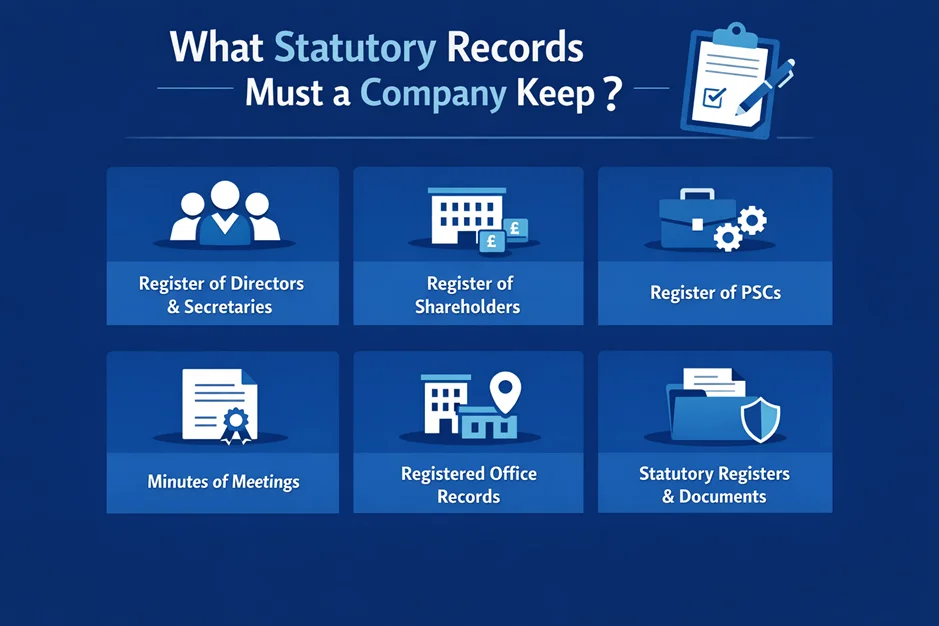
UK law requires every firm to keep internal records called statutory registers. These are the master records of the business. They must be kept at the registered office or a Single Alternative Inspection Location, also called a SAIL.
A legal compliance checklist for private limited company operations must include a regular review of these records. They cover the Register of Members, the Register of Directors, and the Register of PSCs. Accurate bookkeeping sits at the heart of keeping all these records current and correct.
In 2026, the rules for the registered office are stricter. A PO Box is not allowed. It must be a real address where legal documents can be received. Any changes must be sent to Companies House within 14 days. Failing to keep these records is a criminal offence. In the past, cases were rare. In 2026, more directors are being taken to court for ignoring their legal books.
Do You Need an Audit?
Not every firm needs a formal audit. But knowing the audit thresholds matters as your firm grows. A company is free from audit if it meets two out of three tests. These are: turnover of no more than £15 million, gross assets of no more than £7.5 million, or fewer than 50 staff.
If you exceed two of these limits for two years in a row, you must appoint an outside auditor. For sectors like insurance, audits are often required no matter the size. Moving from no audit to a full audit takes months of work. It means a deep check of internal controls and every figure on the balance sheet.
Some private firms choose to get an audit even when they are below the limits. This can build trust with lenders and investors. Speaking to a limited company accounting specialist can help you decide if a voluntary audit makes sense for your firm.
What Are the Penalties for Non-Compliance?
The 2026 penalty rules are designed to deter. Late filing fines for annual accounts start at £150 for just one day’s delay. They rise to £1,500 if accounts are more than six months late. If a firm is late two years in a row, the fines double.
For confirmation statements, the stakes are higher. Missing a filing is a criminal offence. Directors can be taken to court and fined up to £5,000 each. The worst outcome is a Company Strike-off. If Companies House thinks a firm has stopped trading, it posts a notice in the Gazette. If no action is taken, the firm is closed. Its assets go to the Crown.
Getting a closed firm reinstated is a costly and slow process. Repeat non-compliance can also lead to a ban. A director can be banned from the role for up to 15 years. If HMRC contacts you about a potential inquiry, acting fast is critical. LANOP’s HMRC tax investigation support helps you respond with confidence and avoid making a difficult situation worse. Even dormant firms must meet basic filing duties to avoid these risks.
How LANOP Can Help
At LANOP, we know the UK company compliance checklist can feel like a lot to manage. Business owners need to focus on growth, not paperwork. We offer a full range of services to take compliance off your plate.
Our compliance calendar tracks every deadline. From VAT returns to annual accounts, we send you alerts well before each due date. Our team handles all company secretarial duties for you. We maintain your registers, prepare your board minutes, and keep your records in order.
As an Authorised Corporate Service Provider, we manage ID checks for your directors and PSCs. This means your filings are never blocked. Our limited company accounting service covers the full picture, from annual accounts to corporation tax and beyond.
Whether you are handling an insurance company audit or keeping a dormant firm compliant, LANOP has the know-how to help. We focus on avoiding fines and fixing past filing errors. We also support you during HMRC reviews. When you work with us, you gain more than an accountant. You gain a dedicated compliance partner.
Frequently Asked Questions
UK firms must meet several key deadlines. Annual accounts are due nine months after the financial year-end. The confirmation statement is due every 12 months, within 14 days of the review period ending.
The deadline is nine months after the end of the accounting period. If your year ends on 31 December, your accounts must be filed by 30 September the following year.
The corporation tax filing deadline is 12 months after the end of your accounting period. You must file your CT600 even if your firm made a loss or has no tax to pay.
The corporation tax payment timeline is much tighter than the filing deadline. Most firms must pay nine months and one day after the accounting period ends. If your year ends on 31 March, your tax is due by 1 January.
If your VAT-taxable turnover exceeds £90,000 in a rolling 12-month period, you must register for VAT. Most firms then submit quarterly VAT returns. Payment is due within one month and seven days after each quarter ends.
Employers must report payroll data to HMRC in real time. A Full Payment Submission must be sent on or before each payday. It must include each employee’s pay, tax, and National Insurance details. If no one is paid in a tax month, an Employer Payment Summary is due by the 19th of the following month.
Every employer must offer a workplace pension to qualifying staff. Directors must check their workforce every pay period. Any employee aged 22 to State Pension age who earns more than £10,000 per year must be enrolled. LANOP’s auto-enrolment pension service helps employers set this up correctly from day one.
Every UK firm must keep a set of statutory registers. These are held at the registered office or a SAIL. They include the Register of Members, the Register of Directors, and the Register of PSCs.
A PSC is anyone who holds more than 25% of shares or voting rights. You must update your PSC register within 14 days of any change. You must then notify Companies House within a further 14 days.
Conclusion
Company compliance in 2026 is an active, ongoing duty. It needs care and a proactive approach. The move to a more open corporate system in the UK has built trust in the market. But it has also added more work for directors.
By following this UK company compliance checklist, you can keep your firm on the right side of the law. The Companies Act compliance checklist is not just about avoiding fines. It is about building a business that lasts and earns trust.
In 2026, your compliance record is your reputation. Keep it clean, accurate, and on time. If the current rules feel hard to manage, help is available. Our limited company accounting team at LANOP is ready to help you turn compliance from a burden into a business advantage.