
Introduction
All UK entrepreneurs know they ought to budget and forecast, but many use the terms interchangeably and create them annually, then forget about them. But they are not the same: the budget is the plan, and the forecast is what’s happening.
A budget plan includes income and costs for the year, informing decisions on recruitment, marketing, and investment. A forecast, meanwhile, is dynamic, updating based on actual results, changing costs and, importantly, your cash flow. For UK SMEs, it’s a matter of proactive versus reactive growth.

This article will outline the difference between budgeting and forecasting, why relying on a static annual budget is a dangerous strategy in the current UK tax landscape, and how “budget and forecast” can improve cash flow transparency, facilitate better decision making, and minimise the risks of unanticipated HMRC penalties and interest.
What is the difference between financial forecasting and budgeting for UK businesses?
These two words get mixed up all the time. You hear them in board meetings, in pitch decks, and in chats with your accountant. But they are not the same thing. And the difference matters more than most founders think.
A budget is a plan. The forecast is predicted. One sets the goal. The other tells you what is likely to happen.
Budget vs Forecast at a look
| Tool | When it’s Enough | Main Use |
|---|---|---|
| Budget | Small, stable, owner-run businesses | Control, spending limits, year-end targets |
| Forecast | Staff, VAT, debt, stock, or uneven income | Cash visibility, tax timing, scenario planning |
In practice, most UK SMEs use the annual budget for both jobs. That is where the trouble begins. When the budget is the only finance document in the business, founders stop seeing what the numbers are doing month by month.
What does a budget do in practice?
A budget is a static plan. You set it once a year. It splits your expected income and costs into clear categories. It tells you what you plan to spend on staff, software, rent, marketing, and equipment for the next twelve months. It also sets the revenue targets that the business agrees to chase.
Budgets are about control. They give department heads a ceiling. They give the board a benchmark. And they give the founder a simple way to ask, “Are we on track?” Once approved, the figures rarely change, even when the business does.
What does a financial forecast show that a budget cannot?
The forecast is a live picture of what is likely to happen. It is not what you planned. It is what is coming. It pulls actual data from the most recently completed period. Then it updates the months ahead based on what you know.
A good forecast moves with the business. It adjusts for slipping pipelines, rising costs, late-paying clients, and changes in headcount.
The key output is cash visibility. A forecast shows your bank balance week by week or month by month. A budget never does that well. According to the GOV.UK, this is what tells you whether you can afford the next hire, the next stock order, or the corporation tax bill due nine months and one day after your year-end.
Why do UK SMEs often confuse these two concepts?
Most SMEs mix them up because both look like “future numbers in a spreadsheet.” Many treat the annual budget as both a plan and a forecast. This often happens when the accountant builds both off the same set of assumptions.
Reporting tools make it worse. They pull the same input into both views. So, founders fall back on the budget. They only see the difference when the cash runs out, or the tax bill comes due.
When should you use a budget vs financial forecast in your business?
The honest answer is that most growing UK businesses need both. But not at the same stage. And not for the same reason. Knowing which to reach for, and when, is the difference between running ahead of the business and running behind it.
When is the budget sufficient?
A budget is usually enough when the business is small, steady, and run by the owner. Say you turn over £150,000 a year as a contractor with two long-term clients and low overheads. An annual budget plus a basic cash check is fine. Stable costs. Stable income. Low complexity.
The same is true for early-stage businesses. There is no past data to forecast from. So, the budget is just your best guess. There is no extra value in a forecast that says the same thing.
When does a forecast become essential?
The moment you take on staff, debt, stock, deferred income, or VAT, the budget alone is not enough. As HMRC confirms, once you cross the VAT registration threshold of £90,000 in any rolling twelve-month period, you have a quarterly cash bill to plan for. You cannot just react to it. Take a contractor earning £140,000 from two repeat clients with a £70,000 net profit. The budget looks healthy. But once they cross the £90,000 VAT line over twelve months, the next VAT bill will eat into working capital. Our guide to common cash flow problems UK businesses face explains exactly how these timing gaps catch founders off guard. A simple 13-week forecast would catch this. The budget will not. Forecasting is also vital when revenue is lumpy. Or when you employ people through PAYE. Or when trading is seasonal. Without a rolling forecast, you cannot see the cash dip three months out. You only saw it last week.
How do growing UK businesses transition from budgeting to forecasting?
Most businesses move to forecasting once life gets more complex. Hiring staff, holding stock, or taking on debt brings risk that a static budget cannot show.
Most start with a 13-week cash flow forecast. It blends actuals, pipelines, and fixed costs. Then they shift to a rolling monthly forecast. They drop the oldest month and add a new one. Software helps. But the real point is the habit of updating it.
How does poor forecasting lead to real HMRC problems and cash flow crises?
Here, the gap between budgeting and forecasting becomes very real. UK businesses do not usually fail because they make a loss. They fail because they run out of cash to pay their debts. And HMRC is almost always at the top of the list.
Studies on UK SME failure show that 9 in 10 collapses link back to cash flow, not profit. HMRC is often the largest creditor when the money runs dry.
Why does profit not equal cash in your bank?
A profitable business can still go bust. Your customers pay you on 60-day terms. Your suppliers want to be paid in 30 days. Your VAT is due each quarter. The timing gaps create a cash hole that profit hides.
Your P&L says you made £40,000 last quarter. Your bank account says £4,000.
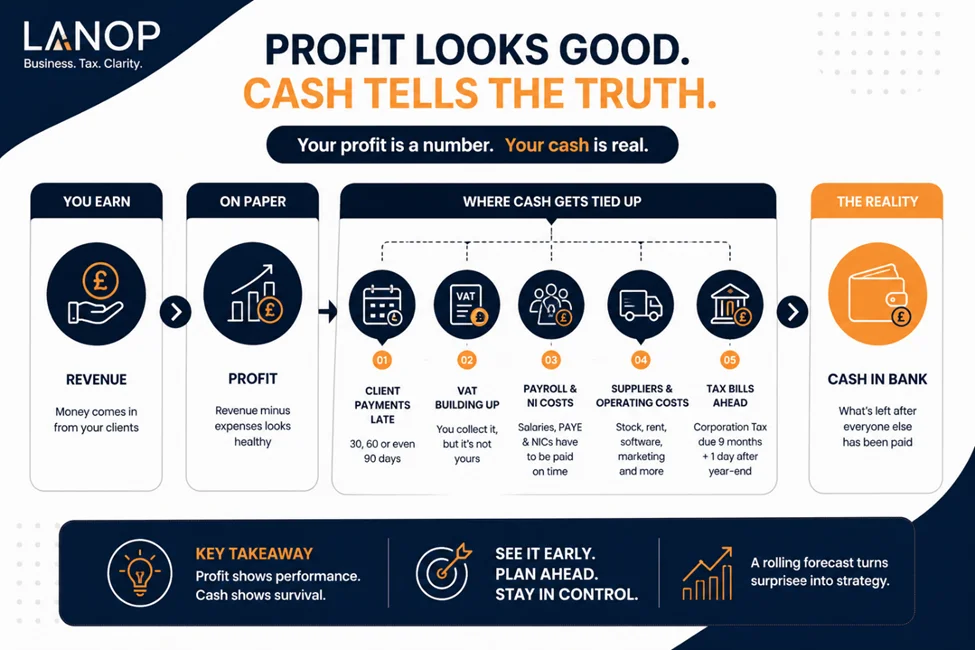
Budgets do not show this. They show annual totals, not weekly cash flow. A forecast tracks money in and out as it actually moves. That is the only thing that tells you if you can run a payroll on the 25th.
How missed forecasts trigger VAT and corporation tax issues
Tax builds up in real time. Every invoice you raise adds to the VAT you owe HMRC. Every month of trading adds to your corporation tax. The cash is in your account. It looks like working capital. Then the deadline hits, and you find you have already spent it.
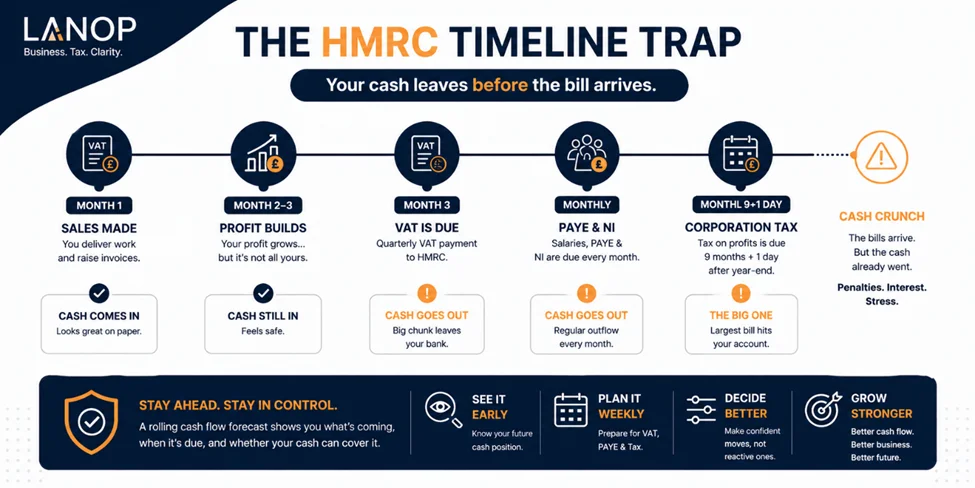
Without a forecast that ring-fences these amounts, the trap is hard to avoid. Founders spent money that did not belong to HMRC. Then they panic when the bill lands. This is one of the most preventable problems that our small-business accounting team helps clients avoid every year.
What happens when you cannot pay HMRC on time?
A late HMRC payment is not just a fixed fine. Interest and penalties build from day one. Interest on unpaid VAT, PAYE, and corporation tax starts to run straight away. It adds to the debt fast.
The damage is not only financial. It hits your operations. It hits your headspace. You end up firefighting instead of growing up. The only real fix is to plan.
What is the most common mistake UK business owners make with budgeting and forecasting?
After working with hundreds of UK SMEs, the same three mistakes keep coming up. None of them needs clever finance to fix. They just need a change of habits.
Relying on annual budgets instead of rolling forecasts
The annual budget is signed in January. By April, no one looks at it. The business has moved on. The budget has not been. By Q3, you are comparing your actuals to a plan written nine months ago. The assumptions no longer apply.
Rolling forecast updates each month. It drops to the oldest month and adds a new one twelve months ahead. The horizon stays the same. The numbers stay current. And the founder always has a forward view, not a rear-view mirror.
Ignoring tax liabilities in financial planning
This is the single most costly mistake we see. Founders forecast revenue and costs but treat tax as the accountant’s year-end job, according to the GOV.UK. In the UK, the corporation tax rate is 25% on profits above £250,000. The small profits rate is 19% on profits up to £50,000. Marginal relief sits in between. These numbers must be built into the forecast as they accrue. Not pencilled in next January as a shock. Working with a specialist on tax planning for your business and directors ensures these liabilities are modelled in real time, not discovered after the fact.
Treating accountant reports as forecasts.
Accountant reports look back. They show what happened. They do not factor in cash timing, sales pipeline, or future bills. Using them for forecasting means you are making decisions based on old data. A forecast must be regular. It must look forward. And it must serve the business, not just compliance.
How do you build a simple financial forecast for a UK SME?
You do not need a finance team or a six-figure ERP system. You need clean inputs, a sensible structure, and the habit of updating them each month. Most of our clients start with a spreadsheet. They move to dedicated software once the business calls for it.
Free 13-Week Cash Flow Template
We have built a free 13-week cash-flow template for UK SMEs. You can use it in Excel or Google Sheets. Download it here, message us, or visit our resources page to get a copy.
⬇ Download ItWhat data do you actually need (not what textbooks say)
Three sources cover most SMEs. First, your accounting software (Xero, QuickBooks, FreeAgent) for actual revenue, costs, and bank balance. Second, your sales pipeline or CRM for forward-looking revenue. Third, a list of fixed costs, rent, payroll, software, loan repayments, and tax due.
That is the base. Everything else is Polish. Skip the textbook chapter on five-year strategic models. You need the next thirteen weeks of cash visibility before anything else.
How to forecast cash flow, not just profit
Build the forecast on cash dates, not invoice dates. If you raise an invoice on 1 March on 30-day terms, that money lands in April at the earliest. Often May in practice. The forecast must show when cash actually moves. Not when the accounting entry is made.
Then layer in tax payments on their due dates. As per HMRC guidance, VAT is due one month and seven days after the quarter end. Corporation tax is due nine months and one day after the year-end. PAYE and National Insurance fall on the 22nd of the next month if paying electronically, according to GOV.UK.
How often should you update your forecast?
Monthly is the floor. Weekly cash flow updates are a good idea for any business with tight working capital, lumpy sales, or stock. The update should take 30 to 60 minutes if your bookkeeping is up to date. If it takes longer, bookkeeping is the real problem.
Tools and systems commonly used by UK businesses.
Most SMEs we work with mix accounting software for actuals with a forecasting layer on top. Float, Fathom, Futrli, and Spotlight Reporting all link with the major UK platforms. For smaller businesses, a well-built Excel or Google Sheets model is plenty. The tool matters less than the habit of using it. For businesses that want cleaner management accounts and forecasting built into their monthly reporting, working with a specialist makes the whole process faster and more reliable.
How do budgeting and forecasting support better tax planning in the UK?
Tax planning without a forecast is a guess. You cannot improve what you cannot see. The real value of forecasting is not just cash visibility. It is the chance to make tax decisions before deadlines, not after.
Forecasting corporation tax liabilities
Say your forecast shows trading profits heading to £80,000 for the year. You are now in marginal relief territory. Your effective rate sits between 19% and 25%, as set out in HMRC’s corporation tax guidance. That insight lets you decide before year-end whether to bring forward capital expenditure, top-up director’s pension contributions, or push income into the next period.
None of these moves works after the fact. They have to happen before the period closes. For limited companies managing corporation tax and dividend planning, a rolling forecast is what makes these decisions possible, rather than being reactive.
Planning for VAT payments and quarterly obligations
VAT is collected, not earned. Yet many founders treat the VAT in their accounts as spare cash. A proper forecast splits VAT collected from net business cash. So, you always know what yours is and what belongs to HMRC at the end of the next quarter.
According to the GOV.UK guidance on late payment penalties, late VAT now carries a 3% penalty on day 15. Another 3% kick in on day 30. A daily penalty of 10% per annum runs from day 31. On top of that, HMRC’s published rates show late payment interest at the base rate plus 4 percentage points from day one. The cost of poor VAT forecasting has gone up sharply.
Managing PAYE and payroll timing
PAYE is one of the most rigid cash bills you have. The 22nd of next month is non-negotiable for electronic payments. A forecast that maps payroll, employer NIC, and PAYE against expected receipts are the only way to avoid month-end stress.
This gets sharper as the headcount grows. Every new hire adds about 13.8% in employer NIC on earnings above the secondary threshold. Plus, pensions. Plus, the salary itself.
Using forecasts to optimise dividends and director pay
A forecast lets directors take money out based on future cash and tax, not gut feel. It makes sure dividends and salaries do not crowd out PAYE, VAT, or corporation tax. It also smooths profit and tax over time. That helps you spot opportunities for planning and keep dividends both legal and efficient.
What recent HMRC changes make forecasting more important than ever?
The compliance landscape has tightened a lot in the last three years. The trend is clear. More frequent reporting. Less patience for late payment. Higher costs for businesses cannot show financial control. Static budgeting is becoming a poor fit by design.
Making Tax Digital (MTD) and quarterly reporting requirements
According to HMRC’s MTD guidance, MTD for Income Tax Self Assessment applies from 6 April 2026 to sole traders and landlords with qualifying income above £50,000. The threshold drops to £30,000 from April 2027 and £20,000 from April 2028. Those affected must keep digital records and file quarterly updates through compatible software.
This is a structural shift. Annual reporting is being replaced with rolling reporting. A business that cannot produce reliable quarterly figures will struggle to comply with. The root cause is almost always weak forecasting and weak bookkeeping.
Changes in corporation tax rates and thresholds
The tiered corporation tax structure brought in from April 2023 still applies in 2026/27. As confirmed in GOV.UK rates guidance, the main rate is 25% on profits above £250,000. The small profits rate is 19% on profits up to £50,000. Marginal relief applies in between, with an effective marginal rate of 26.5%.
The marginal band is a planning chance, but only forecasting reveals it. Knowing in advance you will land on £180,000 of profit lets you act. That is very different from finding out nine months after the year-end.
Increased penalties for late payments and poor cash planning
As per HMRC’s published rates, from 6 April 2025, the late payment interest rate rose from base rate plus 2.5% to base rate plus 4%. VAT late-payment penalties also went up under the penalty reform. The first penalty is now 3% on day 15, plus 3% on day 30. That replaces the previous 2% rates, according to GOV.UK guidance on the change.
The message is simple. The cost of not seeing a tax bill coming has risen sharply. And HMRC has signalled that more is to come.
Why static budgets are becoming outdated in the UK
When reporting was annual, an annual budget made sense. With quarterly reporting now in place for VAT and rolling out for income tax, an annual budget no longer matches the rhythm of compliance. The businesses that adapt fastest are already running monthly forecasts as standard.
How can a virtual FD improve your financial planning and forecasting?
There comes a point in most growing businesses where finance decisions outgrow the founder’s experience. The bookkeeper or accountant is no longer the right person to advise. That gap is what a virtual finance director fills.
What a virtual FD actually does beyond bookkeeping
A bookkeeper records what happened. An accountant prepares the year-end statutory reports. A virtual FD looks forward. They build forecasts, model scenarios, sit in on board meetings, advise on funding, and turn numbers into commercial choices.
The work is strategic, not transactional. A virtual FD will challenge your pricing. They will question your hiring plan. They will model the cash impact of a new client. And they will tell you if your growth target is fundable.
When a business outgrows DIY budgeting
The signal is usually one of three things. Either revenue has grown to where decisions carry six-figure consequences. Or the business is heading for funding or sale. Or the founder spends too much time on finance and not enough on the business itself. Any of these means DIY has run its course.
A full-time FD costs between £100,000 and £180,000, plus benefits. A virtual FD gives the same input at a fraction of the cost. It scales up and down as the business needs.
Strategic forecasting vs basic accounting
Basic accounting records what has already happened. Strategic forecasting uses that data to guide decisions on cash, tax, and growth. Accounting explains performance. Forecasting tells you what is affordable and sustainable. That gap is where real financial strategy lives for growing UK SMEs.
How does Lanop Business & Tax Advisors help UK businesses with forecasting and budgeting?
At Lanop, we have seen the same cycle play out across hundreds of UK businesses. Strong revenue. Weak forecasting. An HMRC mess at year-end. Our view is simple. Every growing UK business should run a rolling forecast, ring-fence tax money, and review its financial direction each month, not once a year.
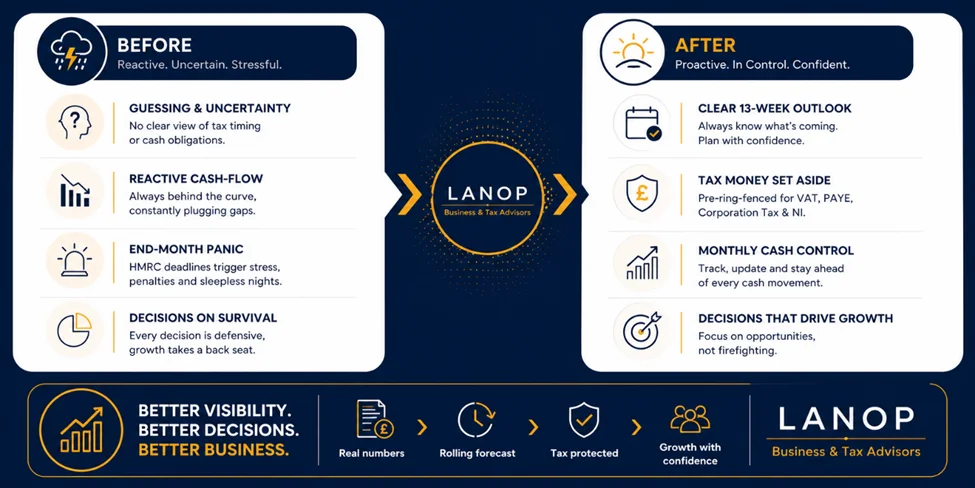
We build forecasting models for SMEs and contractors. Whether the client is managing IR35 risk, nearing the VAT threshold, or sitting in marginal relief territory, we tailor the model to fit. Our tax planning runs on live data straight from your accounting software. So, our advice on corporation tax, VAT, PAYE, and dividends is based on what is happening now, not figures from six months ago. Through our advisory and virtual FD services, we put in the systems, discipline, and tax foresight that finance directors at larger firms rely on. But we price and structure it for businesses that are still scaling. Our clients stop chasing tax deadlines. They start using their numbers to make sharper calls on hiring, pricing, dividends, and growth.
Conclusion
UK businesses that stick with just annual budgets are leaving themselves wide open. MTD reporting is creeping in; HMRC’s interest rates keep climbing, and cash flow issues slip by unnoticed if you’re only looking at profits. These days, budgeting and forecasting aren’t just nice-to-have backup plans for staying in control. If you don’t know where your cash and tax bills stand six months from now, you’re already taking a gamble. The answer isn’t just piling on more reports. It’s about having a clearer view ahead. Set up a 30-minute session with Lanop Business & Tax Advisors. We’ll break down your 13-week cash flow, flag upcoming VAT and PAYE deadlines, and check whether you’re drifting toward the corporation’s tax marginal band, so you can catch problems early and make decisions before things get urgent.
FAQs:
It is only when your company is very straightforward, sub-VAT, without employees or debts, and has stable income that you don’t need a rolling 13-week forecast; from £50k onwards, VAT, or employing people, it is critical to have one.
Review it every month alongside your accounting, and again before making major decisions such as recruitment, expenses, and pricing.
A 13-week rolling cash flow forecast with cash in and cash out, including taxes, and the cumulative balance should be the bare minimum forecasting requirement.
Absolutely! If you are close to the marginal rate of £50k-£250k, you could adjust your expenditure, pension, or income, but only before year-end.
Generate a rolling 13-week cash flow forecast with VAT, PAYE, and corporation tax due dates.