

Introduction
You have booked your one-way ticket. You are ready to start fresh in Dubai, Portugal, maybe Monaco, but there’s someone who has not said goodbye yet, HMRC! And they’re watching closer than you’d think.
Here’s the thing about leaving the UK. It doesn’t wipe your tax slate clean. Not if you’re wealthy, anyway. HMRC’s got systems, flags, whole specialist teams tracking people exactly like you. They want proof you’ve actually gone. More importantly, they want to be absolutely certain you’ve paid for everything you owe.
I’m not trying to sound dramatic here. This is genuinely how the system works now.
So, let’s walk through what HMRC actually checks when you pack up and leave. And, crucially, how you avoid becoming their next case file.
Why HMRC Cares So Much About Departing Wealth
You’d think HMRC would just wave you off, wouldn’t you? Less work for them. Less paperwork. Right?
Wrong. Completely wrong.
High net worth individuals generate serious tax revenue. When someone wealthy moves abroad, HMRC loses future income tax, capital gains, and sometimes even inheritance tax. That’s not a small change we’re talking about.
Which is exactly why they’ve built systems to catch people gaming the rules. People who claim non-residency but somehow spend half the year in Chelsea. People who shift assets offshore and then, oops, conveniently forget to mention them.
HMRC has High-Income and High-Wealth Compliance teams. Their job’s pretty straightforward, really. Identify risk. Close the gaps. Collect what’s owed.
If you’re leaving the UK with significant assets, you’re probably already on their risk-assessment radar. Not because you’ve done anything wrong, just because the numbers matter to them.
The Day Count Dispute: HMRC’s Favourite Trap

Most people mess up this bit.
HMRC counts every single day you’re in the UK. And they count them using rules you’ve probably never even read.
You might think you’re non-resident because you spent most of the year abroad. Fair assumption. But HMRC uses something called the Statutory Residence Test (SRT). It’s not about feelings or rough estimates. It’s pure maths.
The Three Big Tests
HMRC applies three tests to work out if you’re still a UK tax resident:
- The Automatic Overseas Test. Spend fewer than 16 days in the UK and you’re automatically non-resident. Clean win, sorted.
- The Automatic UK Test. Spend 183 days or more in the UK and you’re still resident. No wiggle room whatsoever.
- The Sufficient Ties Test. This is where it gets messy. Between 16 and 182 days, HMRC examines your “ties” to the UK. Family. Property. Work. Even a gym membership can count, believe it or not.
Most HMRC day count disputes happen right in that middle zone. You figured 120 days was safe. But then you had four ties. That pushed you over the residency threshold.
And now you’re getting letters.
What Triggers an HMRC Investigation When Leaving the UK
HMRC doesn’t investigate everyone. They’d never have the resources. They use risk flags instead.
These are the things that make them look twice.
Red Flag #1: Large Asset Sales Around Departure
Did you sell property, shares, or a business shortly before leaving?
HMRC checks whether you correctly reported capital gains while you were still resident. If you disposed of assets during a period when you should’ve been taxed as a UK resident and didn’t report it properly, that’s a problem.
They cross-reference Land Registry data, Companies House filings, and share transactions. Most of this is automated now, which makes it harder to slip through.
Red Flag #2: Offshore Bank Accounts and Structures
Opening an offshore bank account isn’t illegal. Let me be clear about that. Failing to report it, though? That’s illegal.
HMRC receives data from over 100 countries through the Common Reporting Standard. If you’ve got accounts in Switzerland, Singapore, or the Caymans, they probably already know about them. Moving money offshore without declaring it is a massive trigger. Especially large amounts.
HMRC has significantly ramped up its focus on offshore-related tax issues for high-net-worth individuals in recent years, and if you hold international assets that have never been declared, Lanop’s international and offshore accounting specialists can help you understand exactly where you stand before HMRC comes to you first. They’re not guessing anymore. They’re tracking, and they’re quite good at it.
Red Flag #3: Claiming Non-Residency but Keeping Strong UK Ties
You say you live in Spain now. But your kids still attend school in Surrey. Your business headquarters is still in London. You kept your Kensington apartment.
HMRC examines your ties under the Statutory Residence Test. If your facts show you meet the UK residence criteria, they’ll challenge your status. Simple as that.
This is honestly one of the most common HMRC risk flags for wealthy people leaving the UK. The SRT has clear rules, sure, but applying them to real life gets complicated fast.
The Evidence HMRC Demands for UK Non-Residency
If HMRC opens an enquiry, they won’t just take your word for anything. They want proof. Hard proof.
Flight and Travel Records
HMRC can request flight bookings, boarding passes, and passport stamps. They can access border control data.
If you said you were in Dubai but your credit card shows transactions at Harrods, you’ve got a problem. A big one.
Property Records
Do you own UK property? Are you still on the mortgage? Did you rent it out or just leave it vacant?
HMRC checks the Land Registry and council tax records. If you kept a home “available for your use,” that counts as an accommodation tie under the SRT.
Financial and Business Links
Are you still a director of a UK company? Do you receive UK income? Are you invoicing UK clients?
HMRC pulls your self-assessment returns, Companies House data, and bank statements. They want to see where your economic centre actually is, not where you claim it is.
If you have ongoing UK income or rental property after leaving, you will very likely still need to file a UK tax return each year, and Lanop’s self-assessment tax return service exists precisely for people in that situation.
Family Location
If your spouse and children remain in the UK, that’s a family tie. One of the strongest under the SRT.
HMRC can look at school records, GP registrations, and in some cases, investigators may use publicly available information, including social media posts, as supporting evidence of where you spend your time.
If your Instagram shows you at your child’s sports day every other week, they’ll add that to the file. Count on it.
The HMRC Nudge Letter: Your First Warning
Most investigations don’t start with a formal enquiry, actually.
They start with a letter.
These are called “nudge letters.” HMRC sends them to people they suspect might’ve made an error. Or people they think are bending the rules.
The tone’s polite. The message isn’t.
“We think you might owe us money. Now’s your chance to come clean.”
If you get a nudge letter about your departure or offshore accounts, don’t just bin it. HMRC is offering you a chance to fix things through the Worldwide Disclosure Facility before they escalate to a full compliance check. Voluntary disclosure at this stage almost always results in lower penalties than waiting for HMRC to knock harder.
Ignore it, and the next step’s a full investigation. That’s when it gets expensive. Really expensive.
What You Must Report When Leaving the UK
HMRC doesn’t assume you’ve left just because you moved countries.
You must tell them. Officially.
The P85 Form
This is the official notification form for leaving the UK. It’s called “Leaving the UK, getting your tax right.”
You complete it when you leave. It tells HMRC about your departure date, your new address, how many days you expect to spend in the UK going forward.
Without it, HMRC might just continue treating you as a resident. Which means taxing you on worldwide income. Not ideal.
The P85 also helps you claim any tax refunds due. If you’ve overpaid through PAYE, this is how you recover from it.
You can file it online or by post. Just don’t skip it. Seriously, don’t.
Final UK Tax Return
You must file a UK tax return for the year you leave. Even if you’re non-resident for part of that year.
This often involves something called split-year treatment. It shows your UK income and tax position before you leave, and your status after departure.
Get this wrong and you’ll face HMRC penalties for incorrect residence status. Penalties start at a few hundred quid but can climb much higher if HMRC believes you were careless or deliberate.
Offshore Account Reporting
If you hold offshore accounts or assets, you must declare them. Even after leaving.
If you were resident for part of the tax year, you’re taxable on worldwide income during that period. Undeclared offshore accounts are a separate compliance issue that can lead to penalties for late disclosure, tax evasion risk, or even criminal investigation in the worst cases.
HMRC has a robust and well-resourced offshore investigation process. They have data. They have time. And they have legal powers to act on it.
Don’t assume “offshore” means invisible. It really, really doesn’t.
How HMRC Tracks You After You’ve Gone
You filed your P85. Sent your final return. You think you’re done.
Not quite, I’m afraid.
HMRC continues monitoring former residents. Especially wealthy ones. They don’t just forget about you.
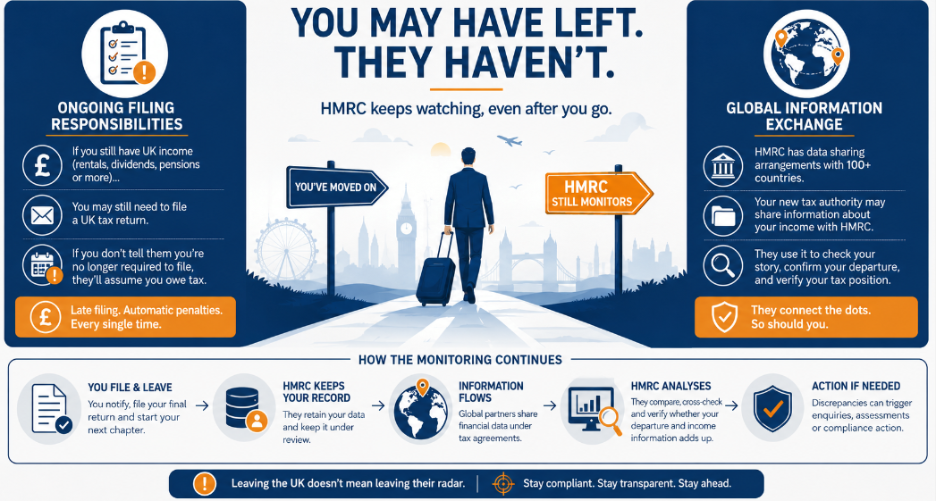
Ongoing Self-Assessment Obligations
If you still earn UK income after leaving, rental income, dividends, and pensions, you might still need to file a UK self-assessment return.
HMRC doesn’t automatically stop your filing requirements. You have to notify them if you no longer need to file.
If you don’t? They assume you owe tax. And they charge penalties for late filing. Every time.
Data Sharing Agreements
HMRC shares data with tax authorities in over 100 countries. If you move to Spain, Portugal, or the UAE, your new tax authority might share information about your income with HMRC.
This helps them verify your departure. And whether your story actually adds up.
Social Media and Digital Footprints
HMRC investigators can use open-source intelligence. That includes LinkedIn, Instagram, Facebook, all the usual platforms.
If you claim to live in Dubai, but your posts say, “Sunday roast in the Cotswolds,” they may use that as one piece of circumstantial evidence in a wider compliance file.
Don’t hand them easy evidence on a plate.
Common Mistakes That Lead to HMRC Compliance Checks
Let me walk you through the errors people actually make.
These turn a clean exit into a compliance nightmare pretty quickly.
Mistake #1: Underestimating Your UK Days
People forget transit days. Or they round down. Or they just lose count over the year.
HMRC won’t lose count. They count every single midnight you spent in the UK.
If you hit 183 days, you’re a resident. No appeal, no exception.
Keep a detailed log. Use a spreadsheet. Or hire someone to track it properly if you can’t be bothered.
Mistake #2: Keeping a UK Home “Just in Case”
Lots of people keep a London flat for visits. Or for the kids to use when they’re back.
But that’s an accommodation tie. And it counts against you in the Sufficient Ties Test.
If you’re trying to establish non-residency, sell the property. Or rent it out on a long-term lease to an unconnected tenant.
Don’t just leave it empty with your name on the deeds. That’s asking for trouble.
Mistake #3: Not Taking Professional Advice
Tax residency is complicated. The SRT rules are detailed and frankly quite boring. And HMRC doesn’t give you the benefit of the doubt.
A good advisor maps out your ties, plans your day count, and structures your departure correctly from the start. Proactive tax planning before you leave is infinitely cheaper than dealing with an HMRC investigation after the fact.
Yes, it costs money. But it’s a lot cheaper than an HMRC investigation and penalties down the line.
What Happens If HMRC Challenges Your Non-Residency
So HMRC thinks you’re still resident. What happens next?
The Compliance Check Process
HMRC opens a formal enquiry. They ask for documents, bank statements, travel logs, proof of your new residency abroad.
You get deadlines. Miss them, and you face more penalties. It’s that simple.
The process can drag on for months. Sometimes years, actually.
You’ll need professional representation. If you find yourself facing this situation, Lanop’s HMRC tax investigation specialists deal directly with HMRC on your behalf, handling all correspondence, preparing evidence, and negotiating the best possible outcome. HMRC won’t negotiate with people who don’t understand the rules. They just won’t.
Penalties and Interest
If HMRC determines you were resident when you claimed non-residency, they recalculate your tax bill.
You owe the difference. Plus interest. Plus penalties.
Penalties depend on your behaviour. Honest mistake? Lower penalty. Careless? Higher. Deliberate? Penalties can reach 100% of the tax owed, especially where HMRC finds evidence of tax evasion.
Interest accrues from the date the tax should’ve been paid. Non-negotiable.
Appeals and Tribunals
You can appeal HMRC’s decision. First to them. Then to an independent tribunal.
Tribunals are public. They’re expensive. They take time.
But if you’re right and have solid evidence, you can win. Just make sure your documentation’s watertight before you go down that road.
How to Leave the UK the Right Way
Let’s flip this around for a second.
Here’s how to do it cleanly, without drama.
Plan Your Exit at Least 12 Months Ahead
Don’t rush this. HMRC absolutely loves people who rush.
Map out your ties properly. Plan your day count. Set up your new residency the right way.
If you need to dispose of assets, do it while clearly resident or after you’ve cleanly left. Don’t sell during the grey zone. That’s when things get messy.
Document Everything
Keep records of every single day you’re in or out of the UK. Keep boarding passes, hotel receipts, work logs, everything.
If HMRC asks later, you’ll have evidence ready to go.
Cut Your UK Ties Cleanly
Close UK bank accounts you don’t need. Resign from UK boards. Move your family if it’s possible.
Fewer ties make it much easier to establish non-residency under the SRT. It’s just cleaner all round.
Get Specialist Tax Advice
This isn’t a DIY project. Not if you’re wealthy and not if you want to do it properly.
A specialist helps with split-year treatment, offshore reporting, and ongoing compliance. They also represent you if HMRC starts asking awkward questions.
If you have inherited property abroad or assets in foreign structures, that adds another layer entirely, and getting proper advice on inheritance tax planning as part of your departure strategy can save you a significant amount further down the line.
Worth every penny, trust me.
File Your P85 and Final Return on Time
Don’t delay. Just get it done.
The P85 notifies HMRC you’ve left. The final return closes your UK tax chapter properly.
Both are absolutely essential.
Wrapping This Up
Leaving the UK is more than just booking a flight and changing your address on Amazon. It’s a legal process. HMRC watches every step of it.
They count your days. They check your ties. They track your offshore accounts. And they have specialist teams making sure you got it right or catching you if you didn’t. But you can leave cleanly if you plan it properly. Keep your records tight. Cut your ties decisively. File everything on time. Get proper advice.
Do that and you won’t end up in a compliance file gathering dust in some HMRC office. You’ll just be another expat. Living your life. Somewhere with better weather and hopefully lower taxes. And HMRC will move on to the next case.