Lanop

IR35 Explained for Contractors | Everything You Need to Know (2026 Guide)

IR35 Explained for Contractors – Everything You Need to Know

Introduction 

Operating as a professional intermediary in the UK requires a comprehensive understanding of the off-payroll work rules, commonly known as IR35. This legislation fundamentally impacts the tax obligations, financial planning, and operational strategy of anyone providing services through their own entity. For IR35 contractors, remaining compliant while legitimately maximizing take-home pay is the central challenge in the 2026 tax year.

What Is IR35? A Contractor-Friendly Explanation  

IR35 is the UK’s main anti-avoidance taxation scheme as per Chapter 8 of the Income Tax (Earnings and Pensions) Act 2003 (ITEPA 2003). The primary aim of the provision is to ensure persons who provide their services to a client through an intermediary, usually their own limited company called a Personal Service Company (PSC), but whose connection with that client is like that of an employee, pay the same amount of Income Tax and National Insurance Contributions (NICs) as a regular employee. Such taxpayers are referred to as disguised employees by HMRC.  

Why IR35 Matters for Contractors in 2026  

Since the 2021 reforms, IR35’s responsibility for medium and large private sector contracts shifted from the contractor’s company to the end client (Chapter 10, ITEPA 2003).  

By 2026, many clients will issue blanket’Inside IR35 decisions to limit tax risk, cutting contractors’ take-home pay without offering employment rights like holiday or sick leave.  

IR35 is no longer just about tax; it’s about getting a fair status determination and knowing how to dispute inaccurate ones, which increasingly requires specialist support.  

Inside IR35 vs Outside IR35  

Differentiating between these two statuses is the single most essential element of the ir35 rules explained for contractors. It dictates the entire tax calculation and business structure.  

Definitions  

  1. Inside IR35 (Deemed Employee): If an engagement is deemed ‘Inside IR35’, it means that, based on the contractual terms and the actual working practices, the individual is considered an employee of the client for tax purposes. This triggers the need to pay Income Tax and NICs comparable to those of an employed person.  
  2. Outside IR35 (Genuine Business): To be ‘Outside IR35’ means the relationship is genuinely business, to, business (B2B). The contractor is operating their own independent business, bears commercial risks, and maintains autonomy over their work. This status allows the PSC to utilize Corporation Tax and efficient salary/dividend structures. This is the desired contractor outside IR35, meaning 

Tax Differences  

The IR35 tax calculator highlights a major gap in take-home pay.  

  1. Inside IR35: The fee payer deducts Income Tax (20–45%) and Class 1 Primary National Insurance (employee NICs).   
  2. They also pay employer NICs (approx. 15%), which often reduces your gross contract rate.  
  3. Outside IR35: Your limited company pays Corporation Tax (19–25%), and you draw income through a low salary and dividends, taxed at lower rates. You can also claim a wider range of business expenses, reducing your overall tax liability.  

Contract Differences  

To ascertain that an engagement is outside of IR35, it is required to be marked as a contract for services’, meaning that a contractor is hired to provide a certain service or achieve certain results.   

Contracts that are perceived as inside IR35 operate as contract of service’, meaning that employment is implied and there is a concentration of time and/or personal service.  Key contractual terms relating to termination, substitution, and proprietary rights are scrutinized heavily.  

Working Practices  

HMRC’s primary consideration when assessing the application of the IR35 legislation is the real-world execution of the engagement. The written contract is merely the starting point. If the day, to, day reality, the working practices contradict the contract terms (e.g., a contract states substitution is permitted, but the client forbids it in practice), the contract is considered worthless in an investigation.   

Contractors must therefore ensure that their actual day, to, day operations genuinely reflect an independent business relationship.  

IR35 Status Determination  

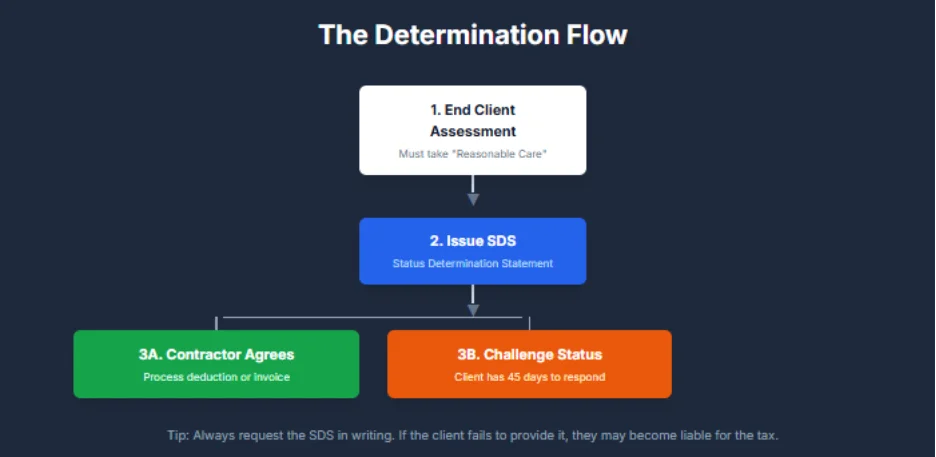
The mechanism for generating a decision regarding status is codified by the Off-Payroll Working rules for medium and large clients. This system centers on the provision of the Status Determination Statement (SDS).  

How Status Is Determined  

Under Chapter 10 rules, responsibility for status determination rests with the end client if they are medium or large. This applies to both the public sector (since 2017) and the private sector (since 2021). The client must analyze the contractual terms and, critically, the actual working relationship against the established common law employment tests. 

Role of End-Client 

In the end, the client is mandated to undertake this assessment using “reasonable care”. This means they cannot simply adopt a blanket policy or base the decision on administrative convenience. They must consider the specific facts of the role, potentially interviewing the contractor or line manager to establish real-world practices.  

What is an SDS (ir35 sds)  

The Status Determination Statement (SDS) is the mandatory formal document that confirms the client’s conclusion regarding the contractor’s IR35 status. It is a legally required component of the engagement process.  

What Must Be Included  

For an ir35 determination statement to be valid, it must meet specific statutory requirements:  

  1. It must clearly state the status decision (i.e., employed or self-employed for tax purposes, or inside ir35 or outside ir35).  
  2. It must provide detailed reasons for that decision, referencing the key employment status indicators.  
  3. The client must attest that they have taken reasonable care when reaching their determination.  

The SDS must be passed to the contractor and any other party in the contractual chain (e.g., the recruitment agency or fee payer) on or before the date of the first payment.  

Right to Challenge  

A crucial protection for IR35 contractors is the statutory right to challenge a determination they disagree with. If a contractor believes their client’s SDS is incorrect, perhaps based on a misunderstanding of their working reality or simply due to a risk, adverse policy, they can lodge a formal appeal.  

The client must have a status disagreement process in place. It is the contractor’s obligation to issue the dispute in writing, explaining the rationale and attaching any supporting documents or evidence, no earlier than 45 days following the contractor’s receipt of the IR35 status determination. After that, the client has 45 days from the date they receive the dispute to reply, either to confirm the original SDS with further explanation or to issue a new SDS.  

“Reasonable Care”  

The “reasonable care” standard is the contractor’s strongest defense against unjust determinations. A decision reached without reasonable care, such as a blanket IR35 assessment applied to an entire class of workers, invalidates the SDS. If the SDS is invalid, the tax liability for the engagement transfers from the fee payer back to the client. This consequence ensures clients treat the determination process seriously and individually.  

Case Study (SDS Challenge & Reasonable Care)  

Scenario: A large financial institution issued a blanket SDS putting all Project Managers “inside IR35” based only on “integration into client processes,” including our client, Mr Patel, a PM working via his PSC.  

Lanop’s Intervention: We used the challenge process, providing emails showing he controlled his own time and equipment, project sign-offs for specific deliverables, and a strong substitution clause, arguing the client hadn’t taken reasonable care.  

Outcome: Within 30 days, the client withdrew the blanket SDS and reissued Mr Patel’s engagement as outside IR35

"Lanop acted fast and knew exactly what to do. Their support helped overturn an unfair decision and got me back to working outside IR35."

IR35 Assessment: How HMRC Tests Status

An accurate IR35 assessment requires a forensic examination of the working relationship, focusing on the common law tests of employment status. This approach involves weighing numerous factors to determine if the arrangement is genuinely B2B.  

Core Tests:  

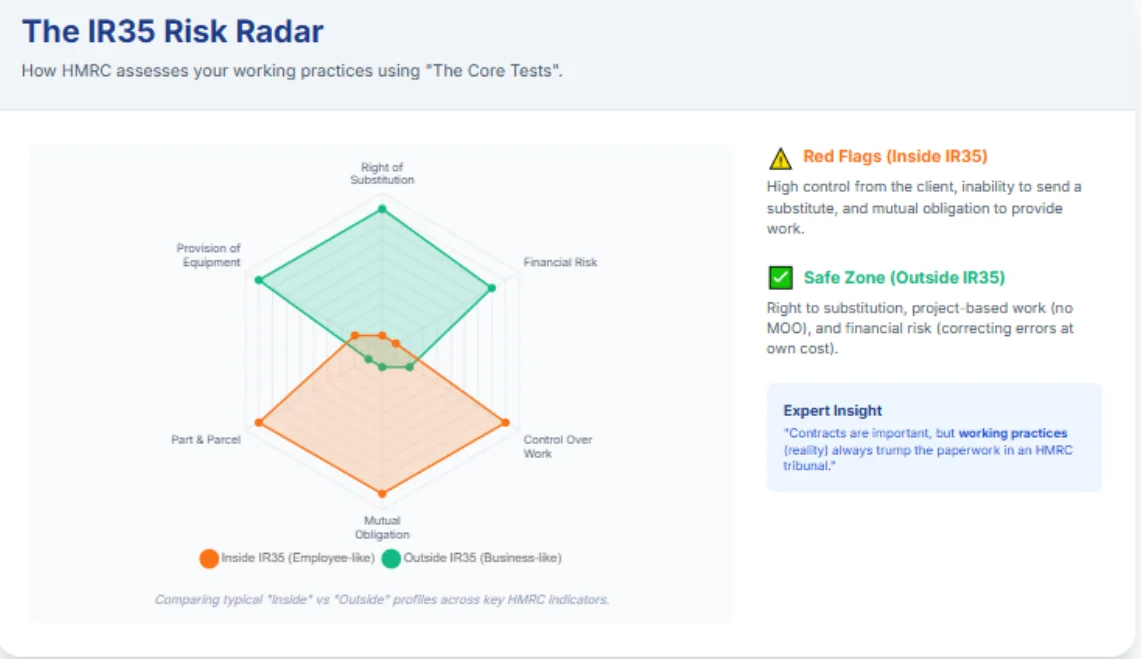
The status hinges primarily on three key pillars: Control, Substitution, and Mutuality of Obligation (MOO).  

Control  

This test looks at who directs the work. If the client controls how tasks are done, sets fixed hours, and supervises closely, the relationship resembles employment. To fall outside IR35, the contractor must show control over how, when, and in what order work is completed.  

Substitution  

A genuine right to send a substitute indicates self-employment. This right must be contractual and unrestricted. If the client can unreasonably reject a substitute, the argument weakens. Even if not used, a valid substitution clause supports an outside IR35 position.  

Mutuality of Obligation (MOO)  

MOO exists when there is an ongoing expectation for the client to offer work and for the contractor to accept it. In business-to-business relationships, this obligation ends with the current project. Continuous or long-term engagements suggest employment and point toward inside IR35. HMRC closely examines regular income patterns.  

Financial Risk  

True businesses bear financial risk. This includes liability for project failure, fixing errors at their own cost, or working on a fixed-price basis. Holding insurance and offering warranties further show business status.  

Business on Own Account (BOOA)  

This looks at whether the contractor operates as an independent business. Indicators include having a website, multiple clients, marketing efforts, investing in tools or training, and being visible as a standalone service provider.  

Provision of Equipment  

Using your own equipment rather than the client’s points to independence, though this factor alone is not decisive.  

Part and Parcel  

If the contractor is deeply embedded in the client’s operations, attending internal meetings, appearing on org charts, receiving staff emails or perks, it suggests employee-like status and supports an inside IR35 classification.  

Working Practices vs Contract  

Why HMRC Values Reality Over Paperwork  

In an IR35 compliance enquiry, HMRC will inevitably request both the written contract and evidence of the actual relationship. Case law, such as the Dragonfly vs HMRC decision in 2008, established that if the reality of the working arrangements contradicts the terms of the contract, the contract is disregarded. A favorable contract is useless if the contractor behaves as, and is treated like, an employee day to day. Therefore, contractors must ensure meticulous record-keeping to prove that their ir35 contract review aligns with the reality of the engagement.  

Red Flags  

Common red flags for HMRC include mandatory fixed hours regardless of output; use of generic employee performance reviews; requiring permission to take time off (rather than notification); and relying entirely on the client’s infrastructure and security passes that denote employee status.  

Case Study (Substitution in Practice)  

Scenario: Ms. Davies, a senior developer working through her limited company, was put inside IR35 after a weak SDS, despite having a substitution clause. HMRC then opened an IR35 inquiry.  

Lanop’s Intervention: Lanop’s IR35 team showed she had a pre-vetted substitute who had already covered two weeks of work while she was ill, and cited Lime IT Ltd v Justin to show genuine substitution is a strong sign of self-employment.  

Outcome: HMRC dropped the case and accepted the engagement as outside IR35, confirming it was a true B2B relationship.  

Tools to Check IR35 Status  

Contractors often seek simple mechanisms to assess their status, leading them to use online ir35 assessment tools. While helpful, these tools have limitations that must be understood.  

HMRC CEST Tool  

The Check Employment Status for Tax (CEST) tool is the official online HMRC IR35 checker. HMRC provides this service, stating they will stand by the result generated, provided the information input accurately reflects the contractual terms and the actual working conditions.  

Limitations  

Despite HMRC backing, CEST is not infallible, and relying on it exclusively can be risky, particularly for complex or borderline cases:  

  1. Undetermined Results: CEST often fails to provide a definitive result in complex scenarios, yielding an ‘undetermined’ status in approximately 20% of cases.  
  2. Ignored MOO: Crucially, CEST does not adequately account for Mutuality of Obligation (MOO). Because MOO is a foundational element of common law employment status, an engagement that passes the CEST test might still be found ‘Inside IR35’ by a tax tribunal if the MOO is overwhelmingly present.  
  3. Tax Law Focus: CEST only determines status for tax purposes; it does not confer employment rights.  
  4. Data Integrity: The result is only reliable if the inputs reflect the reality of the engagement and are not manipulated or based on artificial contract terms. 

IR35 Take Home Pay Calculator

The most immediate and tangible impact of IR35 status is the dramatic change in cash flow and overall net income. The ir35 take home calculator must account for different tax regimes, NICs, and allowable expenses.  

Inside IR35,  PAYE, NICs, Umbrella Structure  

If an engagement is deemed inside IR35, the income is treated as a salary subject to full Income Tax and Employee NIC deductions, reducing the net income significantly.  

  1. Umbrella Structure: For simplicity, many contractors inside IR35 use an umbrella company. The umbrella acts as the fee payer and deducts PAYE and NICs at source. This structure retains, on average, 55%–65% of the gross contract rate.  
  2. PSC Inside IR35: If the contractor remains with their PSC, the fee-payer deducts the deemed employment payment tax liabilities. Although the amount remaining in the PSC can still be offset against Corporation Tax, the primary benefit of tax efficiency is lost. The contractor bears the cost of running their limited company without the corresponding dividend tax benefits or expense claims.  

Outside IR35,  Dividends, Corporation Tax, Expenses  

Operating outside IR35 provides maximum tax flexibility and efficiency, allowing for greater control over income.  

  1. Tax Efficiency: The company pays Corporation Tax on its profits (19% for small profits or 25% for the main rate in 2026). The director then draws income via a small salary (utilizing the tax-free personal allowance) and the remainder as dividends from post-CT profits. This method typically results in a take-home rate of 70%–80% of the gross contract value.  
  2. Expenses: Crucially, the PSC can claim a wider range of allowable expenses (travel, training, home office costs, insurance) against company profits, further reducing the overall tax liability.  

The resulting disparity in net income represents the core of the contractor’s ir35 tax impact.  

Comparison Table (£60k, £90k, £120k) Monthly/Weekly  

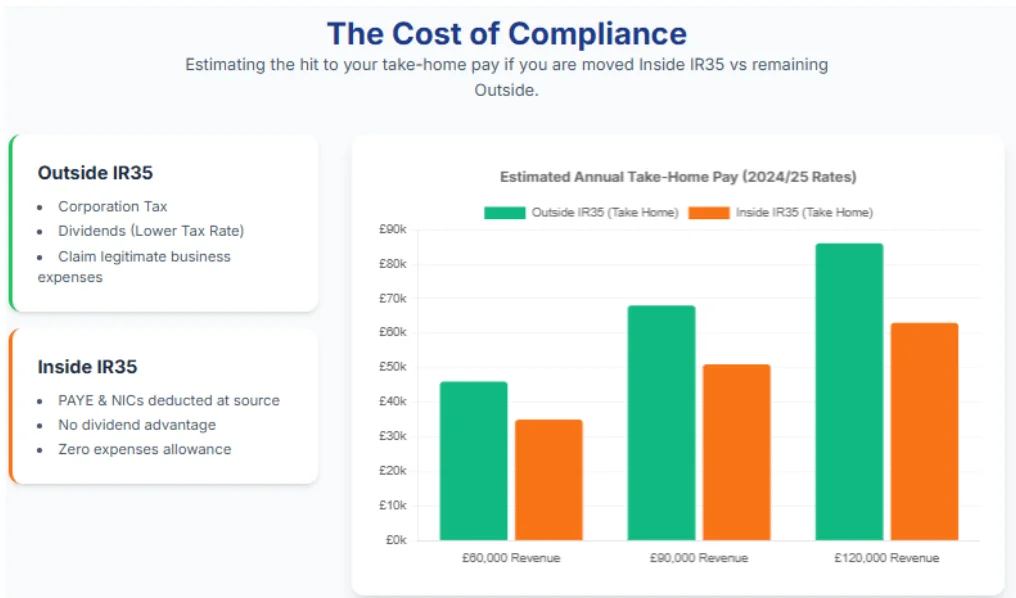
The table below illustrates the approximate annual take-home difference based on the current 2026 estimated tax rates and typical expense claims. This highlights the severity of the economic loss when moving inside ir35 vs outside ir35

Table: Estimated Annual Take, Home Pay Comparison (Outside IR35 PSC vs Inside IR35 PAYE/Umbrella)

Annual Gross Contract Value Outside IR35 (PSC) Inside IR35 (PAYE/Umbrella) Annual Difference
£60,000 £43,200 £38,000 £5,200
£90,000 £64,800 £52,500 £12,300
£120,000 £83,000 £67,000 £16,000

Note: Figures are illustrative estimates for the 2026 tax year, assuming a basic tax strategy, reflecting the significant IR35 take, home pay for contractors disparity. 

Case Study (Financial Planning)

Scenario: Mr. Bell, an established data architect, secured a £90,000 annual contract. He needed to understand if operating via his PSC (Outside IR35) or switching to an umbrella (Inside IR35) was best, especially regarding the financial fluctuation. 

Lanop’s Intervention: Using our proprietary ir35 tax calculator and forecasting 2026 rates, Lanop provided a side-by-side analysis confirming that the Outside IR35 PSC route offered nearly £12,000 more take-home pay annually than the equivalent Inside IR35 umbrella role. We advised him on the documentary evidence needed to defend his outside status against a potential investigation. 

Outcome: Mr. Bell used the precise figures to negotiate a rate increase to offset the tax loss on a future ‘Inside IR35’ contract and successfully defended his current outside IR35 status using our documented compliance roadmap.

"The ir35 take home calculator Lanop provided was instrumental in my rate negotiations. Knowing the exact difference allowed me to plan my finances with certainty, proving they offer the best practice IR35 contractors need."

IR35 for Limited Company Contractors  

PSC Explanation  

The Personal Service Company (PSC) is typically a limited company structure controlled by the worker, through which they provide services to the end client. This structure provides limited liability and access to corporate tax planning mechanisms, making it the preferred vehicle for genuine IR35 contractors

Can Contractors Stay Limited Inside IR35?  

Yes, contractors can continue operating through their Personal Service Company (PSC) even if an assignment is classed as ‘Inside IR35‘.  

However, the financial benefits are reduced. The fee-payer must deduct PAYE and National Insurance before paying the PSC, limiting the use of dividends and allowable expenses.  

If all contracts are consistently inside IR35, some advisors recommend using an umbrella company to simplify admin and cut accountancy costs. Still, some contractors keep their PSC active for professional image and future flexibility. 

Mixed Contracts  

A vital strategy for many IR35 limited company contractors is managing mixed contracts. Since status is determined on an assignment-by-assignment basis, a contractor may have one role deemed ‘Inside IR35’ (paid via PAYE/umbrella) and another concurrently or sequentially deemed outside IR35 (paid via the PSC’s dividend/CT structure). Managing segregated finances and accurately calculating the tax for both streams is complex and requires specialized  ir35 accountant oversight.  

Umbrella vs PSC  

The choice between a PSC and an umbrella company when facing an ‘Inside IR35’ role boils down to administrative complexity versus corporate retention: 

Feature PSC (Inside IR35) Umbrella Company
Tax Processing Fee payer deducts PAYE/NICs from the gross fee; PSC receives the net amount. Umbrella acts as the employer and processes all payments via PAYE.
Tax Efficiency Minimal; only marginal Corporation Tax reduction benefits remain. None; full PAYE/NICs applied.
Administrative Burden High; must still file Corporation Tax, VAT, and full annual accounts. Low; all administration, tax, and NICs handled by the umbrella.
Flexibility High; retains the ability to take on future outside IR35 contracts immediately. Low; requires closing or making the PSC dormant if no outside work is available.

The consensus among tax advisors is that for long, term contractors expecting to secure future outside IR35 work, maintaining the IR35 status for contractor limited company is advisable, even if temporary inside roles are taken. 

IR35 for Sole Traders & Self, Employed 

IR35 technically doesn’t apply to sole traders, as it targets those working through intermediaries like limited companies. Sole traders work as individuals, not through a PSC. 

However, they aren’t off the hook. HMRC can still assess their employment status using the same principles as IR35, Control, Substitution, and Mutuality of Obligation. If a sole trader is found to be working like an employee, they could face backdated tax, NICs, penalties, and interest. 

So, whether you’re a limited company contractor or a sole trader, the key is the same: work independently, show you’re genuinely in business, and stay on top of your status. 

Sector, Specific IR35 Examples 

The application of contracting and IR35 explained principles varies significantly across industries due to differing norms regarding control, equipment, and substitution feasibility. 

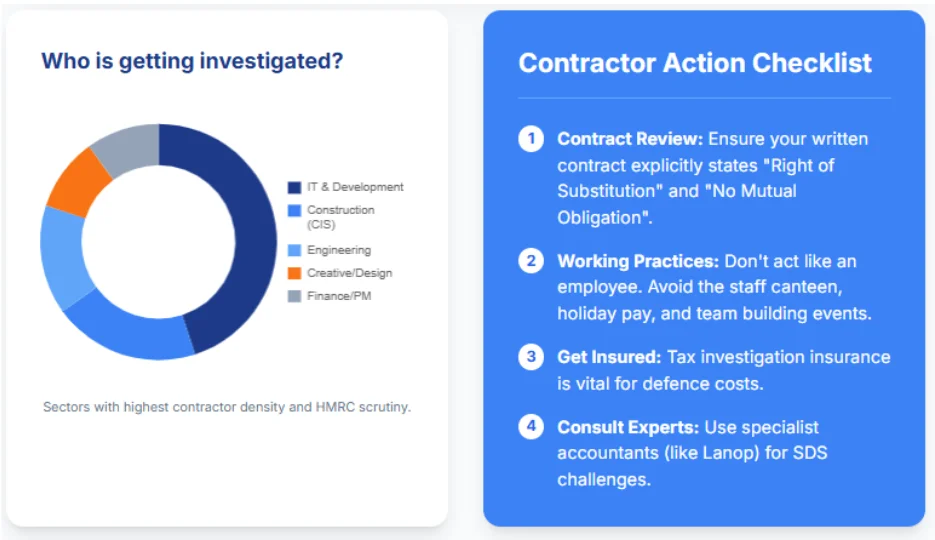
IT: Developers and Project Managers 

This sector is a long-standing IR35 hotspot. Developers often manage their own workflows and resist client micromanagement, which helps support an ‘Outside IR35’ status if autonomy is clear. PMs need to show control over delivery, not just follow client orders. 
In Lime IT Ltd v Justin (2003), a developer’s unexercised but genuine right to substitution was key to proving self-employment. 

Creative Industries 

Journalists and creatives working on long-term contracts, especially with broadcasters, must watch for Mutuality of Obligation (MOO). In the Ackroyd case, seven-year continuous engagement led to an ‘Inside IR35’ ruling. To stay compliant, creatives should avoid exclusivity, link work to defined deliverables, and diversify income sources. 

Construction (CIS) 

Subcontractors under the Construction Industry Scheme (CIS) sometimes fall within IR35. CIS governs payment deductions, but IR35 decides employment status, especially if the subcontractor uses a PSC. For medium and large clients, a Status Determination Statement (SDS) is still required. If deemed ‘Inside’, IR35 rules take priority over CIS deductions in some cases. 

Healthcare 

Locum doctors and other medical professionals often face strict control, particularly in the NHS, where public sector rules have been applied since 2017. Shift structures, compliance protocols, and limited substitution often lead to ‘Inside IR35’ rulings. Many opt for umbrella companies and instead focus on negotiating higher day rates to offset lower take-home pay. 

What To Do If You Are Put Inside IR35 

Receiving an ‘Inside IR35’ determination requires immediate and decisive action to protect the IR35 status for contractor limited company and overall financial position. 

Immediate Steps 

  1. Stop Work Review: Immediately review the SDS to ensure it is valid, paying attention to the specific reasons cited by the client. 
  2. Document Reality: Begin meticulously documenting the actual working arrangements. This means gathering emails, logging instances of autonomy, and proving how the work differs from the reasons given in the SDS. 
  3. Engage an IR35 Accountant: Contact a specialist ir35 accountant to evaluate the determination and prepare a strategic response. 

Challenge 

The formal Right to Challenge must be exercised within 45 calendar days of receiving the SDS. The contractor must submit a formal appeal detailing specific reasons for disagreement, citing common law tests and presenting counter evidence. The client then has 45 days to respond, either by upholding the original decision with detailed rationale or issuing a new, revised SDS. This is the primary route for a contractor inside IR35 to do. 

Evidence 

To succeed in a challenge, the evidence must directly negate the client’s reasoning. Key evidence points for the contractor IR35 checklist 2026 include: 

  1. Contractual terms (ensuring alignment with working practices) 
  2. Confirmation of Arrangements (CoA) agreed with the end client. 
  3. Proof of financial risk (e.g., invoices for fixing errors). 
  4. Documentation proving autonomy and control over methods. 

Should You Close Your Limited Company 

If the determination is upheld and the contractor concludes that all future work will also be inside IR35, they may question if contractors inside IR35 should shut down their company. 

  1. Dormancy: Many choose to make their PSC dormant if they anticipate future outside IR35 work. This maintains the structure while minimizing administrative costs. 
  2. Members’ Voluntary Liquidation (MVL): If the company holds significant retained profits (e.g., over £25,000) and is solvent, an MVL is the most tax efficient method of winding down. MVL allows the profits to be extracted as capital, potentially qualifying for Business Asset Disposal Relief (BADR), saving substantial personal tax compared to extracting the funds as dividends. This process requires expert insolvency and tax advice. 

Case Study (Closing PSC via MVL) 

Scenario: Ms. Johnson, a long, term ir35 contractor with over £80,000 retained profits in her PSC, secured a permanent role, meaning all future work would be PAYE. She needed to wind down her limited company tax efficiently. 

Lanop’s Intervention: Lanop determined that a straightforward strike off was not suitable due to the profit level. We guided Ms. Johnson through a Members’ Voluntary Liquidation (MVL) process, working with liquidators to ensure the profits were extracted as capital, qualifying for BADR, minimizing her personal tax liability compared to extracting the funds as a dividend. 

Outcome: Ms. Johnson closed her limited company efficiently and saved tens of thousands in personal tax liabilities on the retained profits. 

How IR35 Investigations Work 

Despite meticulous planning, HMRC may still open an investigation into accounts, especially those relating to periods when the contractor was responsible for the determination (pre-2021) 

HMRC typically initiates the process with a letter requesting specific information regarding a contract or accounting period, demanding copies of contracts and evidence of working practices. If HMRC finds the contract ambiguous, they may request a face-to-face meeting with the director of the PSC to clarify the situation.  

How Far Back HMRC Can Investigate  

The potential look-back period is significant, highlighting the need for historical record-keeping 

  1. 4 years: Simple innocent error or honest mistake (e.g., miscalculation).  
  2. 6 years: ‘Carelessness’ in preparing tax returns or assessments.  
  3. 20 years: Deliberate tax avoidance or fraudulent activity.  

Expert representation by an ir35 accountant is crucial, as appealing the categorization of ‘carelessness’ can reduce the liability of exposure from six years down to four.  

IR35 Small Company Exemption  

The IR35 small company exemption is pivotal because it dictates whether the liability for determination and tax calculation rests with the client or reverts to the PSC 

Under the Companies Act 2006, the off-payroll working rules do not apply to clients who qualify as ‘small’. For these engagements, the IR35 limited company contractor is solely responsible for determining their status, assessing the tax (if ‘Inside’), and remitting payments to HMRC.  

Detailed Criteria for 2026  

To qualify as small, the client must meet two or more of the following criteria for two consecutive fiscal years:  

  1. Annual Turnover: No more than £15 million (threshold raised from £10.2 million for fiscal years starting on or after 6 April 2026).  
  2. Balance Sheet Total: No more than £7.5 million (threshold raised from £5.1 million for budget years starting on or after 6 April 2026).  
  3. Average Number of Employees: No more than 50 employees.  

Contractors must be aware that while the thresholds are rising from 2026, a company must qualify as small for two fiscal years before the OPW rules cease to apply to them.  

Requesting Confirmation of Client Size  

Contractors can formally request confirmation of the client’s size. The client is then obligated to confirm their size within 45 days. This is a crucial procedural step, as working under the wrong assumption about client size can lead to severe tax complications.  

How an IR35 Accountant (Like LANOP) Helps Contractors  

An IR35 specialist accountant, like LANOP, plays a crucial role in helping contractors navigate complex off-payroll rules. Beyond standard tax filings, they offer expert contract reviews, ensuring agreements align with IR35 criteria such as control, substitution, and mutuality of obligation.   

They also defend contractors during HMRC investigations, handling correspondence, presenting evidence, and negotiating outcomes. For those with both inside and outside IR35 contracts, they manage mixed-income streams, maintain compliance, and optimize tax efficiency. Their targeted expertise provides clarity, reduces risk, and supports long-term financial planning.  

Case Study: IR35 Tax Investigation  

Mr. Jones, a long-standing contractor, faced a £45,000 HMRC investigationover a six-year-old contract, citing ‘carelessness’ in his self-assessment.   

Lanop intervened, presenting evidence of a prior contract review and proof of genuine business practices. We argued the error wasn’t careless, reducing HMRC’s scope to four years and successfully negotiated a 30% reductionin liability, avoiding a costly tribunal.  

IR35 Checklist for Contractors (Master List)  

This comprehensive contractor IR35 checklist 2026 is essential for maintaining robust contractor IR35 compliance 

  1. Client Status Verification: Determine if the client is medium/large (requires SDS) or small (PSC responsibility, check criteria in Section 17).  
  2. Obtain Valid SDS: If required, ensure the client provides a valid ir35 determination statement before the contract starts, including reasons and evidence.  
  3. Contract Review: Secure a specialist IR35 contract review of both the written contract and the Statement of Work (SOW).  
  4. Document Reality: Keep meticulous records (emails, project specs, evidence of autonomy) demonstrating that actual working practices align with outside IR35 meaning 
  5. Substitution Readiness: Ensure the substitution clause is genuine and feasible; consider vetting a potential substitute to prove its viability.  
  6. Manage Financial Risk: Include clauses that expose the PSC to financial risk (e.g., liability for fixing errors).  
  7. Challenge Incorrect Decisions: Be prepared to use the statutory right to challenge within the 45-day deadline if an incorrect IR35 SDS is issued.  
  8. Minimize Integration: Avoid participation in client staff activities, training, or appraisal processes.  
  9. Tax Segregation: If managing inside IR35 and outside IR35 contracts, ensure strict separation of income and expenses within the limited company 

FAQs

How do I know if I’m inside IR35?

If your client is a medium or large business, they are legally required to provide you with a Status Determination Statement (IR35 SDS) that confirms the decision. If your client qualifies for the IR35 small company exemption, your PSC must make the IR35 assessment itself, possibly using an HMRC IR35 checker or specialized IR35 assessment tool 

Yes. IR35 status is determined on a contract, by, contract basis. You may have several outside IR35 contracts and one inside IR35 contract simultaneously. Your PSC must manage the mixed tax consequences.

Yes, are contractors inside IR35 permitted to continue operating their PSC, but they lose the primary tax efficiency benefits (dividends, many expense claims) as the fee-payer must deduct tax and NICs via PAYE. Many choose the simpler route of an umbrella company.  

The impact on IR35 takes home pay for contractors is severe. You are taxed like an employee (full PAYE/NICs) but do not gain corresponding employment rights (sick pay, holiday pay)

No, IR35 does not apply directly to an IR35 sole trader. However, the core employment status tests apply, and the sole trader must be able to prove they are genuinely self-employed, employed to avoid HMRC challenging their status for tax purposes. 

Conclusion   

The compliance challenges faced by IR35 contractors have evolved from a self-assessment task to a process of expert strategic defense and rigorous client monitoring. For any contractor limited company IR35 rules application, the need to achieve and robustly defend outside IR35 meaning has never been more critical due to the enormous contractor IR35 tax impact if caught inside.  

The political volatility of the rules, the complexities of the IR35 small company exemption thresholds, and the ongoing enforcement focused on “reasonable care” necessitate a proactive partnership with a specialist. Simply using an online tool or accepting a client’s SDS without review is a high-stakes gamble with long-term financial consequences.  

To ensure your business model is legally sound and tax-efficient for 2026 and beyond, future-proof your status with a comprehensive assessment of your contracts and working practices.  

Speak to the UK’s leading specialists. Contact Lanop Business and Tax Advisors today for a bespoke ir35 contract review and strategic tax planning consultation. Ensure your business is robust, contractor IR35 compliance ready for 2026 and beyond. 

Request a Free Quote

Get in touch

To learn more about how we can help you grow your business, contact us today:

Monday to Friday 9am – 6pm

Get in touch

To learn more about how we can help you grow your business, contact us today:

Monday to Friday 9am – 6pm

Aurangzaib Chawla

Aurangzaib Chawla

At Lanop, I am providing my services as the Managing Partner and Tax Specialist. My expertise includes helping medium and small-scale businesses in their accountancy and legal requirements, business start-up support, strategic review, payroll system review and implementation, VAT and tax compliance to cloud accounting. I am also an expert in financial reporting, identifying and monitoring risks, strategic business development, client retention, market acquisition and deals closure by carefully planning my sales cycle. 

Free Consultation Call

Book A Free Call Worth £100

Enter Your Name & Email Address for a Free Consultation