
Introduction
I’ll be straight with you. When you are losing over £190,000 a year to income tax alone, staying put stops being about duty and starts looking like a math error. For high earners at the 45p rate, the 2024 tax changes were the final straw. Now in 2026, the real question is where you can go to actually keep what you earn.
Every year, thousands leave the UK tax system legally. They aren’t hiding. They are just moving to places that don’t penalize success. But picking a destination is only half the battle. If you don’t handle the Statutory Residence Test perfectly, HMRC will keep its hand in your pocket no matter where you live.
A clean break needs a real plan. Here is how the European landscape looks for anyone ready to move.

A Quick Word on How These Countries Tax You
Not all low-tax countries work the same way. Picking one without understanding this is how people end up disappointed.
- Territorial tax means the country only taxes income earned inside its borders. Foreign income including UK investments and overseas clients is left alone. Georgia works this way. For remote workers and consultants, it can mean a bill close to zero.
- Remittance-based tax is the middle option. You pay tax only on money you bring into the country. Income sitting in foreign accounts isn’t touched. Malta and Cyprus both run versions of this, and it’s where a lot of the planning value sits.
- Residence-based tax is what the UK uses and what most of Western Europe uses too. You pay on everything, globally, once you’re resident. Moving from the UK to France purely to save tax makes almost no sense.
1. Switzerland
Switzerland does not compete on headline rates. For the right client, it does not need to.
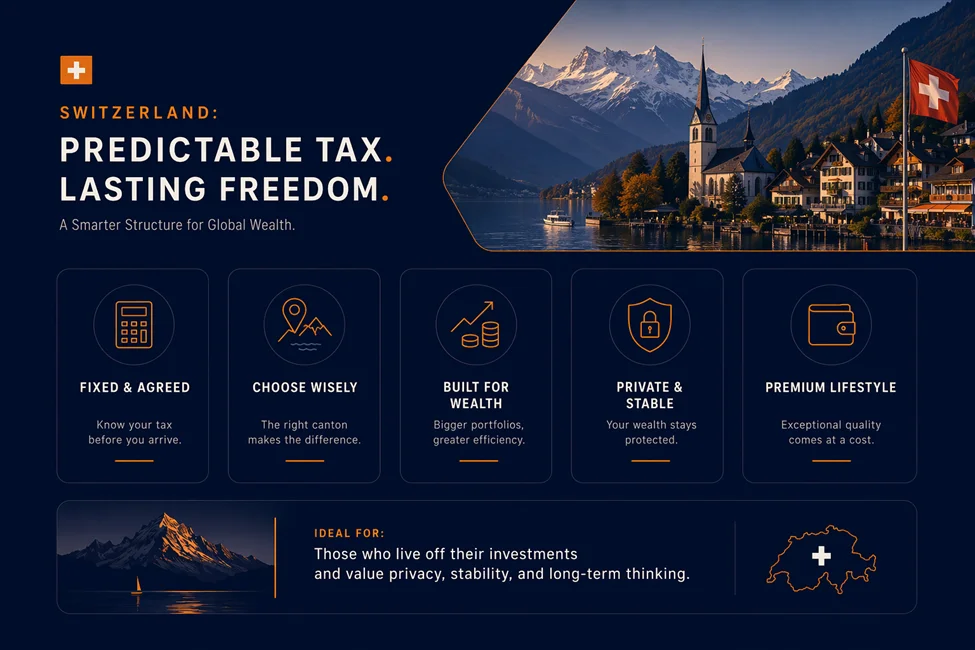
The lump-sum, or expenditure-based, tax regime lets qualifying foreign nationals agree a fixed annual liability with their canton. The calculation is based on their Swiss cost of living, not their global income. On a large enough portfolio, the difference between that figure and what a standard rate calculation would produce is significant.
- Tax based on living costs, not worldwide income.
- Only available to foreign nationals not working in Switzerland.
- Canton choice is a core part of the planning decision.
- Zero capital gains tax on private investment holdings.
- Long-term legal certainty and banking stability included.
To qualify, you must be a foreign national, must not have lived in Switzerland in the past ten years, and must not work there. That last condition closes the door for active founders straight away. This is a regime for people living from portfolios, disposal proceeds or family capital.
Canton selection matters enormously. Zug and Schwyz attract serious private wealth for good reason. Geneva and Zurich are not suited to this arrangement at all. The planning starts with choosing the right canton, not just the right country.
Switzerland is expensive. Groceries, schooling and services all run materially higher than the UK. That cost needs to sit in the numbers alongside the tax saving. For clients who genuinely suit this route, the expenditure-based model gives a level of control over the annual tax position that very few other jurisdictions offer.
2. Monaco
Monaco is the most straightforward option on this list. There is no personal income tax. Full stop.
Residents pay nothing on employment income, dividends, investment returns, business profits or capital gains. That is not a regime with qualifying conditions. It is simply the baseline. For high earners with complex, multi-source income, the clarity of that outcome has real value in itself.
- No income tax, capital gains tax or wealth tax.
- Direct family members exempt from inheritance tax.
- Minimum six months of physical residence required annually.
- Deep private banking and wealth management infrastructure.
- Property market is expensive but liquid and stable.
Residency is not difficult to obtain, but it requires genuine commitment. You need to demonstrate sufficient means, hold qualifying accommodation, and actually spend the time there. Monaco is not a letterbox address. HMRC knows this, and treating it as one is a serious mistake.
The practical point that gets underestimated is connectivity. Monaco is 30 minutes from Nice airport. Milan and Zurich are accessible. For founders and business owners with active professional lives, that proximity to major hubs matters. Day-to-day life in Monaco works well for the right person. It requires real presence, not just an apartment and a residency card.
3. Malta
Malta sits inside the European Union and operates a remittance-based tax framework. That combination is genuinely unusual and where most of its planning value sits.
Under the remittance basis, income arising outside Malta is only taxed if and when it is brought into the country. Foreign capital gains are not taxed at all, even if received in Malta. For clients with offshore investment income, dividends held in foreign accounts or proceeds from asset disposals, the potential saving is substantial.
- Remittance basis available to non-domiciled residents.
- Foreign capital gains fully exempt, regardless of remittance.
- EU freedom of movement included post-Brexit.
- Minimum annual tax of €15,000 applies under qualifying programmes.
- English common law system and familiar professional environment.
What Malta offers that no other jurisdiction on this list can match is EU residence rights alongside remittance-based treatment. Post-Brexit, that matters for anyone whose business or client base requires regular movement across Europe.
The planning here is not passive. It requires careful decisions about which income streams to bring into Malta and which to keep offshore. That structure needs proper international and offshore accounting support to work correctly and consistently across tax years.
Malta is small. Valletta is beautiful but it is not London or Zurich. For clients who need city energy, that will become apparent within months. For those who want warm weather, the sea and a quieter pace alongside real tax efficiency, it works well.
4. Cyprus
Cyprus has one of the cleaner non-domicile setups in the EU. For UK founders and dividend-led earners in particular, it is often the first serious conversation.
The non-domicile exemption removes the Special Defence Contribution that would otherwise apply to dividend and interest income for domiciled residents. Non-doms pay no Cypriot tax on dividends or interest for 17 years from the date of first becoming tax resident. For someone drawing primarily from investment income or company dividends, that is a meaningful position.
- Non-dom exemption covers dividends and interest for 17 years.
- Tax residency available under either the 60-day or 183-day rule.
- Corporate tax at 12.5%, among the lowest rates in the EU.
- Capital gains on overseas property and securities are exempt.
- Active international business and professional advisory community.
The 60-day rule is particularly relevant for internationally mobile individuals. Residency can be established with 60 days of presence, provided you do not spend more than 183 days in any single other country in the same tax year. For people who genuinely split their time, Cyprus handles that without creating friction.
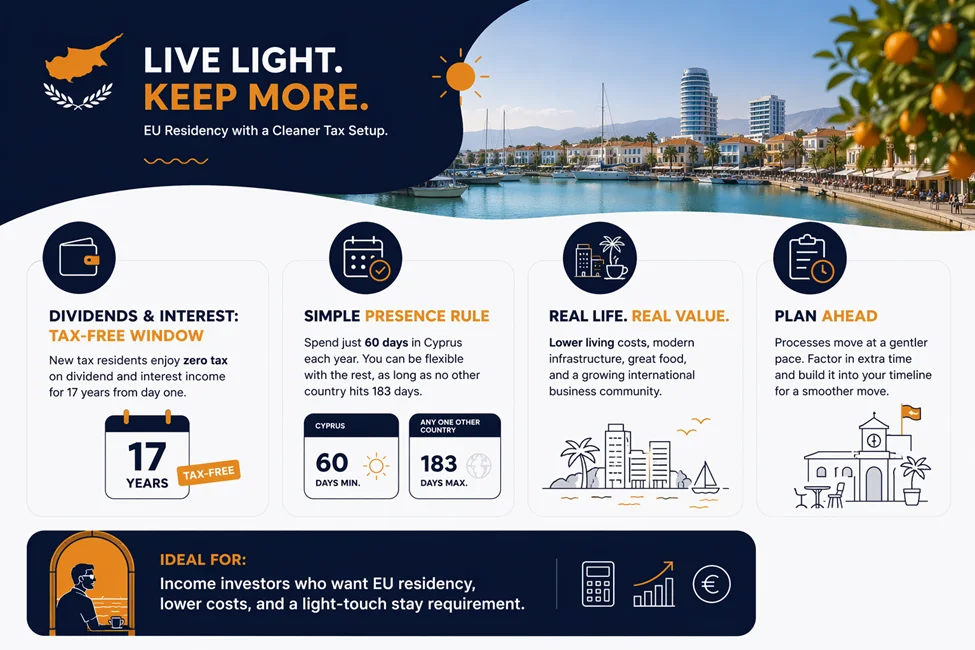
Limassol has changed significantly over recent years. It now has a real international business community and a growing population of UK residents who chose it deliberately. It is not the only option, but it is the most commercially functional base in Cyprus for active business owners.
One caution worth stating plainly: non-domicile status in Cyprus does not resolve UK exposure on its own. Your UK ties, day count and income structure still need proper analysis before and after the move.
5. Andorra
Andorra sits between France and Spain and is consistently underestimated.
Personal income tax runs from zero on the first €24,000 up to a maximum of 10% above that. Capital gains tax is zero. Inheritance tax is zero. The structure is straightforward. There are no complex ongoing arrangements required to maintain the position once residency is established.
- Maximum income tax rate capped at 10%.
- Zero capital gains and zero inheritance tax.
- Minimum 183 days of physical presence required each year.
- Initial investment or government deposit of around €600,000 required.
- Low crime, strong privacy and direct access to southern Europe.
The 183-day requirement is the main constraint. Andorra requires real presence. If your professional life keeps you travelling frequently, hitting that threshold while also staying below the residency triggers in France and Spain takes careful planning.
Barcelona is a few hours by road. The skiing is serious. For clients with business or family ties anchored in southern Europe, the location makes genuine sense.
Visit for a week before deciding anything. Some people find the pace and the mountains exactly what they wanted. Others find a small principality limiting within a year. That personal fit matters as much as the tax position.
6. Isle of Man
The Isle of Man is one of the lowest-friction moves available to a UK high earner. It feels close. It functions close. And the tax position is materially better.
Personal income tax is capped at 20%. Residents can elect for an annual income tax cap of £220,000, meaning total Isle of Man income tax does not exceed that figure regardless of earnings. No capital gains tax. No inheritance tax.
- Annual income tax cap fixed at £220,000 from 2026/27.
- No capital gains tax or inheritance tax on the island.
- Short flight times to the mainland, typically under an hour.
- English law, English language and NHS-comparable healthcare.
- Strong financial services sector with experienced private client teams.
For someone earning above £1 million annually, that £220,000 ceiling is hard to ignore. The same income in the UK carries a far larger bill at the additional rate. On a business disposal worth several million pounds, the saving on a single transaction alone can dwarf the cost and disruption of the move.
Timing on that kind of transaction is everything. The move needs to happen before completion, not after. We see founders attempt to restructure post-sale regularly. It rarely works in their favour. Speak to the team about business tax planning well before any exit conversation becomes concrete.
The Isle of Man is quiet. Douglas is a small town, not a city. For families wanting good schools, open space and a simpler pace of life, that is the point. For those who need city access regularly, the flights to Manchester and London are short enough to manage.
7. Channel Islands
Jersey and Guernsey each offer a flat 20% income tax, no capital gains tax and no inheritance tax. As private wealth environments, both islands have decades of professional depth that most continental options simply cannot replicate.
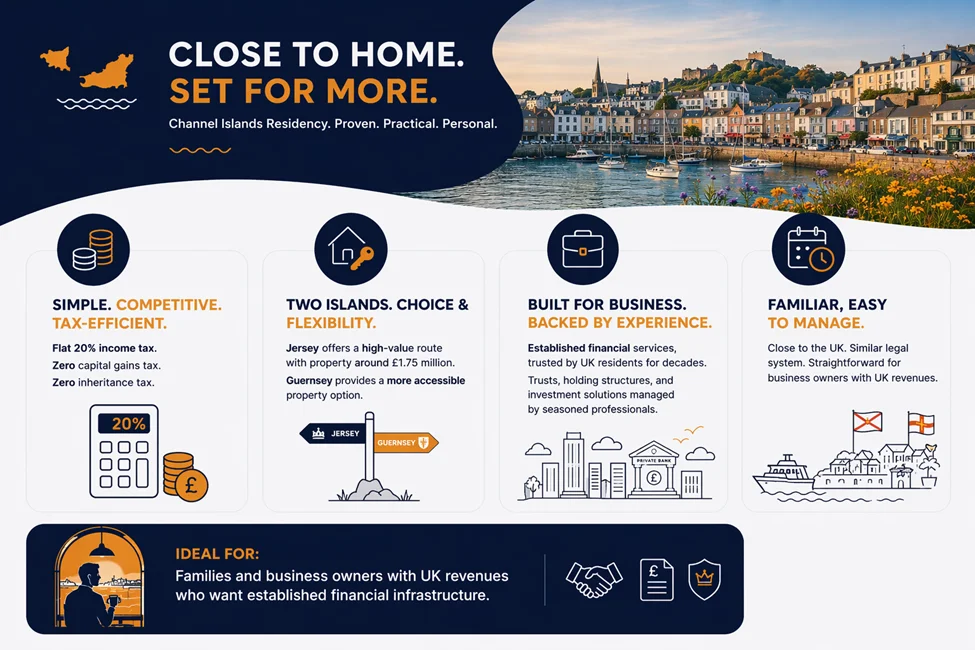
His high-value residency route requires a qualifying property purchase, typically above £1.75 million. Guernsey is more accessible on the property side. Both are close to the French coast and well connected to the UK mainland.
- Flat 20% income tax across all income types.
- No capital gains or inheritance tax on either island.
- Trust, holding and investment structures well established and respected.
- Close to London by short-haul flight or ferry.
- English law, English-speaking and professionally mature environment.
For business owners with UK-facing revenues or clients, the proximity and legal familiarity mean ongoing management is straightforward. There is no new system to learn. The professional infrastructure has handled UK-origin wealth for decades.
Inheritance tax planning is one area where the Channel Islands setup offers real options. The absence of local inheritance tax combined with well-established trust and holding structures gives families genuine long-term succession planning tools. That combination is not available in the same form in most other jurisdictions on this list.
One practical note: getting a purchase licence in Jersey takes time and requires local contacts. Factor that into your timeline from the start.
8. Portugal
Portugal remains in the conversation, but the story has changed and articles that ignore that are out of date.
The original Non-Habitual Resident scheme was repealed from 1 January 2024. The replacement is IFICI, the Tax Incentive for Scientific Research and Innovation. It targets a more specific set of profiles: technology professionals, researchers, qualified innovators and certain regulated roles. Qualifying income is taxed at a flat 20%. Foreign pension income is taxed at 10%.
- Original NHR scheme closed from 1 January 2024.
- IFICI replacement targets specific high-value professional sectors.
- Qualifying income taxed at a flat 20% rate.
- Foreign pension income taxed at 10%, relevant for UK retirees.
- Requires five years of prior absence from Portugal.
Portugal is no longer a universal answer for every UK high earner. The eligibility criteria are stricter and the qualifying income types more narrowly defined. Whether your income profile fits IFICI needs to be confirmed before you apply, not after.
For the right profile, Portugal still works. A qualifying technology professional or someone managing UK pension drawdown from abroad can still access meaningful efficiency here. Outside Lisbon, the cost of living is reasonable. EU residency is included. The lifestyle, particularly in the Algarve and the Silver Coast, remains genuinely attractive. But this is now a case-by-case decision, not a default one.
9. Liechtenstein
Liechtenstein rarely appears on mainstream lists. That is partly why it warrants attention.
Personal tax rates are applied progressively but remain low in effective terms relative to Western European norms. There is no general capital gains tax on private investment holdings. Wealth tax exists but at modest rates. For individuals with substantial portfolios, the aggregate drag over time can be materially lower than a headline comparison would suggest.
- No capital gains tax on private investment portfolios.
- Wealth tax applied at modest rates on net assets.
- Private foundation and trust law among the most sophisticated globally.
- Strong banking system with deep private client expertise.
- Close legal and financial ties with Switzerland.
What distinguishes Liechtenstein beyond its personal tax rates is the private wealth infrastructure. It has one of the most developed private foundation and trust law frameworks in the world. Internationally mobile families have used it for wealth structuring, succession planning and asset protection for generations. That institutional depth is not replicated anywhere else on this list.
Liechtenstein is not a lifestyle destination. It is small and orderly. Its appeal is to clients for whom long-term wealth governance and succession planning matter as much as the immediate tax position. For that specific profile, it is one of the most serious options available in Europe.
10. Estonia
Estonia belongs on this list not because of its personal tax rate but because of how it taxes business profits.
Estonian companies do not pay corporation tax when profits are earned. Tax is deferred until profits are distributed. If you run a business through an Estonian entity and reinvest consistently rather than extract large salaries, the liability does not arise until you choose to create it. When you do distribute, the rate is 20%, but the timing is entirely in your control.
- Corporation tax deferred until profit is actually distributed.
- Retained profits compound inside the business without immediate tax.
- Flat 20% personal income tax rate on distributed income.
- Strong digital infrastructure and efficient company administration.
- E-Residency enables company registration, not tax residency.
For founders who are building and reinvesting rather than extracting, that model allows capital to compound without a portion being removed for tax each year. Over a five or ten-year growth period, the difference in retained capital can be substantial.
One point that causes genuine confusion: Estonian e-Residency lets non-residents register and administer an Estonian company online. It does not create tax residency. The tax deferral advantage requires you to actually live in Estonia. These are not the same thing, and treating them as equivalent is a costly error.
Tallinn is a functional and well-connected city with a strong technology community and a reasonable cost of living. For founders who are comfortable there and focused on building rather than exiting, Estonia is worth serious consideration.
How HMRC Decides Whether You’ve Actually Left
This is where most people go wrong, and it’s worth understanding before you book anything.
You can move to any country on this list and still be treated as a UK tax resident if you haven’t managed your UK ties properly. The Statutory Residence Test looks at five factors:
- a family tie (a spouse, partner, or minor child in the UK)
- an accommodation tie (a UK home you can access, even if you don’t own it)
- a work tie (40 or more days of UK work in a tax year)
- 90-day tie (spending over 90 days in the UK in either of the previous two tax years)
- and country tie (spending more days in the UK than anywhere else).
The number of ties you hold determines how quickly UK residency kicks back in:
| UK Ties Held | Days Before UK Residency Triggers |
|---|---|
| 4 or 5 ties | 16 days |
| 3 ties | 46 days |
| 2 ties | 91 days |
| 1 tie | 121 days |
| 0 ties | 183 days |
A client with a UK spouse, access to a UK flat, and some UK client work can become a UK tax resident again by spending just 16 days in the country. That includes Christmas. That includes a couple of business trips. It happens faster than people expect.
What surprises people further: keeping a UK gym membership, leaving a car on a UK driveway, or holding a storage unit with personal belongings can all contribute to an accommodation tie. HMRC looks at the full picture. Understanding how UK tax residency affects your foreign income is the starting point for any serious move.
If you keep UK property after leaving, rental income from those assets stays taxable in the UK regardless of where you live. Our accountants for landlords handle the ongoing UK reporting for clients who move abroad but keep property here. And if you want to understand what inheritance tax exposure remains on UK assets after you leave, our guide on strategies to reduce inheritance tax covers what’s still available to non-residents.
What the Numbers Look Like in Practice
Selling a business worth £3,000,000:
In the UK, capital gains tax on that sale could run to around £720,000. In Switzerland, Andorra, or the Isle of Man, it’s zero. The saving on a single transaction can pay for the cost of moving many times. The word that matters is real residency. You need genuine presence and clear ties to the new country before the sale completes, not after.
£500,000 in annual income:
In the UK, you’re looking at roughly £197,000 in income and dividend tax plus around £7,000 in National Insurance. As a Cyprus non-dom, dividend income is fully exempt. On the Isle of Man with the tax cap, your total income tax bill is capped at £200,000 regardless of what you earn.
Getting It Right: Our Approach at Lanop
We see the same mistakes repeatedly. Clients who moved without properly understanding the Statutory Residence Test and triggered UK tax residency within six months. Entrepreneurs who relocated after selling their business instead of before. Families who chose a destination based on tax rates alone, without considering whether their income profile suited that jurisdiction.
Good international tax planning isn’t about finding the country with the lowest headline rate. It’s about:
- Timing your move relative to your income events
- Breaking UK residence cleanly and defensibly
- Understanding how your income is sourced and structured
- Matching the destination tax regime to your wealth profile
- Maintaining genuine substance in your new location
- Managing ongoing compliance properly across jurisdictions
That’s what separates successful relocations from expensive disappointments.
At Lanop Business & Tax Advisors, we don’t simply point you toward a jurisdiction and wish you luck. Our international tax team works with you through every stage:
Pre-Departure Planning:
- Comprehensive Statutory Residence Test analysis.
- UK tie identification and mitigation strategies.
- Timing optimization for capital events and business disposals.
- Estate planning and succession planning coordination.
Destination Selection:
- Income profile analysis to match appropriate jurisdictions.
- Family situation and lifestyle compatibility assessment.
- Long-term business and wealth structuring considerations.
- Connection to local advisors in your target country.
Transition Management:
- UK departure compliance and final UK tax returns.
- Establishment of foreign tax residency.
- Cross-border reporting setup and coordination.
- Banking, property, and business restructuring support.
Ongoing Compliance:
- Dual-jurisdiction tax return preparation and filing.
- UK-source income reporting for former residents.
- Foreign account and asset reporting obligations.
- Annual residence status monitoring and tie management.
We’ve guided entrepreneurs through Monaco relocations before business exits worth tens of millions. We’ve established Cyprus structures for dividend-focused business owners. We’ve helped families navigate Portugal’s IFICI applications and manage split-year UK treatment properly.
The common thread is that successful relocations start with understanding both sides. The UK exit matters as much as the foreign destination. Getting one right and the other wrong leaves you worse off than if you’d never moved at all.
Conclusion
Europe still offers genuinely useful options for UK high earners in 2026. The jurisdictions on this list cover a wide range of structures: expenditure-based taxation, remittance frameworks, territorial systems, profit-deferral models, and flat-rate environments. Each suits a different income profile, business structure, and personal situation.
The clients who benefit most are not the ones who found the lowest rate on a comparison list. They are the ones who understood their UK exit position first, matched the destination to how their income is structured, and acted before a significant capital event rather than after it.
Several of these regimes are under ongoing review. Portugal’s original scheme has already closed. Cyprus faces growing EU scrutiny. The window for some of these structures may not remain open on the same terms indefinitely.
If the numbers justify taking this seriously, start with a proper analysis of your UK residence position. That conversation will tell you more than any country comparison.
Get in touch with our team for a structured review.