
Introduction
The era of the non-dom is officially over. Since April 2025, the UK tax system has undergone its most aggressive transformation in decades. For high-net-worth individuals, the shift from a domicile-based system to a residence-based one is not just a technicality. It is a fundamental change in how your global wealth is treated. If you live here, the government now expects a share of everything you earn, regardless of where it is generated in the world.
This change has triggered a massive wave of restructuring. Some people are leaving the UK for good. Others are staying but completely rebuilding their financial foundations. The non-dom abolition in the UK 2025 means the old playbooks are useless. This guide explains the new rules, the risks of the “10-year tail,” and what you should be doing right now to protect your assets.
What the Non-Dom Regime Was?
For over 200 years, the UK used “domicile” as the pivot for its tax laws. It was a concept based on where you intended to live forever. If you were born abroad and planned to return there, you could live in the UK for years while only paying tax on money you brought into the country. This was the remittance basis, and it made the UK a global magnet for wealth.
On the non-dom regime abolition date in the UK of April 6, 2025, that concept was retired. The government moved to a residence-based system. Now, your tax liability is determined by how many years you have lived in the UK, not where your “real” home is. This change is the core of the abolition of the non-dom status in the UK.
If you have been a UK resident for more than four years, you are now likely taxed on your worldwide income and gains as they arise. There is no longer a choice to pay a “remittance basis charge” to keep your offshore money safe. The transparency is total, and the tax rates are the same as those for any other UK citizen. This is why UK HNWI tax planning 2025 has become so critical.
What Replaced Non-Dom Status: The FIG Regime Explained
The government introduced the FIG regime to replace the old non-dom status for newcomers. It is designed to keep the UK attractive for a short period. The UK foreign income gains FIG regime explained is quite simple: if you have not been a UK resident for the last ten years, you get a four-year tax holiday.
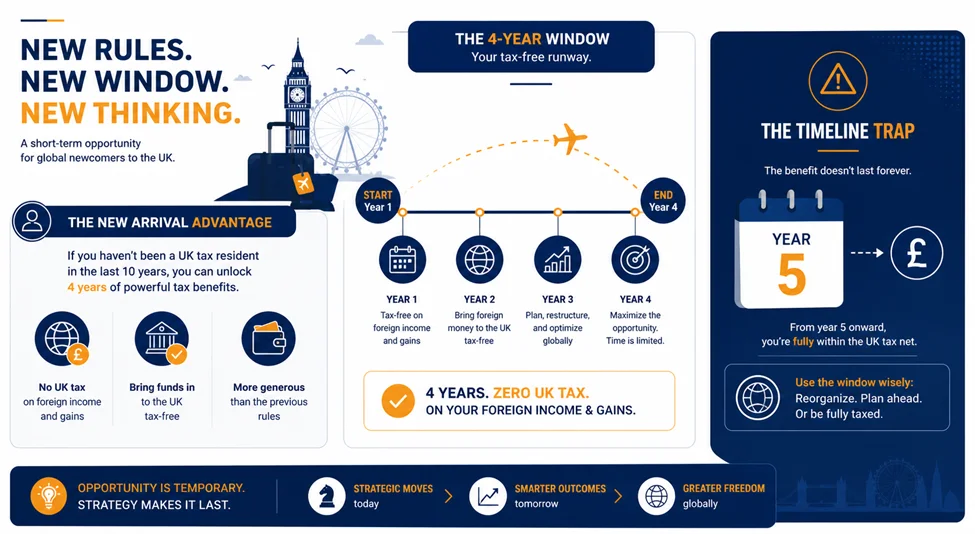
During these first four years of residency, you pay zero UK tax on your foreign income and gains. You can also bring this money into the UK without any tax charges. This is more generous than the old non-dom rules, which taxed any money brought into the country.
The Timeline Trap
However, the trap is the timeline. Four years is not a long time. Once you enter your fifth year of residency, you are subject to the full UK tax net. For many, this four-year window is a time to reorganize global holdings or plan a move to a more tax-friendly jurisdiction before the fifth year begins. The non-dom abolition 2025 UK rules mean that after this window, you lose all special status.
The Temporary Repatriation Facility (TRF): 12% and 15% Rates
For those who have lived in the UK as non-doms for a long time, there is a mountain of “unremitted” income sitting in offshore accounts.
In the past, bringing that money to the UK would have meant paying up to 45% tax. To clear this backlog, the government created the temporary repatriation facility TRF UK.
This is a limited-time opportunity to bring offshore money into the UK at a reduced rate.
- The 12% Window: If you designate and bring the money in during the 2025/26 or 2026/27 tax years, you pay a flat 12% tax.
- The 15% Window: In the 2027/28 tax year, the rate increases to 15%.
Why the TRF Decision Cannot Wait
After April 2028, the TRF disappears. This is one of the most important UK non dom changes what to do now decisions you will make. Paying 12% now to “clean” your capital is often a much better deal than paying 40% or 45% later. It allows you to use your wealth in the UK for property, business, or lifestyle without looking over your shoulder for an HMRC audit. Speaking to a personal tax planning adviser before the window narrows further is not optional for most people in this position.
Inheritance Tax (IHT) and the 10-Year Residence Rule
Income tax is painful, but the changes to Inheritance Tax (IHT) are where the real damage is done. Previously, non-doms only paid 40% IHT on their UK assets. Their foreign property and offshore companies were “excluded property” and were generally safe from the UK taxman.
The abolition of the non-dom regime changed this completely. The UK now uses a residence-based IHT system. If you have been a UK resident for 10 out of the last 20 years, your entire worldwide estate is subject to 40% UK inheritance tax.
The 10-Year Tail
This brings us to the most dangerous part of the new law: the “10-year tail.” Even if you leave the UK today, you might still be liable for UK IHT for up to a decade after you depart.
You cannot simply move to a tax-free country and expect your global wealth to be protected from UK death duties immediately. This rule has fundamentally changed the abolition of non dom status UK conversation from income management to legacy protection.
Proactive inheritance tax planning is now essential for anyone who has spent significant years in the UK, whether staying or leaving. For families thinking further ahead, this also connects directly to estate planning and succession planning, both of which need to be revisited under the new residence-based IHT framework.
The UK Millionaire Relocation Realities
The UK millionaire exodus 2025 is not a myth. Many high-net-worth individuals are leaving because the math no longer works for them. When you combine the loss of non-dom status with aggressive IHT rules, staying in the UK becomes a massive financial liability for the wealthiest families.
Italy has become the most popular destination for those leaving London. Italy offers a flat-tax regime where new residents pay a single annual fee (currently €200,000) to cover all their foreign income. For a billionaire, this is a negligible amount compared to what they would pay under the new UK rules.
Dubai and the UAE are the other top choices. With zero income tax and no inheritance tax, the UAE offers a level of financial freedom that the UK simply cannot match anymore. Many younger entrepreneurs are moving their businesses and families to Dubai to take advantage of the pro-growth environment.
Switzerland and Greece are also seeing an influx of UK wealth. Greece has a 100,000 Euro flat tax for 15 years, while Switzerland offers its classic lump-sum taxation. The common thread is that these countries are making an effort to welcome the wealth that the UK is currently pushing away. This is the reality of HNWI relocating from the UK for tax reasons.
Tax-Efficient Structures for Individuals Staying in the UK
If you choose to stay, you must abandon the old way of doing things. The non-dom remittance basis abolition 2025 means you need new vehicles to hold your wealth.
Family Investment Companies (FICs)
Family Investment Companies (FICs) have become a standard tool. By holding assets in a UK company, you pay corporation tax rates rather than the much higher personal income tax rates.
While you still pay tax when you take money out of the company, a FIC gives you control over the timing. This can help you manage your personal tax brackets more effectively. For families with significant portfolios or property, group and holding company structuring is worth examining as part of this.
Private Placement Life Insurance (PPLI)
Private Placement Life Insurance (PPLI) is another option. These are sometimes called “insurance wrappers.” You place your investments inside the policy, and the growth is generally not taxed until you withdraw the money. This can be a very effective way to defer tax on a large portfolio of stocks and bonds under the worldwide income tax rules for UK residents.
Offshore Trusts: Handle With Care
However, you must be extremely cautious with an offshore trust UK tax 2025. The new rules have removed most of the IHT protections for trusts. In many cases, a trust that was set up ten years ago is now a tax trap.
If you are the “settlor” of a trust and you or your family can benefit from it, HMRC will likely treat the trust’s assets as part of your personal estate for tax purposes. If you have offshore trust interests that have not been reviewed since April 2025, our international and offshore accounting team works specifically with clients in this position.
The Statutory Residence Test (SRT) and Day Counting
In the post-non-dom world, your residence status is everything. The non-dom regime abolition UK makes the Statutory Residence Test (SRT) the most important document in your files. The SRT determines if you are a resident based on a combination of “ties” to the UK and the number of days you spend here.
Getting Your Day Count Right
If you are planning to leave the UK but still want to visit for business or to see family, you must count your days with total precision. A “day” is defined as being in the UK at midnight. If you have too many “ties” such as a home, a job, or family members in the UK, you might only be allowed to spend 16 or 45 days here before you are pulled back into the full UK tax net.
Digital Tracking and Record-Keeping
Many HNWIs are now using digital trackers to prove their location to HMRC. A single mistake in your day count can trigger a tax bill on your worldwide income. If you are moving abroad to escape the non-dom abolition 2025 UK rules, you cannot afford to be sloppy with your travel logs. Compliance and Offshore Trust Disclosure
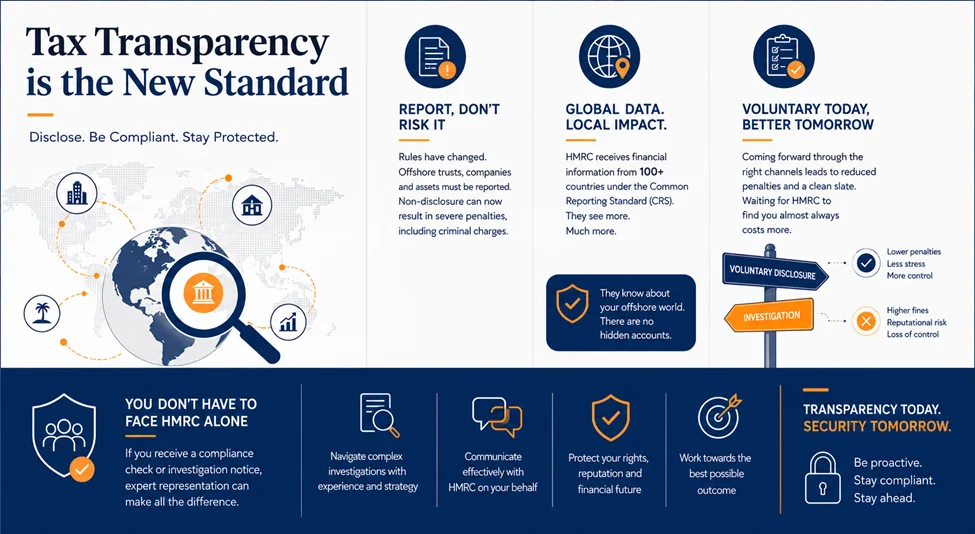
The government has also increased the pressure on disclosure. The abolition of non dom regime came with new requirements for reporting offshore interests. If you have an interest in an offshore trust or a foreign company, the penalties for not disclosing it are now severe.
HMRC’s Global Data Reach
HMRC now receives data from over 100 countries through the Common Reporting Standard (CRS). They know about your bank accounts in Singapore, your property in France, and your investments in the US. The old days of “don’t ask, don’t tell” are over.
Voluntary Disclosure vs. Being Investigated
If you have offshore interests that have not been properly declared, the Worldwide Disclosure Facility exists to help you come forward before HMRC comes to you. Voluntary disclosure almost always leads to better outcomes. Any UK private client tax planning accountant will tell you that total transparency is now the only way to avoid heavy fines or even criminal prosecution.
For individuals who receive a formal compliance check, having a team experienced in HMRC tax investigations behind you makes a significant difference.
How LANOP Supports HNWI Tax Strategy
At LANOP, we do not provide generic advice. We know that your situation is unique, and we treat it that way. We specialize in helping high-net-worth individuals navigate the chaos of the non-dom abolition in the UK 2025.
International Tax Structuring
If you are considering a move, we can help you evaluate your options. We have deep expertise in the UK-UAE corridor, helping clients set up robust structures in Dubai that comply with international standards while protecting their wealth. We bridge the gap between your UK exit and your new global life.
TRF and Mixed Fund Audits
We help you clean up your offshore accounts. Our team performs detailed audits to separate your capital from your income and gains. This allows you to use the temporary repatriation facility TRF UK effectively. We calculate exactly what you owe so you can bring your wealth into the UK at the lowest possible tax rate.
Estate and Succession Planning
The 10-year IHT tail is a massive threat to your legacy. We work with you to restructure your estate, using legal tools like FICs, PPLIs, and gifting strategies to reduce your exposure. Our goal is to ensure that your wealth goes to your family, not to the tax office.
High-Level Compliance Management
We handle the complex reporting requirements that come with the abolition of the non-dom status UK. From SRT day-counting to offshore trust disclosures, we make sure you are fully compliant with HMRC. We use the latest digital tools to manage your data, giving you clarity and peace of mind.
Conclusion
The non-dom status abolished UK headlines were just the start of a very long and complex process. The UK is no longer the tax-friendly destination it once was for the global elite. The new rules are designed to be transparent, aggressive, and expensive.
However, there are still ways to protect your wealth. Whether you choose the four-year FIG holiday, the 12% TRF window, or a complete relocation to a country like Italy or the UAE, the key is proactive planning. The worst thing you can do is wait for HMRC to send you a letter.
At LANOP, we are here to help you make these difficult decisions. We provide the senior-level expertise you need to navigate the UK non-dom reform impact. The landscape has changed, but with the right strategy, you can still secure your financial future. Book a private client tax consultation with our cross-border specialists to review your residency status, assess your exposure under the new rules, and build a protective structure tailored to your global circumstances.