Introduction
Opening a brown envelope from HMRC is a total gut-punch. That instant flash of panic, worrying about your cash flow, is something every business owner feels. But you don’t have to just roll over and pay. You have every right to fight back.
The mess starts with the paperwork. If you mix up the SA370 and the SA371, HMRC will bin your appeal on a technicality. It’s a massive waste of your 30-day window.
To get that fine cancelled, you need to pick the right form. Here is the simple breakdown of how to tell them apart and win your case.
What Exactly Are The SA370 And SA371 Forms?
Both forms do one specific thing. They let you challenge unfair tax fines. HMRC issues penalties automatically when a tax return or tax bill is filed or paid late. Their computer systems do not care why you were late. They just send the fine.
These forms are your way of getting a real HMRC officer to look at your case. However, HMRC splits taxpayers into strict categories. Individuals go in one category. Business partnerships go in a completely separate one. You cannot mix them up.
The SA370 is only for individuals. The SA371 is only for partnerships. Which one you need depends entirely on how your business is set up and registered.
When Should You Use The SA370 Form For Your Appeal?
This form is for people who file a standard Self Assessment tax return. That includes sole traders, freelancers, private landlords, and individual company directors.
If the penalty is linked to your personal Unique Taxpayer Reference (UTR), this is your form. You use it to fight penalties for both late filing and late payment.
The penalties for late filing build up fast:
- 1 day late – £100 fine, even if you owe no tax at all.
- 3 months late – £10 daily charge for up to 90 days (up to £900).
- 6 months late – 5% of the tax owed or £300, whichever is higher.
- 12 months late – another 5% or £300 on top.
You can use the SA370 to appeal at every single stage of this escalation. These are the same penalty thresholds that apply to anyone who files a Self Assessment tax return late, so the rules will already look familiar if you have dealt with HMRC deadlines before.
As for how to send it, many people submit online through their Government Gateway account. This is usually the fastest option and gives you a digital receipt straight away. Or you can print the form, fill it in by hand, and post it.
When Is The SA371 Form The Right Choice For Your Business?
Partnerships work under completely different tax rules. This form is only for penalties tied to a late Partnership Tax Return.
When a partnership return is filed late, HMRC does not issue one fine to the business. They issue a £100 fine to every single partner listed on the registration. Four partners means £400 in fines, instantly.
You might think each partner needs to appeal separately. That is not correct. HMRC requires only the “nominated partner” to handle the appeal. This is the person who originally registered the partnership for tax.
If anyone else signs the paperwork, HMRC will reject it. The nominated partner fills out just one form, not one per partner. If HMRC accepts the reason given, they cancel the fines for all partners at the same time.
This is one area where the rules for partnership tax returns differ significantly from individual Self Assessment, and it catches a lot of business owners off guard.
What counts as a reasonable excuse for your appeal?
You cannot just tell HMRC that you forgot the deadline. You cannot tell them you were too busy working. You must prove you had a legally valid “reasonable excuse.” A reasonable excuse HMRC appeal means an unexpected, unavoidable event stopped you from filing on time.
HMRC applies strict criteria here. They usually accept a sudden, severe illness. This includes emergency hospital stays or life-threatening conditions. They accept the recent death of a partner or a close family member.
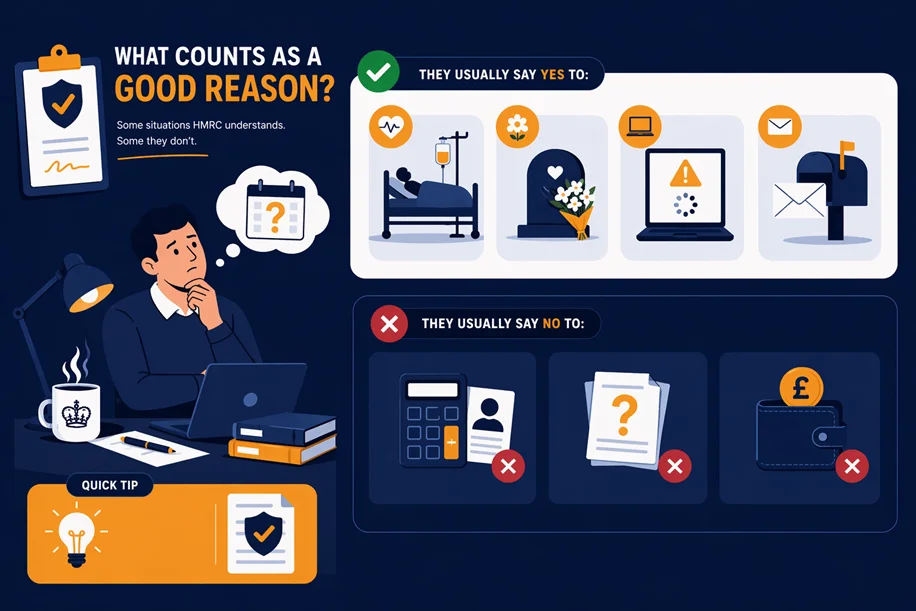
Sometimes, the fault lies with HMRC itself. If their online portal crashes on deadline day, this is a valid excuse. You must prove you tried to log in but their system failed. Unpredictable postal delays are also valid. If a fire, flood, or theft destroyed your vital business records just before the deadline, they will accept this too.
However, HMRC instantly rejects many common excuses. Relying on an accountant who missed the deadline will fail. HMRC legally views your tax as your personal responsibility. Finding the tax forms too complicated is not a valid excuse. Finally, not having enough money to pay your tax bill is never accepted as an excuse for failing to file the paperwork.
What Evidence Must You Gather For A Successful Outcome?
HMRC officers process thousands of appeals. They will not take your word for it. You must provide hard, undeniable proof. Your specific HMRC appeal evidence requirements depend entirely on the excuse you are claiming.
If your excuse is a medical emergency, you need letters from your doctor. You need hospital admission and discharge records. If you blame the post office for a lost return, you must provide tracking receipts. If you blame IT failures, you need screenshots showing the HMRC website error codes.
You must keep a meticulous record of dates. A strong HMRC appeal form checklist always includes your Unique Taxpayer Reference (UTR) and the exact date printed on your penalty notice.
Never send your original documents to HMRC. Always send clear photocopies. We strongly recommend writing a formal HMRC penalty appeal letter UK to act as a cover sheet. This letter should provide a brief timeline of events. It should clearly list the evidence you have attached. Without solid proof, your appeal is guaranteed to fail.
What Is The Step-By-Step HMRC Penalty Appeal Process?
Understanding the chronological steps helps you stay focused. The first step is checking the clock. You have a very strict HMRC appeal deadline in the UK to meet. You get exactly 30 days from the date printed on your penalty notice (Source: UK Government). This is not 30 days from the date you finally opened the letter.
- Step one is filing your missing tax return. HMRC rarely cancels a penalty if you still have not filed the required paperwork. Fix the original mistake first.
- Step two is paying any undisputed tax you owe. If you agree you owe £500 in tax, pay it. You are only appealing the penalty, not the actual tax bill.
- Step three is downloading the correct SA370 or SA371 form. Fill it out completely. Do not leave blank sections.
- Step four is gathering your documents for HMRC appeal and attaching them to your form.
- Step five is submission. If you post it, use recorded delivery. You must be able to prove HMRC signed for the envelope. If you use the online portal, save the final confirmation screen as a PDF.
What Are The Biggest Mistakes Business Owners Make?
At Lanop, we process hundreds of tax appeals every year. We see the exact same mistakes repeated by business owners who try to fight HMRC alone.
The single biggest mistake is being incredibly vague about dates.
If you write, “I was sick in January,” HMRC will reject your appeal. You must be precise. You must write, “I was incapacitated by illness from 14 January to 8 February.”
The second mistake is failing to explain the delay after you recover.
If your illness ended on 8 February, but you did not submit your tax return until 15 April, HMRC will reject your case. You must file your return immediately after the reasonable excuse ends. If it took you two extra months, you must explain exactly why.
The third common mistake is using emotional language.
Do not write a long essay about how unfair the tax system is. Do not complain about how hard you work. HMRC officers only care about facts, timelines, and evidence. Emotional rants distract from your actual excuse and often harm your case. Keep your writing cold, factual, and strictly professional.
How Much Does A Tax Penalty Appeal Cost In The UK?
Submitting an SA370 or SA371 is free. HMRC does not charge any fee to process an appeal. If you do it yourself, your only real cost is a few pounds for recorded delivery postage.
Your time has value though. Gathering evidence and working through the process takes hours away from running your business.
For a basic £100 fine, hiring an accountant may cost more than the fine itself. But if your penalties have built up to £900 or more, getting it right the first time is worth paying for. A rejected appeal means starting the whole process again, and you may not get a second window.
What Are The Next Steps If HMRC Rejects Your Initial Appeal?
A rejection is not the end. It is actually quite common, especially if a piece of evidence was missing. You still have strong options.
Statutory Review: Ask for an internal review. A completely separate HMRC officer looks at your case from scratch. You must request this within 30 days of the rejection letter (Source: UK Government). The reviewer usually gives their decision within 45 days. Many appeals are overturned at this stage.
First-tier Tribunal (Tax) : If the internal review also upholds the fine, you can take your case to an independent tax judge. This is a formal legal setting that takes time and serious preparation. Most standard penalty cases are sorted well before reaching this stage.
If your case escalates to an investigation or formal compliance check, it is worth understanding how HMRC tax investigations typically work, as the process becomes more involved at that point.
How Long Is The HMRC Appeal Processing Time?
Waiting for a decision is the most stressful part of the process. Understanding the standard HMRC penalty appeal timeline UK helps you manage your anxiety. The initial HMRC appeal processing time is usually quite fast. You should receive a basic acknowledgement letter within two to four weeks. This letter just confirms they have your paperwork. Reaching the actual final decision takes much longer. During peak tax seasons, like February and March, the system slows down. It can take up to eight or even ten weeks for an officer to finally review your evidence.
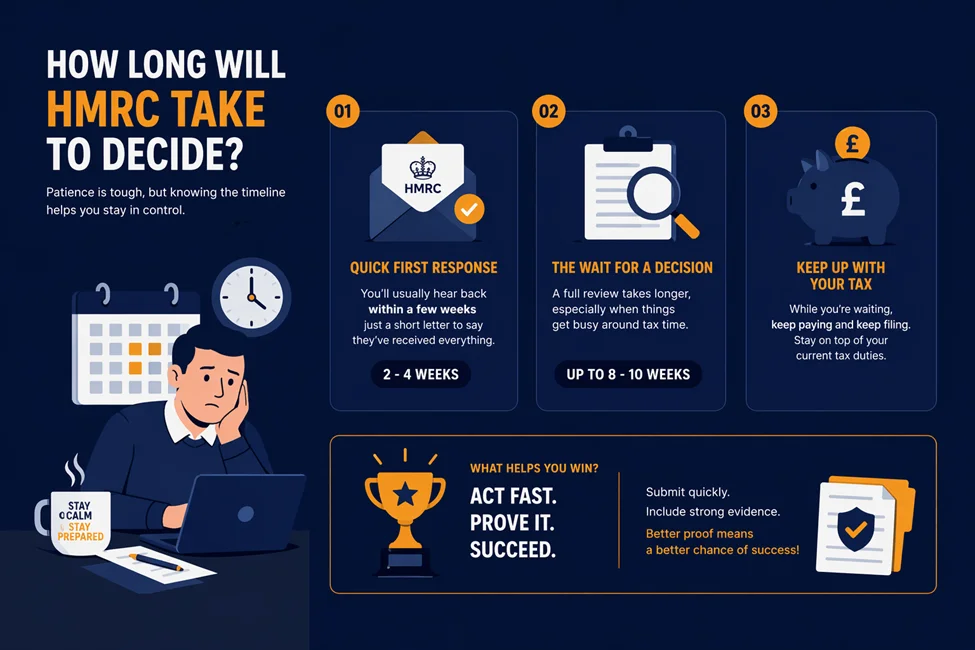
While you wait, do not ignore your current tax duties. Keep paying your ongoing tax bills. Keep filing your current returns on time.
The overall HMRC penalty appeal success rate depends entirely on your speed and your proof. Cases submitted quickly, with undeniable medical or technical evidence, have a brilliant chance of success. Cases submitted late, with zero proof, will fail every single time.
How Lanop Helps You Win Your Tax Penalty Appeal
Dealing with HMRC takes a lot of energy and pulls you away from running your business. At Lanop, we step in to handle the entire dispute so you don’t have to deal with the stress.
Our team works as qualified UK accountants who live and breathe tax compliance. Here is how we get your appeal sorted:
- Evidence Check: We know exactly what proof the taxman wants and the specific way it needs to be presented.
- Legal Review: Your situation gets a full look-over to make sure there is a solid, legal excuse to back your case.
- Paperwork Management: You won’t have to worry about picking the wrong form. We handle the SA370 or SA371 and draft all the cover letters.
- Deadline Security: All documents are filed and tracked to ensure you never miss that 30-day cutoff.
If HMRC refuses the first attempt or asks for a statutory review, the escalation process is fully managed by our team. Think of us as a shield for your business. This lets you stop worrying about tax fines and get back to your actual work.
CONCLUSION:
No one wants to pay HMRC money they don’t have to. If you get your records ready and move quickly, you can get that penalty dropped.
The most important bit is picking the right form. Whether you need the SA370 or the SA371, you have to be spot on. Get your proof together, explain what happened clearly, and get it sent.
If the paperwork is a mess or you’re short on time, don’t just ignore it. Get a bit of help to get the appeal done properly so you can put this behind you.
Frequently Asked Questions
No. If the fine is for a late Partnership Tax Return, the lead partner has to use form SA371. HMRC will just send an SA370 back if you try to use it for partnership issues. Use the SA370 only for your own personal tax.
You get exactly 30 days. The clock starts on the date printed on your letter, not the day you open it. Make sure your form gets to HMRC before those 30 days are up.
No. HMRC says the job of filing on time is yours, not your accountant’s. If they miss the date, you are the one stuck with the bill. You will have to settle that with your accountant yourself later.
HMRC rarely cares about late appeals. You would need a massive, documented reason for why the tax was late and why the appeal is also late. It is a very hard battle to win without serious proof.
No. HMRC needs it in writing to create a legal record. You have to send in the SA370 or SA371 forms. Calling or using webchat won’t count as a real appeal.
No. Being too busy or losing track of the date is never a good enough reason for HMRC. If you just forgot, it is better to pay the fine now before it gets even more expensive.
No. HMRC does not see “no money” as a valid excuse for a late return. File the return on time anyway to avoid the £100 fine. You can then ask them for a payment plan for the actual tax bill.
Never send your original copies. HMRC scans the mail and usually bins the paper copies after. Send clear photocopies of things like medical notes and keep the originals safe in your own desk.