Numerous individuals dream of becoming self-employed. It is all about you and nothing else. In the UK, that dream often starts with one simple step. You become a sole trader.
On the surface, it looks like an easy route. You get going fast, you stay in full control, and there is not much red tape to deal with. But like most things in business, there is another side to it.

Advice on how to set up is everywhere. What you hear far less about is the trade-offs. The setup is cheap and quick, and you don’t have to have a large team or a lot of money to save up. However, the disadvantages are equally as tangible and can bite back in the future. It’s a guide that takes you through both sides, so you can see everything before you register for anything.
What a Sole Trader Actually Is
A sole trader runs a business on their own, with no company sitting in between. In the eyes of the law, there is no split between you and the business. You keep the profits directly, and you also take on any debts or problems yourself.
That is the trade-off in one line. No intermediary and no one to hold accountable, but complete control in exchange. It’s the most popular way to start a company in the UK, and that is why so many freelancers, tradespeople, and side-hustle owners choose it.
There is no company to register and no board to answer. There is just you, your work, and your name on the line. For small setups and independent trades, that often makes good sense. It stays simple and flexible, right up until something unexpected happens.
Sole Trader and Self-Employed Are Not the Same
Here is the point that trips people up. Self-employment does not equate with being a sole trader. Not everyone who is self-employed is a sole trader; all sole traders are self-employed.
You could be in a partnership, or run your own limited company, and still count as self-employed for tax. So, is the sole trader model right for everyone? Not really. It’s easy, but easy isn’t easy. Control also entails that the weight is on you.
How to Register as a Sole Trader
Getting started is refreshingly simple. You do not register a company or file anything with Companies House. You just tell HMRC you are self-employed and sign up for Self-Assessment. GOV.UK says this is free and takes about ten minutes online.
You need to register if you earned or expect to earn more than £1,000 from self-employment in a tax year. Below that, the trading allowance usually covers you, and you may not need to register at all.
Once you sign up, HMRC sends you a Unique Taxpayer Reference, known as a UTR. It usually arrives within about ten working days, so do not leave it to the last minute. You use this number every time you file a return.
Deadlines and Numbers to Keep in Mind
There is one deadline to watch closely. GOV.UK says you must register by 5 October after the end of the tax year in which you started trading. Miss it, and you risk a penalty. After that, your main job each year is to file your Self-Assessment and pay what you owe by 31 January.
You can trade under your own name or pick a business name if you prefer. If your taxable turnover passes £90,000 in any rolling 12-month period, you also need to register for VAT. Keep your records for around five years too, in case HMRC ever asks to see them.
What Does a Sole Trader Need to Be Keeping
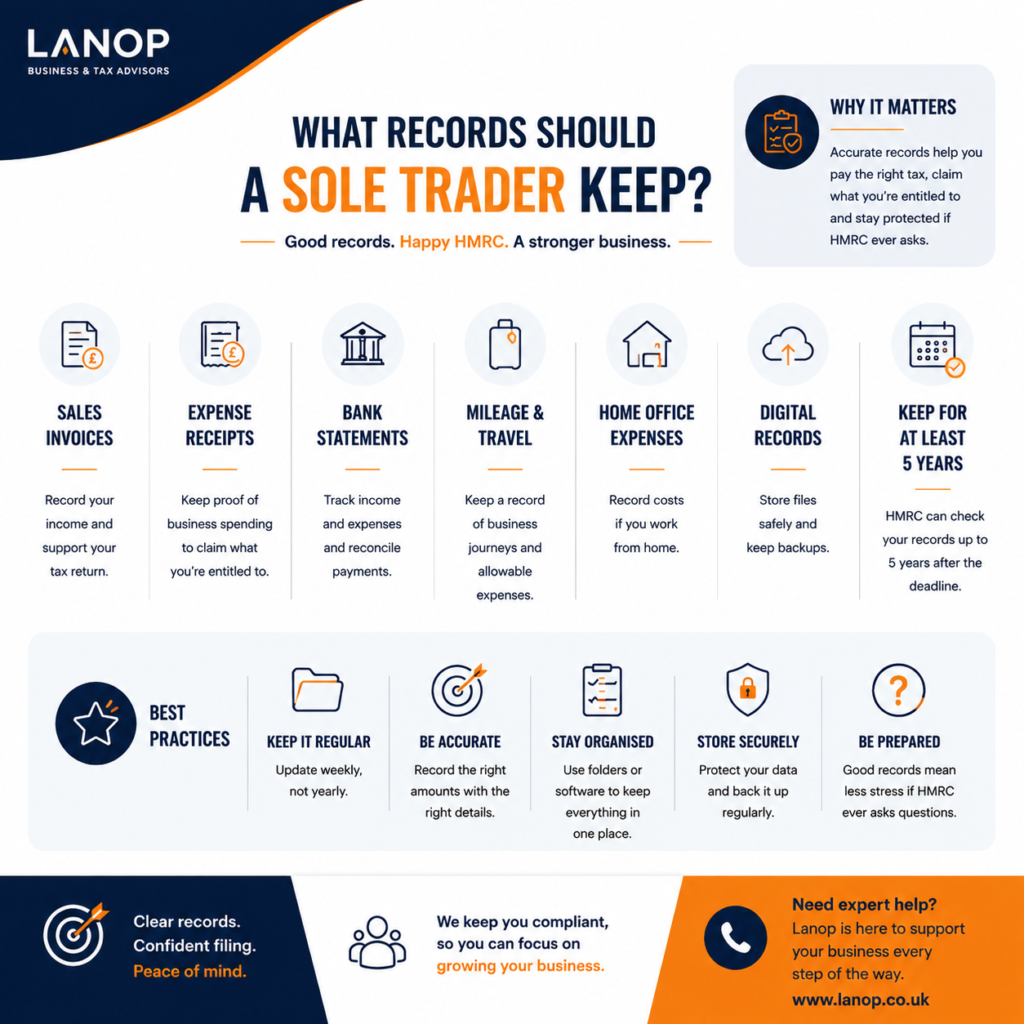
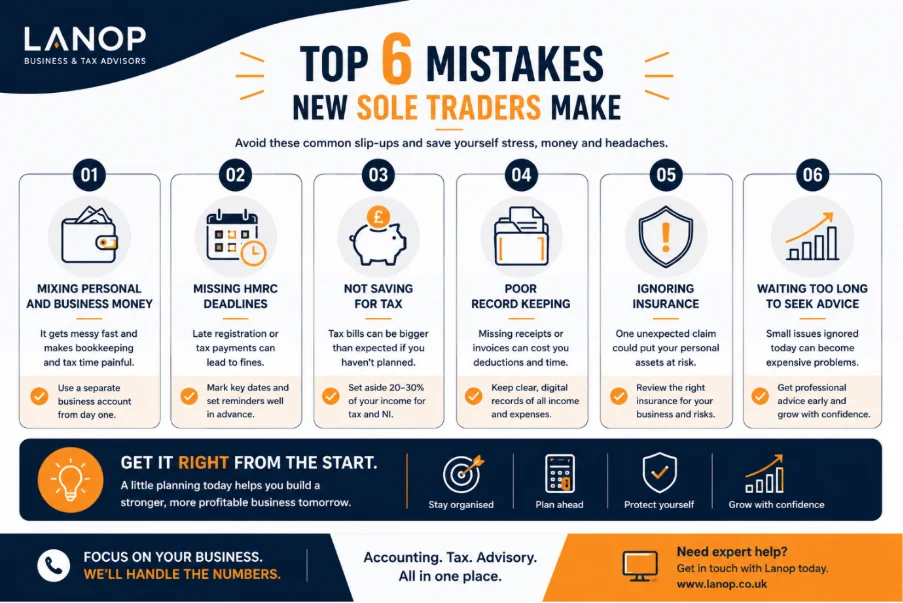
Being in business is not just about making money! It also involves maintaining a record of the inputs and outputs. If HMRC ever requests supporting documentation, good record-keeping will help you be ready and ensure you have fully claimed the expenses you are entitled to.
You are a sole trader, and as such you will need to maintain copies of sales receipts, bank statements, expense receipts and any other documentation that backs up your business income or expenses. Start with everything organised to save time, cut down on stress and make managing your finances as your business grows a breeze.
Prefer watching instead?
Here’s a video summary for you


Do You Need a Business Bank Account
Technically, no. You do not have to open a separate account as a sole trader. You can use your personal account and still stay within the rules. Many people do exactly this in the early months, when income is still low.
But just because you can does not mean you should. Once business and personal spending mix together, the two are hard to pull apart. That turns into a headache when you work out your expenses at tax time, or try to prove your income to a lender.
Opening a second account is neither costly nor hard. Most banks offer basic business accounts, and many help you track what comes in and goes out. It also sends the right signal to clients, to banks and to yourself, that you are taking the business seriously. So, the legal answer is no, but the practical answer is usually yes.
The Upsides of Going Solo
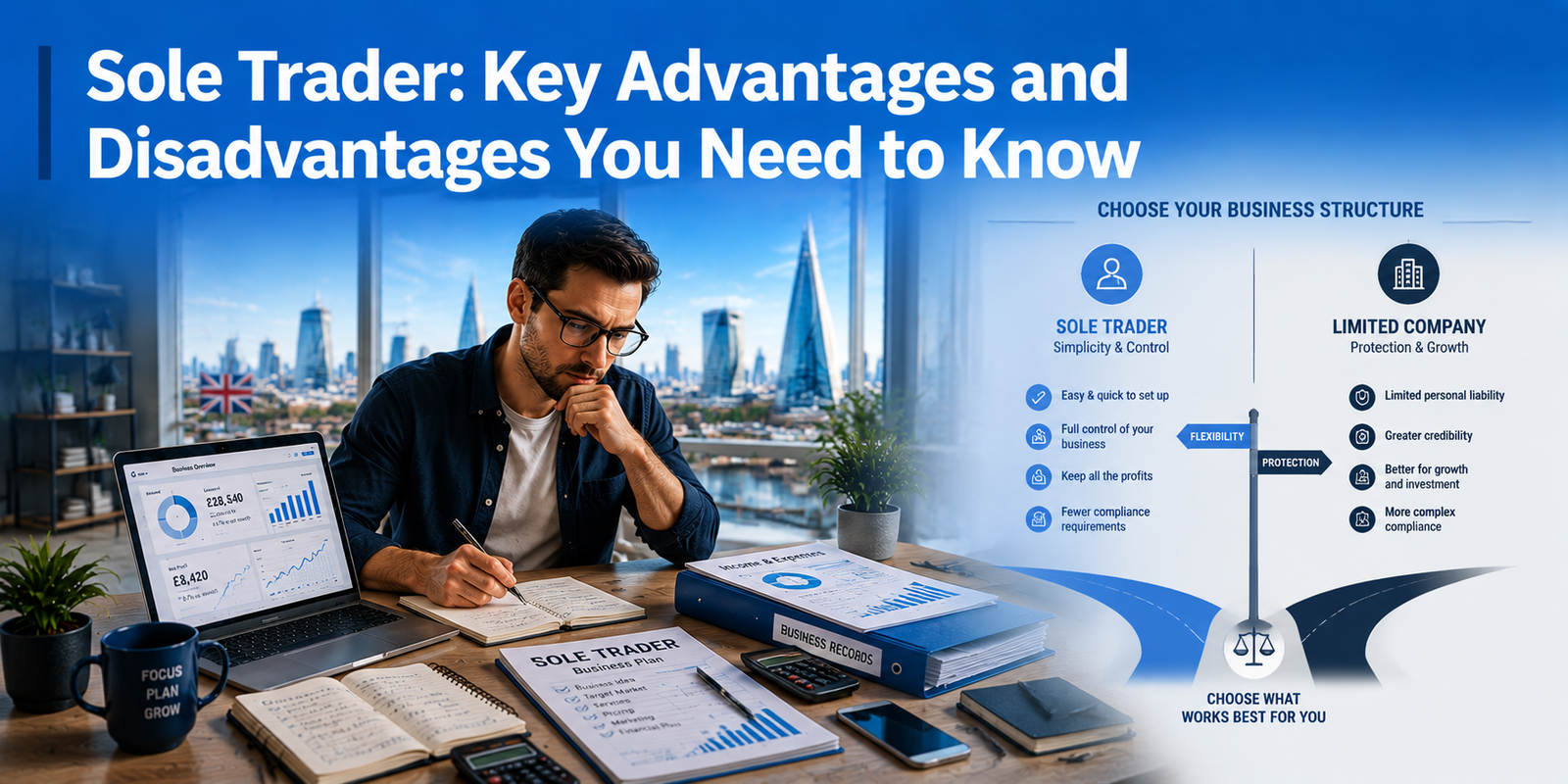
In addition, getting to the beginning of self-employment can be daunting. You’re thinking of some ideas, perhaps a plan, but the rules and paperwork can seem like a burden. Hence, the popularity of the sole trader option. It avoids getting bogged down in red tape and lets you jump straight to work. Let’s see how that’s applied in practice.
Full Control Over Every Call
Likewise, working for yourself means you call the shots. There is no committee, no partner and no boardroom to run things past. Furthermore, you mainly decide whom to work with, what to charge, when to grow and when to say no.
Some days that is a lot to carry. But it also means you can move fast. You do not need permission to try something new, and if a plan is not working, you can change course tomorrow. That freedom is one of the clearest perks of the job, and people rarely give it up once they have had it.
Costs You Can Claim Back
You can claim back many of your running costs. Tools, supplies, travel and other essentials can all count as allowable expenses. If you work from home, you can also claim a share of your home running costs.
GOV.UK lets you use simple flat rates for this, or work out the actual business share of your bills. These claims lower your tax bill in a legal, honest way. They will not make tax fun, but they do make it easier to handle, as long as you keep clean records through the year.
Cheap and Quick to Set Up
Becoming a sole trader does not take much fuss. There is no company registration and no solicitor needed. You tell HMRC you are self-employed, and you are good to go.
Because of that, the upfront cost is close to nothing. You are not spending money before you make any. There is no office you have to rent either. You can work from home, a café or a workshop, wherever suits you or is convenient for you. That is why the model is such a good fit for anyone who is mainly testing an idea or building something part-time.
Simpler Books and the New Digital Rules
Your books stay fairly simple. You only deal with your own income and your business expenses. There is no payroll, no balance sheets, and no director reports. You track what comes in and what goes out, keep your receipts, and file your return.
There is one key adjustment that you will need to be aware of at this time. Some sole traders will have to keep records differently following the launch of HMRC’s Making Tax Digital for Income Tax on 6 April 2026. From the beginning of this year, GOV.UK has introduced a new rule stating that individuals with income from property and self-employment greater than £50,000 will need to retain digital records and submit quarterly returns to HMRC via software that is usually compatible with them.
The threshold then drops to £30,000 from April 2027 and to £20,000 from April 2028. So the old idea that a sole trader never needs accounting software no longer holds for everyone. If you earn below the threshold, your yearly Self-Assessment carries on as normal. Either way, tidy records keep you ahead, even if numbers are not your strong point.
The Downsides Worth Knowing
Going solo has clear perks. But if you are weighing it up, it helps to see what can make the road harder. Not every challenge shows up at the start. A few creep in once the work piles up or an unexpected cost lands. None of this is meant to scare you. It is simply what many people wish they had known on day one.
You Carry All the Risk
Let us blunt. If something goes wrong in the business, it is on you. There is no protective shell around your money. If a client takes legal action, a payment falls behind, or the business fails; your personal savings and assets could be at risk.
It sounds dramatic, but it is the plain truth. There is no legal split between your personal and business life. The other side of freedom is exposure. If you work in a trade with any level of risk, this matters far more than people expect.
Raising Money Is Harder
Here is something that catches people off guard. Funding can be tough to get. Banks and lenders like structures, and a limited company often looks more solid on paper. A sole trader is just you.
That means you may lean on savings, personal credit cards or informal loans. When it is time to grow, buy new kit, rent space or take someone on, those options can feel narrow. This one rarely shows up on day one. It creeps in once you are ready to expand, and the road ahead suddenly feels tighter.
Tax and Deadlines Land on You
In theory, the tax process is simple. In practice, the stress adds up. There is no finance person to chase receipts for you. You track it, you report it, and you sort it out with HMRC when something does not line up.
As your income grows, things get messier, and deadlines get harder to juggle. With Making Tax Digital now live for higher earners, some sole traders also face quarterly updates instead of one return a year. And if you slip up, the penalty lands on you, not on a faceless company. It is fine at the start, but after a year or two, many people want help so they do not fall behind.
The Toll of Working Alone
This one is not about tax or law. It is about your day-to-day. When everything rests on you, the pressure shows up fast. Some weeks feel non-stop. There are no sick days and no backups. If you stop, the business stops.
Then there is quiet. Working alone feels great at first. Peaceful mornings, no office politics, full focus. But give it six months, and you may miss having someone bounce ideas off. You start to notice the silence between tasks. These strains are real, and they are some of the most underrated downsides of going solo.
Is the Sole Trader Route Right for You
Sometimes you just want to start. You have a skill, or a plan, or you are still working it out, and you are tired of waiting for the perfect moment. In that case, becoming a sole trader is the easiest way to get moving.
But everything falls on you. There is no backup team. You send the invoices, chase the payments, keep the receipts and answer the emails. It sounds obvious, yet the weight of it only really lands after a few months.
Whom It Suits and Whom It Does Not
Some people love working this way. They prefer to work alone and keep full control. They are not chasing a big brand or a large team. They just want to earn, manage their time and keep things simple, and for them this setup works well.
Others feel boxed in. If you want to build something big, or you know you will need funding later, the model can feel limiting. That is not a failure. It just means your business may need more structure sooner than you thought.
How Lanop Can Help You Get Started
Starting a business can look easy from the outside. Once you are in it, even sole trader life throws up a dozen questions. When do I register? What can I claim? Am I keeping the right records? What happens if I get something wrong?
That is where we come in. At Lanop, we do not hand you generic steps or point you at a long form. We talk it through. What you do, what you earn and where you are heading. Then we help you set it up properly.
If you are already trading, we check what is missing and help you catch up. We can also handle your tax return each year and get you ready for Making Tax Digital if it applies to you. If you are unsure about anything, ask. That is where it all starts.
Take Your Time Before You Decide
Choosing to operate as a sole trader is not just about what is easier to do these days. Mainly, it’s about choosing a structure that supports your ambitions, finances, and the way you want your business to grow. Also, many successful business owners start as sole traders and later move to a limited company as their circumstances change. What is more significant is making an informed decision that works for your goals, not someone else’s.
Moreover, if you are clueless and unsure, our team of financial advisors at Lanop is here to help. We take the time to understand your business, explain your options more easily, and recommend the structure that best fits your current needs and plans. Furthermore, whether you are starting your first venture or reviewing your existing setup, do try to speak to our experts today and build your business with certainty from the very beginning.
FAQs
When does it make sense to move from sole trader to limited company?
Honestly, there’s no magic number or deadline here. It’s more of a gut feeling that builds over time. You might start weighing it up once your profits climb, once you’re taking on bigger risks, or once you realise you want a business structure that can actually grow with you and shield you a bit more legally.
What exactly are payments on account, and why do they trip people up?
Payments on account mean HMRC collects next year’s tax early, usually as two instalments based on last year’s bill. That’s on top of what you already owe, which is what catches people out. Plan so it doesn’t surprise you.
Should I bother with insurance as a sole trader?
It’s not something the law always forces on you, but skipping it can leave you exposed if things go wrong. How much cover you actually need comes down to what your business does, whom you’re working with, and how risky your day-to-day work really is.
Am I allowed to hire staff as a sole trader?
Yes, and it doesn’t change your business setup at all. What it does mean is you’ll suddenly have real employer responsibilities. Think proper payroll, paying at least the National Minimum Wage, and giving new hires a written statement of employment.
Is getting a mortgage possible while I'm a sole trader?
It is, and plenty of lenders are used to working with sole traders. That said, they’ll want to see solid proof your income is steady, not just a good month here and there. Keeping your books tidy and filing your tax return on time genuinely helps your chances when it’s time to apply.