
Does Transferring a Home to a Company Count as a Disposal for SDLT Refunds?
You buy a new home before selling your old one. This means you pay the higher SDLT rate. You can claim that extra tax back, but you must sell your old home within three years.
What happens if you don’t sell it? What if you transfer your home to a limited company instead?
This is the key question. Does a transfer to a company disposal qualify for an SDLT refund?
A limited company is a separate legal entity. When you move your home into company ownership, you give up your personal title. That looks like a disposal. But HMRC won’t accept it unless the transfer is genuine and complete.
HMRC checks four things:
- Did you transfer the entire major interest?
- Did the transfer happen within three years?
- Do you or your spouse still hold any interest?
- Does the deal have a real commercial purpose?
Many people get this wrong. Simply transferring ownership doesn’t constitute a disposal for refund purposes. The connected persons rules may apply. The company may also owe SDLT on the transfer.
A company transfer can qualify. But every condition must be met. Small errors often lead to a rejected claim.
What Does “Disposal of a Major Interest” Mean for SDLT?
To qualify for a refund, you need to know what HMRC means by a disposal of a major interest for SDLT purposes.
Under the Finance Act 2003, a major interest is a freehold or a leasehold of more than seven years. To get a higher rate refund, you must give up your entire major interest in your old home.
Keeping even a small share blocks the refund. This applies whether you hold it directly or through a trust.
A disposal doesn’t have to be an open market sale. A gift of property to a company can still count as a disposal. But you and your spouse must hold no major interest after the transfer.
Mortgages matter too. If the company takes over your old mortgage, HMRC treats that debt as payment. In connected company deals, the market value rule may apply. This means SDLT is based on the full market value, not what was actually paid.
A transfer to a company can be considered a disposal. But full ownership must genuinely pass to the company.
How Does HMRC Treat Transfers to Limited Companies?
When you move property to a company you control, the connected persons rules apply. Under Section 1122 of the Corporation Tax Act 2010, you are connected to a company if you control it.
This triggers Section 53 of the Finance Act 2003. The transfer to company disposal must be taxed at the market value of the property on the date of transfer.
This rule stops people from avoiding SDLT by gifting property to their own company. Even if you transfer the home to LTD for free, the company must file an SDLT return. It must pay tax based on the open market value.
This creates a real entry cost. You need to weigh that cost against any personal refund you might get.
SDLT Treatment: Individual vs Company
| Factor | Individual (Refund) | Company (Purchase) |
|---|---|---|
| Surcharge Rate | 5% refund if conditions met | 5% surcharge applies |
| Valuation Basis | Based on tax paid at purchase | Deemed market value (Section 53) |
| Thresholds | Based on personal purchase price | 17% rate above £500k |
| Main Goal | Replace main residence | Buy or hold an asset |
How Does the SDLT Refund 3-Year Rule Work?
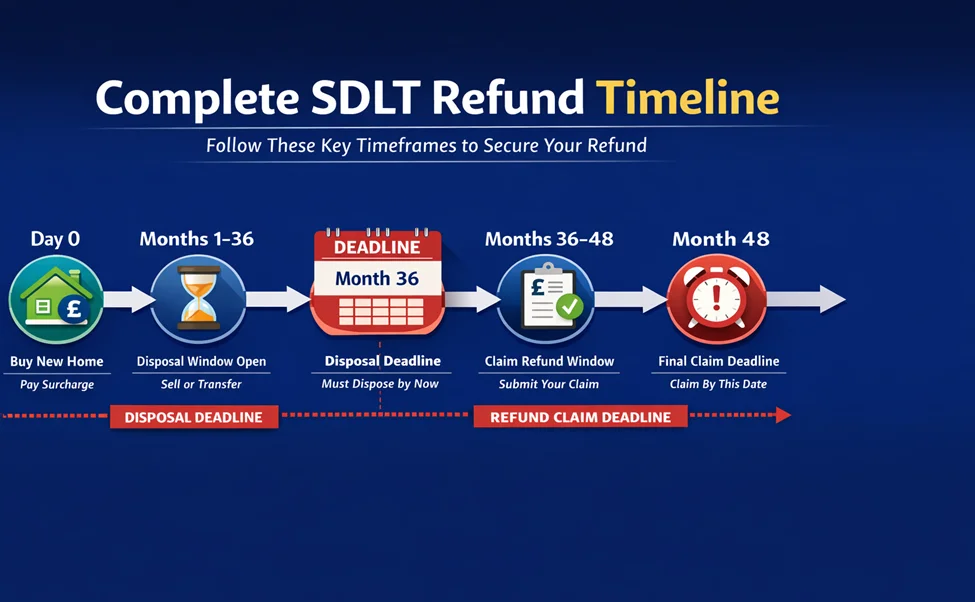
To qualify for the SDLT higher rates refund, timing is strict. Under the SDLT refund 3-year rule, you must dispose of your old home within three years of buying your new one.
The three-year period starts on the completion date of your new purchase. If you completed on 1 June 2024, you must dispose of the old home by 31 May 2027.
Missing the deadline by one day normally means losing the refund. This SDLT refund timing HMRC rule has no flexibility for normal delays. Slow conveyancing or mortgage issues don’t extend the window.
HMRC may give extra time in rare cases, such as serious legal barriers beyond your control. But slow markets or pricing problems don’t count. Always check your completion dates before planning a transfer.
What About Spouse and Partial Ownership Issues?
SDLT treats spouses and civil partners as one unit. If one spouse owns an old home, that interest is shared for SDLT purposes.
Say a wife buys a new home in her sole name. But her husband still owns their old home. She must pay the higher rate. This is how the SDLT refund spouse still owns rule works.
For a refund, neither you nor your spouse can hold any major interest in the old property after the disposal. An SDLT refund partial ownership plan will fail. For example, transferring 99% to a company but keeping 1% personally blocks the refund. Full transfer is required.
Can You Get an SDLT Refund Without Selling?
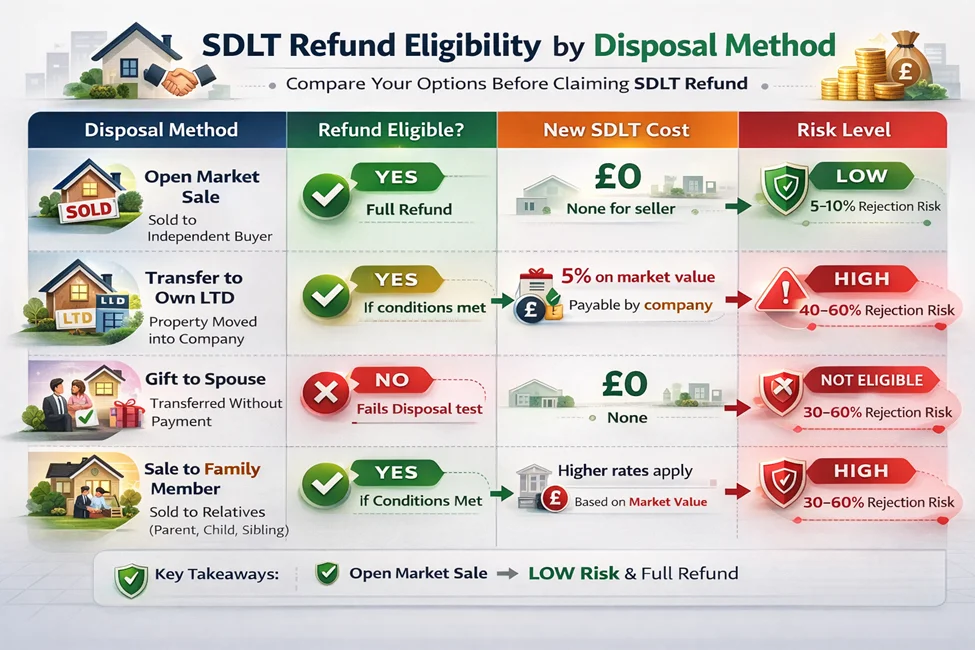
Yes, it’s possible. You can get an SDLT refund without selling it to a third party. A transfer to a company can be considered a disposal. But it often shifts to a tax bill rather than removing it.
Many people want to transfer home to LTD to keep the property as a rental. They also want to recover the surcharge on their new home. This can work. But every statutory condition must be met in full.
What Is the Step-by-Step SDLT Refund Process?
If you complete a transfer to company disposal within three years, you must apply to HMRC. The refund isn’t paid out on its own. You must make a formal claim.
Check the deadline: The SDLT refund claim deadline is 12 months from the date of disposal, or 12 months from the filing date of your SDLT return for the new home. Use whichever is later.
Choose how to apply: Most claims go through the Government Gateway online portal. For complex cases, you can use the SDLT16 refund form. You fill it in, print it, and post it to HMRC.
Find your UTRN: This is the Unique Transaction Reference Number from your SDLT return for the new home. HMRC uses it to track your claim.
Confirm the dates: You must report the completion date of your new purchase and the date of the company transfer. Both must be correct.
State the amounts: Tell HMRC the total SDLT you paid on the new property and the exact amount you’re claiming back. This is usually the 5% surcharge.
Expect interest: HMRC will normally add an SDLT refund interest payment to your refund. This covers the time from when you first paid the tax.
You may also be able to amend SDLT return refund details if the company transfer happens before the filing deadline for the new home. In that case, you complete the return without the higher rates. But in most cases, you pay the surcharge first and claim it back later using SDLT16.
What Evidence Is Required for an SDLT Refund?
HMRC checks refund claims carefully. Your evidence for SDLT refund must show two things: first, that a real disposal took place; second, that the old property was your main home.
TR1 transfer deed: This is filed at the Land Registry. It shows the company as the new legal owner.
Solicitor’s completion statement: This shows how the deal was settled, for example, via a director’s loan or mortgage transfer.
Main residence proof: HMRC may ask for utility bills, council tax records, or voter roll entries from the old address.
Mortgage documents: These show that your personal mortgage on the old home was paid off and, if needed, replaced by a company mortgage.
A common mistake in the SDLT refund solicitor documents checklist is failing to transfer the beneficial interest. Some people move the legal title to a company but keep the beneficial interest through a trust deed. This usually blocks the refund.
Why Does HMRC Reject Refund Claims?
A rejected claim can be very costly. SDLT refund rejected reasons tend to follow a clear pattern.
Missed deadlines: Applying one day late after the 12-month window means losing the refund. The same applies if the transfer happens after the 36-month disposal window.
Retained interest: Keeping even a tiny share of the old home will trigger rejection. The Sajedi case confirmed this. A leasehold interest of more than 21 years also counts.
Weak main residence proof: If the old home wasn’t your primary residence within the relevant period, the replacement test fails.
Uninhabitable property claims: Arguing that the old home was uninhabitable is very hard to win. In Mudan v HMRC, the court ruled that if a property was previously used as a home and still retains the character of a dwelling, it remains a dwelling for SDLT purposes, even if it requires repairs.
No real commercial purpose: If the company transfer looks like a paper exercise set up only to get the refund, HMRC can use the General Anti-Abuse Rule or the Ramsay principle to deny it.
If HMRC rejects your claim, you can appeal to the First-tier Tribunal. You must do this within 30 days of the rejection notice. You’ll need to show that every statutory test was met. This is why getting advice early is so valuable.
Case Study: Securing an SDLT Refund After a Company Transfer
One of Lanop’s clients bought a new home while still owning their previous property. They paid the higher rate surcharge at completion. They chose to move house into company as part of a long-term rental plan.
After the transfer, they tried to claim the SDLT higher rates refund. They assumed the transfer to company disposal would qualify. HMRC raised questions. It asked whether a valid disposal had taken place and whether all conditions were met. The client came to Lanop before the SDLT refund claim deadline passed.
What Lanop Did
We reviewed the whole structure. We confirmed that the full major interest had been transferred. We checked that no beneficial interest had been kept. We also checked that the deal fell within the SDLT refund 3-year rule and that the mortgage transfer was properly recorded.
We then wrote a clear technical response to HMRC. We explained why the SDLT refund transfer company claim met the replacement of main residence rules.
The Outcome
HMRC accepted that a full disposal had taken place. The client got the surcharge back on their new home.
Client Testimonial: “We assumed moving the property into our company would be simple, but HMRC’s questions showed how technical the rules are. Lanop explained our position, handled all the letters, and got the refund approved. Their care made all the difference.” — James Whitmore, Property Investor, London
How Can Lanop Business and Tax Advisors Help?
SDLT refunds after company transfers are rarely simple. Questions around disposal, connected persons, mortgage treatment, and the SDLT refund 3-year rule all need careful analysis. Small errors can cost you the refund or create new tax bills.
Lanop Business and Tax Advisors offer clear checks on whether you qualify before you proceed with a transfer to company disposal. We review refund claims, including SDLT refund transfer company cases. We advise on connected companies and market value issues. We also help with HMRC enquiries and disputed claims. And we give guidance on whether company ownership fits your wider tax plan.
Getting advice early prevents costly mistakes. It also keeps you in line with how HMRC reads the rules.
Conclusion
Transferring a property to a limited company can count as a disposal for SDLT refund purposes. But only if all legal and statutory conditions are fully met.
The rules are strict. You must give up your entire major interest in your old home. You must do so within three years. And neither you nor your spouse can keep any interest in the property.
HMRC doesn’t accept a transfer to company disposal as a given. HMRC will check whether real ownership changed hands and whether the deal has substance. Mortgage treatment connected person rules, and the three-year limit all affect whether an SDLT refund transfer company claim succeeds.
For most people, the challenge isn’t the idea of a company transfer. It’s handling the detail correctly. A missed deadline or a wrong interpretation of disposal can cost you the refund for good. Plan carefully before you act. When large sums are at stake, early advice is always worth it.
FAQ
Yes, it can. A transfer to company disposal may qualify if you give up your entire major interest and keep no legal or beneficial ownership. HMRC will check whether real ownership has passed to the company.
It may qualify if it meets the replacement of main residence rules. You must dispose of your old home within three years. Neither you nor your spouse can retain any interest.
Yes. You may claim the 5% surcharge back if the company transfer counts as a valid disposal and all statutory conditions are met. Timing and ownership are both critical.
Yes, it can still count. But HMRC will look more closely due to the SDLT refund connected persons rules. The disposal must be full and commercial.
A gift of property to a company can qualify as a disposal. You must transfer the full major interest and keep no share. The lack of payment doesn’t block the disposal test.
Mortgage assumption alone doesn’t determine whether a disposal has occurred. But if the company takes over the mortgage, HMRC treats that debt as chargeable consideration for SDLT.
For SDLT, the disposal date is the completion date. Land Registry registration doesn’t set the effective date.
Generally, no. You must have given up the major interest in your old home. You can’t qualify while you still own it.
Yes. Any retained beneficial interest, even a very small share, can block the refund. This is a common reason for SDLT refund partial ownership claims being denied.
Usually not. You must give up the whole major interest. Keeping any part of it will normally block the refund.
No. The SDLT refund spouse still owns rule is clear. Spouses are treated as one unit. If your spouse holds any interest, the refund will be denied.
No. The same three-year rule applies. The disposal must be done within three years of buying the new home, no matter how the transfer is structured.
The SDLT refund claim deadline is 12 months from the disposal date or 12 months from filing the original SDLT return, whichever is later.
In most cases today, you amend the original SDLT return online. The SDLT16 refund form is only used when online amendments aren’t possible.
HMRC needs your SDLT reference number, completion statements, a TR1 transfer deed, and proof that no ownership was kept. Clear SDLT refund solicitor documents are key to avoiding delays or a rejected claim.