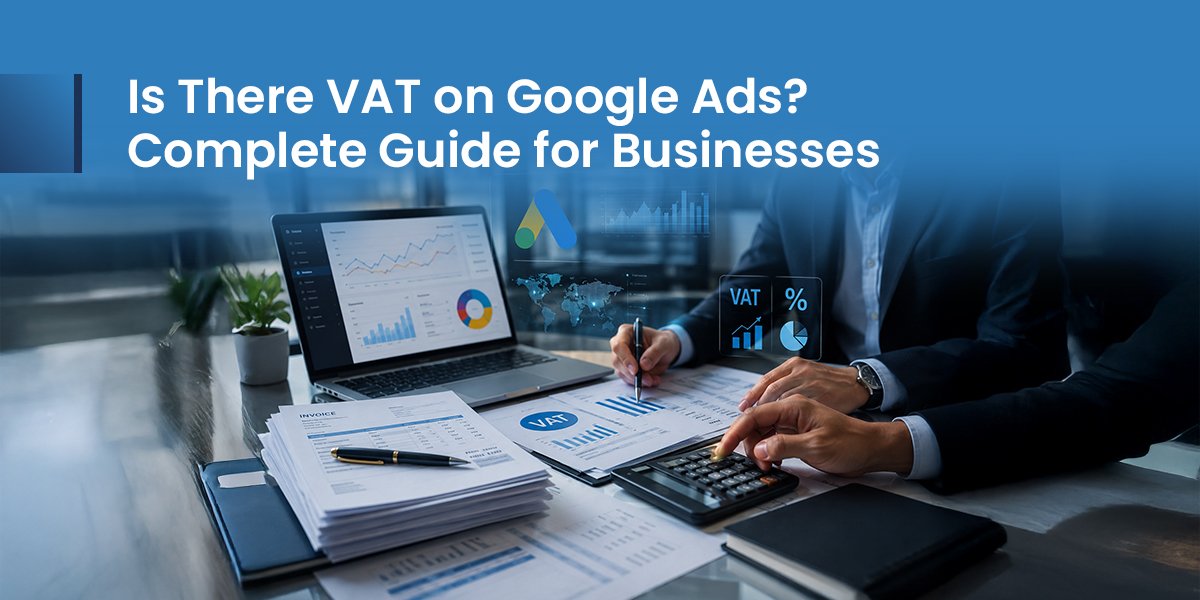
Google Ads helps many UK businesses grow online. But many business owners get confused when the invoice arrives. The invoice often shows 0% VAT and a billing address in Dublin, Ireland. This leaves many businesses asking the same questions.
Why is Google Ireland charging me? Do I still pay VAT? Could HMRC see this as incorrect reporting? Many businesses misunderstand VAT on Google Ads in the UK because reverse charge VAT rules can feel complicated at first. If handled incorrectly, it may lead to bookkeeping mistakes or VAT reporting issues.
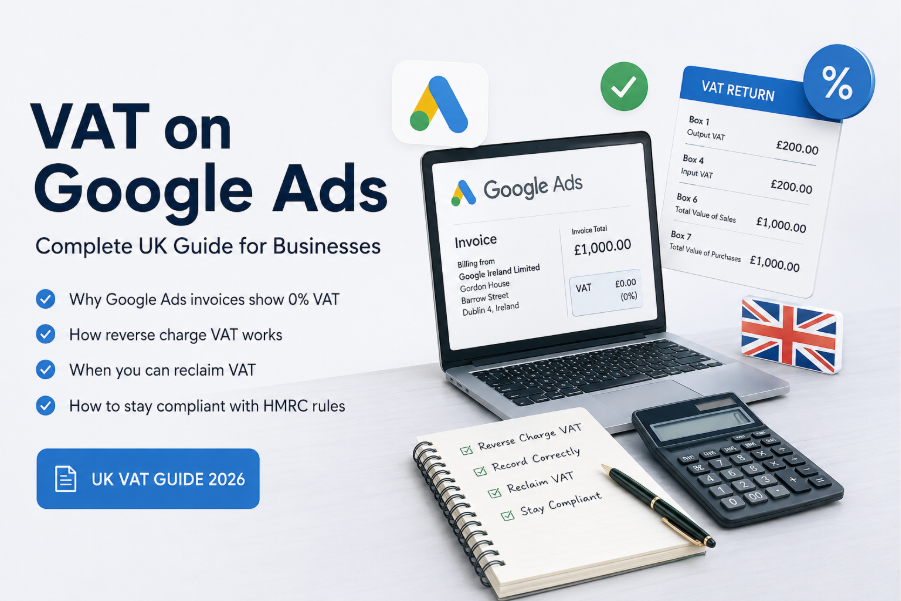
This guide explains VAT on Google Ads in simple terms. You will learn how reverse charge VAT works, when businesses can reclaim VAT, and how to stay compliant with HMRC rules in 2026.
Does Google Ads Charge VAT in the UK?
Google Ads usually does not add UK VAT directly to business invoices. Still, that does not mean the service is outside VAT rules. Many UK businesses must handle the VAT themselves through reverse charge accounting.
Is There VAT on Google Ads?
Yes, but it works differently from a normal UK supplier invoice.
Google normally supplies advertising services through Google Ireland Limited. HMRC treats these services as imported business services because they come from outside the UK. This means the business buying the ads becomes responsible for reporting the VAT.
Why Do Google Ads Invoices Show 0% VAT?
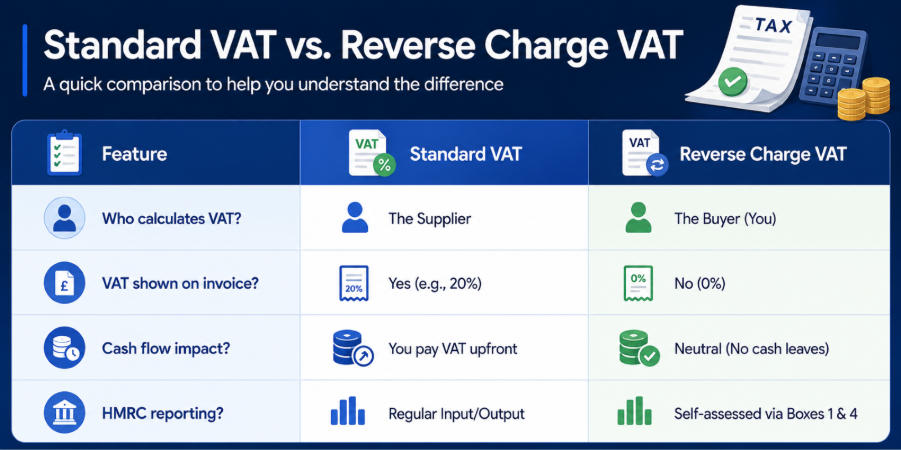
Many businesses notice £0.00 beside the VAT section on Google Ads invoices. This happens because Google uses reverse charge VAT instead of charging standard UK VAT directly.
Rather than collecting VAT itself, Google expects VAT-registered businesses to record the VAT on their own VAT return.
That is why many VAT on Google Ads invoices show no added VAT even though VAT rules still apply.
Why UK Businesses Are Billed by Google Ireland Limited
Google centralises its European operations in Dublin. Because Ireland is a different tax jurisdiction from the UK, the sale is considered a cross-border B2B (business-to-business) transaction.
Do You Still Need to Report VAT if Google Charges None?
Yes. Even though the invoice says 0%, you are legally required to report this to HMRC if you are VAT-registered. If you are not VAT-registered, these “0% invoices” still count toward your total turnover, which could force you to register for VAT sooner than you think.
Why Google Ads Invoices Come from Ireland
Understanding the why behind the Irish invoice helps clarify your accounting obligations.
Who Is Google Ireland Limited?
Google Ireland Limited is the company’s headquarters in Europe, the Middle East and Africa (EMEA). This is a company based in Ireland, not Google UK Ltd, which specialises in marketing and local support for most advertisers based in the UK.
Why UK Businesses Receive Irish Invoices
By billing from Ireland, Google follows international tax treaties. For digital services supplied from one country to a business in another, the “place of supply” is where the customer is based.
How Cross-Border Digital Services Affect VAT Google Ireland Limited is the company’s headquarters in Europe, the Middle East and Africa (EMEA). This is a company based in Ireland, not Google UK Ltd, which specialises in marketing and local support for most advertisers based in the UK.
Digital services like online advertising are subject to specific rules. Since the service is “consumed” by your UK business, UK VAT rules apply, but the reverse charge system is used to simplify the process for the international seller.
Why Google Ads Uses Reverse Charge VAT
If Google had to register for VAT and collect taxes in every single country where it has customers, the administrative burden would be immense. The reverse charge system places that burden on the business customer, who is already integrated into their local tax system.
What Is Reverse Charge VAT on Google Ads?
The reverse charge is the most critical concept for any business owner using Google Ads.
Reverse Charge VAT Explained in Simple Terms
Essentially, the reverse charge is an accounting “loop” where you act as both the supplier and the customer for VAT purposes. You “charge” yourself the VAT and then “reclaim” it immediately on the same tax return.
How Reverse Charge VAT Works for UK Businesses
- You receive an invoice for £1,000 from Google with 0% VAT.
- You calculate what the VAT would have been (£200 at the standard 20% rate).
- You record £200 as Output Tax (VAT you owe HMRC).
- You record £200 as Input Tax (VAT you are reclaiming).
Why Google Does Not Charge UK VAT Directly
Google assumes that any business using its platform is a taxable person. By providing your VAT number in your Google Ads billing settings, you confirm your status, allowing Google to legally issue invoices without adding VAT.
Add your VAT number to Google Ads is something you can do. You can add your VAT number into Google Ads.
You shouldn’t include your VAT number in Google Ads billing settings as this can lead to the VAT being incorrectly applied on an invoice.
What Reverse Charge VAT Means on Your VAT Return
When you file your return via software like Xero or QuickBooks, the reverse charge affects several boxes:
- Box 1: You add the “notional” VAT amount here.
- Box 4: You add the same “notional” VAT amount here (to reclaim it).
- Box 6: You include the net value of the purchase.
- Box 7: You include the net value of the purchase.
Is Reverse Charge VAT VAT-Neutral?
For most businesses, yes. Because you add and subtract the same amount, there is no physical cash payment to HMRC for that specific transaction. However, it must still be recorded to show a transparent audit trail.
What Happens if You Ignore Reverse Charge VAT?
Ignoring it makes your VAT return technically inaccurate. While it might not result in a net underpayment of tax, HMRC can still issue penalties for “careless” reporting or inaccurate record-keeping.
Can You Claim VAT on Google Ads?
The ability to claim VAT depends entirely on your business’s VAT status and the nature of your trade.
Can VAT-Registered Businesses Reclaim Google Ads VAT?
Yes. If you are VAT-registered and use Google Ads to promote your taxable supplies, you can reclaim the VAT via the reverse charge mechanism. Since you are “charging yourself” the VAT, the “reclaim” simply cancels out the charge.
When Google Ads VAT Is Usually Recoverable
You can recover the VAT if the advertising is used purely for business purposes to generate sales that are standard-rated, reduced-rated, or zero-rated.
When VAT Cannot Be Fully Reclaimed
You cannot reclaim the VAT if:
- The ads are for personal use.
- Your business is not VAT-registered.
- Your business is partially exempt.
VAT Recovery for Partially Exempt Businesses
If your business makes both taxable and exempt sales (e.g., a financial services firm or a health provider), you may only be able to reclaim a portion of the VAT. In this scenario, the reverse charge is not VAT-neutral. You will owe the “Output” portion but can only reclaim a percentage as “Input.”
Can Marketing Agencies Reclaim VAT on Client Ad Spend?
This is a common pain point. If an agency pays for a client’s Google Ads directly, the agency records the reverse charge. However, it is usually cleaner for the client to pay Google directly, so the tax liability sits with the ultimate beneficiary of the service.
Google Ads VAT for Non-VAT-Registered Businesses
If you are not VAT-registered, the rules are slightly different and arguably more dangerous.
Do Non-VAT-Registered Businesses Still Need to Consider VAT?
Yes. Just because you aren’t registered doesn’t mean VAT doesn’t exist. When you buy services from Google Ireland, you are “importing” them.
Can Sole Traders Reclaim VAT on Google Ads?
No. If you are not VAT-registered, you cannot reclaim any VAT. You simply treat the total amount paid to Google as a business expense to reduce your taxable profit.
What Happens if You Do Not Add a VAT Number?
If you don’t provide a VAT number, Google may treat you as a “private consumer” (B2C). In some cases, they might charge Irish VAT or UK VAT directly. However, for UK business accounts, Google usually insists on a VAT-registered status for specific features.
When Google Ads Spend Becomes a VAT Issue
The biggest risk for small businesses is the registration threshold. HMRC rules state that the value of “imported services” (like Google Ads) must be added to your UK turnover when checking if you have hit the £90,000 limit.
Is it worthwhile for small businesses to register for VAT?
If you do spend a lot on Google Ads, you may want to opt-in. This means that you can continue to be compliant with the reverse charge rules and, perhaps, obtain the VAT on the other business expenditure back.
Can Google Ads Spend Push You Over the VAT Threshold?
This is the Hidden Trap many startups fall into.
How HMRC Treats Imported Digital Services
HMRC views imported services as part of your “taxable turnover.”
Do Reverse Charge Services Count Toward VAT Obligations?
Yes. To calculate if you need to register for VAT, you must add:
[Your Total UK Sales] + [Your Total Google Ads/Meta Spend] = Your VAT Turnover.
When Businesses Must Register for VAT
If the combined total above exceeds £90,000 in a rolling 12-month period, you must register for VAT.
Examples for Growing Businesses and Agencies
Imagine a consultant with £85,000 in annual fees. They spend £7,000 on Google Ads.
- UK Sales: £85,000
- Imported Services: £7,000
- Total for VAT Threshold: £92,000
This consultant has breached the threshold and must register, even though their actual income is below £90k.
Google Ads VAT After Brexit
Brexit caused plenty of confusion for UK businesses running Google Ads. Many people expected the VAT process to change completely once the UK left the EU.
That did not really happen.
Did Brexit Change VAT on Google Ads?
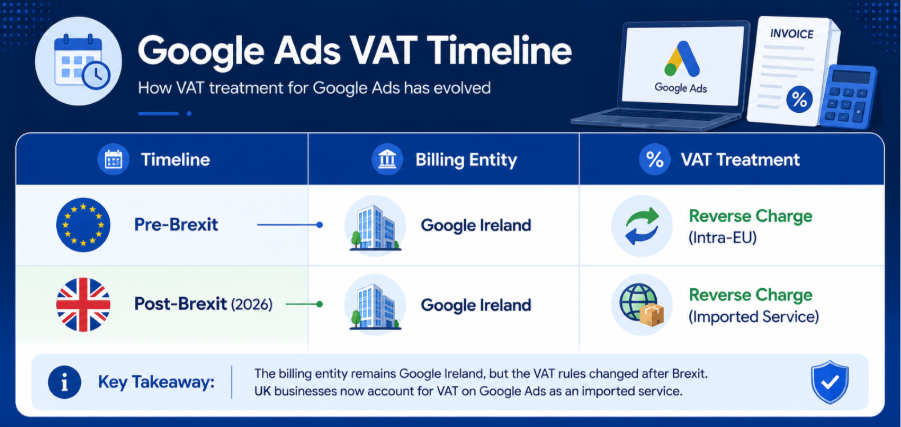
The UK left the EU VAT system, but businesses still use reverse charge VAT for Google Ads.
Google normally bills UK advertisers through Ireland. Because of that, UK businesses still account for the VAT themselves instead of paying VAT directly on the invoice.
What Stayed the Same?
The overall reporting process stayed almost identical.
Businesses still:
- declare VAT on the return,
- reclaim VAT where allowed,
- and record the transaction through reverse charge accounting.
For many companies, the process today looks very similar to the system used before Brexit.
Why Does Reverse Charge VAT Still Apply?
Google Ads services still come from Ireland. HMRC treats these services as imported business services.
That is why reverse charge VAT rules still apply in 2026, even after Brexit. This also explains why many Google Ads invoices continue showing 0% VAT.
What Should UK Businesses Do in 2026?
Most businesses no longer deal with EC Sales Lists.
However, bookkeeping settings still matter. Accounting software should use reverse charge VAT settings instead of old EU VAT options. Incorrect settings may create HMRC reporting errors later.
How To Record Google Ads VAT in Xero and QuickBooks
Manual data entry is a recipe for disaster. Here is how to handle it in modern software.
Which VAT Code Should You Use for Google Ads?
- Xero: Use the “Reverse Charge Expenses (20%)” tax rate.
- QuickBooks: Use the “20.0% RC” (Reverse Charge) code.
How To Record Reverse Charge VAT Correctly
When you create a bill or explain a bank transaction:
- Select the Google Ads expense account.
- Enter the Net amount from the invoice.
- Apply the Reverse Charge tax code.
The software will automatically calculate the 20% and put it in the correct boxes on your return.
Which VAT Return Boxes Include Google Ads?
Your software should automatically populate:
- Box 1: Output VAT on the purchase.
- Box 4: Input VAT (the reclaim).
- Box 6: The value of the purchase (as a sale).
- Box 7: The value of the purchase (as a cost).
Common Bookkeeping Mistakes Businesses Make
Many users simply select “No VAT” or “Zero Rated.” This is incorrect. While the net payment to HMRC remains the same, your total turnover and purchase figures will be wrong, which is a red flag for HMRC.
Why Google Ads VAT Is Often Recorded Incorrectly
Most business owners think “No VAT on invoice = No VAT on Xero.” They miss the “reverse” part of the process, leading to under-reporting of both sales and purchases.
Common Google Ads VAT Mistakes UK Businesses Make
Avoid these pitfalls to keep HMRC away from your door.
- Treating Google Ads as VAT-Free: It is not VAT-free; it is self-assessed.
- Ignoring Reverse Charge VAT Rules: This leads to inaccurate MTD filings.
- Using Incorrect VAT Codes: Don’t use “Zero Rated” or “Exempt.”
- Forgetting To Add a VAT Number to Google Ads: This can cause Google to charge you the wrong tax or limit your account.
- Incorrectly Reclaiming VAT: If you are partially exempt, you might be reclaiming too much.
- Assuming Brexit Removed VAT Obligations: It didn’t. The rules just moved from EU law to UK law.
What To Do if Your Google Ads VAT Has Been Reported Incorrectly
If you’ve realized your past returns are wrong, don’t panic.
How To Identify VAT Reporting Errors
Check your previous VAT returns. If Box 1 and Box 4 don’t reflect your Google Ads spend, you’ve likely been recording them as “Zero Rated” or “No VAT.”
Can Previous VAT Returns Be Corrected?
Yes. If the error is below £10,000 (or 1% of your turnover, up to £50,000), you can usually correct it on your next VAT return.
When To Contact an Accountant
If the error spans several years or involves large sums of money, professional advice is essential to avoid heavy HMRC penalties.
What HMRC Usually Looks for During Reviews
HMRC looks for consistency. If your bank feed shows payments to “Google” but your VAT return shows no reverse charge activity, it triggers a “reconciliation error” in their system.
When Should You Speak to an Accountant About Google Ads VAT?
Signs Your Business Needs VAT Advice
- You are spending over £1,000 a month on Google Ads.
- You are close to the £90,000 registration threshold.
- Your business is partially exempt from VAT.
When Reverse Charge VAT Becomes Complex
Complexity arises when you manage multiple accounts or if you are an agency billing client for “recharged” ad spend.
How an Accountant Can Help Prevent VAT Errors
A specialist accountant can set up your Xero or QuickBooks defaults so that every Google Ads transaction is handled correctly without you having to think about it.
Conclusion
Many UK business owners are initially confused by Google Ads VAT. When invoices show 0% VAT, there is a tendency to believe that there is no VAT. This is typically not the situation.
Google Ads continues to be a reverse charge VAT service for many businesses. Correctly recording these transactions can prevent bookkeeping errors and issues with HMRC reports in the future.
With an increasing budget on ads, small VAT mistakes can turn into large compliance problems. Why it is important to have accurate records and the proper VAT settings, particularly for businesses on Xero or QuickBooks.
If you’re not sure that your Google Ads VAT is being managed correctly, it’s worth seeking professional advice sooner rather than later as this can save you time and money in the long run. At Lanop, we support businesses in the UK with practical VAT accounting assistance, reverse charge, and digital advertising costs. Having trouble with your Google Ads VAT? Call Lanop today for professional advice specific to your company.
FAQs:
Meta Ads, Facebook Ads, LinkedIn Ads, and similar advertising platforms usually follow the same reverse charge VAT rules as Google Ads when billed from outside the UK.
If Irish VAT appears on a Google Ads invoice, the account may have an incorrect VAT number or be treated as a non-business account. Businesses should review billing settings and contact Google support.
VAT is normally calculated on the net advertising spend after promotional credits or discounts are applied. This means free ad credits may reduce the taxable amount on the invoice.
Under Making Tax Digital (MTD), reverse charge VAT transactions must be recorded digitally and reported accurately through compatible accounting software like Xero or QuickBooks.
Even when Google Ads invoices show 0% VAT, the standard UK VAT rate of 20% still applies through reverse charge accounting for most VAT-registered businesses.