

Italy’s flat tax regime has attracted attention for years. But after the government raised the annual charge from €100,000 to €300,000, the conversation changed. Some still view it as one of Europe’s most attractive tax regimes for high-net-worth individuals. Others question whether the financial benefits still justify the cost.
If you are a high-net-worth UK national thinking about relocation, this guide is for you. We break down exactly how the regime works in 2026, who benefits, who does not, and what practical steps you should take next.
What Is Italy’s Flat Tax Regime in 2026?
How Italy’s Flat Tax Regime Works
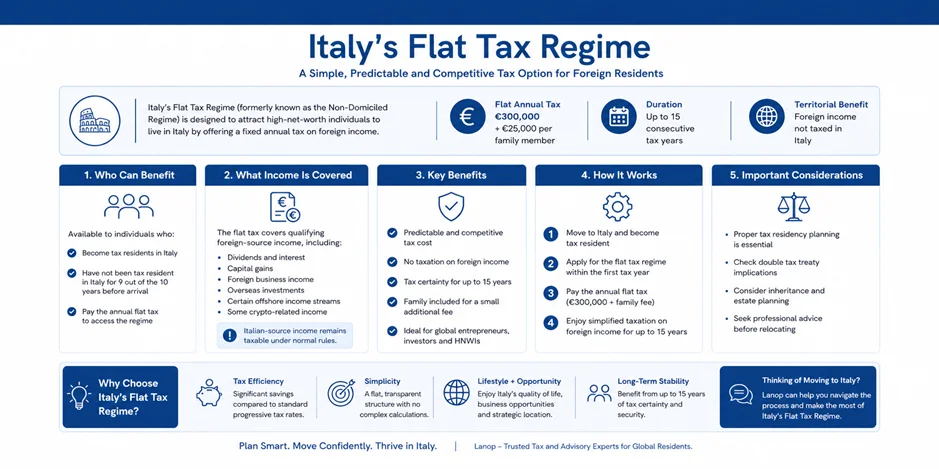
Italy’s flat tax regime is a special tax status for new residents.
Here’s how it works. You move to Italy. You apply for the regime. Then you pay one fixed annual sum on all your foreign income.
Your offshore gains, dividends, and rents? All covered by that one payment. That is the core of it.
Italy’s Flat Tax Increase From €100k to €300k Explained
The original 100k flat tax Italy was a strong draw for high earners.
In 2024, the Italian government more than doubled the fee to €300,000. That’s a huge jump. The maths now only works at higher income levels. If you earn tens of millions abroad, it still makes sense. But if you earn closer to €1m, you need to model it carefully.
Who Can Apply for Italy’s Flat Tax Scheme
To qualify for the Italy flat tax for foreigners, you must not have been an Italian tax resident in nine of the last ten years. Your nationality does not matter. UK nationals can apply. That’s confirmed.
What Income Is Covered Under the Flat Tax
The Italy flat tax foreign income exemption is broad. It covers dividends, overseas rental income, capital gains, and foreign business profits.
One key point: Italian-sourced income is not covered. That gets taxed at normal Italian rates.
Why UK Nationals Are Looking at Italy After Non-Dom Changes
How UK Non-Dom Reforms Changed Tax Planning
The UK’s non-dom regime ended in April 2025. That was a big moment for wealthy UK residents. Before, you could shelter foreign income from HMRC. Now you can’t. All worldwide income is taxable in the UK.
Italy’s non dom regime 2026 fills a very similar gap. It’s not the same, but it serves the same purpose.
Why Wealthy UK Residents Are Exploring Tax Relocation
Since the non-dom changes, more UK high earners are looking to leave. Italy, UAE, Portugal, and Switzerland top the list.
Italy stands out. It has lifestyle appeal, European access, and a regime built for moving to Italy for tax HNWI UK purposes.
Brexit, Residency Rules, and Tax Mobility in 2026
Post-Brexit, UK nationals need a visa to live in Italy. That adds a step. But it does not block the route. Italy’s elective residency visa and its investor visa both work for UK nationals.
Is Italy’s €300,000 Flat Tax Worth It in 2026?
At What Income Level the Regime Makes Sense
At €300,000 per year, the flat fee is fixed. So, the maths is simple.
If your foreign income tops €2 to €3 million per year, the savings are real. If your income sits closer to €1m, the benefit shrinks fast.
When the Flat Tax Can Deliver Big Savings
The regime works best for those with:
- Large offshore investment portfolios
- Several overseas properties that earn rental income
- Foreign business dividends above €2m a year
- Big capital gains from assets outside Italy
When the Regime May Not Be Cost Effective
If your foreign income sits between €500k and €1m, think twice.
The €300k flat fee eats a large slice of that. Other countries or tax structures may give you a better result.
Real Examples of Tax Savings for UK Nationals
| Scenario | UK Tax Exposure | Italy Flat Tax | Annual Saving |
|---|---|---|---|
| €5m foreign income | €2.25m+ (45%) | €300,000 | €1.95m+ |
| €2m foreign income | €900k+ (45%) | €300,000 | €600k+ |
| €1m foreign income | €450k (45%) | €300,000 | €150k |
| €500k foreign income | €225k (45%) | €300,000 | Loss of €75k |
Who Benefits Most from Italy’s Flat Tax Regime?
Entrepreneurs and Business Owners
Founders who have sold UK businesses often have large, one-off foreign income events. A single exit of €10m or more makes the flat fee look very small. For these people, the regime is a strong fit.
Investors With International Income
If you hold global equities, offshore property, or structured products, Italy’s flat-rate tax regime may be a good fit. Every pound earned outside Italy falls under the flat fee. None of it gets taxed again.
Family Offices and Ultra-High-Net-Worth Individuals
For ultra-HNWIs, the current €300k fee is a tiny fraction of their tax bill. The effective rate at €10m of income is just 3%. Family offices with complex global income streams get a clean, simple tax picture in Italy.
Retirees With Foreign Assets and Pension Income
Retirees have a separate, cheaper option. Italy’s 7% pension flat tax retirees scheme costs far less than €300k. We cover that in detail further below.
Who May Not Benefit from Italy’s Flat Tax Regime?
UK Residents with Mostly UK-Sourced Income
The flat tax only covers foreign income. If most of your income comes from the UK, you get little protection. Italian-sourced income is taxed at normal Italian rates. The regime does not help there.
Individuals With Lower Levels of Foreign Income
As the table above shows, if your foreign income is below €1m, the €300k fee can cost more than just paying local rates elsewhere.
At that level, the numbers do not work in your favour.
Founders Running Active UK Businesses
If you are the key decision-maker in a UK business, HMRC may say you have not truly left. Your relocation must be real. You need to cut your UK ties and reduce your active role in UK operations.
Can Existing Residents Keep the €200k Regime?
Italy’s Grandfathering Rules Explained
This is a hot topic right now. Lots of people want to know if they are protected.
The good news: Italy grandfathering flat tax regime €200k €300k rules do protect existing applicants. If you applied under the old €100,000 fee, you keep that rate. You are not forced onto the new €300,000 level.
Tax Residency Timing Before the €300k Increase
Anyone who locked in Italy tax residency lock in before the €300k increase prior to the law change keeps the lower rate.
That protection runs for the rest of their 15-year window.
How UK Nationals Can Qualify for Italy’s Flat Tax Regime
Italy Tax Residency Rules Explained
To become an Italian tax resident, you must spend more than 183 days per year in Italy. You also need to sign up on the local municipal register and make Italy your main home. Both steps matter.
Visa and Immigration Requirements After Brexit
UK nationals now need a visa. The elective residency visa asks for proof of passive income. The usual threshold is around €31,000 per year or more.
The investor visa is another route. It requires a qualifying Italian investment.
The Italy Golden Visa and Flat Tax Regime
The Italy golden visa HNWI UK investor route can be paired with the flat tax. You can invest €500,000 into an Italian company or €2m into Italian government bonds to qualify.
Common Mistakes During Relocation Planning
- Registering in Italy before fully leaving the UK tax system
- Keeping too many UK ties such as property, family, or active business roles
- Missing the flat tax election deadline in the right Italian tax year
- Not checking Italian-sourced income levels before moving
Can HMRC Tax You After You Move to Italy?
Understanding the UK Statutory Residence Test
Yes, HMRC can still tax you if you fail the UK Statutory Residence Test.
Having an Italian address is not enough on its own. You must cut enough UK ties and stay below the day-count limits. Understanding exactly how the Statutory Residence Test works and how foreign income is treated under UK rules is essential reading before you make any decisions.
Temporary Non-Residence Rules Explained
Watch out for this one. If you return to the UK within five years of leaving, HMRC can reclaim tax on gains made while you were abroad.
Many people miss this rule. It catches people who move away and come back too soon.
Dual Tax Residency Risks Between the UK and Italy
Both countries have rules that can make you a tax resident at the same time.
The UK-Italy double tax treaty has a tiebreaker clause. But you need expert help to use it correctly.
Why Proper UK Exit Planning Is Critical
A bad exit can leave you filing tax returns in both countries. That costs time and money. UK exit planning is not optional. It is the base layer of any good international move.
Italy Flat Tax vs UK Tax After Non-Dom Reform
Foreign Income Taxation: UK vs Italy
After the non-dom reform, all foreign income is taxed in the UK at up to 45%.
Under the Italian flat tax, all foreign income is wrapped into one annual payment. The amount does not change, no matter how much you earn abroad.
Capital Gains Tax Comparison
The UK charges up to 24% on property gains and 20% on other assets. Under the Italy flat tax regime, gains on non-Italian assets are included in the flat fee, with no additional tax.
Inheritance Tax Exposure in Both Countries
The UK charges 40% IHT on estates above £325,000. That is a heavy burden for large estates.
Italy’s inheritance tax rates on foreign assets are much lower. Rates run from 4% to 8%, with generous allowances. For big estates, this gap alone can be life changing.
Hidden Costs Wealthy Expats Often Miss in Italy
Milan Property Costs for Wealthy Expats
Milan property tax wealthy expats planning often skips the buy-in costs.
Prime Milan homes run €10,000 to €20,000 per square metre. Add notary fees, agency charges, and a registration tax of 2% to 9% on top of that.
IMU Property Taxes and Local Taxes in Italy
Italy charges IMU on property. For non-primary homes, the rate can reach 1.06% of assessed value each year.
It is not huge, but it adds up over time.
Private Healthcare and International School Costs
Top international schools in Milan cost €15,000 to €35,000 per child per year. Private healthcare is good quality but not free. Budget €5,000 to €15,000 per year for a family plan.
The Real Annual Cost of Living for HNWIs in Italy
Beyond the flat tax, a wealthy family in Milan should budget €150,000 to €400,000 per year. That depends on whether you own or rent, how many children you have, and your lifestyle choices.
Italy Inheritance Tax and Foreign Asset Planning
How Italy Treats Foreign Assets and Offshore Wealth
Under the flat tax, Italian IHT applies to assets in Italy. Foreign assets stay outside the Italian IHT net during the 15-year window.
That is a real advantage for those with large global wealth.
Trusts, Family Offices, and Succession Planning
Italy does accept foreign trusts. But their tax treatment can get complex. Set up your structure before you move. Fixing it after you become a resident is slow and costly.
Cross-Border Wealth Structuring Points to Know
UK holding companies and family investment vehicles need a review before you relocate. What works for a UK-based owner may not fit cleanly in an Italian tax context.
Can You Keep a UK Business While Living in Italy?
UK Company Ownership While Living Abroad
You can own shares in a UK company from Italy. That is simple and common. What gets complex is actively running that company from abroad.
Management and Control Risks Explained
UK tax law says a company is UK-resident where its top-level decisions are made. If you are the key decision-maker and you live in Italy, that control may shift. That can create a corporate tax issue.
Permanent Establishment Concerns for Founders
If you do UK business from Italy on a regular basis, both tax authorities may take notice. HMRC and the Italian tax office can both argue that a taxable presence exists. Get advice before you move.
Italy’s 7% Pension Flat Tax vs the €300k HNWI Regime
What Is Italy’s 7% Flat Tax for Retirees?
The 7 percent flat tax in Italy is a separate scheme. It is designed for foreign pension holders, not high earners. You pay a flat 7% on all foreign-sourced income. The scheme lasts ten years.
Key Differences Between the Two Regimes
| Feature | €300k HNWI Regime | 7% Pension Regime |
|---|---|---|
| Annual fee | €300,000 fixed | 7% of foreign income |
| Duration | 15 years | 10 years |
| Location | Anywhere in Italy | Southern Italy only |
| Best for | Very high earners | Retirees and lower earners |
| Income sweet spot | Above €2m | Below €4.3m |
Which Regime Is Better: Retirees vs HNWIs?
For a UK retiree with €100,000 to €300,000 in foreign income, the 7 flat tax Italy pension scheme wins. The cost is far lower.
For higher earners above €2m per year, the HNWI regime delivers the better outcome.
Best Italian Cities for Wealthy UK Expats
Living in Milan as an International HNWI
Milan is the top pick for most wealthy UK expats. It has direct flights to London, a strong expat community, and elite private schools. The legal and financial advisory network in Milan is also the best in Italy.
Rome vs Milan for Tax Residents
Rome has culture and history. But it has less business speed than Milan. Milan is closer to Swiss and French financial hubs. Most HNWIs end up choosing Milan for that reason.
Lifestyle, Safety, and Connectivity to London
Both cities are safe by global standards. Milan to London takes around two hours by air. The Italian lakes and Alps are less than an hour from central Milan. That is a strong lifestyle draw.
What Happens When Italy’s 15-Year Flat Tax Period Ends?
Tax Exposure After the Regime Expires
After 15 years, the flat tax ends. You fall into normal Italian tax rates. Foreign income becomes taxable at up to 43%. That is a sharp jump. You need to plan for it well in advance.
Long-Term Residency and Succession Planning
Many HNWIs plan to leave Italy before year 15. Others shift their income so that most of it comes from outside Italy. The 15-year window is a tool. It is not a forever fix.
Planning Exit Strategies Before the Regime Ends
Start exit planning three to five years before the end date. Options include moving to another low-tax country, using charitable structures, or shifting income into tax-sheltered vehicles.
Risks and Downsides of Italy’s Flat Tax Regime
Political and Regulatory Risks in Italy
Italy has changed this regime twice in recent years. The jump from €100k to €300k proves that the government will move the goalposts.
Future increases are possible. That is a real risk for new applicants.
Possibility of Future Tax Increases
Italy faces budget pressure. If the flat tax becomes a political issue, further changes may come. Grandfathered residents look protected. But new entrants carry more policy risk.
Bureaucracy and Admin Challenges
Italy’s admin system takes time to navigate. Visas, property registration, tax filings, and municipal sign-ups all need local help. Do not try to manage this alone. Use experienced advisers in Italy.
Why Some HNWIs Choose Dubai or Switzerland Instead
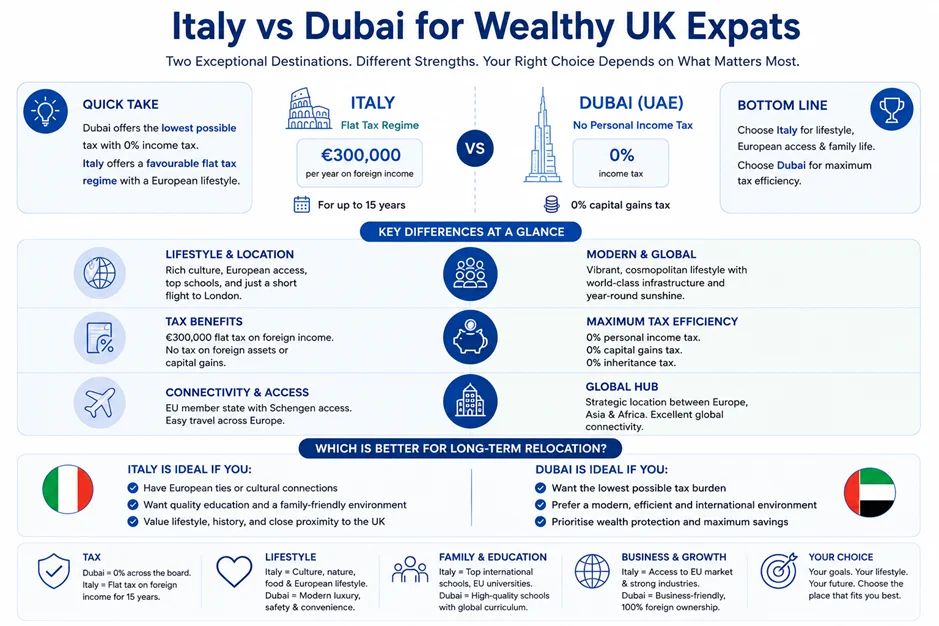
Dubai gives zero tax with no annual fee. Switzerland gives political safety and strong privacy. Italy’s edge is lifestyle. If that does not matter to you, other options may fit better.
Is Italy a Smart Tax Base for UK Nationals in 2026?
If your foreign income tops €2 million per year, the €300k flat fee is still a great deal. Add in Italy’s low IHT rates, and the 15-year horizon, and the maths remain strong.
When Other Countries May Be a Better Fit
If your income sits below €1m or you have no real ties to Europe, look at other options first. Dubai, Malta, and Portugal each offer their own tax benefits. Each has its own rules and trade-offs.
Why Tax and Lifestyle Planning Must Go Together
Tax residency is not just a numbers game. You are choosing where to live and build your life. Italy rewards people who want to be there. If that is you, the regime can work very well.
What Should You Do Next?
Italy’s flat tax 2026 UK nationals’ regime is not dead. For the right person, it is one of the best tax structures in Europe.
The key is knowing if you are that person. Ask yourself three questions.
- Do you have more than €2m in foreign income each year?
- Are you ready to make Italy your real home?
- Have you fully planned your UK tax exit?
If the answer to all three is yes, Italy can deliver serious savings.
At Lanop, we help UK nationals work through this step by step. We model the numbers, plan the UK exit, and link you with the right advisers in Italy.
The regime rules can change. The admin takes longer than most people expect. So, start planning now.
Want to know if Italy’s flat tax is right for you? Contact the Lanop team today.
FAQs:
Yes. Eligible UK residents may reduce global tax exposure through Italy’s flat tax regime. The scheme allows qualifying individuals to pay a fixed annual tax on certain foreign income instead of standard worldwide taxation. Proper UK tax exit planning is still essential.
Italy’s flat tax scheme generally applies to qualifying foreign-source income, including:
- foreign dividends
- overseas investments
- international capital gains
- offshore income streams
- foreign business income
- some crypto-related gains held abroad
Italian-source income usually remains taxable under standard Italian tax rules.
UK nationals must become Italian tax residents to access Italy’s flat tax regime. This generally involves living in Italy, shifting financial and personal ties, and meeting residency registration requirements.
After Brexit, UK citizens may also need a visa or residency permit.
Eligible individuals can usually benefit from Italy’s flat tax regime for up to 15 years. The programme is designed for long-term international residents seeking greater tax certainty while living in Italy.
UK nationals should carefully review several tax risks before relocating.
Common concerns include:
- accidentally remaining a UK tax resident
- triggering dual tax residency issues
- poor UK exit planning
- inheritance and succession exposure
- permanent establishment risks for UK businesses
- misunderstandings around trusts and offshore structures
Early cross-border tax planning can help reduce these risks.
In many cases, qualifying foreign dividends, investments, and some crypto-related gains may fall under Italy’s flat tax scheme. Treatment depends on asset structure, reporting obligations, and residency timing.
Possibly, but careful planning is essential.
UK business owners moving to Italy should review:
- UK Statutory Residence Test rules
- management and control risks
- permanent establishment exposure
- ongoing UK business activity
- director residency concerns
Incorrect structuring may leave parts of the business exposed to UK taxation.
Before relocating, UK nationals should review:
- UK tax residency status
- HMRC departure planning
- offshore asset structures
- inheritance and succession planning
- business ownership arrangements
- Italian residency requirements
- visa and immigration obligations
- foreign investment reporting exposure
Early planning usually provides more flexibility and helps reduce future tax complications.