

Introduction
Leaving the UK is rarely about flights. For high-net-worth individuals, the real challenge is cutting the cord with HM Revenue and Customs.
If you do not plan your exit with surgical precision, you can find yourself living in Dubai or Monaco while still being taxed on your worldwide income in London.
This guide explains how to break UK tax residence properly. We will focus on the mechanical rules that HMRC uses to keep you in their system.
What Actually Makes Someone a UK Tax Resident?
HMRC does not care about your “spirit” or where you feel you belong. They care about facts. Residency is a status determined by the Statutory Residence Test (SRT). It is a yearly assessment. You can be a resident for one year and not the next.
If you are a resident, you pay UK tax on your global income. If you are not, you usually only pay tax on money you make inside the UK. To know how to exit UK tax residency successfully, you must understand that the burden of proof is on you. You must prove that you are not here.
The Difference Between Residency, Domicile, and Citizenship
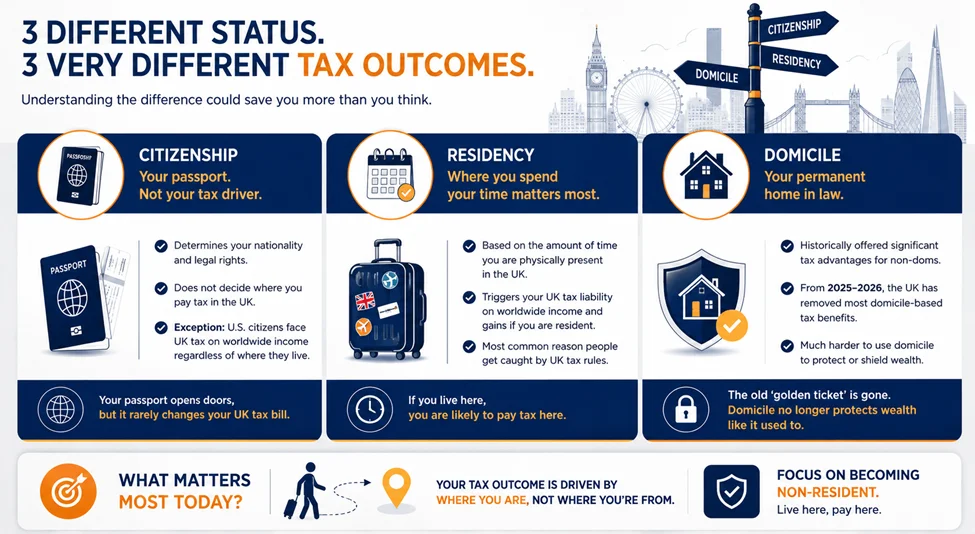
These three terms are often confused, but they are very different tools in the tax man’s kit.
- Citizenship: This is your passport. It has almost no impact on your UK tax bill unless you are an American citizen.
- Residency: This is about where you physically spend your days. It is the most common way people get caught.
- Domicile: This used to be the “golden ticket” for non-doms. However, in 2025 and 2026, the UK removed most of these benefits. It is now much harder to use domicile to shield wealth.
Today, your focus must be on becoming non resident for uk tax. If you live here, you pay here.
Why HMRC Focuses on Behaviour Instead of Intentions
HMRC does not care if you intend to move to Portugal. They care if you still have a gym membership in Mayfair. They look at your “lifestyle footprint.” This includes where your car is, where your dog lives, and where you see your doctor.
If your lifestyle looks like a UK lifestyle, HMRC will treat you as a resident. They use data from banks, mobile phone towers, and flight records. When breaking uk tax residence, your actions must match your claims.
Understanding the Statutory Residence Test
The statutory residence test leaving UK is a three-part filter. You start at the top and work down.
- Automatic Overseas Tests: If you meet these, you are out.
- Automatic UK Tests: If you meet these, you are definitely in.
- Sufficient Ties Test: This is for everyone else. It compares your days in the UK to your “ties” or connections.
Why Most UK Tax Exits Fail
Most HNWIs do not fail because they lied. They fail because they were lazy with the details.
Keeping a UK Property Available
An “available” home is a massive trap. It does not matter if you own it. If you have a flat that you can use for 91 days a year, and you stay there for just one night, it counts as a tie. To become non UK tax resident, you should ideally rent out your home on a long-term lease or sell it. Understanding capital gains tax when you rent out your home is an important part of this decision.
Family Remaining in Britain
If your spouse or minor children stay in the UK, you have a “Family Tie.” This significantly limits how many days you can spend in the UK. Many people try to commute. This is the fastest way to trigger a tax audit.
Misunderstanding UK Day Count Rules
A day counts if you are here at midnight. However, if you have many ties, your allowed days drop fast. Some people think they have 90 days. They might only have 15.
Continuing to Run a UK Business
If you are still the main boss of a UK company, you likely have a “Work Tie.” If you work for more than three hours in a day while in the UK, that counts as a work day. Forty of those days, and you have a tie.
This is particularly relevant if you also operate a company overseas. Understanding the UK tax risks of running a Dubai company is essential for HNWIs with international business interests.
Returning to the UK Too Soon
If you leave for two years and come back, HMRC may apply “Temporary Non-Residence” rules. They can tax the gains you made while you were gone.
The Statutory Residence Test Explained Clearly
This is the math of breaking uk tax residency.
Automatic Overseas Test
You are a non-resident if:
- You spend fewer than 16 days in the UK (if resident in the last three years).
- You spend fewer than 46 days in the UK (if not resident in the last three years).
- You work full-time abroad (35+ hours a week) and spend fewer than 91 days in the UK.
Automatic UK Test
You are a resident if:
- You spend 183 days or more in the UK.
- Your only home is in the UK.
- You work full-time in the UK.
The Sufficient Ties Test
If you don’t meet the automatic tests, you must count your ties.
- Family Tie: Spouse or minor children in the UK.
- Accommodation Tie: A place to stay available for 91 days.
- Work Tie: Working 40+ days in the UK.
- 90-Day Tie: Spending 90+ days in the UK in either of the last two years.
- Country Tie: Spending more days in the UK than any other country.
Timing Your Departure Properly
The date you leave is a financial decision.
Why the Tax Year Matters
The UK tax year is April 6 to April 5. If you leave in the middle of the year, you could be taxed as a resident for the whole year. This is a nightmare for leaving UK permanently tax implications.
Split-Year Treatment Explained
This allows you to split the year into a “UK part” and an “Overseas part.” It is vital for HNWIs. You must meet specific criteria, like starting a full-time job abroad or giving up your UK home completely. If you qualify, you only pay UK tax on your global income for the months you were here. For a detailed breakdown of how tax residency and split-year treatment interact, our dedicated guide covers the key conditions you must satisfy.
Timing Dividends and Capital Gains
You should wait until you are officially in the “Overseas part” of the year before you take a big dividend or sell a business. This requires a formal plan from your tax team.
Selling a Business Before vs After Leaving
Selling a company is a high-stakes move. If you sell while you are a UK resident, you pay UK Capital Gains Tax. If you sell as a non-resident, you might pay zero UK tax on the shares. However, you must stay away for a long time to keep that gain tax-free.
The Five-Year Temporary Non-Residence Trap
HMRC knows that people leave just to sell assets. To stop this, they use the five-year rule. If you have been a UK resident for four out of the last seven years, you must stay non-resident for five full tax years. If you return in year four, HMRC will tax the gains you made while you were away as if you never left. This is a core part of UK exit tax planning HNWI.
How HMRC Treats Returning Expats
HMRC is suspicious of people who return. They will look at your history. If you move back, you need to show that your move abroad was genuine and not just a “tax holiday.”
Overseas Gains That Can Become Taxable Again
It isn’t just business sales. Dividends from companies you control can also be pulled back into the UK tax net if you return within five years. Even some pension payments fall under this rule.
Common HNWI Mistakes
The biggest mistake is “drifting” out of the country. You must take a break.
- Do not leave your mail going to your old UK house.
- Do not keep your UK mobile phone as your main number.
- Do not use your UK credit card for every meal abroad.
HMRC uses these small details to build a case against you.
What Happens to Your UK Income After You Leave?
You might stop being a resident, but the UK still takes a cut of what you leave behind.
UK Rental Income
This is always taxed in the UK. You must file a tax return. You should also register for the Non-Resident Landlord Scheme so your agent doesn’t take 20% off the top. Working with experienced accountants for landlords can ensure your UK property remains a source of income rather than a compliance liability.
UK Company Dividends
Usually, these are “disregarded” for non-residents. This is a major benefit for becoming non resident for uk tax.
Capital Gains on UK Assets
You always pay UK tax when you sell UK property (land or houses). You cannot escape this by moving. Non-residents pay capital gains tax on sales of UK residential property, and the rates mirror those applied to UK residents.
Pension Income
Most UK pensions are taxed in the UK. However, if you live in a country with a tax treaty, you might be able to pay the tax there instead.
Inheritance Tax Exposure
This is the most dangerous area in 2026. The UK is moving to a residence-based IHT system. If you have lived in the UK for 10 out of the last 20 years, your worldwide estate stays in the UK IHT net for 10 years after you leave.
This “tail” means you are still liable for 40% tax on your global wealth even if you live in the Bahamas. Understanding strategies to avoid inheritance tax is now an essential part of every HNWI exit plan.
How HNWIs Usually Structure a Clean UK Exit
To how to become a non uk tax resident safely, you need “substance” in your new home.
Relocating Genuine Economic Activity
If you have a family office, move the staff. If you have a business, move the board meetings. HMRC wants to see that your money is being managed from your new home, not from a London boardroom.
Managing UK Business Interests Properly
Switch from an “Executive” role to a “Non-Executive” role. Do not sign contracts while you are visiting the UK. This keeps your “Work Tie” count low.
Creating Substance Abroad
Buy a real home. Join a local golf club. Get a local driver’s license. These seem small, but they are the evidence you need in an audit.
Avoiding Aggressive Tax Structures
In 2026, HMRC is very aggressive toward “schemes.” Stick to the law. Use the SRT rules as your framework. A clean, simple exit is much harder for HMRC to challenge than a complex web of offshore trusts.
The Evidence HMRC Actually Looks At
In a tax court, your word means nothing. Only paper matters.
Travel Records and Day Counts
Save every boarding pass. Keep a spreadsheet of every night you spend in the UK. If you are here at midnight, it is a day. No excuses.
Overseas Accommodation Evidence
HMRC will look at your electric bills in your new country. If they are very low, they will argue you weren’t actually living there.
Employment and Business Documentation
Keep copies of your new overseas employment contract. Show that you are paying tax in your new country. This proves you have moved your “centre of life.”
Banking, Utilities, and Lifestyle Evidence
Use a local bank card for your daily coffee and groceries. This creates a digital trail that proves you are physically in your new country.
Why Documentation Matters More Than Intention
If HMRC opens an inquiry, they will ask for your records from three years ago. If you don’t have them, you lose. Documentation is your shield. It is the only way to break UK tax residence with total peace of mind.
Can You Claim Tax Back When Leaving the UK Permanently?
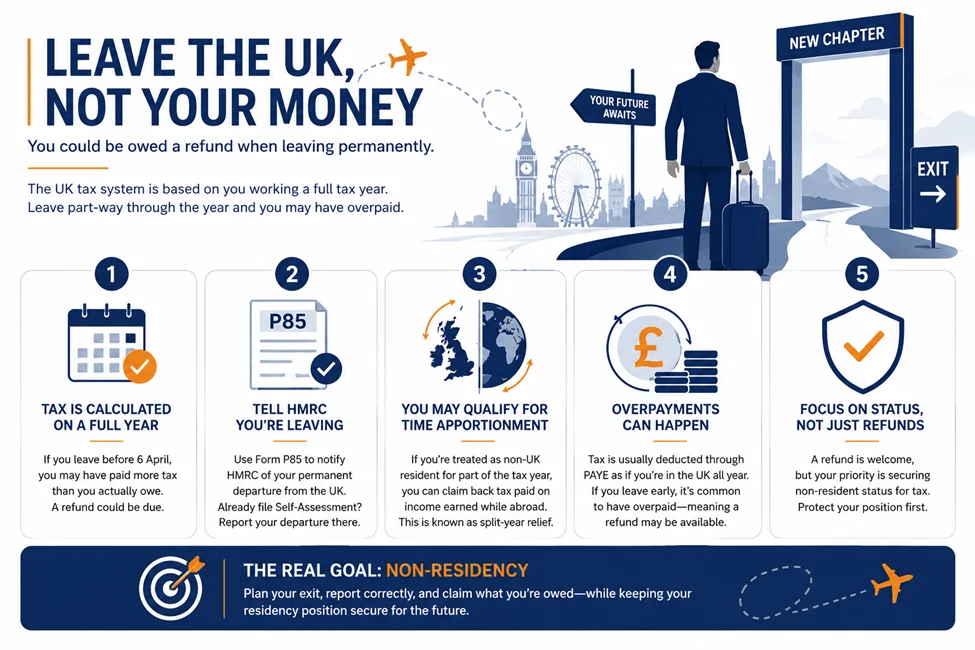
Yes, many HNWIs are owed money when they leave.
When Tax Refunds May Apply
The UK tax system assumes you will work a full year. If you leave in October, you will likely pay too much tax on your salary. This leads to a tax refund leaving the UK permanently.
Understanding Form P85
This is the form you use to tell HMRC you are leaving. However, if you already do a Self-Assessment tax return, you must report your departure there instead. This is how you trigger a tax claim when leaving uk permanently.
PAYE Overpayments and Split-Year Relief
If you qualify for split-year treatment, you can often get a leaving the UK permanent tax refund for the months you were abroad but still had tax withheld.
Common Refund Misunderstandings
A refund is nice, but it is not the goal. The goal is non-residency. Do not let the chase for a small tax back leaving uk permanently amount compromise your residency status.
A Practical Pre-Departure Checklist for HNWIs
Before you go, do this:
Review Your Residency Position
Run the SRT math for the year you leave and the year after. If the numbers don’t work, don’t leave yet.
Analyse UK Ties
How many ties will you have on day one? If you have four ties, you are in trouble. Can you cancel a gym membership? Can you rent out your house? Cut as many ties as possible.
Plan Asset Disposals Carefully
Don’t sell anything until you are sure you have become a non-resident for UK tax status. One mistake here can cost millions.
Prepare Supporting Documentation
Start your “Residency File” today. Put your flight logs, bills, and contracts in one place.
Coordinate UK and Overseas Tax Advice
Make sure your UK exit doesn’t create a tax disaster in your new country. You need advisors in both places talking to each other. Our international accounting services for expats and immigrants are designed exactly for this cross-border coordination.
How LANOP Can Help You Navigate Your UK Exit
The process of breaking UK tax residence is fraught with technical traps that can cost high-net-worth individuals millions in unforeseen liabilities. At LANOP, we specialize in the “clean break” strategy, ensuring that your transition is legally sound and fully documented.
Our senior tax advisors provide end-to-end support for HNWIs, including:
- Custom SRT Audits: We perform a deep dive into your current ties and lifestyle to determine your exact maximum day count for the upcoming years.
- Split-Year Strategy: We help you time your departure and asset disposals to maximize the benefits of split-year treatment.
- IHT Tail Management: With the 2026 residence-based shifts, we structure your estate to mitigate the 10-year inheritance tax “tail.”
- HMRC Liaison & Filing: From submitting complex SA109 residency pages to managing your tax claim when leaving UK permanently, we handle the paperwork, so you don’t have to.
- Non-Resident Landlord Setup: We ensure your UK property remains a source of income rather than a tax liability by registering you correctly for the NRL scheme.
If you are planning to become a non-resident for UK tax purposes, don’t leave your wealth to chance. Let LANOP build your residency defense before you board your flight.
Conclusion
Leaving the UK tax system is a precision job. You cannot “feel” your way out of it. You must use the Statutory Residence Test as your map. The 2026 rules for inheritance tax mean that your exit is now a ten-year commitment. By cutting ties, documenting your life abroad through international and offshore accounting services, and timing your moves with expert tax planning, you can protect your global wealth through strategic estate planning. If you want a tax back leaving UK permanent calculator HMRC style result, do the work now. A clean break today is the only way to secure your financial future tomorrow.
Book a consultation with our cross-border tax specialists to review your departure strategy and ensure your UK exit is structured correctly from day one.