Introduction
You just got a penalty notice. You had a real reason for missing the date. But HMRC does not just accept “good reasons.” They use a strict legal rule called a “reasonable excuse.”
Getting this right is vital. The gap between a cancelled fine and one you must pay usually depends on two things: whether your excuse meets the law, and whether you can prove it.
This guide covers exactly that. Nothing else.
What Is a Reasonable Excuse Under UK Tax Law?
Tax law does not give a clear meaning for “reasonable excuses.” Instead, court cases fill in the blanks.
The standard is this: a reasonable excuse is an unexpected event, outside your control, that stopped you from meeting a tax date, even though you truly tried to follow the rules.
HMRC uses a “common sense” test they call the prudent taxpayer standard.
They basically try to stand in your shoes. They ask themselves a simple question. Would a careful person who genuinely tried to follow the rules have missed the date if they were in your situation? If yes, your excuse carries legal weight.
The Three-Part Legal Test (Perrin v HMRC)
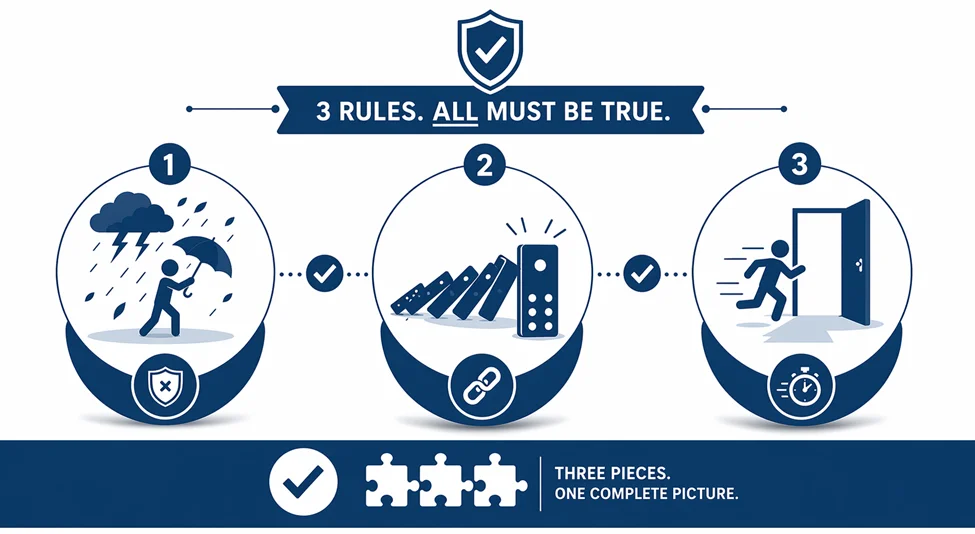
Every excuse HMRC looks at is checked against three rules. These come from a major court case called Perrin v HMRC [2018].
1. The event was out of your hands
It must have been something you could not see coming or avoid. Office problems, staff being away, or just being busy at work will not pass this test.
2. The event was the direct cause of the failure
You need a clear link between the event and the missed tax payment. Timing is the key here. Getting sick in March cannot be the reason for missing a deadline in October. The two facts just do not align.
3. You acted fast once the excuse ended
The safety of a reasonable excuse stops the moment you are able to handle your taxes again. Any wait after that point is judged on its own and will make your case weaker.
All three rules must be met. Passing two out of three is not enough.
What HMRC Accepts as a Reasonable Excuse
Serious Illness
The illness must have been bad enough to stop you from handling your money affairs. A small cold does not count. Being in the hospital, having a major health diagnosis, or a condition that truly stops you from working will qualify.
It must also affect the right person. If a business partner or an accountant could have done the work for you, HMRC will ask why they didn’t.
Evidence needed: A letter from your doctor or specialist on official paper. It should state the diagnosis, the dates you were unwell, and how it stopped you from dealing with tax.
Death of a Close Family Member
The death of a spouse, partner, parent, or child near the tax date is accepted. HMRC and the courts usually treat this with a lot of sympathy.
Relationships and timing both matter. The loss of a distant friend, while sad, is unlikely to meet the legal standard.
Evidence needed: A death certificate and a short note explaining your relationship and how close the death was to the deadline.
Unexpected Hospital Stay
Going into the hospital suddenly is seen very kindly. The key word is “unexpected.” A planned surgery, where you knew how long it would take to recover, has less weight. This is because you had time to plan.
Evidence needed: Hospital papers showing the dates you went in and when you were sent home.
HMRC System or Technical Failure
If HMRC’s own website was broken when you tried to file, this is a valid excuse. You need to prove you actually tried to file while the system was crashing. Attempting it at a different time won’t work.
Evidence needed: Grab a photo or screenshot of the error message. It must show the exact date and time on your screen. Also, keep any emails from the HMRC helpdesk. Without proof of the time you tried to file, this is hard to win.
Fire, Flood, or Theft
These count if they destroyed your records or made them impossible to get to. You must show that you truly could not get the data back before the date. A flood that happened but did not touch your tax files will not count.
Evidence needed: Reports from the police or fire brigade, insurance papers, and photos if you have them.
Major Post Delays
This is a very narrow rule. It only counts if you posted your forms with plenty of time for normal delivery, but a big, proven disruption caused a delay. Posting at the last minute and having it arrive late will not count.
Evidence needed: Proof of postage with a tracking number and proof of the specific post problems at that time.
What HMRC Does Not Accept
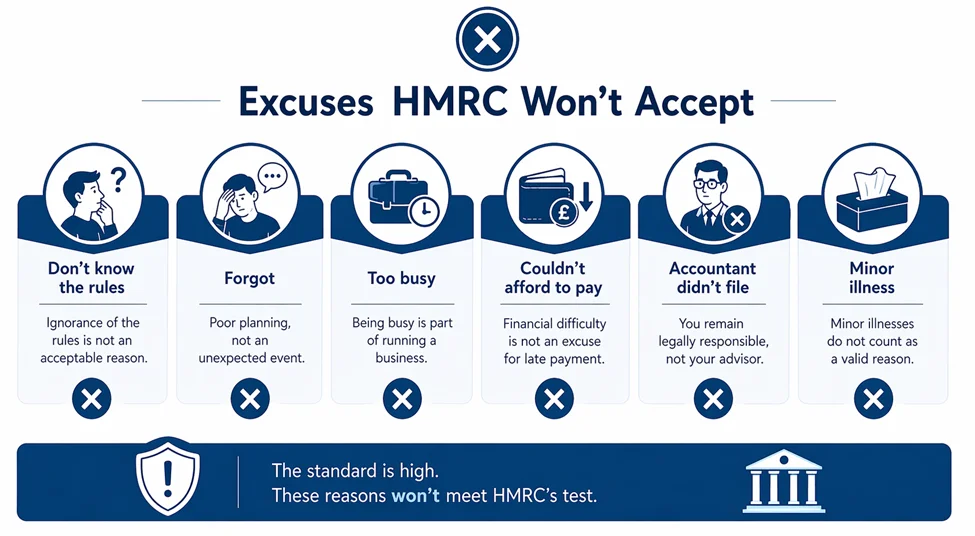
These are the most common reasons HMRC says “no” to, even if they feel fair to you.
“I did not know the date.”
Not knowing the rules is no excuse. You are expected to know your duties. Our blog on UK Self Assessment deadlines and how to avoid penalties covers every key date you need to keep eye on throughout the tax year.
“I forgot.”
This shows bad planning, not an unexpected event.
“I was too busy.”
Everyone is busy. It does not meet the legal bar.
“I could not afford to pay.”
Not having cash is not an excuse for paying late. The only tiny exception is if a major event you couldn’t see coming caused the loss, like a big client going bust without warning. You must prove this in detail.
“My accountant did not file it.”
Giving the job to an accountant or someone else does not shift the legal blame. You are still the one responsible.
Minor illness.
A cold, a short stomach bug, or a brief flu does not meet the bar for “serious.”
How to Prove a Reasonable Excuse
A good excuse with no proof will fail. A weak excuse with strong, outside proof will often win.
Three rules apply:
- Use outside sources. HMRC trusts hospital letters, police reports, and fire records much more than your own word. Third-party proof is a must.
- Build a clear timeline. Your proof must show clearly: when the event started, when the deadline was, when the excuse ended, and when you finally filed. The link must be easy to see in the papers.
- Be specific. Avoid vague lines like “I was sick.” Try this instead. I was in X Hospital from [Date] to [Date] for [Condition]. I simply could not work during my stay, and this doctor’s note proves it.
Make sure to explain any gap between the end of the excuse and when you filed. If there is a gap, HMRC will focus on it. If there was a reason for the delay, prove it.
Does a Reasonable Excuse Cancel the Fine Automatically?
No. HMRC must agree to the excuse first. Until then, you still owe the fine.
If they agree, the fine is cancelled. However, any interest on the tax you owe is a separate matter. A reasonable excuse does not stop interest from growing.
It is worth reading our detailed breakdown of how HMRC Self Assessment extensions and penalty waivers work to understand exactly what can and cannot be reduced through an appeal.
Mental Health Conditions as a Reasonable Excuse
HMRC does accept mental health issues, but the bar is high. Things like depression or anxiety must have been so bad that you truly could not manage your life or money during that time.
A letter from a doctor or therapist explaining how the condition stopped you from doing your taxes at that exact time is vital. Just having a diagnosis is not enough.
What If Your Excuse Only Covers Part of the Delay?
HMRC might say your excuse is valid for some of the time but not all of it. In this case, they might lower the fine instead of cutting it completely.
The time covered by the excuse is safe. The time after it ended is not. This is why you must act fast once you are able.
Many individuals and businesses in this situation benefit from working with a specialist who understands how to respond to HMRC penalty notices and reduction requests.
Conclusion
A reasonable excuse that HMRC accepts is not about their pity. It is about meeting a legal test with clear, outside proof.
The event must be real, unexpected, and linked to failure. Your proof must be specific, from a third party, and shown in a clear timeline. You must also fix the tax issue as fast as you can once the event is over.
If you are not sure if your case counts, or if you need help building a file that meets the law, LANOP’s tax team can help. We can look at your case and find the strongest grounds for you.
Contact LANOP today for a private chat.
Not easily. HMRC looks at your past. If you are always late and always have an excuse, they won’t believe you. A one-off event is much easier to prove.
Sometimes. Courts have allowed longer times if the person who died was the one who ran the business or the money. Medical proof of your grief making you unable to work helps a lot.
A “no” at first is not the end. You can ask for a review. This means a different, more senior officer looks at your case. Many decisions are changed at this stage.
No. Interest on late tax happens automatically. Only the fine itself can be stopped.
Both can. For a business, the excuse must relate to the person who is in charge of the taxes.