
Introduction
The £420 Universal Credit story is doing the rounds, and most of what people are being told about it is wrong. The figure is real, it is not made up or clickbait, but it is not a payment, and nobody is putting a lump sum into your bank account. What actually changed is the rate at which the DWP takes money back from your Universal Credit.
This article will explain what the change is, who qualifies, when it shows up in your payments, and what else has shifted with Universal Credit in 2026 that you should know about.
Right, What Actually Is This £420 Thing?
No lump sum. Nobody is sending you a cheque. Get that idea out of your head right now.
What happened is that the government finally stopped being quite so aggressive about clawing money back from Universal Credit. They used to take up to 25% of your standard allowance to pay back advances and overpayments. Now it is capped at 15%.
So, if you owe them money, and let’s be honest, loads of people took that advance when they first claimed because five weeks is a joke, they are taking less each month. About £35 less for most people.
35 quid times 12 months equals 420. That is where the number comes from. You are not getting £420. You are keeping an extra £35 every month while you pay back what you borrowed or got overpaid.
And before anyone says, “Well, that is still good though,” yeah, it is. An extra £35 a month when you are skint is massive. That is nearly 40 quid. That is petrol for two weeks. That is a week’s food shopping if you are careful. That is your phone bill paid.
It is not anything. But do not expect a windfall.
Who Actually Gets This?
Not everyone. And I need to say this loud for the people in the back: if you are not repaying any DWP debts, this does not apply to you.
You only get the lower deduction rate if money is already being taken from your UC to pay back:
- That advance you took when you first claimed (because waiting five weeks for money is mental)
- Benefit overpayments from whenever
- Budgeting advances
- Any other money you owe the DWP
1.2 million households are affected. About 700,000 of those are families with children. So, it is not exactly rare.
If you are paying stuff back, you should already be seeing it. The change happened April last year. Log in to your account. Look at the deductions section. Compare it to your statements from early 2025. The difference should be there.
When You Will See It (If You Have Not Already)
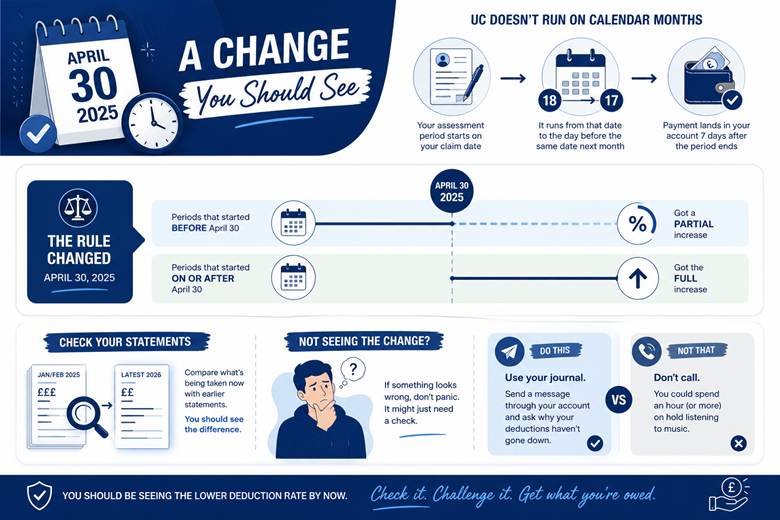
The policy kicked in April 30, 2025. So, by now, in 2026, everyone eligible should be seeing it.
But Universal Credit does not work on normal calendar months. Your payment runs on something called an assessment period. It starts on whatever date you first applied. If you claimed on the 18th, your month goes from the 18th of one month to the 17th of the next. Payment lands in your account seven days after that.
This is the same quirk that causes headaches for people who are also working while on UC. If your employer ever pays you early, say around Christmas, it can throw your assessment period off because of how RTI payroll reporting works. Our guide to Christmas payroll and Universal Credit assessment periods explains how that interaction works in detail.
When the rule changed last April, people whose assessment periods started before April 30 but ended after it got a partial bump. People whose periods started after April 30 got the full thing.
By now, unless something is wrong with your claim, you should be getting the lower deduction rate. Pull up your last few statements and look at what is being taken. Compare it to statements from January or February 2025. You will see the difference.
If you are not seeing it and you think you should be, do not ring them. Use your journal. Ringing the DWP is like willingly choosing to spend an hour listening to hold music. Send a message through your account asking why your deductions have not gone down.
What Else Changed This Year (Besides the Debt Thing)
The Fair Repayment Rate is not happening in isolation. There have been a few other shifts with Universal Credit in 2026. Some good, one absolutely mental.
Everyone Got a Pay Rise
Well, not a pay rise exactly. But the standard allowance went up 6.2% in April 2026.
Single person over 25? Used to be £400.14 a month. Now it is £424.90.
Couples where at least one of you is over 25? Was £628.29. Now £666.97.
For once, this increase is actually above inflation. Makes a change from real-terms cuts year after year.
The Two-Child Limit Finally Died
About bloody time.
This was the rule where you could only claim the child element for your first two kids. If you had three, four, five children, thought. You only got payments for two of them.
From April 6, 2026, it is gone. Finished. Dead.
If you have got three kids or more, you can now claim all of them. Each child element is worth £333.33 a month. So, a family with four children gets an extra £666.66 every month compared to what they would have got under the old system.
That is genuinely life-changing money for bigger families. It is worth double-checking your entitlement if your family size has changed recently. The two systems interact in ways that catch people out, and our guide on Child Benefit claims and HMRC payment timing covers how UC and Child Benefit sit alongside each other.
The Health Payment Situation Is Absolutely Ridiculous
Deep breath for this one because it makes me genuinely angry.
If you have a health condition or disability that stops you from working, you can claim something called the LCWRA element. Limited Capability for Work and Work-Related Activity. Dreadful name.
If you were getting this before April 6, 2026, you are fine. Still getting £429.80 a month after the annual increase.
If you are claiming it for the first time after April 6, 2026, you get £217.26. Half. Literally half.
Unless you have got what they are calling a “severe condition” that will last your whole life. Then you might still get the higher rate. They have not properly defined what counts, though. Something about severe learning disabilities and progressive conditions.
So two people with the exact same health condition get wildly different amounts of money depending on when they happen to claim. Disability charities are furious. Anyone with a brain is furious. But here we are.
Applying for Universal Credit (If You Are Not On It)
Not on Universal Credit yet but think you should be? The whole application is online.
Go to GOV.UK and search Universal Credit. Make certain you are on the proper government website with gov.uk at the end of the URL. The number of fake sites trying to charge people to “help” with applications is unreal.
What you need to have ready:
- ID (passport or driving licence)
- Your rent or mortgage details
- Bank details
- National Insurance number
- Info about savings or other income
- Work details if you are employed
Got kids? Birth certificates or adoption papers. Claiming based on health? Eventually, you will need medical evidence, but you do not need it to start.
That Five-Week Wait Nobody Warns You About
The first payment takes five weeks to arrive. There is a one-month assessment period, then seven days of processing. Five weeks total. It is ridiculous if you have just lost your job, or left an abusive relationship or any of the hundred reasons people need benefits urgently.
You can request an advance, up to the full amount of what you are expected to get. But you must pay it back. And this is exactly where that Fair Repayment Rate matters, because they can only take back 15% of your standard allowance each month now instead of 25%.
Still means you are paying it back for months. But at least it is not quite as brutal as it used to be.
My advice? If you can possibly avoid taking the advance, avoid it. Borrow from family, use a credit card, sell stuff, whatever you can do. Because that advance follows you around for ages, and it is one more thing being deducted from payments that are already tight.
Assessment Periods and When Money Actually Arrives
Your assessment period is your own personal Universal Credit month. Starts on the date you first claimed.
Claimed on the 24th? Your month runs 24th to 23rd. Payment arrives seven days later, on the 30th. Or the next working day if that falls on a weekend or bank holiday.
When Universal Credit rates change, they start from your first assessment period that begins on or after the change date. That is why the April 2026 increases showed up at different times for different people. Some got it in April. Some in May. Depends entirely on when their personal assessment period started.
It is confusing. The DWP knows it is confusing. They do not seem to care that it is confusing.
What Counts as Income (And What Does Not)
Universal Credit is means-tested. They look at everything you have got coming in and adjust your payment accordingly.
Earn money from work? For every pound over your work allowance, your UC goes down 55p. The work allowance is £673 a month if you do not get housing help, or £344 if you do.
Some benefits do not count. Disability Living Allowance and PIP are ignored. But most other income does count.
If you are self-employed, things get more complicated because of the Minimum Income Floor, the DWP assumes you earn a certain amount even if you do not. A self-employed accountant can help you understand how your reported earnings interact with your UC entitlement, especially if your income varies month to month.
Savings are where it gets irritating. Under £6,000, no problem. Over £6,000, for every £250 above that, they pretend you are earning £4.35 a month from it. Hit £16,000 in savings and you cannot get Universal Credit at all.
These catch people out constantly. Someone gets an inheritance or a redundancy payment. Suddenly, they have got £18,000 in the bank, and their Universal Credit stops dead. Even though that money is supposed to tide them over while they find work.
What Gets Taken Out Before You Even See It
Besides DWP debt repayments, loads of other stuff can come straight out of your Universal Credit:
- Rent arrears (up to 10-20% of your standard allowance)
- Fuel debts (up to 10%)
- Council tax arrears
- Water bills
- Court fines
- Child maintenance
Maximum they can take from everything combined is 25% of your standard allowance. But the DWP debt portion specifically maxes out at 15%.
Check your statement every single month. Mistakes happen more than you would think. People are paying deductions for debts they had already cleared. Incorrect amounts. Deductions that should not be there at all.
If you spot something wrong, screenshot it. Then message through your journal. Keep screenshots of that too. The DWP has a special talent for losing things.
Sanctions: The Bit Everyone Dreads
If the DWP reckons you have not done what you are supposed to do, like attending appointments or applying for jobs, without a good reason, they can sanction you.
That means they reduce your payment. Sometimes they take the whole standard allowance for a month. In extreme cases, sanctions can last up to three years.
You can challenge sanctions. Ask for the decision to be explained. You have the right to mandatory reconsideration and then appeal if needed. The same principle applies here as with any government decision you think is wrong challenge it properly and in writing.
If a sanction leaves you struggling, you can request a hardship payment. These are 60% of your standard allowance if you are single without kids, or 80% if you have got children or certain health conditions.
Checking Payments and Reporting Changes
Everything happens through your online account on GOV.UK. Log in with the email and password you set up when you claimed.
You will see your journal, your payment statements, and a to-do list for things they need from you. Your statement shows your maximum award, any earnings reported, deductions, and your final payment.
You must report changes through your journal straight away:
- Starting or stopping work
- Changes to your earnings
- Moving house
- Changes to who lives with you
- New health conditions
- Changes to childcare costs
Report them straight away. Reporting late can mean overpayments you will have to pay back later. The same principle applies here as it does with self assessment tax returns — late reporting almost always costs you more than it would have if you had dealt with it promptly.
If You Disagree with a Decision
Got a decision you think is wrong? You can fight it.
First step is mandatory reconsideration. You are asking the DWP to look at it again. You have got one month from the decision to do this. Explain why it is wrong and include any evidence.
They will send you a mandatory reconsideration notice with their new decision. If they still have not changed their mind and you are still not happy, you can appeal to an independent tribunal.
Appeals go through the HM Courts and Tribunals Service, not the DWP. You have one month from the mandatory reconsideration notice to submit it.
Get help with this. Citizens Advice or local welfare rights groups can tell you if your case has legs and how to present it properly. Many appeals succeed because people get proper advice. If you have ever had to appeal a penalty decision from HMRC, the logic is similar — document everything, respond within deadlines, and do not try to wing it alone.
Watch Out for the Scammers
Every time benefits change, the scammers appear like wasps at a picnic.
You will see posts saying you need to “apply” for a one-time £420 payment. Some ask for your login details. Some want you to pay a “processing fee.”
All scams. Every single one.
The Fair Repayment Rate change happens automatically. You do not apply. You definitely do not pay anyone to access it.
Real DWP communications come through your UC journal, arrive by post to your registered address, never ask for payment or login details, and never contact you through social media or WhatsApp.
See something dodgy? Report it to Action Fraud. Do not click on anything. Do not share the details. Do not send money.
Actually Using That Extra Money Wisely
If you are one of the 1.2 million households getting that extra £35 or so a month, think about how to use it.
Some people set up a separate savings account for emergencies. Even £10 or £20 a month builds up. It means you might not need another advance next time something breaks.
Struggling generally? Check you are getting everything you are entitled to. Loads of people miss out on council tax reduction, free school meals, and help with NHS costs simply because they do not realise they qualify.
Citizens Advice, Turn2us, and Entitled To all have free benefits calculators. Check every six months because your circumstances change. If your situation is more complex, for example, you are also self-employed or have rental income on top of UC, it is worth getting proper financial planning advice to make sure everything is being reported correctly and you are not accidentally creating an overpayment problem down the line.
Conclusion
Universal Credit keeps evolving. The government has promised above-inflation increases for the next few years, which should help.
But some things are still uncertain. The benefit cap has not gone up with inflation, so some families are still getting their total income limited. Local Housing Allowance rates are frozen too, which is tough for private renters.
And that two-tier LCWRA system, where two people with identical conditions get different amounts based on when they claim, is just odd. It could change with future budgets or governments.
Stay informed. Check out your statements. Know what you are entitled to.