
Introduction
Introduction The management of family funds at this point in the year must be precise when you depend on what the state considers enough to live on. This guide will help you navigate HMRC Christmas payments, telling you when the money hits your account and what to do if something goes wrong.
In the following sections, we will detail the specific child benefit payment dates in the UK for the 2025/26 festive season, explain the nuances of the High-Income Child Benefit Charge (HICBC), and how it can create a Self-Assessment tax return requirement, and provide a roadmap for those making a first-time claim. It’s also important to understand who needs to file Self-Assessment in the UK because HICBC can create a tax return obligation even when Child Benefit payments feel “automatic.”
It’s key to note the difference between HMRC (which manages Child Benefit) and the DWP (which looks after Universal Credit and the State Pension), as their payment systems and ‘bonus’ structures are very different.
Here, you’ll find everything you need to know about HMRC Christmas payments 2025 so that by the time you get to the end of it, all your gems swimming in your head (it is still damp from being read from one page) will bubble out happily ever after.
What changes at Christmas and why (bank holidays + payment processing)
The primary reason for changes in your payment schedule is bank holidays. Because banks and government offices do not process outbound payments on public holidays, any payments due on those days must be moved forward.
Bank holidays and “paid early” rules
According to the standard procedure, if a payment date is Saturday or Sunday (and some also include bank holidays), the recipient should receive their money on the last weekday before the payment date. For the 2025/26 season, the main bank holidays are:
- Thursday, 25 December (Christmas Day)
- Friday, 26 December (Boxing Day)
- Thursday, 1 January (New Year’s Day)
In Scotland, Friday, 2 January 2026, is also a bank holiday, which may further shift local payment processing for some devolved benefits.
HMRC vs DWP: Who pays what at Christmas
While many households receive support from both departments, they operate different systems. HMRC is responsible for HMRC Christmas payments related to Child Benefit and Tax Credits. The DWP manages the DWP and HMRC Christmas payments for Universal Credit, Personal Independence Payment (PIP), and the State Pension. While both departments follow the “early payment” rule for bank holidays, the specific date you receive your money depends entirely on your original due date.
Common misconceptions to correct early
A frequent source of confusion is the HMRC Christmas bonus. But in fact, Child Benefit does not receive its own bonus from HMRC at Christmas. People on certain means-tested benefits (such as disability living allowance or pension credit) get £10 tax-free, known as the HMRC Christmas bonus (though it is technically administered by the DWP).
But most people claiming Child Benefit are unlikely to get it unless they also meet the criteria for a DWP benefit. Furthermore, not everyone is “paid early”; if your payment date falls on a normal working Monday or Tuesday that is not a bank holiday, your schedule remains unchanged.
Child Benefit Christmas payment dates (HMRC)
How Child Benefit payment timing normally works
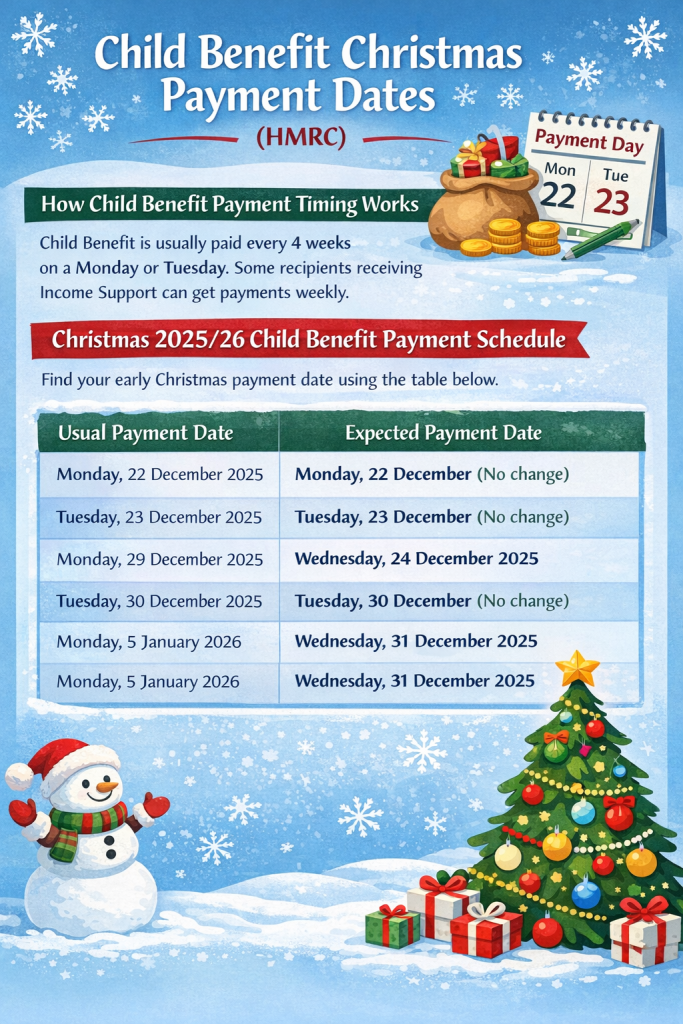
Child Benefit is generally paid every 4 weeks on a Monday or Tuesday. Some recipients, such as single parents or individuals, also in receipt of other benefits like Income Support, can receive payments on a weekly basis. That means you can often plan your payment throughout the full year.
Christmas 2025/26 Child Benefit payment schedule
To assist with your festive planning, use the table below to identify your early Christmas payment child benefit date.
If your usual Child Benefit payment date is X, expect Y
| Usual Payment Date | Expected Payment Date |
|---|---|
| Monday, 22 December 2025 | Monday, 22 December (No change) |
| Tuesday, 23 December 2025 | Tuesday, 23 December (No change) |
| Monday, 29 December 2025 | Wednesday, 24 December 2025 |
| Tuesday, 30 December 2025 | Tuesday, 30 December (No change) |
| Monday, 5 January 2026 | Wednesday, 31 December 2025 |
The Payment Arrangement tables shows payments due on bank holidays or on the Monday after a weekend bank holiday as being paid the previous working day. If your payment date falls on a bank holiday, timing may change and people should confirm via their bank/payment pattern and HMRC if unsure.
How to check your own Child Benefit payment date quickly
The most efficient way to verify your HMRC Christmas payment schedule is through the HMRC personal tax account or the HMRC app. You can view your payment history and see the “next payment” date. If you notice your child’sbenefit payment dates in the UK have changed recently, it may be due to a change in circumstances or a previous missed cycle.
Case Study:
A single parent on weekly payments was confused by the double bank holiday in late December. Lanop calmly mapped out their specific early payment dates for 24 and 31 December, reassuring them so they could pre-book grocery delivery with the confidence that the funds would be cleared in time.
Client quote:
“Knowing exactly when my money would land allowed me to plan our Christmas dinner without the usual stress.” — Emma P., Office Manager
DWP and HMRC Christmas payment dates (avoid schedule confusion)
DWP early payment dates overview (context only)
The DWP typically issues a press release clarifying DWP HMRC Christmas payment dates. For 2025, the DWP will likely move payments due on the 25th and 26th of December to the 24th of December. Because the DWP handles a higher volume of daily payments (like Universal Credit), their “paid early” window often feels broader than HMRC’s four-weekly cycle.
Where Child Benefit fits in (HMRC timing vs DWP timing)
It is crucial that you do not assume your Child Benefit will arrive on the same day as your Universal Credit. Even though DW Pand HMRC benefits are to be paid early for Christmas, they are processed on different systems. Check out your HMRC app specifically for Child Benefit to avoid a shortfall in your festive budget.
Claiming Child Benefit in the UK (first-time claim)
Eligibility (UK, current rules)
Child benefit eligibility in the UK in 2025 is generous but closely defined. You may be able to get it if you are responsible for a child under 16 (or a child aged 16, 17 or 18 who is in approved education or training). You don’t have to be the child’s parent, but you do need to be the one caring for them.
Example: Shared Care. Sarah and Tom have separated. Their daughter spends four days a week with Sarah and three with Tom. Only one person can claim the Child Benefit for the child. If they cannot agree, HMRC will usually decide to pay the person the child lives with most of the time.
How to claim Child Benefit (step-by-step)
How to claim child benefit in the UK is now primarily a digital process:
- Create a Government Gateway user ID.
- Fill in the online claim form on GOV.UK.
- Provide the child’s birth or adoption certificate (HMRC can often verify UK births automatically).
- Submit the claim. It can take up to 12 weeks to process a new claim.
Evidence and documents checklist for a new checklist for a new claim:
- Your National Insurance number
- Your child’s birth or adoption certificate (original)
- Your bank details for payment
- Optional: your child’s Red Book for reference (not mandatory)
- Your child’s birth certificate (original) or adoption certificate.
- Your bank details for payment.
- Your child’s health record (Red Book) is useful for reference, but not mandatory for the form.
Backdating rules and what “backdate” actually means.
If you forgot to claim when your baby was born, can I backdate the child benefit claim? Yes, HMRC allows you to backdate payments for up to 3 months from the date it receives your application. This is why HMRC urges parents to claim child benefit for Christmas as early as possible to avoid losing any backdated funds.
Case Study:
We assisted a new parent who missed the initial claim window due to a prolonged hospital stay. Lanop guided them through the digital application process and successfully secured three months of backdated payments, providing a £300+ injection of funds just as the December holiday costs peaked.
Managing your Child Benefit before Christmas (prevent issues)
Changing bank details safely before Christmas
If you are moving to a new bank account in December, changingthe bank details for the child benefit is a priority. You can do this online, but you must do it at least five working days before your payment is due. If you close your old account before HMRC processes the change, it may delay your Christmas child benefit payment.
Reporting changes to HMRC (and why Christmas makes this risk). The HMRC Christmas child benefit reminder usually highlights that you must report if your child leaves education, if you move house, or if a partner moves in. Processing times slow down in late December, so staying proactive helps ensure you enjoy a worry-free Christmas without missing a child benefit payment. Christmas.
If your income has changed
If your income rises above £60,000, your eligibility for the full amount changes. Conversely, if your income has dropped below this threshold recently, you may be entitled to keep more of the benefit. If your income change pushes you into HICBC, you may need tax return support via Self-Assessment to stay compliant.
Overpayments and recovery risk during the Christmas period
A child benefit overpayment during the Christmas period is often caused by failing to report that a child over 16 has left full-time education. HMRC will recover this money by reducing future payments, which can be a financial shock in January. If HMRC starts asking questions or opens a review, get support early through HMRC tax investigations rather than waiting until it’s too late.
Case Study:
When a client’s payment was stopped in November because their 16-year-old’s education status hadn’t been updated, Lanop stepped in. We helped the family navigate the HMRC app to verify “approved training” status, resulting in a full reinstatement of funds and arrears before the final December payment cycle.
High Income Child Benefit Charge (HICBC) at Christmas
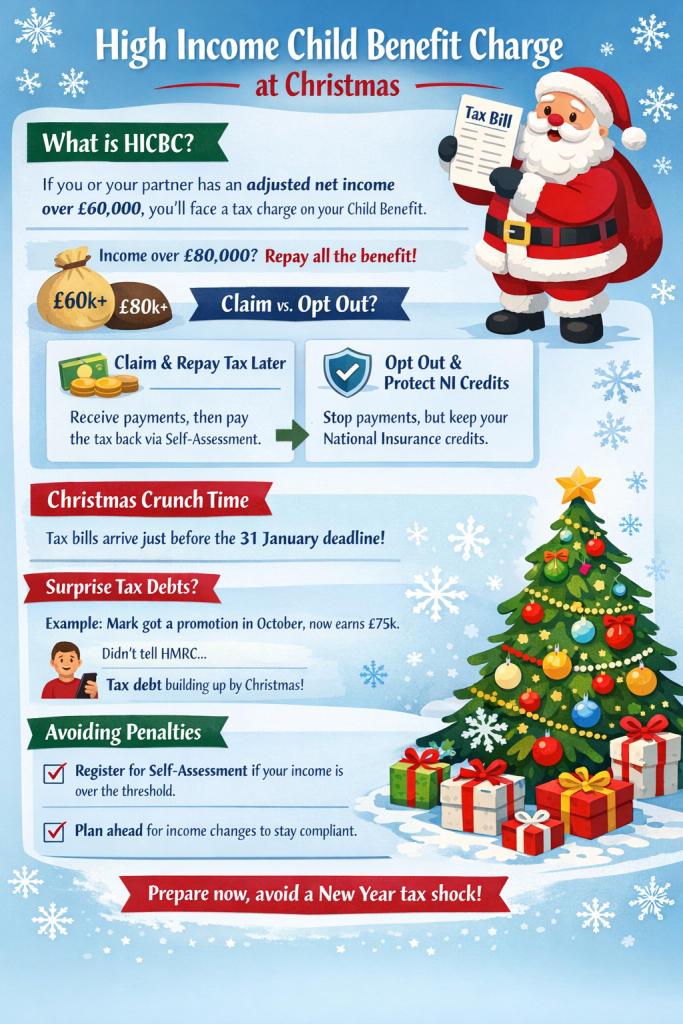
What HICBC is Christmas is the time when many parents first realise they owe tax, the high-income child benefit charge. If you or your partner has an “adjusted net income” of more than £60,000 then you will have to repay some of the benefits through Self-Assessment. Where income is higher than £80,000, the charge is the benefit in full.
Practical decision: claim vs opt out vs repay
You have two choices:
- Receive the cash and pay the tax back later via a tax return.
- Opt out of receiving the payments but keep the claim “active” to protect your National Insurance credits for your State Pension.
Christmas-specific pain points
December is the month before the 31 January Self-Assessment deadline. Many parents discover that they have a tax bill for the previous year, just as they are trying to manage the Christmas cost of living, to help parents in the UK. If you are already behind, review the Self-Assessment extension and penalty waiver guide to understand what HMRC will and will not accept.
Example: Income Rise. Mark received a promotion in October, taking his salary to £75,000. He hasn’t told HMRC. By Christmas, he is technically accruing a tax debt for the HICBC that he will need to settle in the next tax year.
Avoiding compliance errors
To avoid penalties, ensure you are registered for Self-Assessment filing if your income is over the threshold. Many families mistakenly believe that because Child Benefit is “automatic,” the tax is too. It is not. If you want fewer surprises, proactive tax planning is the cleanest route, especially when your income fluctuates.
Case Study:
A Marketing Director earning £68,000 was concerned about the 31 January tax deadline. Lanop calculated their “adjusted net income” by factoring in their private pension contributions, which lowered their HICBC liability and allowed them to keep more of their benefit than they originally expected.
Problems at Christmas: late, missing, incorrect payment
Triage checklist (do this in order)
- Check out your bank statement to see if the payment is “pending.”
- Confirm the HMRC Christmas payment schedule above.
- Check your HMRC personal tax account for any “stopped” notices.
- Verify that your bank details are still correct in the HMRC app.
Missed or delayed Child Benefit payment
A missed child benefit payment at Christmas is rarely a system error; more often, it’s due to a change in circumstances (like a child turning 16) or a bank details error. If the money has not arrived by the expected day, contact your bank first. If HMRC flags a review or asks for evidence, use HMRC tax investigations support to avoid missteps.
Incorrect amount / unexpected payment timing
If you receive less than the child benefit Christmas 2025 rates (£26.05 for the first child, £17.25 for others), it may be because HMRC is recovering a previous overpayment.
Complaints and escalation pathway
If you believe HMRC has made an error, you can file HMRC Christmas payment complaints online. Record every call and the name of the counsellor you speak to. If the matter develops penalties or late-filing retribution, see how do I appeal a Self-Assessment penalty (step-by-step) and do not supply rushed or erratic explanations.
For general context on how checks work, you can also review Lanop’s guide on HMRC compliance checks rights and obligations.
Contacting HMRC (Child Benefit)
The HMRC child benefit phone number for Christmas is 0300 2003 100. Lines are typically open from 8 am to 6 pm, but lines will be closed on the Christmas bank holidays.
What to prepare before you call HMRC:
- Your National Insurance number.
- The child’s birth certificate or HMRC reference number.
- Details of your last three payments and dates.
- Your current bank details.
If you want Lanop to handle HMRC communication for you, use the Contact Us form.
Case Study:
A freelancer switched bank accounts in early December, but the Child Benefit was sent to the old, closed account. Lanop provided a step-by-step triage plan to track the bounced payment and coordinate with HMRC’s helpline, ensuring the funds were rerouted to the new account before New Year’s Day.
Client Quote:
“Lanop’s emergency checklist saved the day when my payment went to a closed account during the festive rush.” — Anita K., Freelance Designer.
Extra Christmas help and cost-of-living support (set expectations)
“Extra help with bills” vs Child Benefit timing changes
There is no specific Christmas bonus for the child benefit in the UK issued by HMRC. Any extra help with bills at Christmas in the UK usually comes from local council Household Support Funds or DWP cost-of-living schemes. However, many families also improve cash flow by checking whether they’re overpaying tax, see Are you paying too much tax? for common causes like tax code issues and missed reliefs.
Where to look for support (signposting only)
If you are struggling, check out the “Help for Households” section on GOV.UK or contact Citizens Advice. These organisations can help with energy vouchers and local grants that are separate from HMRC Christmas payments.
Related HMRC Christmas topics that people confuse with Child Benefit.
HMRC Christmas party allowance (limited companies)
For business owners, the HMRC Christmas party allowance exempts annual social events costing up to £150 per head. This is an exemption, not an allowance you “claim back” as cash from HMRC.
HMRC Christmas gift allowance
The HMRC Christmas gift allowance (trivial benefits) allows employers to give employees gifts worth up to £50 tax-free, provided they aren’t cash or a reward for performance. Directors of close companies have an annual cap of £300.
“HMRC Christmas bonus” (what people mean vs what exists)
As clarified, the only “bonus” is the £10 DWP payment. While many search for DWPHMRC Christmas benefits discounts, these are usually commercial offers for benefit recipients rather than government grants.
How Lanop can help
Navigating the intersection of family benefits and tax compliance can be daunting. At Lanop Business & Tax Advisors, we provide specialist support to ensure you remain compliant while maximizing your entitlements.
Child Benefit claim support (first-time and complex cases)
We assist families in setting up their claims correctly from day one. We can review your evidence, assist with the online application, and help troubleshoot any issues with delayed Christmas child benefit payments by communicating with HMRC on your behalf.
HICBC support (reduce risk, avoid surprises)
The High-Income Child Benefit Charge is a common trap. We help you calculate your “adjusted net income” to see if you fall above the £60,000 threshold. We provide clarity on whether you should claim and pay the tax or opt out to protect your NI record.
HMRC correspondence and dispute support
If you receive a letter regarding an overpayment or an investigation into your child’s benefit Christmas 2025 payments, our team can handle the correspondence. We draft formal responses and represent your interests to resolve disputes quickly.
Year-end readiness (December–January)
Our year-end service includes:
- Check for changes in your tax code.
- Preparing Self-Assessment returns for the January deadline.
- Ensuring HMRC Christmas party allowance and trivial benefits are recorded correctly.
Conclusion
Check your HMRC Christmas Payment dates for child benefit early, and if you believe any information is incorrect, inform the HMRC as soon as possible. Keep in mind that the HMRC Christmas payments guide is based on bank holidays to ensure you don’t get an unexpected lack of child benefit at Christmas. It’s a good idea to be ahead of the game.
Do you want us to check your HICBC position or help with a fresh claim? If you like, tell us when you are free, and we’ll confirm your spot.
FAQs
When will my HMRC Christmas child benefit payment be paid?
If your payment is due on a bank holiday (25, 26 Dec or 1 Jan), it’ll be made on the last working day before. Next year, the overwhelming majority of holiday payments will be received on 24 or 31 December.
Will the child's benefit be paid early at Christmas this year?
Yes, but only if your usual due date falls on a bank holiday or a weekend. Payments due on either a normal working Monday or Tuesday will be as usual.
How do Christmas bank holidays affect child benefit payment dates?
When bank holidays occur, banks close, so money cannot be transferred, prompting HMRC to pay the day before or after the holiday. This way, you get paid before those long holiday weekends.
What should I do if my Christmas child benefit payment is late?
First, look at the “pending” transactions on your bank’s website, and then check that your details are correct in the HMRC app. If there’s no obvious problem, speak to your bank before contacting the HMRC helpline.
How do I claim child benefit for the first time in the UK?
You can apply online through the GOV.UK or on the HMRC app with your Government Gateway ID. You will need your National Insurance number and details of your child’s birth or adoption certificate.
Can I backdate a child benefit claim over the Christmas period?
Yes, you can backdate a claim up to 3 months. HMRC will pay any arrears owed from that point as a single payment after your claim is processed.
Who is eligible for the child benefit in the UK right now?
Claimants can be anyone responsible for a child under 16 years old (or up to age 20 in approved education). Eligibility is tied not only to biological parenthood but also to residential status and responsibility for the child.
How does the High-Income Child Benefit Charge work at Christmas?
Pay back part of the benefit. If you earn more than £60,000, you’ll have to pay some of the benefits back through Self-Assessment. This tax bill falls due in January, and many parents are living under it as December opens.
How do I change my bank details for child benefit before Christmas?
Update your details via the HMRC app or your online personal tax account. Do this at least five working days before your payment is due to avoid a festive payment delay.
Will I still get child benefits at Christmas if my income has changed?
Yes, payments continue regardless of income changes, but your HICBC tax liability may change. If your income has risen above £60,000, you may owe more tax; if it has fallen, you may owe less.
What happens if I miss reporting changes to HMRC before Christmas?
Failure to report changes, such as a child leaving education, can lead to overpayments. HMRC will eventually recover this money by reducing your future payments, often without much warning.
Is there any extra Christmas payment or bonus with the child's benefit?
No, HMRC does not provide a Christmas bonus for Child Benefit. The £10 Christmas Bonus is a DWP-specific payment for those on other qualifying benefits like PIP or Pension Credit.
How do HMRC and DWP coordinate Christmas benefit payments and dates?
Although both departments pay in advance for bank holidays, they use different systems and have different timings. Always check your HMRC app for Child Benefit and separately check your DWP portal for Universal Credit.
What evidence do I need to support a new child benefit claim?
You’ll need your National Insurance number, the child’s birth certificate, and your bank details. Most UK births are now verified digitally, with no physical posting required.
How do I contact HMRC about a missing or incorrect Christmas child benefit payment?
Contact the Child Benefit Helpline on 0300 200 3100. Make sure you have your National Insurance number to hand in and remember to check for bank holiday closures before you call.