
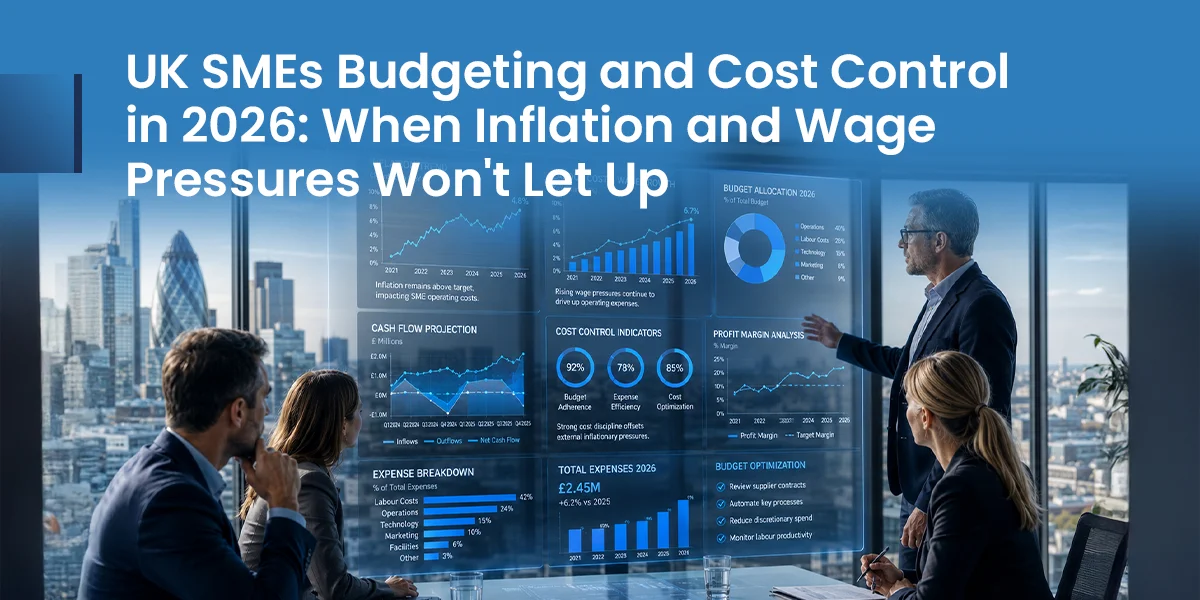
Running a small business in 2026 can feel like aiming at a moving target. Wages are up. Employer National Insurance bites sooner. Energy deals are renewed higher. And customers pay later. None of it is dramatic on its own. But put together, it quietly changes what your business can afford.
Most owners do not want a finance lecture. They want to know where the money goes. They want to know what is coming next. And they want to know which choices really matter. So this guide keeps it plain. It is a practical look at budgeting and cost control for UK SMEs this year.

How Can UK SMEs Build a Budget That Still Works When Costs Keep Rising in 2026?
Why a once-a-year budget no longer protects you
The fixed annual budget was built for a calmer world. You set it once, then follow it for the year. But that no longer works. Costs, wages and borrowing rates can all shift in a single quarter. By the time you spot the gap, the money is often gone. So the fix is simple. Check the numbers often, not once a year.
Which costs are rising fastest for UK SMEs?
Payroll and National Insurance
Payroll is the highest cost that most firms can control. And it has gone up in two ways. First, the wage floor rose, according to the Gov.in the UK, the National Minimum Wage rates: the National Living Wage went up to £12.71 an hour for workers aged 21 and over from 1 April 2026. The 18 to 20 rate rose to £10.85. The 16- to 17-year-old and apprentice rates rose to £8.00. Second, the employer’s National Insurance now bites sooner. HMRC’s Rates and thresholds for employers 2026 to 2027 confirm employers pay 15% above the £5,000 secondary threshold. So each hire costs more than the wage on the contract.
Energy and utilities
Energy has come down from its peak. But it has not returned to its state before 2022. Many SMEs are now leaving fixed deals they signed when prices were high. So the risk is a sudden jump in your bills the day a contract rolls over.
Supplier and stock costs
Supplier price rises are now routine. Many firms accept the yearly increase without a word. That habit is costly. Check your main suppliers against the market instead. It is one of the few jobs that pays for itself almost at once.
Finance and borrowing costs
Borrowing costs are far higher than they were three years ago. Overdrafts, asset finance, and loans all carry higher rates now. So, they are worth a closer look. If your debt has a variable rate, watch it every month. Variable borrowing rates are impacted by the Bank of England base rate being reduced to 3.75% in December 2025. Nevertheless, mortgage rates are well above the levels they were three years ago.
How rolling forecasts make budgeting more accurate
A rolling forecast is different from the once-a-year guess. You keep it updated. It looks twelve months ahead and gets refreshed every month. As one month ends, you add another. So a full year is always in front of you. For a growing SME, it is the single most useful change you can make.
Which numbers should you review every month?
A monthly review does not need dozens of figures. It needs a few that warn you early. Watch your profit margin. Watch your cash flow and closing cash balance. And watch your debtor and creditor days. Late payment is the problem I hear about most. Research by FreeAgent found that 62.6% of small business invoices in the year to August 2025 were paid late. So track your debtor days month by month. It is one of the earliest warnings you can get.

How Do You Control Business Costs Without Hurting Growth?
Sorting fixed, variable and optional costs
Good cost control starts with knowing what each cost does. Fixed costs, like rent, stay the same regardless of what you sell. Variable costs, like materials, move with sales. Optional costs, like marketing, you can pause. Sort your spending into these three groups first. It is the basis for every sensible call that follows.
Which costs should you review first?
Start with the optional spending. It carries the least risk. Then move to recurring costs, which renew quietly while no one is watching. Leave the costs tied straight to sales until last. Cut those too soon, and you can do real harm.
How to rank cuts by their effect on profit
Not every pound saved is the same. A cut that protects your margin matters more than one that shaves a tiny overhead. So, deal with the big, low-risk savings first. And go gently with anything your customers can feel.
Cost-cutting versus cost optimisation and why it matters
There is a real difference between the two. Cost-cutting removes spending. Cost optimisation makes each pound work harder. Often, that means spending the same money more smartly. Blunt cutting can damage your capacity, your team, and your sales. So the firms that come through tough times well usually optimise first and cut second.
How to lift profit margins without raising prices
The price is only one level. And it is rarely the first to reach for. You can lift your margin in other ways. Cut waste. Agree on better supplier terms. Drop product lines that lose money. Help your team get more done. The wins that stick are dull but repeatable, like a supplier renegotiation or a well-timed energy renewal.
Where Do SMEs Overspend Without Realising It?
Subscription and software creep
Software spending grows almost invisibly. A tool gets added for one project. A licence is never cut when someone leaves. Renewals tick over with no review. So, check who uses what, and how often. A quick look nearly always turns up savings.
Services and contracts you no longer use
Plenty of firms pay for services they no longer touch. The contract renews on the old terms while the business moves on. So read what you are signed up for. Then match it to what you actually need now. It is dull work, but it pays off again.
Too much stock on the shelf
Stock on the shelf is cash you cannot use. It also costs you storage, insurance, and the risk of going out of date. So, trim your stock to real demand. That frees up cash that many owners did not know was stuck.
Slow, manual admin
Manual admin is a cost, even with no invoice attached. It eats paid hours. Re-keying data, chasing approvals, and reconciling by hand all add up. So, tidy up these tasks or automate them. You cut both errors and costs.
Hidden finance costs
Some costs hide in plain sight. Overdraft fees, invoice finance charges, card rates, and interest on old loans rarely get an annual review. The pattern is always the same. Nobody chose to keep paying. The cost just renewed while attention was elsewhere. So, sweep every recurring payment once a year. It recovers more than owners expect.
How Can You Cut Payroll Costs Without Making Redundancies?
Check how working hours are used
Redundancy is rarely the best first answer. Look at how working hours are really used instead. Spare time, doubled-up roles, and uneven workloads are common. Sort them out, and you lift output without losing people.
Outsourcing versus hiring
For some jobs, outsourcing costs less than employing. Add up employer NIC, pension, holiday and a fixed salary, and the gap is clear. Specialists or up-and-down work is often cheaper outside. The right answer depends on volume, control, and how core the job is.
Where automation helps SMEs
Automation lets a smaller team do more without burning out. Invoicing, payroll, bookkeeping, and routine reports are all good places to start. The aim is not to remove staff. It is to free their time for work that needs a person.
Salary sacrifice and other tax-smart options
Salary sacrifice is worth a look, most often for pensions. It can cut National Insurance for both the employee and the employer. That is because the contributions sit below the pay on which NIC is charged at 15%, as set out in HMRC’s Rates and thresholds for employers 2026 to 2027. But it must be set up correctly to stay compliant. So, get proper advice rather than guessing.
Handling the National Living Wage rise on a tight budget
The wage rise to £12.71 an hour from April 2026 is locked in and published on GOV.UK’s National Minimum Wage rates. So, the task is to absorb it without harm. Start by claiming what you already qualify for. In HMRC’s Rates and thresholds for employers 2026 to 2027, the Employment Allowance is at £10,500 for 2026/27. This is the least played of them. Important: If you are a one-person company (with no secondary company employees earning more than £5,000), you cannot claim. But there’s more to see as well. The Employment Rights Act 2025 will affect how staff are engaged. So, secure your contracts right now and steer clear of expensive revisions down the line.
What Is the Most Common Budgeting Mistake UK Owners Make?
Watching profit while ignoring cash
The most dangerous mistake is simple. Owners watch profit and ignore cash. But profit is just an accounting result. Cash is what pays your suppliers, your staff and HMRC. A profitable business can still fail if the money turns up too late.
Why growing sales can still leave you short
Growth eats cash before it makes it. You pay for materials, wages, and stock to fill new orders. But customers pay you a lot later. This is overtrading, where you take more than your cash can support. And it catches the firms that are doing well.
Managing the cash tied up in the business
Working capital is the cash stuck between paying out and being paid. You can free it up in three ways. Chase debtors sooner. Use supplier terms sensibly. Keep stock lean. Each one releases cash without an additional sale.
Putting tax into the budget
Tax is not optional. Yet it often gets left out of the budget until the bill lands. As GOV.UK’s guidance on paying your Corporation Tax bill sets out that Corporation Tax is due 9 months and 1 day after your accounting period ends. VAT and PAYE have their own dates too. So set money aside as these build up. A separate account works best.
Keeping a reserve for surprises
A budget with no slack assumes nothing will go wrong. That is never safe. A reserve absorbs the broken machine, the late-paying customer or the sudden price rise. A short thirteen-week cash flow forecast helps as well. It shows the squeeze coming before it bites.
Which Expenses Can You Cut Without Causing HMRC Problems?
What counts as allowable and what does not
To cut tax safely, you first need to know what HMRC accepts. Allowable expenses are those spent only for the business. Costs like client entertainment and most fines are not allowed. Claiming what you are owed is fine. Claiming what you are not invites trouble.
Everyday costs versus buying assets
Day-to-day running costs are revenue spending. You deduct them in full in the year you spend them. Money spent on things that last, like equipment, is capital spending. That is treated differently, through capital allowances. Get the split right, and you protect both your accounts and your claim.
Director expenses and common slip-ups
Director expenses draw extra attention from HMRC. The usual slip-ups are personal costs run through the company and unclear director’s loan account entries. There’s a sting in the tail, too. If funds are withdrawn and are not repaid, they could result in a second Corporation Tax liability under the section 455 regime. The outstanding loan amount is 33.75% of the S455 charge. Maintain a separation of personal and business funds and retain receipts. It’s the most effective protection.
Staff perks and entertainment rules
Staff costs are deductible. But perks and entertainment carry their own rules. Benefits given to employees usually attract Class 1A employer National Insurance at 15%, per HMRC’s Rates and thresholds for employers 2026 to 2027. They must be reported correctly, too. Trimming the cost is fine. Getting the reporting wrong is the real risk.
Why does cutting too hard raise your tax risk
Cut too hard in the wrong place, and it can cost more than it saves. Spend less on record-keeping or professional help, and you raise the chance of errors and penalties. That gets expensive fast. Late payment interest now sits at 7.75%, as published in HMRC’s interest rates for late and early payments. So good records are not an overhead to trim. They are what keep penalties off the table.
What HMRC and Legal Changes Should SMEs Budget For in 2026?

Making Tax Digital for Income Tax
This one affects sole traders and landlords. According to HMRC’s Making Tax Digital for Income Tax guidance, the rules become mandatory from 6 April 2026 for those with qualifying income over £50,000. The threshold then drops. It falls to £30,000 from April 2027, and to £20,000 from April 2028. Those affected must keep digital records and send quarterly updates. So budget for the software and the time to adjust.
The National Living Wage and your budget
The National Living Wage rose to £12.71 an hour from 1 April 2026, as confirmed in GOV.UK’s National Minimum Wage rates. The effect reaches past minimum-wage staff. Pay gaps between roles often need to be adjusted, too. So work out the full-year cost now, rather than month by month.
Employer National Insurance
HMRC’s Rates and thresholds for employers 2026 to 2027 set employer National Insurance at 15%. That applies to earnings above the £5,000 secondary threshold. The Employment Allowance, at £10,500 for 2026/27, can offset some of it. But check whether you qualify. The allowance is not available where a sole director is the only person on the payroll.
Corporation Tax rates and filing
GOV.UK’s Corporation Tax has two main rates. The small profits rate is 19% on profits up to £50,000. The main rate is 25% on profits above £250,000. In between, marginal relief gives an effective rate between the two. There is a catch if you control more than one company. The thresholds are shared between them. So, the higher rate can apply sooner than you expect.
Companies House filing duties
Filing deadlines are fixed, so treat them that way. As GOV.UK’s guidance on preparing annual accounts for a private limited company explains, private companies must file annual accounts within 9 months of their accounting reference date. Confirmation statements and the new identity checks also bring duties. So put every deadline in your calendar and keep it there.
Late filing penalties and interest
The penalties for filing late have grown, and they deserve respect for private company accounts filed late at Companies House, GOV.UK’s late-filing penalties guidance sets them at £150 for up to one month late. After that, they rise to £375, then £750, then £1,500 for more than six months late. File late for two years running, and they double. There is more on the tax side. HMRC’s guidance on Company Tax Return penalties confirms the fixed late-filing penalty doubled to £200 for returns due on or after 1 April 2026. It rises to £400 after three months. In addition to any penalty, if tax becomes overdue, HMRC will impose interest on the unpaid tax. It published its interest rates for late and early payments, reducing the rate to 7.75% per annum, down from 8.00% as of 9 January 2026.
Identity checks at Companies House
This change is creating the most work right now. It is Companies House identity verification under the Economic Crime and Corporate Transparency Act 2023, and as set out in GOV.UK’s Companies House identity verification guidance, it became mandatory for new directors and people with significant control from 18 November 2025. Existing directors must verify by 18 November 2026. Ignore it, and the result is serious. You can face blocked filings or even have the company struck off. So it belongs on every director’s list this year.
How Do You Build a Monthly Budget and Cost Process That Works?
Set a fixed monthly review
A process only works if it happens on a set date. So pick a recurring day each month. Then protect it as you would a client meeting. A focused hour every month beats a long session once a quarter.
Track budget against actual
Each month, compare what you planned with what actually happened. Go line by line. The gaps are where the insight is. A cost that is always over budget points to a bad assumption or a problem to fix.
Keep an eye on cash flow
Update your cash flow forecast at every review, not just your profit figures. Ask one simple question. Will there be enough cash to meet what is due over the coming weeks? A forward view gives you time to act. You can arrange finance or chase debtors before a gap becomes a crisis.
Review payroll and overheads
Payroll and overheads are large and recurring. So they belong in every review. Check that staffing matches workload. Check that overheads have not crept up. A little attention each month stops the slow creep that yearly reviews miss.
Spot early warning signs
A regular review catches trouble while it is still small. Longer debtor days, a shrinking cash buffer and slipping margins are all early signals. Spot them early, and you keep your options. Spot them late, and those options are gone.
Give someone ownership
A process needs an owner. So give clear responsibility for the budgets, the review, and acting on what it shows. When everyone owns the numbers, nobody does.
How Does Good Budgeting Support Long-Term Profit?
Protecting margins when prices rise
Good budgeting lets you see margin pressure as it builds. You catch it before it does damage. With clear figures, you can adjust pricing or costs promptly. That is why firms that watch their margins tend to hold them.
Making smarter investment choices
A reliable forecast shows what you can afford to invest, and when. Choices about hiring, equipment or expansion then rest on numbers, not hope. That is the difference between a planned step and a gamble.
Standing firm in uncertain times
A business that plans, forecasts and keeps a reserve can absorb shocks. A less careful one would sink under the same blow. Resilience is not luck. It is the result of preparation. So the edge goes to those who plan for it.
Growing with a clear sight of the numbers
Growth is safer when you can see where the money comes from and where it goes. Clear figures let you scale on purpose. You are not just hoping the cash keeps up. So growth becomes a reward rather than a risk.
Better decisions all round
Budgeting is a decision-making tool, not a chore. Every choice is better when it rests on current figures, from pricing to hiring. Owners who lead from the numbers make calmer, faster, better calls. That is the real return on the effort.
How Does Lanop Help SMEs Improve Budgeting and Cost Control?
Management accounts and reporting
We prepare your management accounts. Each month or quarter, you get a short, readable pack. You see the numbers that matter without having to pull them together yourself. Then we talk through what they show and what to act on.
Cash flow forecasting and budgeting
We build your forecast with you and keep it up to date. Say you are weighing a new hire, a big order or a piece of kit. We run the scenario first. Then we show you the effect on cash before you commit.
Tax-smart cost management
We plan your taxes for the full year, rather than reacting at year-end. That means checking what you qualify for. It means arranging costs and paying sensibly. And it means flagging decisions before a deadline closes the door.
Payroll planning and compliance
We run and oversee your payroll. We file the reporting to HMRC. And we keep your pension auto-enrolment duties on time. As the wage and National Insurance rules change, we update them all. So, the admin and the risk stay off your desk.
Advice between the deadlines
Most of our value shows up between the deadlines. You can call us when a decision comes up. And we will come to you when we spot something worth raising. It is a steady relationship, not a once-a-year filing job.
Frequently Asked Questions
There is actually some relief here for most firms. From 1 April 2026 in England, the small business multiplier dropped to 43.2p (from 49.9p) and the standard rate to 48.0p (from 55.5p), while retail, hospitality and leisure pay just 38.2p or 43.0p, and anything above £500,000 carries a 50.8p rate.
Quite a lot, as it happens. Since 6 April 2026, sick pay kicks in on day one. The old earnings threshold has gone, so everyone qualifies, and the rate is £123.25 a week, or 80% of average weekly earnings if that works out lower.
They have edged up by two points. From 6 April 2026, the basic rate is 10.75% (up from 8.75%), and the higher rate is 35.75% (up from 33.75%), while the additional rate holds at 39.35%, and you still get the first £500 tax-free.
Yes, and it quietly costs you. The £5,000 point where 15% employer NIC starts is frozen right through to April 2031, so as wages climb, more of each salary sits above the line, and your bill creeps up even when nobody new joins.
It is holding steady at £90,000 of turnover over any rolling 12 months, the same as it has been since April 2024, with deregistration at £88,000. The trick is to watch that rolling figure rather than your year-end, because it can sneak up on you.
Not right away, but keep it on your radar. It still saves National Insurance on both sides in 2026/27, though from 6 April 2029, anything sacrificed above £2,000 a year will start attracting NIC, so it pays to plan early.
Not all of them. Business rates are devolved, so those multipliers are England-only; Scotland, Wales, and Northern Ireland set their own, but the sick pay, dividend, and National Insurance changes apply right across the UK.
Where This Leaves You in 2026
After years of guiding businesses through both tighter and easier times, one lesson holds firm. You will never out-guess inflation, wage rises or HMRC’s deadlines, and the owners who try usually tie themselves in knots. The ones who come out ahead do something far simpler. They build a rhythm, and they stick to it.
So here is the guidance we would give any owner heading through the rest of 2026. Look at your numbers every month, without fail. Keep a rolling view of your cash, not just your profit. Put tax aside as it builds, rather than scrambling when the bill lands. And hold a reserve for the months that test you. Get these four habits right and most of the worries in this guide never reach your desk.
This was never about being the cheapest business on the street. It is about being the one who always knows exactly where they stand and is never caught off guard. In our experience, that steadiness is what separates the firms that grow with confidence from the ones that merely scrape through. Make it your standard, and the harder decisions start to feel a good deal easier.
If you would value a steady, experienced hand to set that rhythm up and keep it running, that is precisely what we do. Speak to our team at lanop.co.uk and let us help you take on the rest of 2026 on the front foot.