
Unlocking the HMRC Worldwide Disclosure Facility (WDF): A 2026 Guide to Tax Compliance
With a growing open world tax system, it has never been more important to remain within the confines of HMRC rules, whether as individuals, as a business, or even as trustees. The HMRC Worldwide Disclosure Facility (WDF) offers a voluntary option to taxpayers to rectify undisclosed offshore income, gains, or assets and to bring their tax position up to date.

With the rise of international information exchange by the Organisation for Economic Co-operation and Development Common Reporting Standard (CRS) and the increase in the attention to offshore compliance by HMRC, offshore assets are becoming less visible off the radar. It is against this background that the WDF has emerged as a valuable tool for proactively resolving historic tax problems, managing compliance risks, and responding to increasing HMRC scrutiny.
Why the WDF Matters in 2026
Knowing how the WDF works is key if you have any offshore interests. A solid grasp of the rules helps you stay on track. It also helps you avoid steep fines or legal trouble.
The Labour government has asked HMRC to close the tax gap. The team has invested heavily in new data tools, additional staff, and stronger agreements with foreign tax authorities. Waiting for HMRC to find you first is now far riskier than it used to be.
The WDF is built for this moment. It lets you fix mistakes before HMRC opens a formal case. That often means a smaller bill and far less stress.
What the HMRC Worldwide Disclosure Facility Actually Is
The HMRC Worldwide Disclosure Facility is a voluntary route. It allows individuals and firms to report any UK tax bill linked to an offshore matter. Its purpose is simple. It helps you bring your tax affairs up to date and meet HMRC’s rules.
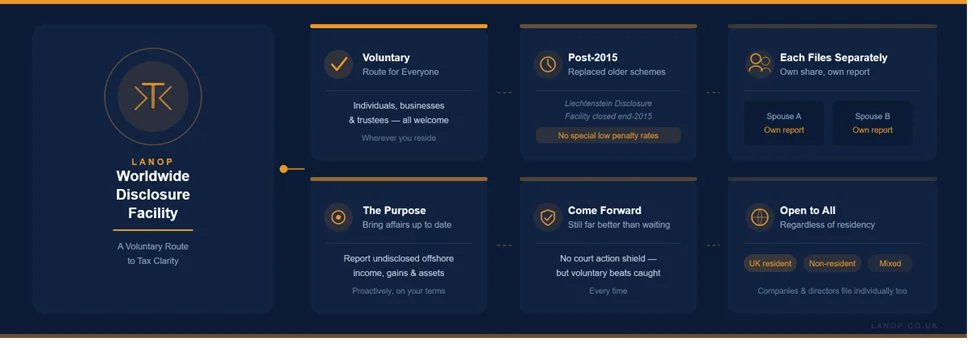
The WDF replaced older schemes like the Liechtenstein Disclosure Facility, which closed at the end of 2015. Unlike those older schemes, the WDF does not give you special low penalty rates or shield you from court action. Even so, coming forward on your own is still much better than getting caught.
Who Can Use the WDF
Anyone who needs to report a UK tax bill linked to an offshore issue can use the WDF. This applies to both people and firms, no matter where they live. It is open to UK residents, non-residents, and those with mixed tax positions.
If a husband and wife both have hidden income, they must each file their own report. Each one must show their own share. The same rule applies to a company and its directors, who file their cases individually.
Why Preparation Matters
Before you start the WDF process, you need to do your homework. That means pulling together every bit of paperwork that backs up your case. Bank statements, fund reports, property records, and rental income all need to be in one place.
You also need to weigh up just how much hidden income or how many offshore assets you are dealing with. This step gives you a clear view of your likely tax bill and any fines you might face.
With this picture in front of you, you can plan a smart strategy. You can walk into the disclosure with calm rather than fear. If you cannot find every record, do not panic. HMRC knows that gaps happen, more so with older accounts. You can use fair estimates as long as you have made a real effort to find the missing details.
How to Notify and Disclose Through the DDS
The first step is to tell HMRC you plan to come forward. You do this through the Digital Disclosure Service (DDS), which is the safe online tool for starting your case. At this stage, you only need to confirm that you plan to disclose. You do not have to share any figures yet. Once you have told HMRC, the clock starts ticking. You then have 90 days to file the full report, work out the extra tax due, and pay what you owe.
Self-Assessing Your Behaviour
During the report, you must rate your own behaviour. This is a key step that has a big effect on fines. Your behaviour sets how many years your case must cover. This can be four, six, twelve, or up to twenty years based on your case.
The four-year window applies to honest mistakes. The six-year window covers careless behaviour. Willful non-compliance can stretch back twenty years. A twelve-year time limit also applies to some offshore cases, which adds another layer to deal with.
Being honest about points like your residence or domicile status is vital. Getting these wrong can change your whole bill.
Reporting Your Asset Values
You also need to report on the highest value of assets you held outside the UK over the past five years. This covers cash, funds, property, and personal items. The aim is a full and honest report with nothing left out.
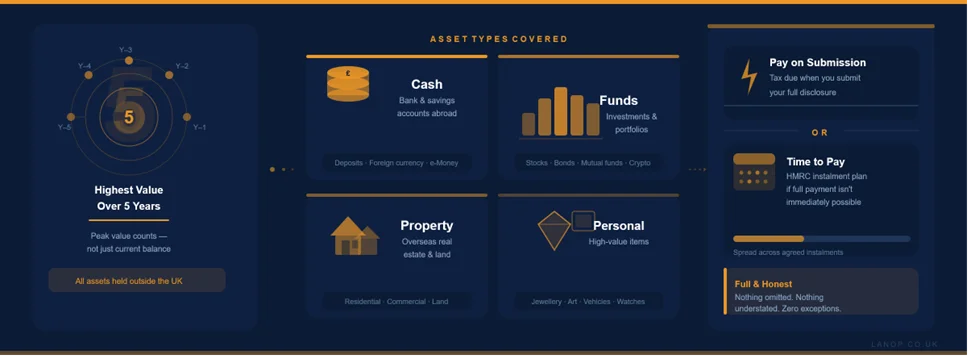
Payment of the disclosed tax is often due when you submit. If paying in full is not doable, you can ask HMRC for a “Time to Pay” plan to spread the cost.
How HMRC Reviews Your Disclosure
Once your report is in, HMRC’s team takes a careful look at all you have shared. They check the offshore income or assets, work out the right tax owed, and decide on any fines.
In recent years, HMRC has begun to call taxpayers and their agents to talk through the reasons behind the missing data. These chats let you share any factors before HMRC sends a final penalty letter.
After that letter, you have 30 days to add more proof before the fine is set in stone. You can still appeal a fine if you do not agree with it. Staying open and helpful at this stage is the best way to achieve a fair result.
Understanding the Penalty Rules
Fines under the WDF depend a lot on the type of report and the country involved. The lowest fine for a voluntary report is 100% of the unpaid tax, provided the report is complete and honest. This shows just how vital it is to act before HMRC contacts you through a formal tax investigation.
For reports prompted under the Failure to Correct (FTC) rules, fines can reach 200% of the unpaid tax. Sending in a full and honest report can bring that down to 150%.
Fines also depend on the country where your offshore interests sit. HMRC sorts countries into groups, and less open ones bring steeper charges. In bad cases, HMRC can even add an asset-based fine and put your name on the public list of wilful tax defaulters.
Resolving Your Position
When you reach the end stage, you have a few options for your tax bill and fines. You can pay it all up front. You can also agree on a payment plan that fits your budget. Knowing the terms of each option matters. Take time to grasp them before signing anything.
Staying compliant after your report is just as key as the report itself. A clean record from this point on shields you from future trouble. It also keeps your money on stable ground.
The Benefits and Trade-Offs of Voluntary Disclosure
Coming forward through the WDF brings real perks. You show HMRC that you mean to put things right. This often leads to lower fines than if HMRC had found you first. You also gain a level of control over the process that fades once a case begins.
Voluntary reports can also lower the risk of court action, though they do not give you full cover. Tax evasion is still a crime. Cases involving fraud should instead be handled through the Contractual Disclosure Facility or Code of Practice 9. These do shield you from court action.
There are trade-offs to think about, too. Damage to your name is one. The cost of expert help is another. Still, for most people, the calm that comes from a clean slate is worth it.
What Happens If You Ignore a Nudge Letter
HMRC sends nudge letters to anyone it thinks might have hidden offshore income or gains. Ignoring one of these letters is one of the worst moves you can make. It often pushes HMRC to open a formal case. That leads to higher fines and far less room to move.
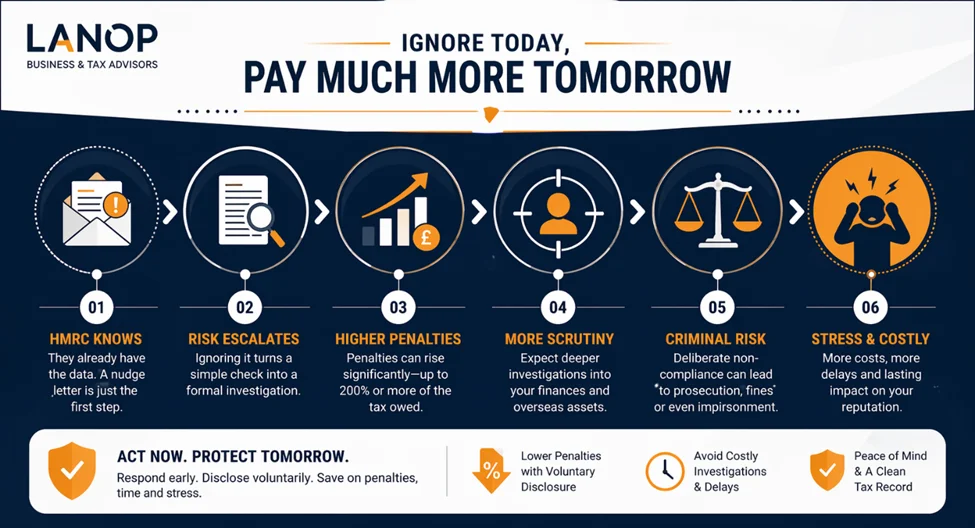
If you get a nudge letter, get advice fast. The right reply can keep your case in the voluntary lane and away from harsher steps.
Why CRS Data Has Changed Everything
The Common Reporting Standard now covers more than 100 countries. Each year, banks and other firms in those countries send details of UK taxpayers’ accounts to HMRC. This includes balances, interest, dividends, and money from selling assets.
In 2026, the data flowing into HMRC is broader than ever before. Digital wallets and e-money providers are now part of the reporting net too. If you have ever thought an overseas account was off the radar, that view no longer holds.
This shift means voluntary reports are not just a good idea. For many people with offshore interests, it is the only smart path.
Conclusion
The HMRC Worldwide Disclosure Facility is a valuable avenue through which taxpayers can remedy their offshore tax affairs, get back on track, and minimise the risk of things getting even worse when HMRC comes into the picture. Although the process may seem complicated, early intervention and a properly drafted disclosure can improve the outcome. As offshore reporting comes under increasing scrutiny, today, some proactive measures will give you certainty, save your position, and help you to proceed with confidence.
The way Lanop Business and Tax Advisors can assist.
A WDF disclosure can be tricky to navigate and may require consulting a specialist, making precise calculations, and establishing a clear approach to managing HMRC. At Lanop Business and Tax Advisors, we assist clients at every step of the process, including evaluating historical offshore liabilities, making disclosures, handling HMRC correspondence, and negotiating practical payment terms where necessary.
We are dedicated to assisting clients with full and proper disclosure and to penalising as effectively as possible.
Have you received an HMRC nudge letter or are you thinking about a voluntary disclosure? Our qualified UK tax advisors can provide specific advice on this matter to help you clear the air with confidence. Get in touch with our team by calling 02083929375 or using our adviser’s Calendly link to find out what to do with your position.
FAQs
1. Will the WDF include offshore crypto assets?
Possibly. Until their nature is determined, offshore cryptos may require a declaration. An offshore crypto account can trigger undisclosed taxes in the UK and thus likely requires a declaration. It would be beneficial to obtain advice from a specialist in offshore crypto tax compliance.
2. Can disclosed facts be amended after the submission to HMRC?
Yes. The facts disclosed are subject to amendments, in certain cases, where mistakes are made. It’s crucial to respond and rectify mistakes promptly if the goal is to reduce the extent of the problem.
3. Can HMRC target specific estimations made in a disclosure?
Yes. There is a strong possibility that HMRC will target estimates, especially if the facts are disclosed, and certain records are unavailable. Therefore, it’s vital to ensure estimations are as accurate as possible with the facts.
4. Do offshore gifts/inheritances disrupt disclosures?
Potentially. Due to UK tax policies, certain offshore debts (finance/inland trade, and commerce) may be subject to indirect taxes, which may disrupt a decision.
5. What is the process once HMRC accepts a disclosure?
Once there is a settlement, the process shifts to ensure compliance, with a focus on proper controls and reporting policies for the disclosed facts.