

Most UK nationals who think about moving abroad hit the same question. Do you keep paying into a UK pension, or do you move it overseas?
Until October 2024, the choice was easy for anyone heading to the EEA. You could transfer a pension within the EEA and pay no 25% Overseas Transfer Charge. The 2024 Autumn Budget then removed that exemption for UK nationals.
This guide walks through where things stand in 2026. We look at what the rules now say. We add up the full fee stack for each option. And we show how the country you move to changes the answer.
We cover Italy, Greece, Cyprus, Spain and Portugal. We also cover the April 2027 inheritance tax changes, which a surprising number of expats have still not planned for.
SIPP vs QROPS briefly
What Is a SIPP?
A Self-Invested Personal Pension keeps your money inside the UK tax system, under FCA rules. You pick the investments yourself. You can start taking money out at age 55, though this rises to 57 in 2028. Some older schemes carry protected ages. And if you take money out early without authorisation, the penalties are steep.
For expats, the key point is simple. Moving a SIPP when you leave the UK is a choice, not a must. You can claim double tax treaty relief and draw income under your new country’s rules. The pension stays registered in the UK the whole time. Thousands of UK nationals live this way for good.
What Is a QROPS?
QROPS stands for Qualifying Recognised Overseas Pension Scheme. HMRC approves these schemes to take UK pension transfers. Once the money moves across, it leaves the UK system for good. From then on, it follows the rules of whichever country the scheme is based in.
QROPS worked well for many expats for a long time. But the 2024 rule changes sharply reduced their appeal. So, the QROPS vs SIPP choice now needs a fresh look, different from even two years ago.
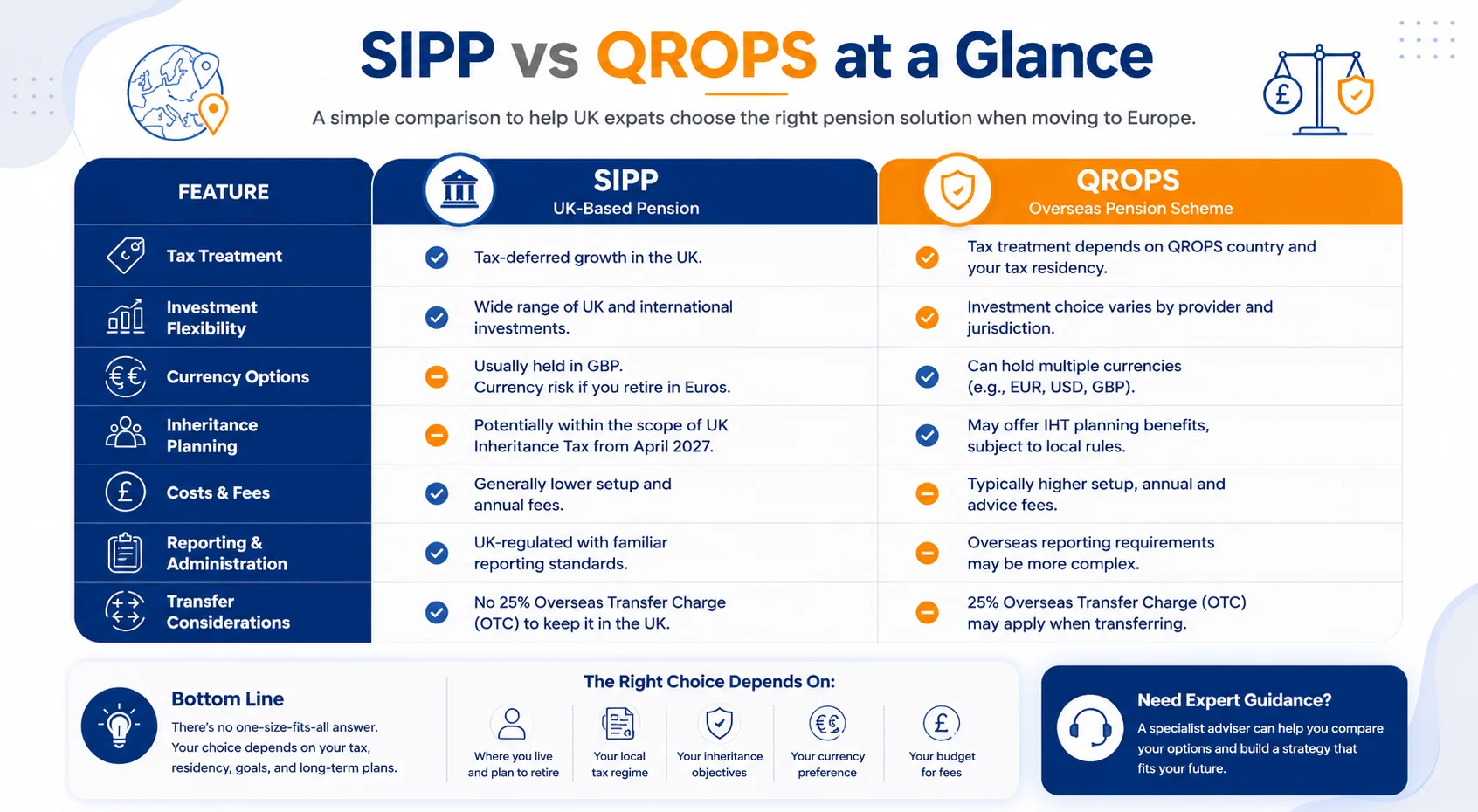
International SIPP vs QROPS: Key Differences
| Timeline Milestone | Standard Business | Cash Accounting Business |
|---|---|---|
| VAT Deregistration Process Start | Day 0 | Day 0 |
| HMRC Confirmation Receipt | Week 3 | Week 3 |
| Stop Charging VAT | At EDC | At EDC |
| Final VAT Return Deadline | 1 Month post-EDC | 2 Months post-EDC |
| Payment of Final Tax | 1 Month post-EDC | 2 Months post-EDC |
What Changed for UK Pension Transfers in 2024?
The October 2024 Budget Removed the EEA Exemption
Until 30 October 2024, an EEA resident could transfer a UK pension to a QROPS in another EEA country. There was no overseas transfer charge to pay. The route suited many expats, and many had built their plans around it.
The 2024 Autumn Budget shut that route. The test now is simple. Are you living in the same country as your QROPS?
If the answer is no, the 25% Overseas Transfer Charge kicks in. For example:
- Live in Italy with a Malta QROPS, and you pay the charge.
- Live in Spain with a Gibraltar QROPS, and the same charge applies.
In practice, there is no way around this rule.
The Overseas Transfer Allowance Came In on 6 April 2024
On 6 April 2024, the old Lifetime Allowance checks for QROPS transfers were swapped for the Overseas Transfer Allowance. The OTA sits at 1,073,100 for 2024/25. Move more than that, and a 25% charge hits the excess. This sits on top of the OTC, rather than replacing it.
So anyone with a big pension pot can face both charges in a single transfer if the planning is not done first. And that is not a rare case.
What This Means in 2026
For UK nationals moving to Italy, Greece, Cyprus, Spain or Portugal, keeping a SIPP is now the natural starting point in 2026. This is not just a fallback. It reflects how the new transfer rules work.
There was one exception during the switch. Transfers requested before 30 October 2024 and completed by 30 April 2025 could still go through under the old rules.
That window has now shut. So any transfer you weigh up in 2026 falls under the new framework in full.
The Biggest Mistakes UK Expats Make When Moving to Europe
- Treating QROPS as the automatic best choice. The reasoning that made it attractive before October 2024 no longer applies to most European moves.
- Starting a transfer before residency is properly confirmed. Full tax residency in the target country must be in place before the transfer request is submitted.
- Underestimating the five-year tail rule. Move to a different country within five years of a QROPS transfer, and you can trigger the OTC with no warning.
- Working with advisers registered on only one side of the border. A cross-border pension decision needs someone authorised in both the UK and the new country.
- Mixing a defined benefit pension into the QROPS decision. Final salary schemes are a separate category entirely. The FCA requires specialist advice for transfer values above 30,000, precisely because these decisions are so hard to reverse.
- Overlooking how much exchange rate movement matters. Sterling pension income spent in a Euro country means every rate shift affects what you can buy each month.
- Not planning for the April 2027 inheritance tax changes. The IHT treatment of pension funds has changed significantly since that date. And the impact differs depending on whether you hold a SIPP or a QROPS, and in which jurisdiction.
QROPS vs SIPP UK: What Does It Actually Cost in 2026?
Running a SIPP as an Expat
A good UK SIPP is cheap to run. Platform fees usually range from 0.15% to 0.45% per year. Fund charges add roughly 0.10% to 0.75% on top. For most people, keeping the total under 1% a year is realistic.
There is no setup fee and no transfer fee, because the pension stays put. So, when expats run a ten-year cost comparison, the SIPP often wins before anything else is weighed.
QROPS Running Costs
QROPS cost more, and the gap is often wider than people expect going in. Setup usually runs from 1,500 to 5,000. Annual trustee and admin fees range from 1% to 2.5% for larger pots.
Many providers charge flat annual fees of 1,500 to 3,000, whatever the pot size. On a 150,000 pension, a 2,500 flat charge works out at 1.67% before fund costs. On smaller pots, that drag gets worse.
The Charges Most Comparison Guides Leave Out
| Cost Type | SIPP (approx.) | QROPS (approx.) |
|---|---|---|
| Setup Fee | Nil | £1,500 to £5,000 |
| Annual Platform/Admin Fee | 0.15% to 0.45% | 1% to 2.5% |
| Investment Fund Charge | 0.10% to 0.75% | 0.50% to 1.5% |
| Financial Advice (One-Off) | £2,000 to £5,000 | £3,000 to £8,000+ |
| Overseas Transfer Charge (if applicable) | None | 25% of the pension pot |
| Exit Fees (within 5 years) | Nil to Low | Up to £3,000 |
| Currency Conversion (Ongoing) | Via drawdown only | Built-in if multi-currency |
Understanding the 25% Overseas Transfer Charge
The overseas transfer charge takes 25% of the full transfer value when the same-country residency test fails. On a 300,000 pot, that is 75,000 lost at once. On 500,000, it is 125,000.
Four things trigger the charge:
- Transferring to a QROPS in a different country from your country of residence.
- A transfer value above the 1,073,100 OTA limit.
- Relocating to a different country within five years of the transfer completing.
- Missing the 60-day deadline for HMRC Form APSS263.
When you and the scheme share the same country, the charge does not apply. A UK national who has properly settled in Malta can transfer to a Malta QROPS with no charge.
Country-by-Country Guide for UK Pension Holders
Italy
Italy’s Article 24-ter regime puts a 7% flat tax on all qualifying foreign income. That includes UK pension income. It applies to new residents in eligible Southern municipalities, and it runs for 10 years.
To qualify, you must not have been an Italian tax resident in the previous five years. The 2026 expansion of qualifying municipalities means more towns now fall within the scheme than before.
If you move to Italy now, transferring to a Malta QROPS triggers the OTC in full. Keep the SIPP instead, draw income under the UK-Italy double tax treaty, and you reach the same 7% Italian tax outcome with none of the transfer cost.
Greece
Article 5B applies a flat 7% rate to all foreign pension income of qualifying new residents for up to 15 years. Unlike Italy’s scheme, it is not limited to certain regions. It applies across the whole country.
You apply in your first Greek tax year after you become resident. A UK SIPP is how this works, since HMRC’s ROPS list shows no active scheme in Greece at present. The 7% rate then applies to SIPP income drawn under the UK-Greece double tax treaty.
Cyprus
Cyprus gives UK retirees a real choice on pension tax. You can elect a flat 5% rate on pension income above EUR 3,420 a year. Or you can use the standard progressive bands, which range from 0% to EUR 22,000.
Most UK retirees choose the flat 5% option, and for obvious reasons. Cyprus also offers a non-dom regime for investment income, an English-based legal system, and a solid double tax treaty with the UK. There are no QROPS currently active in Cyprus and listed on HMRC’s ROPS list. So, if you reside there as a member of a Malta QROPS, the 25% charge is triggered.
Spain
Spain has no flat pension tax for retirees. Standard progressive rates apply, reaching 47% at the top. The Beckham Law targets people relocating for work, so most retirees cannot use it.
A managed SIPP drawdown, paired with Spanish tax planning, is usually cheaper overall. The UK-Spain double tax treaty stops your pension income from being taxed twice.
Portugal
Portugal’s NHR scheme has been closed to new applications since 2025. IFICI, the Tax Incentive Scheme for Scientific Research and Innovation, is replacing it. That one is aimed at professionals in specific fields, not retirees.
Pension income now faces progressive rates of up to 48%. For several years, Portugal was the most popular European destination for UK expats. But in 2026, Greece and Cyprus will offer better terms specifically for pension income.
Pension Tax: UK Rules and Double Tax Treaties
HMRC normally taxes UK pension income drawn by non-residents at source. The exception is when a double tax treaty hands the taxing right to your country of residence.
The UK has treaties with Italy, Greece, Cyprus, Spain and Portugal, and each one works differently. Some assign taxing rights fully to the country you live in. Others leave a partial UK claim in place. So, you need to know which one applies to your own country and pension type.
To stop UK tax being taken off at source, you ask HMRC for a Non-Taxable (NT) tax code. This takes time, sometimes several months. So, it is vital to start the application before your pension income begins. LANOP’s tax planning team can help UK expats through this process.
Defined Benefit Pension Transfers Abroad
Final salary pensions need to be handled as a separate question. FCA rules require specialist advice from a pension transfer specialist for transfer values above 30,000, before anything can be moved.
Here is the reason. A defined-benefit pension pays a guaranteed income for life. Transfer it away, and the guarantee goes with it. After that, investment returns decide what you receive. The FCA has reviewed many DB transfer cases and found that most were not in the members’ interests.
For most people, the sensible path is to keep the DB pension in the UK and draw it from abroad. The income stays guaranteed. The Pension Protection Fund provides a safety net. And the tax can be managed through the relevant double tax treaty.
SIPP vs QROPS for Estate Planning and Inheritance
The estate planning picture changed with the 2024 Autumn Budget. It confirmed that unused pension funds would count toward UK inheritance tax from 6 April 2027. Right now, a SIPP sits outside the IHT net. That changes on 6 April 2027.
Take someone with a 400,000 SIPP, a 300,000 home and 50,000 in savings. Under the new rules, their taxable estate will be much larger than anything calculated today.
A QROPS does not automatically remove UK inheritance tax. What matters for UK IHT is where you live, not where the scheme is located. A few local inheritance taxes may exist, too. But you can still be liable to UK IHT if you are domiciled in the UK. So, it is wrong to call a QROPS a good IHT shelter. The rules work quite differently. Move to a QROPS to dodge IHT, with no cross-border IHT issue to solve, and you are very much flying blind.
HMRC puts the number of newly affected estates at around 10,500 a year from 2027. If your pension pot is large, your estate plan needs to be reviewed before April 2027. And waiting until the following year is a genuine risk.
Sterling vs Euro Pension Income: Currency Risk Explained
A UK SIPP pays in Sterling, while most European countries use the Euro. That gap matters more than people expect. Every move in the GBP/EUR rate changes what your pension income actually buys at the supermarket.
Over the past decade, that rate has ranged from roughly 1.08 to 1.45. Someone drawing 2,000 per month from a SIPP got EUR 2,160 at the weak end and EUR 2,900 at the strong end—same pension each month, yet a 34% swing in purchasing power, just from timing.
A QROPS in Euros removes that ongoing rate exposure. The trade-off is the high upfront cost. Does it make sense? That depends on your pot size, how long you expect to stay in the Eurozone, and how much of your spending is in Euros Day to day.
Some expats handle this without transferring at all. They keep the SIPP and hold a separate Euro buffer of six to twelve months of living costs. That removes the pressure to convert Sterling at whatever rate happens to be running each month.
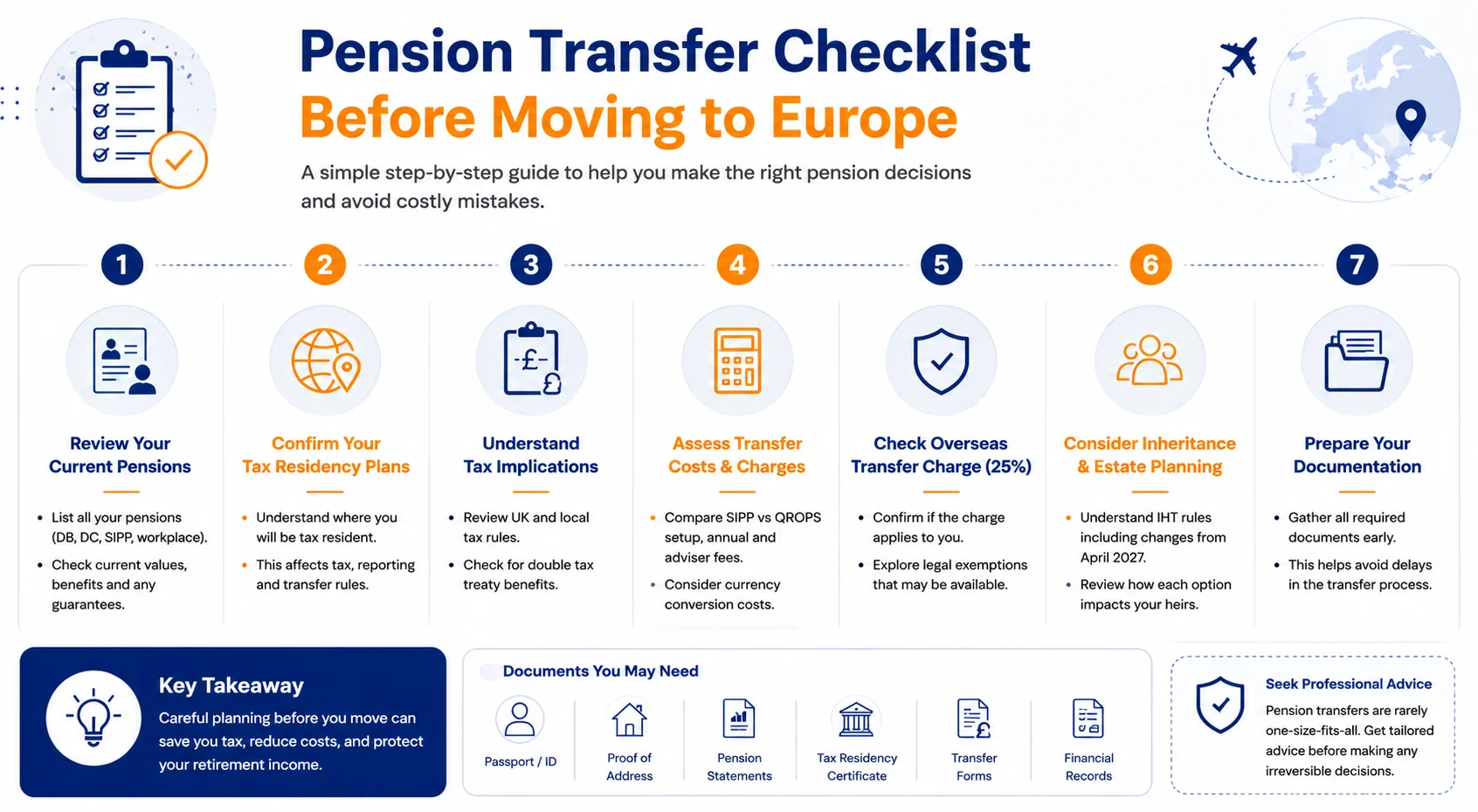
Pension Transfer Checklist Before Moving to Europe
- Confirm you are fully tax-resident in the target country before any QROPS transfer request is submitted.
- Check the live HMRC QROPS list before proceeding. Schemes are removed periodically, and only approved schemes can legally receive UK transfers.
- Apply to HMRC for a double tax treaty exemption and NT tax code well before pension income begins. This process can take several months.
- Use advisers regulated in both the UK and the destination country. Advice from just one country, on a cross-border move, is a known source of problems.
- Submit HMRC Form APSS263 within 60 days of the transfer request. A late one automatically triggers the OTC. There are no exceptions.
- Model the full ten-year cost before you decide. That means setup fees, annual charges and any transfer charge.
- Review your estate plan in light of the April 2027 IHT changes before committing to anything irreversible.
- Treat defined benefit pension decisions entirely separately, with specialist DB transfer advice.
QROPS Paperwork Requirements
Paperwork gaps cause delays. And a missed deadline for APSS263 automatically triggers the full OTC charge. Here is what the process normally requires:
- HMRC Form APSS263: Must reach HMRC within 60 days of the transfer request. No extensions are given.
- Proof of residency: Utility bills, local tax registration or a residency certificate confirming you are based in the same country as the scheme.
- Certified identification: Passport and proof of address. Some countries also ask for notarisation.
- Transfer discharge form: Written sign-off from your UK provider agreeing to release the funds.
- Benefit crystallisation event forms: Required where a pension commencement lump sum has already been taken.
- QROPS scheme acceptance letter: Written confirmation from the overseas scheme that it will accept the transfer under current HMRC rules.
Allow three to six months from start to finish. Do not hand in your notice or close UK accounts until you have written confirmation that the transfer is complete.
SIPP vs QROPS Decision Matrix for UK Expats
| Your Situation | Likely Better Option | Key Reason |
|---|---|---|
| Moving to Italy | UK SIPP + Double Tax Treaty | No QROPS jurisdiction match; 7% flat tax works with SIPP income. |
| Moving to Greece | UK SIPP or International SIPP | No Greek QROPS; 7% flat tax applies to SIPP drawdown. |
| Moving to Cyprus | UK SIPP (5% flat tax option) | 5% rate applies to SIPP income; no Cyprus QROPS available. |
| Moving to Spain | UK SIPP + Spanish Tax Planning | No flat-rate regime; double tax treaty relief is generally more cost-efficient. |
| Moving to Malta (only) | Malta QROPS may apply | Same-country rule satisfied; specialist advice required. |
| Large Pension with Estate Planning Focus | Specialist Review Required | April 2027 IHT changes and Overseas Transfer Allowance interaction need detailed modelling. |
| Defined Benefit Pension Holder | Keep the DB Pension | Guaranteed income is lost on transfer; FCA-regulated advice is mandatory. |
| Short Stay Under 5 Years | UK SIPP Only | The five-year tail rule often makes QROPS unsuitable. |
Frequently Asked Questions
The OTC is a 25% tax on QROPS transfers when you and the scheme are in different countries. It also applies if you relocate away from the scheme’s country within five years. The EEA exemption that protected many European transfers was removed on 30 October 2024, and it cannot be relied on for new transfers.
No, and most people do not. A UK SIPP stays registered in the UK, and you draw from it under whatever double tax treaty applies to your new country. It is usually the cheaper and simpler arrangement. The transfer to a QROPS is an option, not a requirement.
Malta is the only EEA jurisdiction with an active QROPS list in 2026. If you are living in Malta and transfer to a Malta QROPS, the same-country test is satisfied, and the OTC does not apply. For every other European country, the charge applies under the post-October 2024 rules.
From 6 April 2027, unused defined contribution pension funds, SIPPs included, will be counted in your estate for UK inheritance tax. That reverses over 30 years of treatment. A large pension pot added to property and savings could create a substantial IHT charge that did not exist before. So, planning before that date is worth doing now.
It can, but the FCA requires specialist advice from a pension transfer specialist for transfer values above 30,000. Most advice concludes that giving up a guaranteed lifetime income is not in the member’s interest. And in a large majority of cases, that conclusion is right.
Conclusion
Since October 2024, the starting point for this decision has changed. Are you a UK national moving to Italy, Greece, Cyprus, Spain or Portugal? Then the usual best move in 2026 is simple. Keep a SIPP in the UK. Draw from it under the relevant double tax treaty.
Specialist advice matters most in three cases:
- You have a pension pot large enough to be affected by the April 2027 inheritance tax changes.
- You are considering transferring a defined benefit pension.
- You already hold a QROPS and need to confirm whether it still works under the 2026 rules.
Cross-border pension decisions made without advice in both countries can be very costly. Transfer before residency is confirmed, and you can trigger a charge. Overlook the five-year tail rule, and the same can happen. Some of these charges are hard to reverse. A few are impossible. So, it is worth getting personalised advice on cross-border pensions and tax. At LANOP, our specialists advise UK nationals and expats across Europe. We cover pension strategy, QROPS suitability, double tax treaty planning, and estate planning ahead of the April 2027 IHT changes. Contact LANOP today at lanop.co.uk to arrange a pension and tax planning review.