

Italy is one of the best places to move to for UK citizens seeking a new life abroad. The pull is very easy to comprehend. Yummy food, sunshine, reduced costs, and slower lifestyles.
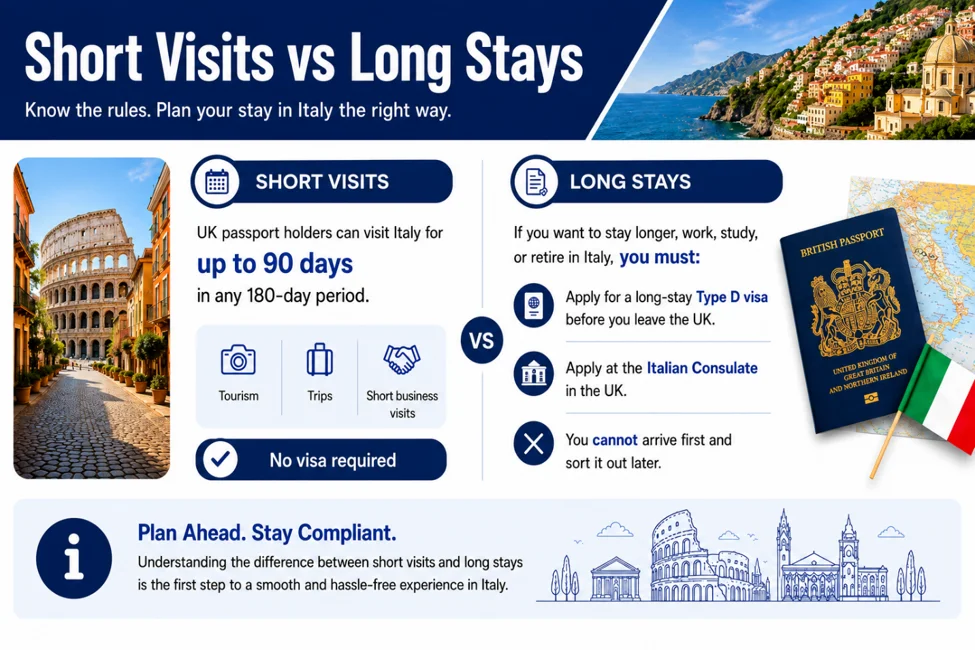
However, Brexit has altered the circumstances. Before 2021, moving was easy. You might be able to decide to leave and travel. British nationals are still allowed to apply for entry into the country without a visa for up to 90 days within 180 days. This will change in late 2026, when the EU’s new ETIAS travel authorisation will be implemented. ETIAS will be neither a visa nor a substitute for a visa. It is a fast online permit, bound to your passport, and costs approximately EUR 20. It’s a short visit, but you can do that.
It is a short visit, you can do that. Another is living in Italy. If you are planning to stay for a longer period, you will need to obtain the appropriate visa before travel and a residence permit within eight working days of your arrival. It can cause long and expensive delays if you don’t get it done on time. This guide is for all the key pathways to Italian residency in 2026, including timelines, paperwork, tax and the pitfalls.
Can UK Citizens Still Move to Italy in 2026?
Yes. It just takes more steps than it did before Brexit.
How Brexit Changed the Rules
If you want to move to Italy from the UK, you now count as a non-EU national. That changes the whole process.
Before Brexit, British people could live in any EU country with no visa or permit. That right ended on 1 January 2021. UK nationals who registered as Italian residents before 31 December 2020 keep their rights under the Brexit deal. Everyone else follows the new rules.
What Rights Come With Italian Residency?
Once you hold a valid permit, a lot opens. One can access the national health service, establish a long lease, and open a bank account. You also get Schengen travel rights, meaning you can travel freely between the 29 Schengen Member States without additional visas. A permanent permit can be requested over time, and then full Italian and EU citizenship afterwards. Cruise, fly or visit the 29 Schengen countries without extra visas. In time, one can apply for a permanent permit and then for full Italian and EU citizenship.
Understanding the Italian Residency Process
What is a Permesso di Soggiorno?
The Permesso di Soggiorno is your residence permit in Italy. It is applied for as soon as you come to Italy. It demonstrates that you are legally entitled to remain. A long stay is not included in your visa. Applications for this must be made within 8 working days of your arrival. If you miss that window, you may be fined or have issues when you attempt to renew.
Residency, Permanent Residency, and Citizenship Explained
| Stage | What It Means | When You Can Apply |
| Italian Residency | Right to live in Italy on your visa route | After arriving with a valid visa |
| Permanent Residence | Right to stay with no need to renew | After 5 years of legal, non-stop residence |
| Italian Citizenship | Full Italian and EU nationality | After 10 years of legal residence |
Which Italian Residency Route Is Right for You?
This is the biggest choice you will make. Choose the wrong visa, and your case may be refused. There is no single route that fits everyone.
Elective Residence Visa for Retirees and Passive Income Earners
The Elective Residence Visa Italy is for people who do not need to work. It suits retirees and anyone living on a pension, overseas rent, or savings returns.
The money must come only from passive sources, so remote work and client fees do not count.
In 2026, the income threshold is roughly EUR 31,000 to EUR 32,000 per year for one person, and the London Consulate often wants to see income well above that amount.
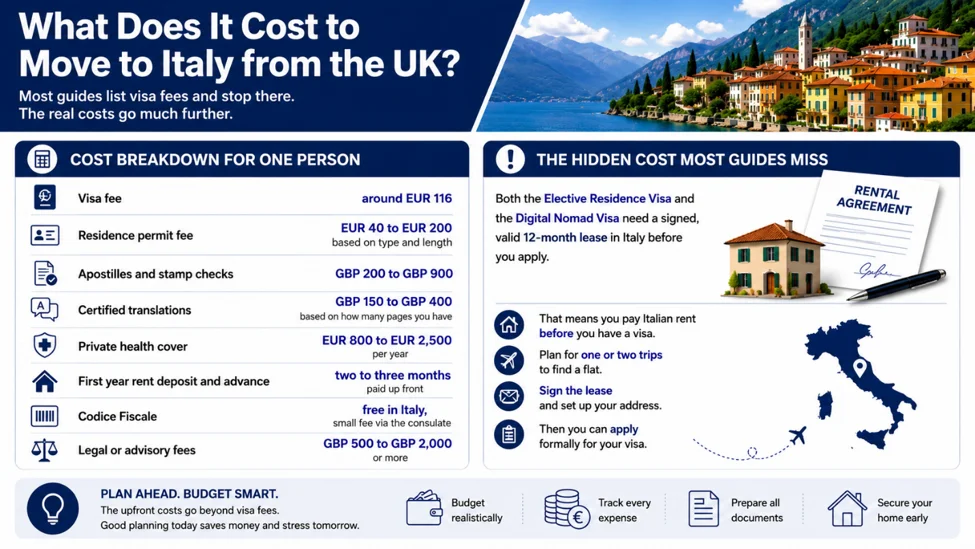
You also need a 12-month signed lease or a property deed in Italy before you apply. Private health cover of at least EUR 30,000 is a must, too.
Digital Nomad Visa for Remote Workers
The digital nomad visa has been introduced in Italy since April 2024. Now, one of the most open ways for UK nationals to work remotely.
You need to earn at least EUR 28,000 a year from clients or employers based outside Italy. It must come from your work, not passive income.
You also need six months of remote work history, a degree or trade qualification, and private health cover. The visa lasts one year and can be renewed. After five years, you can apply for a permanent permit.
One key rule. Your work must be for a client or employer outside Italy. A few Italian clients are fine, but consulates prefer foreign work, so add at least one non-Italian client.
Self-Employment Visa for Consultants and Business Owners
This journey is designed for those who will use it to run a business or consult in Italy and is more detailed. It must be approved by the Italian immigration office and is subject to the annual quota system. If applied late, reapply in a year.
If you plan to set up a business once you arrive, read about business registration in Italy before you start the visa process. The structure you choose, whether a full S.r.l. or a branch office, shapes your tax position from day one.
Family Reunification
If your spouse, partner, or child is a legal resident of Italy or an Italian citizen, you may be able to join them. This route gives you a permit based on that family tie.
Investor Visa for High-Net-Worth Individuals
The investor visa requires a large sum. You can put EUR 500,000 into an Italian company, EUR 1 million into a charity project, EUR 250,000 into an Italian start-up, or EUR 2 million into Italian government bonds.
It gives a fast, clear route to residency for those who meet the threshold.
Comparing Italy’s Main Residency Routes
| Visa Type | Min. Income | Can You Work? | Processing Time |
|---|---|---|---|
| Elective Residence | EUR 31,000 to 32,000 per year (passive income) | No | 60 to 90 days |
| Digital Nomad | EUR 28,000 per year from foreign sources | Remote work only for foreign employers or clients | 30 to 120 days |
| Self-Employment | Varies | Yes, through your own business | 3 to 6 months |
| Investor | No income requirement; capital investment only | Yes | 60 to 90 days |
| Family Reunification | Proof of financial support required | Depends on the residence permit type | 2 to 4 months |
Italian Residency Requirements for UK Nationals
Core Documents You Will Need
Every visa route requires a basic set of documents. One missing item can hold up your whole case.
- A valid UK passport with at least 15 months left from your application date
- Proof of a home in Italy, such as a 12-month signed lease or a property deed
- Private health cover of at least EUR 30,000, valid across the Schengen area
- Proof of income to match your chosen visa route
- A clean criminal record, stamped with an apostille and translated into Italian
- Two recent passport photos that meet ICAO rules
- A completed long-stay national visa form
- Bank statements and tax records for the past one to two years
Common Mistakes That Cause Delays
The London Consulate runs strict checks. These are the slip-ups they see most:
- Using a hotel or Airbnb as proof of a home. It will not be accepted.
- Sending health cover that does not name Italy or the Schengen area.
- Income proof with no apostille or no Italian translation.
- A lease that has not been filed with the Italian tax office.
- A passport with less than 15 months left from the date of your application.
How to Apply for Italian Residency Step by Step
Step 1. Choose the Right Visa Category
This is not just about filling in a form. The wrong visa means a refused case. So be crystal clear about your income, your work, and your plans in Italy before you decide.
Step 2. Prepare Your Documents
Allow four to eight weeks for this stage. Apostilles, certified translations, and bank letters all take time. Do not leave it until the last minute.
The London Consulate usually asks for a bank letter as part of the application. It should clearly confirm your balance and income flow.
Step 3. Apply for Your Italian Visa From the UK
Book your slot through the Prenot@mi portal. Slots at the Italian Consulate in London fill up weeks ahead.
Applying from the UK means going in person. There is no online-only option.
Step 4. Enter Italy and Start the Residency Process
Your Type D visa lets you enter Italy. Once you arrive, you have eight working days to apply for your Permesso di Soggiorno.
You do this at the local post office, using a kit from the Questura. Do not put it off.
Step 5. Get Your Codice Fiscale
The Codice Fiscale is your Italian tax number. You need it to open a bank account, sign a lease, get healthcare, and register locally.
Apply at the Agenzia delle Entrate in Italy. You can also apply at the Italian Consulate before you travel.
Step 6. Register With Your Local Comune
Comune registration makes you an official Italian resident. A local officer will visit your address to check that you live there. This can take two to six weeks.
Step 7. Finish the Residency Check
Once the Comune confirms your address, you get your residency record. Your permit then comes from the Questura.
Keep every paper, every receipt, and every booking note from start to finish.
How Long Does It Take to Get Italian Residency?
| Stage | Typical Timeline |
|---|---|
| Visa Application at the London Consulate | 60 to 120 days. It is advisable to book your appointment approximately 3 months in advance. |
| Apply for the Permesso di Soggiorno After Arrival | Within 8 working days of arriving in Italy. |
| Comune Address Verification | Typically completed 2 to 6 weeks after local registration. |
| Full Residence Permit Issued | Usually issued 2 to 4 months after the application is submitted. |
What Happens After You Arrive in Italy?
The first 90 days are the busiest for the admin. Beyond your permit, tax number, and Comune registration, a few more tasks need to be done early.
- Open an Italian bank account, which needs your Codice Fiscale and address
- Sign up with a local GP to access the national health service
- Set up gas, power, and water in your name once your lease is filed
- Swap your UK driving licence for an Italian one within 12 months of residency
Healthcare Access
Once you are an Italian tax resident, you can join the national health service (SSN). Private cover is a visa requirement, and many people keep both. The SSN handles the basics, while private cover cuts waiting times at clinics.
Italian Residency and Italian Tax Residency Are Not the Same
The 183-Day Rule
Spend more than 183 days in Italy in one calendar year, and you become an Italian tax resident.
At that point, Italy can tax your worldwide income, including UK pensions, rent from UK property, and gains from savings.
The UK-Italy Double Tax Treaty
The UK and Italy have a double-taxation agreement. It stops most income from being taxed twice. But you need to set things up before you move. Get it wrong, and you could face tax bills in both countries, so speak to a tax specialist before your move date.
Tax by Situation
| Your Situation | Key Tax Point |
|---|---|
| UK Retiree with a State Pension | State pension income is generally taxable in Italy. A special 7% flat tax regime may apply for up to 10 years if you relocate to a qualifying municipality with a population of up to 30,000 in one of eight southern Italian regions (Abruzzo, Basilicata, Calabria, Campania, Molise, Puglia, Sardinia, and Sicily) and receive foreign-source income. The population threshold increases from 20,000 to 30,000 from April 2026. |
| Remote Worker on the Digital Nomad Visa | Italian tax residency generally begins once you exceed 183 days in Italy. Once tax resident, worldwide income is typically subject to Italian taxation. |
| UK Property Owner Living in Italy | UK rental income must usually be declared in Italy. Relief under the UK–Italy double taxation treaty is available in many cases to prevent double taxation. |
| Business Owner or Consultant | Permanent establishment and permanent base rules may apply. Depending on the circumstances, Italian personal or corporate taxes could become payable. |
Why Applications Get Delayed, Refused, or Complicated
Most problems can be avoided. On top of the document slip-ups above, these are the bigger errors that derail a case:
- Wrong visa type. Do not pick the Digital Nomad Visa when your income is passive, or the Elective Residence route when you plan to work remotely. Match the visa to how you actually earn.
- Weak income proof. Meeting the headline figure is not enough. The income must be stable, regular, and well-documented.
- Too much time outside Italy. Long gaps can break your non-stop residency record, which hurts your case for a permanent permit or citizenship.
- Late quota application. Self-employment visas fall under Italy’s yearly quota. Apply late, and you wait another year.
How to Qualify for Italian Permanent Residence
Five Years of Non-Stop Residency
After five years of legal, non-stop residence in Italy, you can apply for Italian permanent residence.
Non-stop means no long gaps. Short trips abroad are fine. But more than six months away in one year can reset your five-year count.
Benefits of a Permanent Permit
- No more renewals. Your right to stay is open-ended.
- You can change jobs or start a new business with no need to reapply.
- Access to more public services and some benefits for long-term residents.
- A strong base from which to apply for full Italian citizenship.
How to Get Italian Citizenship Through Residency
Italian Citizenship by Residency Explained
If a person who is not a citizen of the European Union wants to become an Italian citizen, they are able to do so after 10 years of uninterrupted legal residency in Italy. This is the main route for most British passport holders. In June 2025, Italy tried to reduce this to five years, but it failed, and the ten-year rule remains.
There is one faster option. Under Law 74/2025, you can apply after just two years if you have a parent or grandparent who is, or was, an Italian citizen by birth. This is a concessory naturalisation. It is a discretionary grant, not a guaranteed right, and you still have to move to Italy and register as a resident.
Either route needs a clean record, a steady income, and a B1 Italian language certificate.
The B1 Italian Language Test
Since 2018, a B1 language certificate has been a legal requirement for citizenship by residency. B1 is a mid-level standard. You should be able to hold a conversation, read Italian text, and handle day-to-day tasks. Accepted tests include CILS B1 and CELI 2.
You can sit these at approved centres in the UK or in Italy. Allow three to four months between the test and getting your certificate. So, start early.
Citizenship Timeline and Process
| Stage | Requirement or Timeline |
| Residency required | 10 years of non-stop legal residence |
| Language test | B1 Italian (CILS or CELI 2) |
| Application | Online via the Italian Ministry of the Interior portal |
| Processing time | 2 to 3 years in practice, up to 36 months by law |
| Criminal record check | From every country you have lived in since age 14 |
| Income proof | Show that you can support yourself at the time of your application. |
The citizenship process is long and needs a lot of paperwork. Start building your residency records from day one. File your Italian tax returns each year. Keep your address certificates safe.
How Lanop Supports UK Nationals Moving to Italy
Moving to Italy is about much more than a list of forms. It takes tax planning, income checks, healthcare setup, and a long-term view on your permanent permit and citizenship. One wrong step can set the whole plan back by months.
Lanop works with UK nationals at every stage of an international move, whether you are a retiree picking the right income route, a remote worker on the Digital Nomad Visa, or a business owner going self-employed. If you also plan to set up a company once you arrive, our business registration in Italy service covers company structure, tax registration, and banking setup for UK nationals.
Our support covers visa route advice, document prep, Italian tax planning, UK exit tax review, property setup, and long-term residency strategy.
Frequently Asked Questions
Yes. Several routes do not require a job in Italy. The Elective Residence Visa suits retirees and anyone with enough passive income. You just need to show your funds, accommodation, and health insurance.
Yes. The Digital Nomad Visa lets eligible professionals live in Italy while working remotely for employers or clients based outside Italy, if you meet the income and qualification rules.
No. Buying property does not give you Italian residency on its own. You still need a qualifying visa and an Italian residence permit. Property can support an application, but it is not a route by itself.
Most UK nationals can apply for Italian permanent residence after five years of uninterrupted legal residence, and for citizenship by residence after ten years, provided they meet all requirements.
Yes. UK state and private pensions can usually keep paying while you are living in Italy. Once you are an Italian tax resident, you may need to declare this income, and the UK-Italy double-taxation agreement helps prevent it from being taxed twice.
Your Next Step Toward Italian Residency
Italy is open to UK nationals in 2026. The process has more steps than before Brexit, but it is very doable with the right prep. If you are a retiree on a pension or savings, the Elective Residence Visa is likely your route. Plan for at least EUR 31,000 in passive income and start your lease search well before you apply.
If you work remotely for foreign clients, the Digital Nomad Visa works from EUR 28,000 per year. Book your consulate slot at least three months before your target move date.
If you are starting a business or planning to consult in Italy, the self-employment route takes more planning but is fully open with the right advice.
The biggest traps are picking the wrong route, not having enough paperwork, and leaving Italian tax questions until after you have moved.
Contact the Lanop team before you start. A short chat now can save months of delay and a lot of money later.