

In 2025, 16,500 millionaires were expected to leave the UK and move abroad. That is the biggest annual exit from any country ever tracked. Experts think 2026 will top that figure.
Relocating to Italy has become one of the most talked-about choices. Italy offers the lifestyle many UK families are looking for, with Italian residency, easier access to life in Europe, Schengen travel benefits, and a flat tax regime that can be far more attractive than the UK system.
But moving to Italy is not easy. The tax rules are complex. The paperwork takes time. And small mistakes cost a lot of money.
This guide covers what you need to know. Read it before you decide anything.
Why UK HNWIs Are Relocating to Italy Right Now
The UK Tax World Has Changed
The UK ended its non-dom regime on 6 April 2025. It is gone. The new FIG regime lasts just four years. After that, you pay UK tax on all income from around the world. No options, no delays.
The highest rate of income tax in England, Wales and Northern Ireland is 45% of earnings over £125,140, with different income tax rates applying in Scotland. The new capital gains tax rates are 18% and 24% from 6 April 2026, as determined by the type of asset and the taxpayer’s position. Also, the latest UK inheritance tax rules mean your global assets could still be subject to UK IHT up to ten tax years after you have departed the UK, based on how long you have been resident in the UK.
Furthermore, many UK HNWIs have looked at this and decided to go. Italy is where a lot of them are heading.
What Makes Italy Worth Considering
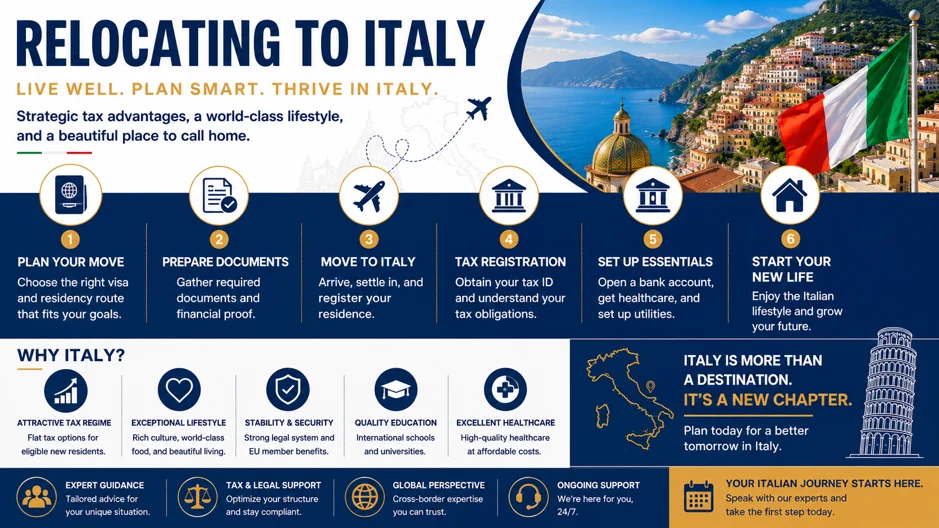
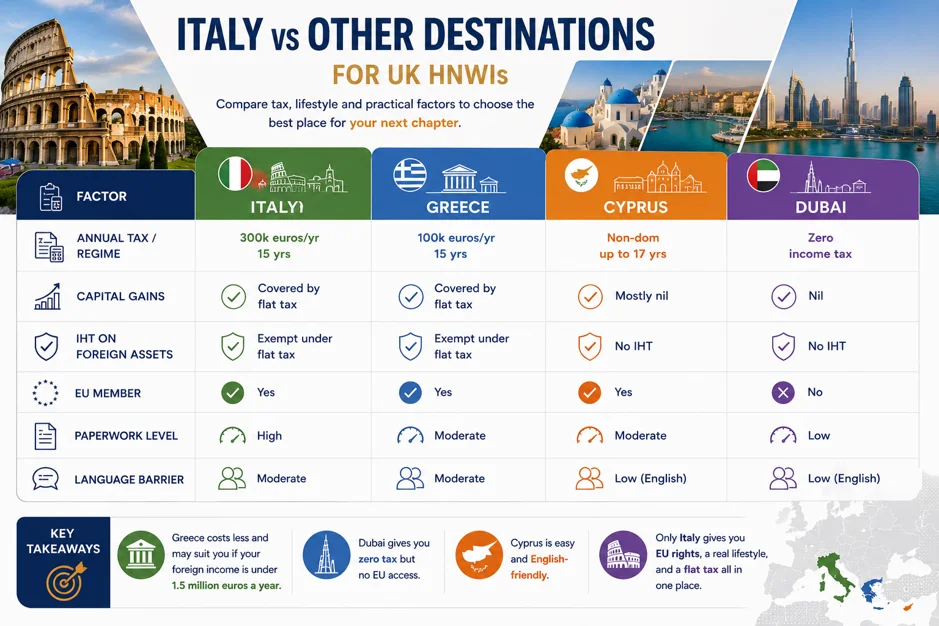
Italy has a flat tax regime under Article 24-bis of its tax code. New residents who qualify pay one fixed annual sum on all their foreign income. A € 300,000 a year flat tax for new arrivals in Italy and moving residence, from January 1, 2026. If desired, each qualifying dependent family member also for € 50,000 a year.
Moreover, the regime runs for up to 15 years. It covers foreign dividends, interest, gains, rent, and business income. You also get no Italian wealth tax on foreign assets and no Italian inheritance tax on assets held abroad.
Is Italy the Right Move for You?
Italy works well for some people. For others, it does not stack up. Here is how to tell which camp you are in.
Italy Suits You If You:
• Earn a lot of passive income from overseas funds, property, or a business abroad
• Want Italian residence, a European lifestyle, and easier Schengen-area travel for short trips
• Value lifestyle as much as tax savings
• Have a family who will genuinely settle and put down roots
• Can spend more than 183 days a year in Italy without it feeling forced
• Have substantial foreign-source income to support the fixed flat-tax annual expense, on commercial grounds
Italy May Not Work for You If You:
• Most of your income comes from Italy or the UK
• You run a UK business and cannot step back from day-to-day management
• You want a simple, low-paperwork move. Dubai or Cyprus may suit you better
• Your kids are in school and you plan to live in a rural southern area with no international schools nearby
Key point: Very broadly, as a commercial rule of thumb, the flat tax only starts to become compelling once your foreign income levels are such that they make the price of €300,000 per year feel worth it. The precise breakeven point varies with your personal mix of income, treaty position, and assets, but this is the way to think about it and have a fully blown tax plan modelled out for you before making the choice.
How to Relocate to Italy from the UK: Step by Step
The Italy residency process has many stages. Most people underestimate the time each one takes. Start planning at least 12 months before you want to move.
- Pick your visa route based on your income and plans
- Get your key documents ready. You need bank statements, proof of income, and health cover
- Apply at the Italian consulate in the UK before you travel
- Once you arrive in Italy, you must apply for your residence permit within 8 days.
- Then you can register with your local Anagrafe office if you plan to stay for more than three months.
- Get your Codice Fiscale. This is your Italian tax number
- Open an Italian bank account and register with the local health service
- File your first Italian tax return and elect the flat tax regime
- If your tax position is complex, ask the Italian Revenue Agency for advance sign-off
Your Visa Options as a UK National
The Investor Visa is for those who want to put money into Italy. The entry point is 250,000 euros into a startup. Other routes go up to 2 million euros in government bonds. Getting your pre-approval takes 45 to 60 days. Full processing from start to permit takes 3 to 6 months.
The Elective Residence Visa is the most used route for wealthy UK retirees and people who live on passive income. You need to show at least 31,000 to 32,000 euros a year if you are single. Couples need closer to 38,000 to 40,000 euros. You also need a home address in Italy, private health cover of at least 30,000 euros, and a clean record.
This visa does not let you work in Italy or do remote work for a foreign firm. It is only for people who live on income they already have.
Furthermore, if you are going to continue working for a company abroad, running your own company in Italy, or providing services from within Italy, you are going to want to explore other visa options, as the Elective Residence Visa is not the right route.
Understanding Italian Tax Residency
When Does Italy See You as a Tax Resident?
Italy looks at three things. You become a tax resident if you spend more than 183 days a year in Italy, or if Italy is the centre of your life, or if you are on the Italian civil register. Hit just one of these three and you are a tax resident.
Five Mistakes UK Expats Make with Residency
1. Not leaving UK tax first. You must pass the Statutory Residence Test to leave the UK tax net. Just moving away is not enough.
2. Too many days in the UK. If you have UK ties, spending more than 16 to 90 days back in the UK in one year can pull you back into UK tax.
3. Missing the flat tax sign-up. You must elect the regime in your first Italian tax return. Miss it and the chance is gone for good.
4. Thinking the flat tax covers Italian income. It does not. Any income from Italian sources gets taxed at normal Italian rates up to 43%.
5. Ignoring the UK inheritance tax tail. Even after you leave the UK, your worldwide assets could remain within the 40% UK IHT net for up to 10 tax years, depending on your UK residence history. Proper inheritance tax planning before you depart is the only way to get ahead of this.
Italy’s Flat Tax Regime: What You Need to Know in 2026
What Changed on 1 January 2026?
Italy’s 2026 Budget Law increased the annual flat tax charge for new entrants from 200,000 euros to 300,000 euros. The annual charge for each qualifying family member also increased from 25,000 euros to 50,000 euros. However, for those entering the scheme before 1 January 2026, the original tax regime should typically apply.
Who Can Join?
• You must not have been an Italian tax resident for at least 9 of the last 10 years
• You must move genuine tax residence to Italy
• You must elect the regime in your first Italian tax return after you arrive
Family members can also join, but everyone has to follow all the rules and be charged the annual flat tax separately.
• The scheme lasts a maximum of 15 years
What the Flat Tax Covers
• All foreign dividends, interest, and gains
• Overseas rent and foreign business income
• Foreign pensions and employment income from abroad
• No Italian wealth tax on assets you hold outside Italy
• No Italian gift or inheritance tax on assets held abroad
What the Flat Tax Does Not Cover
• Italian-source income: taxed at normal Italian rates up to 43%
• Gains on qualifying stakes in non-EU firms during the first five years
• Income tied to an Italian place of business
How Much Could You Save?
This table gives you a clear picture of the gap between staying in the UK and moving to Italy.
| Income Type | UK Tax Position | Italy Under Flat Tax |
|---|---|---|
| Foreign Dividends (€3 million per year) | Up to 39.35% tax (approximately €1.18 million) | Covered by the €300,000 annual flat tax |
| Capital Gains Abroad (€5 million) | Up to 24% Capital Gains Tax (approximately €1.2 million) | Covered by the flat tax regime |
| Overseas Rental Income (€500,000 per year) | Up to 45% income tax | Covered by the flat tax regime |
| Inheritance Tax (Foreign Assets) | 40% on worldwide estate | Exempt under the flat tax regime |
| Effective Tax Rate on €10 Million Annual Income | Approximately 40% or more | Under 3% effective tax rate |
These are examples only. Your real numbers depend on your income mix, assets, and how the UK-Italy tax treaty applies to you. Always get a personal tax model done first.
What Happens to Your UK Assets and Business?
Property, Investments, and Trusts
• UK property: you still pay UK capital gains tax on UK homes after you leave. The flat tax does not change this
• UK investments: gains after you become an Italian resident may fall under the flat tax
• UK ISAs: Italy does not treat ISAs as tax free. Growth becomes taxable in Italy
• UK trusts: money paid to you from a trust can trigger Italian tax. Get expert advice well before you move
Can You Keep Your UK Company?
Yes, but with real care. If you manage a UK firm from Italy, Italy may decide that the firm is run and controlled in Italy. If that happens, the firm pays Italian corporate tax at 24% IRES plus 3.9% IRAP.
• Review all UK board roles before you move
• Hold UK board meetings in the UK and keep proper records
• Get a permanent establishment risk check done on your UK roles
• Dividends paid to you personally may fall under the flat tax if they come from abroad
If you are also thinking about how to restructure the group before or during your move, our group structuring and holding company service covers exactly that, reviewing your UK entity setup and how it interacts with an overseas personal tax position.
What Happens to UK Pensions?
Once you are an Italian resident, UK pension income is taxable in Italy. The good news is that it should fall inside the flat tax umbrella if you have signed up for the regime.
• UK state pension: likely covered by the flat tax
• SIPPs and personal pensions: income covered as foreign-source income
• Defined benefit pensions: treaty rules apply. Get specific advice on your scheme
• Pension transfers: complex rules. Never transfer before taking specialist advice
Note: Pension transfers require your scheme-specific treaty advice, as do Government service pensions and defined benefit schemes.
Best Places to Live in Italy for UK Expats
Where you live shapes your costs, your kids’ schools, and your social life. Here is a simple comparison.
| Location | Property Cost | Schools | Transport Links | Best For |
|---|---|---|---|---|
| Milan | Very High | Excellent | Excellent | Business owners |
| Tuscany | High | Good | Good | Families, lifestyle |
| Rome | High | Good | Excellent | Culture, families |
| Lake Como | Very High | Limited | Good | Privacy, luxury |
| Naples | Moderate | Moderate | Good | Urban life, food |
| Calabria | Low | Limited | Growing | Value, retirees |
Relocating to Tuscany
Tuscany is the top pick for UK families. Florence, Lucca, and Siena have good international schools and strong private health options. There is a well-known British expat crowd here. A serious country home costs 2 to 6 million euros.
Relocating to Naples
Naples gives you city energy, great food, and easy access to the Amalfi Coast. The city has changed a lot in recent years. It costs less than Milan or Rome and has decent school options.
Relocate to Calabria
Calabria is worth a look for retirees. Italy offers a 7% flat tax regime for eligible foreign pensioners who establish residence in one of Italy’s designated “southern” eligible towns and villages. The qualifying town size recently expanded, according to reports from 20,000 to 30,000 residents in 2026, so the precise town eligibility should be verified before one proceeds under this tax benefit.
Ten Costly Mistakes UK HNWIs Make When Relocating to Italy
- Using UK and Italian advisers who do not talk to each other. Gaps between them cost money
- Moving before leaving UK tax residency the right way under the Statutory Residence Test
- Ignoring the up-to-10-year UK inheritance tax tail on their world assets
- Missing the flat tax sign-up in their first Italian tax return
- Thinking UK business income is covered by the flat tax when it is not
- Skipping a permanent establishment risk check on their UK company roles
- Buying Italian property without getting their own legal checks and a building survey
- Expecting UK ISAs to stay tax-free in Italy. They do not
- Underestimating Italian paperwork. Allow 6 to 12 months for full registration
- Moving assets or trusts into Italy without getting clearance advice first
Frequently Asked Questions
Once you leave UK tax residency under the SRT, you stop paying UK tax as a resident. But you still pay UK tax on some UK income, like gains on UK property. The ten-year inheritance tax tail also applies.
Up to 15 years from the year, you first join. After that, normal Italian tax rates apply to all your income.
Yes. Each family member joins separately at 50,000 euros per year from 2026 onwards. They each need to pass the 9-out-of-10-year non-residency test on their own.
No. The flat tax only covers foreign income. Income from Italy is taxed at normal Italian rates.
You can, but it creates risk. Italy may decide your UK firm is run and controlled in Italy and tax it there. Get a permanent establishment check done before you move.
Italy will grant you tax residence more definitively if you spend over 183 days there per year; they will consider your centre of personal interests and usual abode. Too many days spent in the UK could be an issue.
Foreign pension income should fall inside the flat tax. But pension transfers have complex rules. Take specialist advice before making any changes.
It can be slow. Big banks like Intesa Sanpaolo work with new wealthy residents but need a lot of paperwork. Private banks with Italian offices are often quicker for HNWIs.
Final Thoughts: Should You Move to Italy in 2026?
Italy is not the cheapest move. It is not the easiest either. But for the right person, it offers something rare. You get a great life inside the EU, a clear tax bill on foreign income, and up to 15 years of planning certainty.
The worst thing you can do is move without a plan. The UK exit, the Italian entry, the company review, the pension check, and the trust structure all need to work as one. Get one of them wrong and it is slow and costly to fix.
At Lanop, we work with UK HNWIs who want a proper, structured move. We cover your UK exit, your flat tax sign-up, your company risk review, and your tax filings in both countries. If you are also planning to set up a business structure in Italy, our business registration and setup in Italy service covers company formation, tax registration, visa support, and Italian banking, all in one place.
If you are thinking about moving to Italy, talk to Lanop before you sign anything. We help UK HNWIs do this the right way.
All in all, this article is a guide to the main points and not tax, legal, immigration or investment advice. Regulations change and will differ in each situation. We recommend taking advice before relocation, company restructuring, pension transfers or purchase of property, particularly in the UK and Italy, as both change frequently.