Introduction
Type “how to avoid paying VAT on imported goods” into Google. You’ll find lots of confident tips. Mark the parcel as a gift. Split one order into three boxes. Ask the seller to write a lower value on the invoice. None of that is a clever trick. It’s a misdescription, and HMRC or Border Force can treat it as fraud rather than tax planning.
Here’s what most guides leave out. There are real, legal ways to pay less VAT on imports, and some can mean paying nothing at all. But they are narrow. They only work in specific cases: genuine gifts worth £39 or less, moving your own belongings into the UK, sending back goods you already own, or buying eligible goods for a qualifying disability.
Apart from those exceptions, VAT is generally charged on goods sent from outside the UK to Great Britain, except genuine gifts worth £39 or less. VAT is normally added at checkout when you buy overseas goods worth £135 or less. If the goods are worth more than £135, VAT is usually paid to the delivery company before delivery or collection.
The real question isn’t how to dodge it. It’s which rule fits your case, and how to pay it without extra fees you didn’t expect.
This guide also covers second-hand goods. People often mix this up with imports, but it’s a different topic. It runs its own scheme, called the margin scheme, and the rules are easy to get backwards.
What Import VAT Actually Is
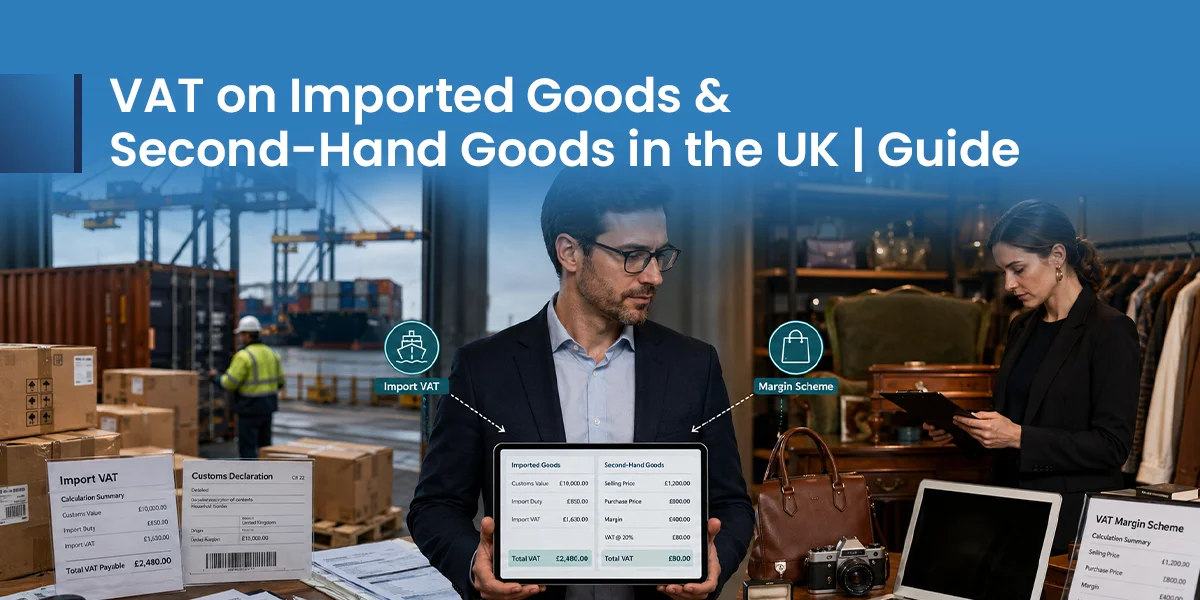
Import VAT is just VAT, charged when goods cross into the UK rather than at a UK shop’s till. It applies to goods from anywhere outside the UK, including the EU, since Brexit ended free movement of goods. The standard rate is 20%, the same as the UK VAT rate. A few goods get a lower 5% rate, and some, like most food and children’s clothing, get a 0% rate.
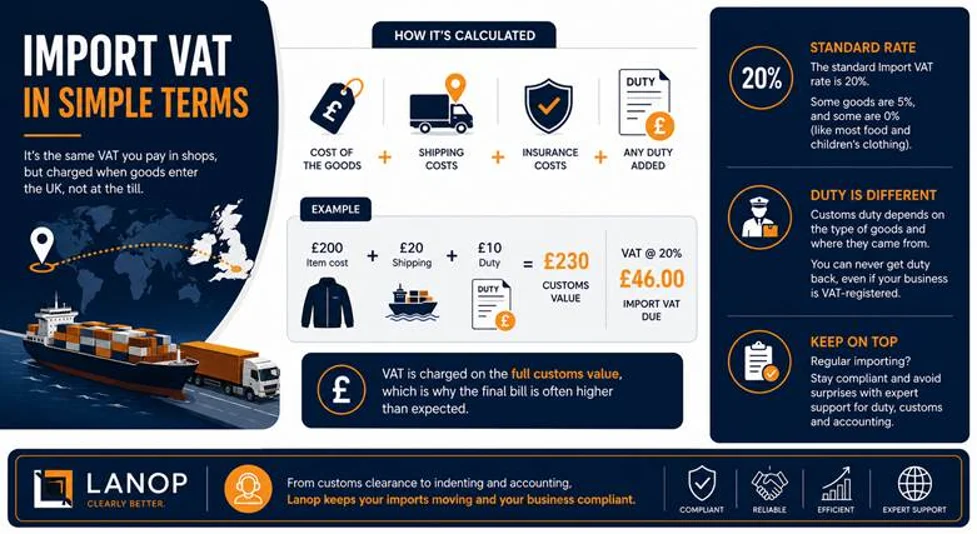
Here’s the part that catches people out. Import VAT isn’t based on the price of the goods alone. It’s based on the full customs value: the cost of the item, plus shipping, plus insurance, plus any duty already added. Buy a £200 jacket, pay £20 for shipping, and £10 in duty gets added. VAT is then charged on £230, not £200. That’s why the final bill often comes in higher than people expect.
Customs duty is a separate charge based on the item and its origin. Unlike with import VAT, it is not possible to reclaim customs duty on a VAT return simply because your business is registered for VAT. In some instances, however, repayment or remission may be possible, such as where the duty is overpaid, the goods are rejected for import or are damaged, or a customs relief applies.
If your business regularly imports goods and needs help staying on top of duties and customs, Lanop’s customs clearance and indenting accounting service covers exactly that.
The £39 and £135 Thresholds
Two numbers matter most here: £39 and £135.
VAT/Customs duty should not be charged on a genuine gift valued at £39 or less. A genuine gift over £39 will attract import VAT. In addition, if it is valued at over £135, customs duty may also apply depending on the article and its origin. If you are buying goods that you have sourced yourself from overseas, the £135 limit applies differently. Online vendors or sellers typically add the UK VAT to goods priced at £135 or less. Any goods over £135 are treated as normal imports, with VAT generally levied before delivery, and customs duty may also apply.
What “Genuine Gift” Actually Means
The £39 gift relief sounds simple, but it’s stricter than most people think. It only covers items sent by a private person abroad to a private person in the UK. No one in the UK can have paid for it, and it must be for an occasion like a birthday, not a regular thing.
If you buy something online and ask the seller to mark it “gift,” it doesn’t count. That’s true even if it’s addressed straight to the person who’ll use it. Customs looks at who paid, not what the label says.
If one parcel has items for several people, each item gets its own £39 limit. You can’t split a £50 item between two people to dodge the rule. This is the exact detail most “how to avoid VAT” guides skip.
Upcoming Changes to Low-Value Import Relief
One more thing worth tracking. At the Autumn Budget 2025, the government confirmed that it will remove customs duty relief on low-value imports. This means commercial goods valued at £135 or less will become subject to customs duty, with the change due to take effect by March 2029 at the latest. A consultation on how the new rules will work ran until 6 March 2026, so the finer details are still being settled.
Importantly, this change applies to commercial imports, not personal gifts. The government has said it intends to keep the existing relief on genuine gifts worth £39 or less sent between private individuals. The current duty relief also remains in place, with tariff-free treatment maintained until at least 31 December 2026. VAT rules for low-value imported goods, including the £135 threshold, are expected to remain broadly unchanged in the near term. As always, check the latest position on gov.uk before you rely on it for an important purchase or for planning.
VAT on Goods From the EU to the UK After Brexit
Before 2021, buying from an EU shop felt just like buying from a UK one. No extra charges, no surprises at the door. That’s gone now.
In most cases, goods imported from the EU are taxed, and customs are declared like goods imported from other countries outside the UK for Great Britain. There may be different rules for Northern Ireland, so please check NI cases separately.
The same £39 and £135 limits apply, as does the 20% VAT rate. For a deeper look at how the rules changed across the board, Lanop’s guide to UK post-Brexit VAT changes for importers is worth reading alongside this one.
In practice, many EU sellers now collect UK VAT at checkout for orders under £135, so the price you see already includes it. For orders over £135, you might get a separate bill from the courier later. This is the biggest source of complaints about EU shopping since Brexit. People pay once at checkout, then get hit with a second bill days later.
If you’re charged duty on EU goods and think that’s wrong, ask the seller for proof of EU origin. Goods genuinely made in the EU can often be cleared duty-free under the UK-EU trade deal, though VAT still applies.
VAT on Goods from the USA (and Everywhere Else Outside the UK)
The rules for the USA, China, or anywhere else outside the UK work the same way. What matters is value, not the country. Under £39 is a real gift; no charge applies. Between £39 and £135, 20% import VAT applies. Above £135, you may incur VAT and customs duty, depending on the product.
One tricky bit catches buyers and US sellers off guard. Some marketplaces add VAT at checkout for low-value orders. Others bill it separately once the parcel lands in the UK. Check before you buy something pricey, so you’re not surprised by a knock at the door asking for money.
How to Pay VAT on Imported Goods in the UK
For Personal Shoppers
For most personal orders, you don’t pay import VAT separately. The courier or Royal Mail pays it to HMRC first. Then they ask you to pay them back, usually with a handling fee added, before they release your parcel. Royal Mail, DHL, and UPS all work this way. If you don’t pay, the parcel sits and waits, or gets sent back to the sender.
For Businesses: EORI Numbers and Postponed VAT Accounting
For businesses, the process looks different. You’ll need an EORI number to clear goods through customs. VAT-registered businesses can then use Postponed VAT Accounting. This lets you declare the import VAT on your normal VAT return instead of paying it upfront at the border. If the business is entitled to recover the import VAT as input tax, PVA can allow the VAT due and the VAT reclaimed to appear on the same VAT return, subject to normal VAT recovery rules. That’s far better for cash flow than paying cash at the port.
Reclaiming VAT on Imported Goods (For Businesses)
If your business is VAT-registered, and the goods are for business use, you can usually reclaim the import VAT. It works the same as reclaiming VAT on a UK purchase. You’ll need a C79 certificate or your Postponed VAT Accounting records as proof. Our UK VAT compliance checklist covers exactly which records HMRC expects you to hold and when.
Customs duty works differently. You can never reclaim it, not under any VAT scheme. If duty is a high cost for you, the better question is whether your goods qualify for a lower duty rate or an origin-based exemption.
Claiming Back VAT on Exported Goods: Two Different Situations
This keyword covers two very different groups of people and mixing them up confuses.
Tourists Visiting the UK
Say you’re a tourist who shopped in England, Scotland, or Wales. You might hope to reclaim VAT at the airport, as in Paris. That scheme no longer exists in Great Britain. It was scrapped in January 2021. Some shops will still ship your purchase to an address abroad, removing the VAT at the point of sale instead. Northern Ireland still runs the old refund scheme for visitors, but Great Britain doesn’t.
UK Businesses Exporting Goods
Now, say you’re a UK business selling goods abroad. The rules work completely differently and are far better for you. Genuine exports to customers outside the UK are usually zero-rated, so you charge 0% VAT, not 20%. You need proof that the goods left the country.
It’s built into how you invoice the sale, not a refund you claim later. Businesses that trade internationally and want to ensure their cross-border VAT and tax compliance is set up correctly from the start are usually better off seeking professional advice before issues arise.
VAT on Second-Hand Goods and Used Goods
This is where the topic stops being about imports. It becomes something else: how VAT applies to resale within the UK.
Private Sellers: No VAT to Worry About
Say you sell your own sofa, phone, or car privately, to a friend or through a marketplace app. You don’t charge VAT at all. Private people aren’t VAT-registered businesses, so there’s no VAT to add, full stop. Most “Do I pay VAT on second-hand goods?” questions come from exactly this case, and the answer is simply no.
VAT-Registered Dealers: How the Margin Scheme Works
It’s different for VAT-registered businesses that buy and resell used goods, like second-hand car dealers, vintage shops, antique sellers, and charity shops. They usually can’t reclaim VAT on what they paid a private seller, since no VAT was charged on that purchase to begin with. Without help, they’d pay VAT on the full resale price anyway, even with nothing recovered. This is the problem the VAT margin scheme fixes.
Under the margin scheme, a dealer only pays VAT on their margin. That’s the gap between what they paid and what they sold it for, not the full sale price. VAT is calculated as 16.67% (one‑sixth) of the VAT‑inclusive margin, which is equivalent to 20% of the margin itself.
For example, if a dealer buys a guitar for £200 and sells it for £350, the margin is £150. The VAT due is 1/6 of £150, which is £25. This is much less than charging VAT on the full £350 sale price.
The margin scheme can only be used for eligible second‑hand goods, works of art, antiques and collectors’ items. It cannot be used if VAT was already charged and reclaimed on the original purchase, or for new goods, precious metals, gold, precious stones, and certain other categories such as some second‑hand vehicles, horses and houseboats.
Margin Scheme: The Details That Trip People Up
The receipt won’t show a separate VAT line under this scheme. Any VAT is already baked into the price you see. If a dealer sells at a loss, no VAT is due, but they can’t claim anything back for the loss either. Where a second‑hand dealer deals in large volumes of low‑value eligible items, they may use the Global Accounting Scheme (GAS), which is a simplified version of the margin scheme. Instead of calculating VAT on each item, the dealer works out VAT on their total sales and total purchases of eligible items for each VAT period (usually quarterly).
Charity shops are an exception: sales of freely donated goods by charities can often be zero‑rated if the required conditions are met; this is separate from the margin scheme.
One key exception. The margin scheme can’t be used if VAT was already charged and reclaimed on the original purchase. It also can’t be used for new goods, precious metals, gold, or precious stones.
Mixing eligible and non-eligible stock without keeping the records apart is a common reason HMRC challenges a business over this scheme. If you run a retail business that buys and resells second-hand stock, keeping your records clean from the start matters a great deal here.
VAT on Digital Goods
This topic deserves its own space. Digital goods work nothing like physical imports. There’s no parcel, no courier, and no customs value to work out.
For UK sellers of digital products (ebooks, courses, software, etc.), normal VAT registration rules apply when their total taxable turnover exceeds £90,000 in any 12 months. This includes all taxable sales, not only digital ones.
The UK VAT threshold and what counts toward it is a topic that catches many small digital sellers off guard, so it’s worth understanding before you assume you’re below it.
Once registered, you must charge UK VAT on digital products sold to UK consumers, regardless of your turnover.
As with UK-established sellers, UK VAT does not require a threshold to apply to overseas sellers that supply services to UK consumers, but it may apply from the first taxable supply to a UK consumer. If the sale takes place via a 3rd-party platform or marketplace, the platform may be the entity responsible for accounting for VAT. This may differ for sales to VAT-registered business customers, sometimes subject to reverse charge treatment.
VAT on Electrical Goods, and VAT Relief for Disabled People
Is there a VAT on electrical goods? Yes, almost always, at the full 20% rate. Doesn’t matter if it’s a kettle, a laptop, or a TV. There’s no special discount for electronics, despite what some forum posts claim.
There is a real relief that often goes unused, called VAT relief for disabled people. If you are chronically sick or disabled, certain products that are designed or adapted for your condition can be sold to you VAT‑free, for example:
- mobility aids
- hoists
- specially adapted vehicles
You do not need to be formally registered as disabled, but you must meet HMRC’s definition of “chronically sick or disabled” and the product must qualify. You make a short declaration to the seller at checkout. It is not automatic, and many eligible buyers never ask because they do not know it exists.
Note that this relief is product‑specific: most standard electrical goods (kettles, TVs, laptops) are still charged at 20% VAT even if bought by a disabled person; only those products that meet the criteria are eligible for VAT relief.
Reclaiming VAT on Returned Goods
If imported items are returned and the goods were imported with VAT or customs duty already paid, there may be a chance of a repayment or remission, depending on the reasons for returning the goods and the documentation on hand. In a business sale, there is a need for credit notes and evidence of return. There is a specific process for reimbursement and remission of rejected or damaged imports, and there may be time limits.
There’s a separate relief for your own goods sent out, then brought back unchanged, like equipment that went abroad and is now returning home. You must be both the original exporter and the one bringing it back, and the goods can’t have been upgraded along the way. Meet those conditions, and you can usually bring them home VAT and duty-free, normally within three years of the original export.
Who Gets Left Out by the Standard Rules
A few groups keep falling through the gaps here. Casual online sellers clearing out a garage rarely know the margin scheme exists. They either overpay VAT or, more often, they’re too small to register for VAT at all. That’s fine, but it means they shouldn’t charge VAT on what they sell.
Small overseas sellers without UK VAT registration often miss a key rule. They must register from their very first UK sale of low-value goods or digital services, with no gentle threshold to ease them in.
Disabled buyers who don’t know about VAT relief pay full price for years on items that should have cost less. And tourists planning a UK trip around an airport VAT refund get a shock, since that option was removed from Great Britain back in 2021.
What Can Actually Go Wrong
Underdeclaring the value of goods isn’t a grey area. HMRC and Border Force call it tax evasion, plain and simple. Parcels can get seized, delayed, or sent back, sometimes with a penalty on top. If HMRC opens an inquiry into your records, Lanop’s HMRC tax investigation support can help you respond appropriately and protect your position.
Mislabeling a paid purchase as a “gift” is one of the most common mistakes. It doesn’t save anything if it’s caught. Customs reassess the charge and delay your delivery while they do it.
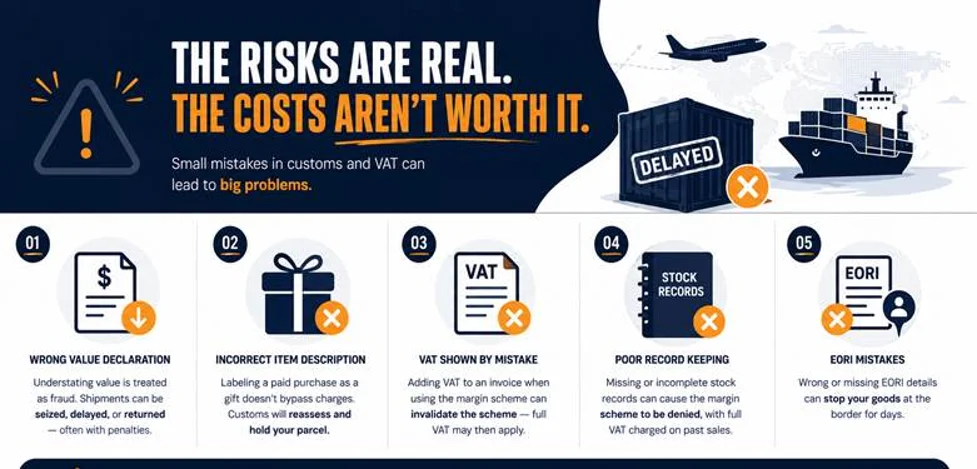
Businesses using the margin scheme sometimes show VAT separately on an invoice by mistake. That single slip can void the scheme for that sale, so full VAT applies to the entire price, not just the margin. Others fail to keep a proper stock book. HMRC can use that gap to deny the scheme during an inspection, then apply full VAT on past sales.
For importing businesses, forgetting an EORI number is a common headache. Quote the wrong one on a customs form, and your goods can sit stuck at the border for days.
Final Word
Most of this comes down to one thing: know which rule fits your case, instead of hunting for a workaround that doesn’t exist. Real reliefs do exist, for gifts, returns, disability, and exports, but they’re specific. Using them the wrong way can cost more than just paying the VAT.
If your business imports stock, resells second-hand goods, or sells across borders, getting this wrong tends to surface at the worst time. That’s usually during an HMRC check.
Lanop’s tax advisors handle VAT registration, returns, and cross-border compliance for UK businesses every day. That includes import VAT, margin scheme record-keeping, and the setup of Postponed VAT Accounting. Worth a chat if you’d rather not work it out alone.
VAT rules in this area change often, especially around thresholds and reliefs. It’s worth checking the current details on gov.uk before you rely on them for an important purchase or sale.
Frequently Asked Questions
Not if you’re buying privately from another person. If you’re buying from a VAT-registered dealer using the margin scheme, VAT is in the price, but only on the dealer’s margin, not the full value.
Yes, when a VAT-registered business sells them. It’s usually worked out on the profit margin, not the full selling price.
Yes, on anything over £39 unless it qualifies for a specific relief, such as genuine gift status, returned goods, or moving home.
For personal parcels, the courier or Royal Mail collects them from you first. For commercial imports, VAT-registered businesses can use Postponed VAT Accounting to settle the VAT on their VAT return instead.
Yes, the rates for most everyday electrical items are standard, usually 20%, including kettles, televisions and laptops. Some specially designed and adapted products for disabled persons are, however, eligible for VAT relief if both the product and the buyer meet the criteria.
If you are a tourist visiting Great Britain, there is no VAT refund scheme for visitors in Great Britain; it ended on 1 January 2021. Some shops may still remove VAT at the point of sale if they ship your purchase directly to an address outside the UK.
If you are in Northern Ireland, the old visitor VAT refund scheme still operates there.
If you are UK business exporting goods: exports to customers outside the UK are usually zero‑rated, so you charge 0% VAT on the sale and do not need to claim a refund later. You need to keep proper evidence that the goods left the UK.
Yes. UK sellers charge it once they pass the £90,000 threshold. Overseas sellers must charge UK VAT from their very first sale to a UK customer.