
Six years. This is how long it took Monzo Business to reach from zero to one million UK businesses.
Announced on 28 July 2026, it is a milestone that makes Monzo become the first regulated digital bank in the UK to achieve this feat. It is also an indication of how much the dynamics of interaction between small businesses and banks have shifted.
The Numbers Behind the Announcement
Monzo Business launched in March 2020. The customer base doubled in fewer than two years. That kind of growth does not happen because of marketing. It happens because people are actively choosing to leave somewhere else.
More firms used the Current Account Switch Service to move to Monzo than to any other business bank in 2025. Not just sign up. Switch. Leave a relationship that existed, and replace it.
One in six UK businesses now bank with Monzo, including one in five newly established firms. It has at least one business client in all 121 postcode regions in the UK.
In Monzo’s latest full year figures, the bank earned £1.7 billion in revenue with an adjusted pre-tax profit of £172.6 million.
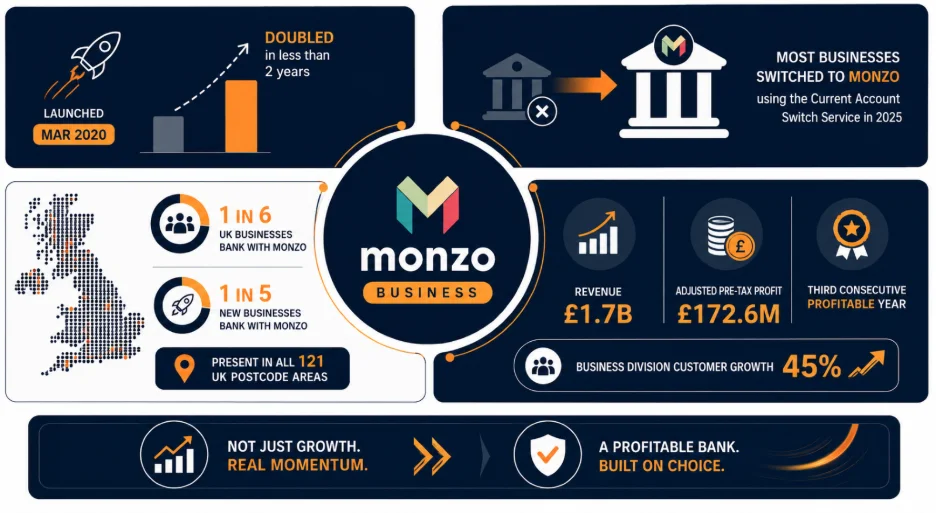
That was its third consecutive profitable year. The business division posted 45% customer growth in the same period.
This is not a startup burning investor cash to buy customers. It is a profitable bank with accelerating business banking numbers.
Why SMEs Are Moving
Monzo commissioned research alongside the announcement. More than two thirds of SMEs, 68%, said they now rely on digital banking more heavily than they did in 2020. 63% said they started using more digital tools during the pandemic. 61% said they want their bank to offer financial management tools beyond a basic account.
That last figure is the one that matters most. Businesses are not just looking for somewhere to put money. They want software. They want integrations. They want invoicing tools, expense tracking, savings pots, and accounting connections that reduce the admin load on a Friday afternoon.
Friction has been stripped away from business banking by challenger banks. No need for branch visits, very little paper work, accounts that can be set up within minutes. However, traditional banks reign supreme when it comes to lending, overdrafts, and financial relationships.
But for day-to-day operating accounts? Fintech firms grew four times faster than traditional banks in 2025. Over 62% of UK banking customers now use at least one challenger bank.
What Monzo Business Actually Offers
Monzo Business runs three tiers. A free account covering the essentials, a £9 per month plan for growing businesses, and a £25 per month option for small teams.
The product suite now includes expense cards for teams, integrated invoicing and payment tools, accounting integrations, and a free Making Tax Digital tool built in partnership with Sage. That MTD tool is significant timing. From April 2026, sole traders and landlords with qualifying gross income above £50,000 must file quarterly with HMRC through recognised software. Monzo now offers a way to do that at no extra cost.
Business customers have saved more than £4 billion through Instant Access Savings Pots since the feature launched and currently hold almost £1 billion in those accounts. For cash-conscious SMEs managing tax reserves and working capital, that is a real function, not a nice-to-have.
FSCS protection covers business deposits up to £120,000. That is a materially different regulatory position from payment accounts and e-money institutions, and for businesses holding significant operating balances, it matters.
Where Digital Banking Still Falls Short
None of this means digital banks are the right fit for every business. There are gaps worth knowing about.
Monthly cash deposit limits sit at £3,000 for sole traders and £10,000 for limited companies, with each deposit costing £1. For retail businesses, market traders, or hospitality operators where cash is central to daily operations, those limits create a recurring problem.
International payments run through Wise, with a 1% conversion fee capped at £1,000 per transaction. For businesses trading regularly in foreign currencies, that cost compounds quickly.
All directors and persons of significant control must be UK residents. Non-UK applicants are ineligible. For businesses with overseas founders or international directors, that is a hard block.
And for anything requiring structured lending, an overdraft facility with meaningful limits, or a relationship manager who can advocate internally for a business loan, traditional banks still hold the advantage. The decision for most founders still comes down to a clear question: speed and simplicity now, or banking built for longer-term scale?
What the Broader Market Looks Like
Monzo is the headline, but it is not operating alone.
Starling Bank built one of the largest SME digital banking bases in the UK and reached profitability well before Monzo did, building a technology platform that now powers other banks. Tide focuses on micro-businesses and freelancers and remains one of the largest SME digital platforms by customer numbers. Revolut received its UK banking licence in 2024 and now holds over 75 million customers globally, though its business banking proposition in the UK is still maturing relative to its consumer offer.
These institutions are no longer niche challengers. They are profitable, growing rapidly, and for many customers becoming primary banking relationships rather than secondary spending accounts.
Despite this, only 14% of UK banking customers have fully abandoned traditional institutions. Most businesses use a mix: a digital account for daily operations and an established bank for lending or more complex financial products.
What This Means for Your Business
The shift toward digital banking has a direct interaction with HMRC’s current compliance direction that many businesses are not yet joining up.
Under Making Tax Digital for Income Tax, which launched April 2026, sole traders and landlords with qualifying income above £50,000 must maintain digital records and submit quarterly. HMRC strongly recommends a separate business bank account to make that record-keeping clean. Most accountants require it as a working condition. A business account that integrates with accounting software cuts the admin time on that quarterly submission significantly.
For anyone setting up a new company or moving to a digital-first banking setup, the choice of account now has direct implications for how easily you can comply with MTD requirements, track deductible expenses, and keep personal and business finances clearly separated.
That separation is also the most common thing HMRC looks for when it questions whether expenses have been correctly claimed. A mixed personal and business account does not just make bookkeeping harder. It creates compliance risk.
Whatever account structure you use, getting your accounting and record-keeping set up properly from the start is worth doing properly, not as an afterthought.
Lanop works with sole traders, limited companies, and startups across the UK on accounting, tax compliance, and making the most of digital tools. Get in touch today if you want advice on structuring your business finances properly.