
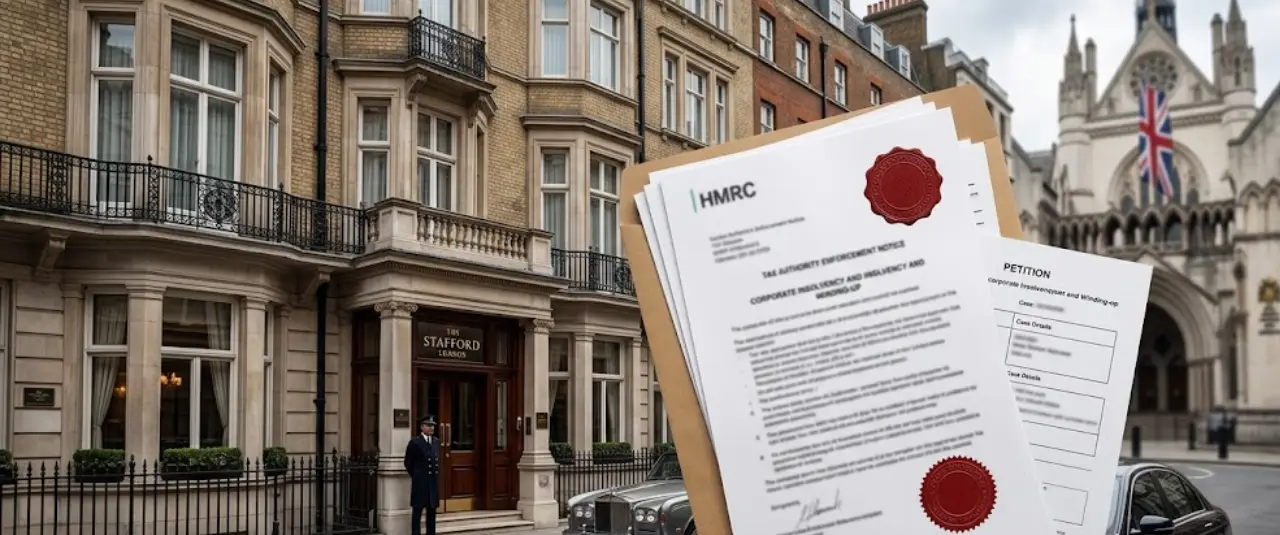
One of London’s oldest five-star hotels is facing formal legal action from HMRC over unpaid tax debts. The Stafford London, a 107-room Mayfair property dating to the 17th century, has been served a winding-up petition filed at the High Court. Its parent company, BHL Global, has received a separate petition.
Key facts briefly:
- HMRC has filed winding-up petitions against both The Stafford London and its owner BHL Global
- The hotel’s turnover fell 5% to £30.5 million in 2024, with the group citing rising costs and staff shortages
- The petitions follow the abrupt departure of managing director John McLean after just one year
- Neither The Stafford nor BHL Global has commented publicly
Who Owns the Stafford and What Is BHL Global?
Stafford traces its history to the 17th century and has wine cellars that are considered some of the oldest in London.
The hotel was bought by BHL Global, previously called Britannia Hospitality – in 2009 for a value of £77.5 million. According to Colliers’ 2019 valuation, its value stood at £142 million. This is not an issue with the asset. BHL Global is owned by the El Sharkawy family, which is one of the most successful Egyptian property and hospitality firms.

The El Sharkawy family started The Stafford Collection back in 2019, assembling a collection from places where food and hospitality matters.
This can be seen in places like Norma, their Sicilian-inspired restaurant located in Fitzrovia, and in Lympstone Manor, which lies in Devon and was added to their collection in June 2025 together with Michael Caines.
The Stafford and Lympstone Manor have managed to maintain Michelin stars in all of their restaurants, this describes their entire brand.
What the Accounts Show
BHL Global’s most recent accounts tell a pressured story.
Turnover fell five per cent to £30.5 million in the year to December 2024. The group pointed to an increasingly competitive London luxury hotel market. It also flagged rising wage costs, food and utility bills, and a shortage of skilled labour.
These are complaints shared across the sector. They sit less easily, however, against the backdrop of a Mayfair address owned by a family with significant property wealth.
The Managing Director Who Left After One Year
The petition lands months after the abrupt departure of managing director John McLean.
McLean had never been hired from the outside. Prior to becoming a manager at The Kensington, Browns in Mayfair, and The Lanesborough, McLean had worked as a chef at The Stafford. This makes the reason for his departure after only one year particularly strange when viewed considering his background.
The petition adds context. Whether the two are directly connected remains unknown. Neither party has addressed it publicly.
What a Winding-Up Petition Actually Is
A winding-up petition is not a warning letter. It is a formal application to the High Court asking a judge to order a company’s compulsory liquidation.
Many of these petitions are filed by HMRC every year. The receipt of a petition does not necessarily suggest that any fraud or evasion is being committed. It merely indicates that the case is now past the stage where any reminders, statutory demands, or repayment negotiations might be attempted.
What triggers a petition
The most common causes are unpaid VAT, PAYE and National Insurance, and corporation tax. HMRC rarely acts at the legal minimum of £750. In practice, petitions follow larger debts and persistent non-payment.
What options remain once it arrives
A company has limited time to respond once a petition is served. The available routes are:
- Pay the full debt immediately
- Apply to court for an injunction to prevent the petition being advertised
- Negotiate a Time to Pay arrangement with HMRC
- Demonstrate a genuine legal dispute about the amount owed
Most directors who resolve petitions successfully act within the first few days. A week’s delay can close off options entirely.
HMRC’s stated position remains unchanged: “We take a supportive approach to dealing with customers who have tax debts and only file winding-up petitions once we’ve exhausted all other options, in order to protect taxpayers’ money.”
The Stafford Is Not the Only One
This case is part of a pattern that has been building across hospitality throughout 2025 and into 2026.
Hotel Cafe Royal, another West End luxury venue, was served a petition by HMRC in January 2026. The authority later withdrew it after confirming it had been filed in error.
The Fat Duck group, Heston Blumenthal’s restaurant company, is currently facing its own petition after recording losses of over £2 million. Tax liabilities make up a substantial part of a total debt position more than £2.7 million.
The broader enforcement numbers
HMRC’s outstanding debt amounted to £43.8 billion by the end of September 2025, an increase from the previous quarter when it was reported as being £42.6 billion.
423 winding-up petitions were issued by HMRC during the month of October 2025, the largest number since October 2024.
Even though total company insolvency cases have been easing off somewhat early in 2026, HMRC winding-up petitions continue to increase, largely due to their efforts in collecting overdue VAT, PAYE and Corporation Tax payments post-pandemic restrictions since 2022.
Why Hospitality Carries More Risk Than Most Sectors
Luxury hotels are structurally exposed in ways that other businesses are not.
All of those costs are above revenues from trading that can become softer instantly. When occupancy is lower or room rates are softer, then the difference between the revenue and the costs becomes smaller.
The tax timing problem
VAT on room rates, PAYE on large staff payrolls, and corporation tax on hotel profits all create liabilities on a rolling quarterly and annual cycle.
If reserves are not maintained through a strong trading period, those obligations pile up. The tax debt does not pause while the business recovers.
The government has committed £555 million annually to HMRC investment and is targeting an additional £5.1 billion in tax revenue per year by the end of the current Parliament. Tax experts told City AM they expect enforcement to intensify further across 2026. Post-pandemic forbearance is over.
What Any Business Should Take from This
The Stafford is high-profile. The mechanics behind its situation are not.
Unpaid VAT. Missed PAYE. Overdue corporation tax. These are the liabilities that lead to winding-up petitions regardless of the size or reputation of the business involved. In 2020, HMRC’s creditor status was elevated to secondary preferential for VAT and PAYE, increasing its priority in any insolvency and sharpening its appetite for enforcement.
A winding-up petition is not the start of HMRC’s process. It is the end of it.
By the time a petition is filed, demands have been sent, statutory notices have been issued, and repayment discussions have already broken down. The businesses that avoid reaching that point are the ones that manage their tax position before the arrears accumulate, not after.
Lanop’s team works with businesses on corporation tax planning, VAT compliance, and payroll obligations. If your business is carrying tax arrears or you want to confirm your compliance position is solid before HMRC’s enforcement activity reaches you, speak to us today.