

Introduction
There are plenty of countries offering tax incentives to lure foreign retirees. Most are marketing dressed up as policy. Greece’s 7% flat tax for foreign pensioners is different. It’s a functioning legislative regime, introduced in 2020, that genuine high-net-worth UK retirees are using to reduce their effective tax rates to levels that would be unthinkable at home.
And yet, the financial planning community in the UK has barely covered it. That will change.
With the UK non-dom regime abolished from April 2025 and Labour showing no appetite to replace it with anything comparable, the question of where to take your tax residency is more pressing than it has been in decades. Greece is now a serious answer.
What the 7% Regime Actually Is
The Legislative Basis
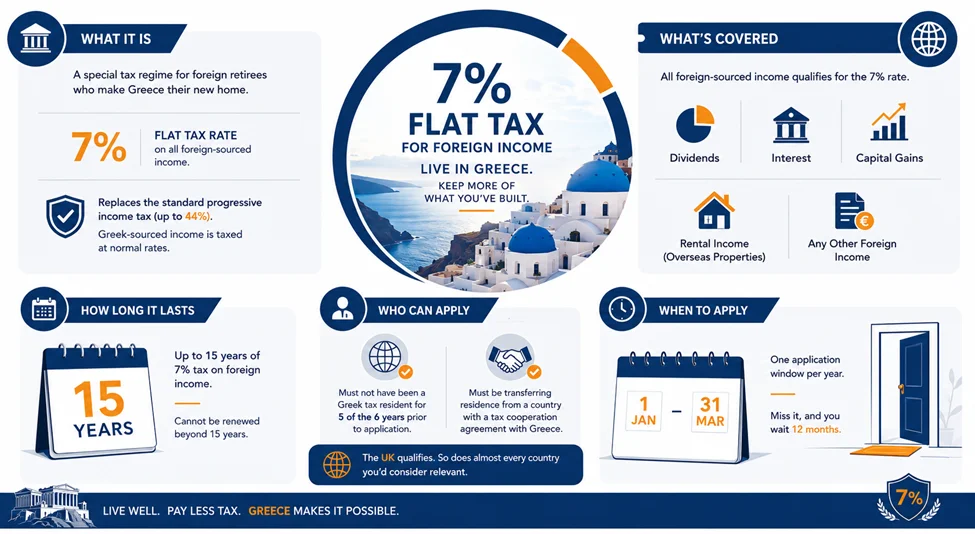
The regime, legislated under Article 5A of the Greek Income Tax Code and active from the 2020 tax year, allows foreign pensioners who transfer their tax residence to Greece to pay a flat 7% on all foreign-sourced income. Not just their pension. That includes dividends, interest, capital gains, rental income from overseas properties, and any other income originating outside Greece. All of it, taxed at 7%.
The standard Greek progressive income tax scale runs up to 44% for income above €40,000. The 7% regime replaces all of that for foreign income. Greek-sourced income remains subject to standard rates, but for a UK retiree whose wealth is almost entirely offshore, that distinction is largely academic.
Duration and Eligibility
The regime lasts for up to 15 years. It cannot be renewed beyond that ceiling.
To qualify, an applicant must not have been a Greek tax resident for five of the six years prior to the year of application. They must also be transferring their residence from a country with which Greece has an administrative cooperation agreement in the field of taxation. The UK qualifies. So does almost every country you’d consider relevant.
Start Your Business in Greece
Book a free consultation with our specialists and receive tailored advice on company formation, tax planning, banking, and compliance. We'll guide you through every stage of establishing and growing your business in Greece.
The Application Window
There is one application window per year: 1 January to 31 March. Miss it, and you wait 12 months.
The UK-Greece Double Tax Treaty: What It Actually Means for Your Pension
How the Treaty Works in Practice
This is where most articles become useless. They tell you there’s a treaty, that double taxation is avoided, and move on. The mechanics matter enormously.
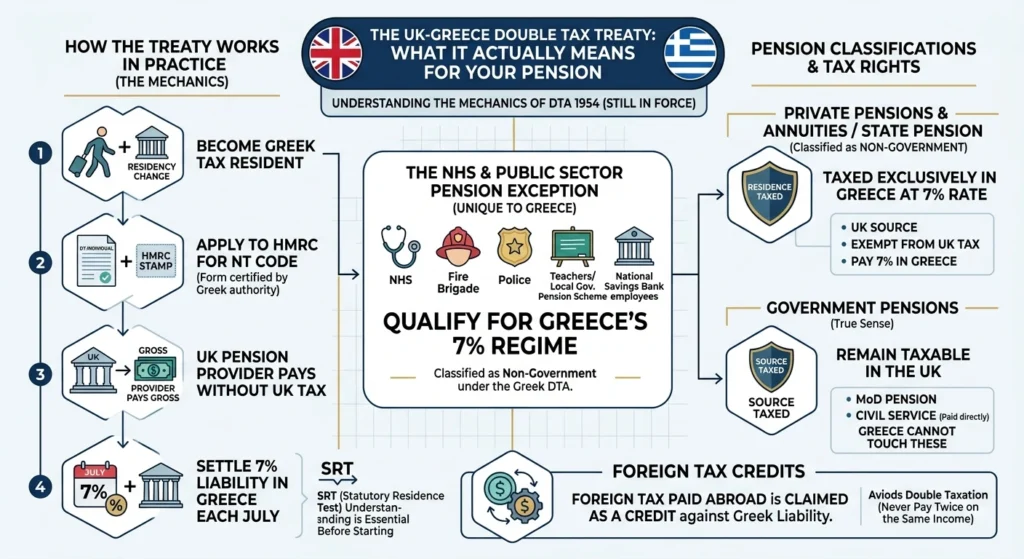
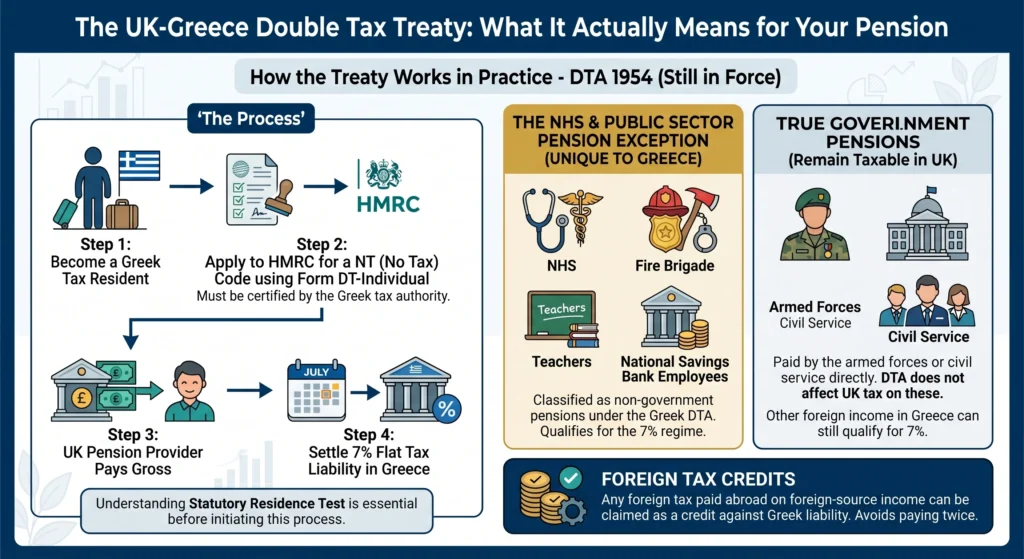
Under the UK-Greece Double Taxation Agreement of 1954 (still in force), private pensions and annuities are taxed exclusively in the country of residence. Once you become a Greek tax resident, private pension income derived from UK sources is exempt from UK tax.
You apply to HMRC for a NT (No Tax) code using Form DT-Individual, which must be certified by the Greek tax authority. From that point, your UK pension provider pays gross, and you settle your 7% liability in Greece each July.
The state pension follows the same principle. Once you’re a Greek tax resident, you can apply for a No Tax code from HMRC so your UK state pension will no longer be taxed at source. You declare it in Greece at 7%.
Understanding your UK tax residency status and obligations under the Statutory Residence Test is essential before initiating this process.
The NHS and Public Sector Pension Exception
There is also a point almost no one flags: Greece is unique in Europe for how it treats certain public sector pensions. NHS and Fire Brigade pensions paid by local authorities, as well as pensions for police, teachers, and National Savings Bank employees, are classified as non-government pensions under the Greek DTA, meaning they can qualify for the 7% regime.
In most other countries with similar tax schemes, these would be treated as government pensions and excluded. For a retired NHS consultant or a former teacher with a Local Government Pension Scheme, this distinction is significant.
Government pensions in the true sense, such as those paid by the armed forces or the civil service directly, remain taxable in the UK regardless of your residency. The DTA does not let Greece touch those. A retired career soldier will still pay UK income tax on their MoD pension, though other foreign income they bring into Greece can still qualify for 7%.
Foreign Tax Credits
One more thing the treaty enables: any foreign tax paid abroad on foreign-source income can be claimed as a foreign tax credit against the Greek liability. So, if you have income streams from countries where withholding is unavoidable, you’re not paying twice. This is the same principle that underpins double taxation relief across international arrangements.
7% vs €100,000: Which Regime Is Actually Better?
Two Regimes, One Decision
Greece runs two premium tax regimes simultaneously, and the confusion between them is constant.
The €100,000 non-dom regime (sometimes called the alternative taxation regime) targets high-net-worth investors. It offers a fixed €100,000 annual tax on all overseas income, regardless of the amount earned, for a 15-year term, with the option to include family members for €20,000 each. It also requires a substantial investment in Greece of at least €500,000 within three years of application.
The 7% pensioner regime requires no investment at all. It simply requires a pension or income from abroad and proof of prior non-residency.
The Crossover Calculation
The crossover point is straightforward arithmetic. If your annual foreign income is below approximately €1.43 million, the 7% regime produces a lower tax bill than a flat €100,000. Above that threshold, the fixed-fee non-dom regime becomes cheaper.
For the vast majority of UK retirees, even well-off ones, the 7% scheme wins. Someone with £150,000 a year in pension and investment income, which is a very comfortable retirement, pays around £10,500 in Greek tax. Under the €100,000 regime, they’d pay roughly seven times more.
When the €100,000 Regime Makes Sense
The €100,000 regime does have one structural advantage: it offers no-questions-asked simplicity on very complex, multi-jurisdictional income. If your financial affairs span several countries with potentially awkward withholding arrangements, the fixed-fee certainty has a value. And the investment requirement, often met through property purchase anyway, may suit someone planning to buy in Greece regardless.
But for the typical retired couple with a UK pension, an ISA portfolio, some rental income from a property back home, and perhaps a SIPP they’re still drawing down, the 7% regime is the obvious choice.
Getting In the Door: Residency After Brexit
What Changed and Why It Matters
UK nationals lost free movement when the UK left the EU. That is the starting point. You cannot simply arrive in Greece and declare tax residency. You need a legal basis for a long-term stay.
There are two principal routes for retirees.
The FIP Visa Route
The Financially Independent Person visa, known as the FIP, is designed precisely for this cohort. The minimum income requirement was raised from €2,000 to €3,500 per month through Law 5038/2023. Add a spouse and that requirement rises further.
The permit is issued for three years and is renewable as long as the income requirement continues to be met. After submission and fingerprinting, the initial FIP residence permit is usually issued within six to eight months. You will need private health insurance for the first year.
The FIP is the cleaner path for pensioners. It requires no property investment, just demonstrable passive income. UK pension income, investment dividends, and rental receipts from overseas properties all count toward the threshold.
The Golden Visa Route
The Golden Visa is the alternative, and it suits those who plan to buy property in Greece regardless. The Golden Visa offers a five-year renewable residence permit with no minimum stay requirement, most commonly tied to a real estate investment of €250,000 or more, though the qualifying threshold is now €400,000 in most major areas following 2024 reforms.
The Golden Visa does not by itself grant tax residency. You still need to spend at least 183 days per year in Greece and file for tax resident status separately, unless you structure things otherwise.
The Pre-Travel Requirement
One thing to be clear about: if you plan to stay longer than 90 days, you must apply for a national Type D visa before travelling. You cannot apply for a long-stay permit after you arrive in Greece on a visa-free entry. This catches people out. The application must be made at the Greek Embassy or Consulate in the UK before you leave.

The Residency Test Nobody Takes Seriously Enough
183 Days: Not a Suggestion
To claim the benefits of the Greek pension regime, you must be a Greek tax resident. To be a Greek tax resident, you must spend at least 183 days per year in Greece.
That sounds obvious. It is often ignored.
UK retirees with property in both countries, grown-up children in the UK, and the instinct to drift home frequently can easily find themselves spending more time in the UK than they planned. If HMRC forms a view that you remain a UK tax resident under the Statutory Residence Test, you have a problem.
How the UK’s SRT Evaluates Your Status
The UK’s SRT looks at factors including days spent in the UK, the availability of UK accommodation, your work ties, and your family ties. Moving abroad does not automatically make you a UK non-resident. Spending more than 90 days in the UK in any tax year while having a home available, there is a red flag under the SRT. Spending more than 45 days is problematic if other ties apply.
If you’re planning a clean break, it’s worth reading the full technical requirements for exiting UK tax residency as a high-net-worth individual, particularly around the five-year rule on capital gains.
What Living in Greece Actually Means
The practical implication: you need to live in Greece for most of the year. Not as a notional address, but genuinely. Your phone data, bank transactions, and loyalty card history are the kind of evidence that might matter if HMRC decides to enquire. This is not a regime for people who want to pay 7% while quietly spending their summers in the Cotswolds.
Mistakes That Cost People Dearly
Taking the Pension Lump Sum at the Wrong Time
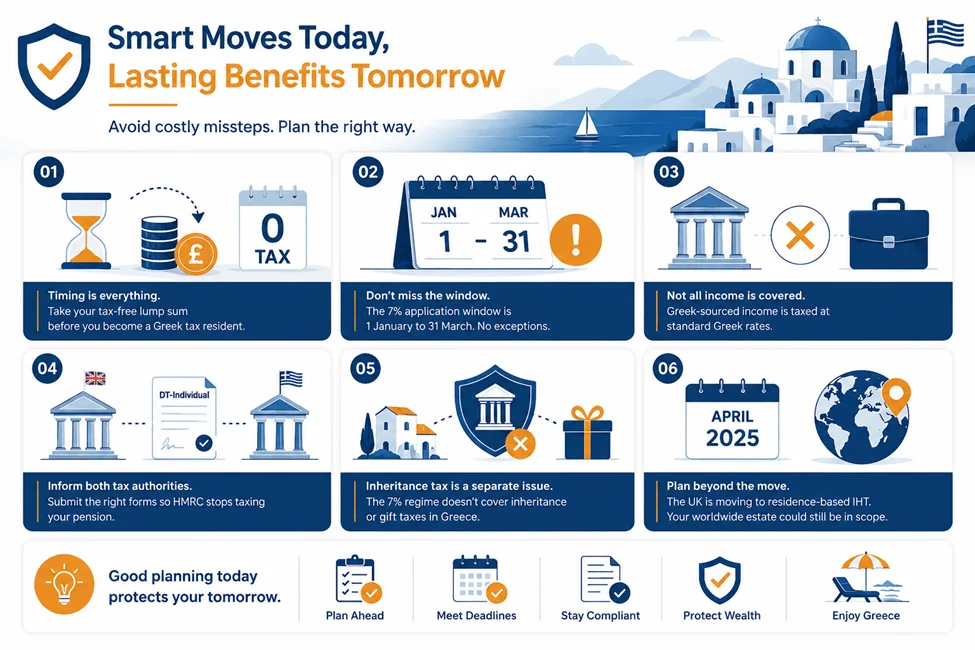
Your pension commencement lump sum (PCLS) is 25% of your pension fund, tax-free under UK law. Once you become a Greek tax resident, however, your pension withdrawals are subject to the 7% regime, including the pension commencement lump sum. If your PCLS is £100,000, taking it as a Greek tax resident costs you £7,000. Taking it before you transfer residency costs nothing. Sequence matters.
This is a core area where structured advice pays for itself. Our guide to tax on private pension contributions covers the UK-side of these decisions in more detail.
Missing the Application Window
The 7% application must be submitted between 1 January and 31 March of the tax year in which you want the regime to apply. There is no rolling admission. Missing this window means waiting until the following year. People who relocate in the autumn expecting to file immediately often discover they’re looking at a 15-month wait.
Assuming Greek Income Is Covered
It is not. Greek-sourced income is taxed at standard Greek rates under both the 7% and €100,000 regimes. If you work part-time in Greece, take a Greek salary, or earn rental income from Greek property, that income sits outside the preferential regime.
Failing to Inform Both Tax Authorities
You need to formally transfer tax residence to Greece and notify HMRC of your non-UK residency. HMRC will not automatically stop taxing your UK income simply because you’ve left. The DT-Individual form, certified by the Greek tax authority and returned to HMRC, is how you trigger the UK exemption on pension payments. Without it, your pension provider will continue deducting UK income tax.
This is also where self-assessment filing obligations can persist longer than retirees expect. If you have UK-sourced income that remains taxable in the UK such as rental income from UK property, you may still need to file a UK self-assessment return even after becoming a Greek tax resident.
Ignoring Greek Inheritance Tax
The 7% regime is an income tax concession. It does not touch Greek inheritance or gift taxes. Successful applicants are not exempt from the Greek inheritance tax, or Greek gift tax on movable assets located abroad. If you’re buying a property in Greece and expect to leave it to your children, this matters. Structure your Greek property holding with advice; a company or trust structure may be appropriate depending on the size of the estate.
The UK’s inheritance tax picture is also shifting. From April 2025, IHT moves to a residence-based system. If you’ve lived in the UK for 10 of the last 20 years, your worldwide estate can remain on the UK IHT net for up to 10 years after departure. Proper inheritance tax planning is no longer optional for anyone with significant assets on both sides of the border.
The State Pension Question
Triple Lock Uprating Still Applies
There is one consistent piece of good news for UK retirees in Greece that gets surprisingly little attention. Greece is part of the European Economic Area, so the UK state pension uprating continues to apply. Your state pension rises with the triple lock. This is not the case if you retire to most non-EEA countries, where the state pension is frozen at the rate it was when you first claimed it.
For a UK retiree in their mid-60s who might live another 25 years, the cumulative value of continued uprating is substantial. It is one of the structural advantages of retiring within the EEA that often gets overshadowed by the conversation about tax rates.
Is Greece the Right Move?
The 7% regime is not a loophole. It is deliberate policy by a government that watched Portugal use its now-defunct NHR regime to attract tens of thousands of wealthy foreign residents and decided it wanted a version of its own.
The Tax Case Is Stronger Than Most Realise…
For a UK retiree with income above £80,000 a year, the tax saving is likely to be substantial. Someone paying 40% on income above £50,270 could be looking at a rate difference of 30 or more percentage points on much of their income. Over 15 years, that compounds into a meaningful sum.
The lifestyle case for Greece is well understood. The tax case is less so.
What It Actually Takes?
What it requires is real commitment to residency, careful sequencing of pension decisions before you leave, and advisers who understand both UK and Greek tax law.
Start well before you plan to move. The visa timeline alone runs six to eight months, and the March application deadline adds further lead time. Eighteen months of preparation is realistic for doing this cleanly.
How Lanop Can Help
At Lanop, we help UK nationals manage cross-border tax positions including residency transitions, double taxation treaty claims, and ongoing HMRC obligations. Speak to our international tax team to get started.
FAQs:
Can I qualify if my only pension is a SIPP?
Possibly not. Greece requires a recognised employment-linked pension and SIPP-only applications have been rejected. If you also receive the UK state pension, your eligibility improves considerably.
What happens if I spend a year under 183 days in Greece?
You risk being treated as UK tax resident for that year, which invalidates your Greek residency status for that period. Track your days carefully and keep documentary evidence throughout the year.
Does the 7% rate apply to cryptocurrency gains?
It is unsettled. Greek tax law has no clear answer on whether crypto gains are foreign-sourced or Greek-sourced. Get a definitive view from a Greek specialist before relying on the regime to cover those gains.
Can my spouse be included in the application?
Your spouse must apply separately and meet all eligibility criteria independently. There is no family lump sum as there is under the €100,000 scheme. Each of you pays 7% on your own foreign income.
What happens to UK rental income from a property I keep back home?
UK rental income remains taxable in the UK regardless of your residency. You will still need to file UK self-assessment returns for that income.
How does the Greek regime interact with the UK's new IHT residency rules?
Moving to Greece does not immediately remove you from the UK IHT net. If you have been UK resident for 10 of the last 20 years, your worldwide estate stays exposed to UK IHT for up to 10 years after departure.