

Why Pre-Arrival Tax Planning Matters
Most people focus on schools, homes, and where they will live. That makes sense. But for a high-net-worth relocation UK move, what you do before you land often matters more than anything after.
The UK tax system rewards early action. Structures that protect wealth when set up before arrival can become very hard to put in place once you are here.
What often catches people out is the timing. Many assume UK tax residency begins only once the move is fully complete. Even a few unplanned weeks in the UK can trigger the rules and create an unexpected tax bill.
Why early planning gives you more options
Before you become a UK tax resident, you have real choices. You can review assets, change how things are held, close certain positions, and plan how money will come into the UK.
Once you are a resident, many of those options close. Sometimes for good.
Common mistakes wealthy people make before moving
- Mixing clean capital with other funds
- Assuming non-dom rules will still protect them in the same way
- Not sorting out their business structure before the move

UK Non-Dom Changes 2026 and the New UK FIG Regime Explained
The UK non-dom changes 2026 are the biggest shift in UK tax for globally mobile people in a long time. The old system, where non-doms could keep overseas income and gains offshore with no UK tax, has ended.
What the FIG Regime offers new arrivals
Under the UK FIG regime new arrivals rules, if you have not been a UK resident in any of the ten tax years before you arrive, you can claim relief on foreign income and gains for your first four UK tax years.
During that window, foreign income and gains are not taxed in the UK. And here is the key part: you can bring that money into the UK freely. That is a big change from the old rules, where you had to leave money abroad to avoid tax.
Who qualifies for the four-year window
- You were not UK resident in any of the ten tax years before arrival
- You must claim the relief each year. It is not given to you by default
- Relief only covers foreign income and foreign gains
- UK income and gains are taxed from day one, no matter what
Key planning points
The four-year window is a real benefit. But it only helps if you plan around it. You need to know which income counts, how to set up payments, and what to do before the window closes.
UK Tax Residency Rules for New Arrivals
The UK Statutory Residence Test new arrivals framework decides whether you are a UK tax resident. It is not just about where you sleep most nights.
How the day counts rules work
A day counts if you are in the UK at midnight. If you arrive on Monday and leave Tuesday morning, that is one day. If you spend 183 or more days in a tax year, you will always be resident. But with enough ties to the UK, you can become resident with far fewer days.
Ties that can trigger residency sooner
The UK residency timing rules get more complex when you have connections here. Each tie can lower the number of days you need to spend before you become a resident.
| Tie Type | Example | Effect on Day Count |
|---|---|---|
| Family tie | Spouse or child is UK resident | Lowers the threshold by a lot |
| Home tie | A UK home you can use, even rented | Counts as a tie |
| Work tie | Working 40 or more days in the UK | Counts as a tie |
| 90 day tie | 90 or more UK days in a prior year | Counts as a tie |
Real example: You spend 90 days in the UK in year one. You have a UK flat. Your spouse lives here. In year two, you could become a UK resident even with far fewer days.
Should You Sell Assets or Exit a Business Before Moving?
When you sell assets matters a lot. It is one of the most valuable parts of pre arrival tax planning in the UK. Get it right, and you can protect a lot of value. Get it wrong, and the cost can be very high.
Selling a company: before or after arrival
If you own a business and plan to sell it, finishing the deal before you become a UK resident usually means the gain is not taxed in the UK. After arrival, that gain could be taxed at 24 percent or more, depending on how the deal is done.
Even if the sale takes time, the date you sign the contract matters. Talk to your adviser well before any deal moves forward.
Investment portfolios and crypto
For investment accounts, UK capital gains planning before arrival often means looking at gains you have not yet locked in. You then decide whether to sell before you become UK resident.
Digital assets like crypto are treated as taxable assets under UK rules. Planning here is often missed but can make a big difference for those with large crypto holdings.
Bringing Wealth to the UK Without Creating Tax Risks
What is clean capital?
For anyone arriving under the new FIG rules, knowing how to handle bringing wealth to the UK starts with clean capital. Clean capital is money you built up before becoming a UK resident. No UK tax is owed when you bring it in.
Under FIG, foreign income and gains can come into the UK freely during the four-year window. But once that window closes, the type of money matters again. You need to know what qualifies as clean capital and how each source of funds will be treated.
Mixed funds and banking issues
If income, gains, and clean capital all go into the same account, things get messy fast. The remittance basis UK changes left behind a set of rules that still affect how mixed money is treated. The UK rules decide what is seen as brought in first, and it is rarely the most tax-friendly order.
Keep your accounts separate. Do it before you arrive. Do it as you settle in. It is not just good practice. It is essential.
Source of funds and bank checks
Large transfers into the UK trigger checks by banks. For anyone doing a high-net-worth relocation in the UK, having clear records of where your money came from prevents delays and stops accounts being frozen.
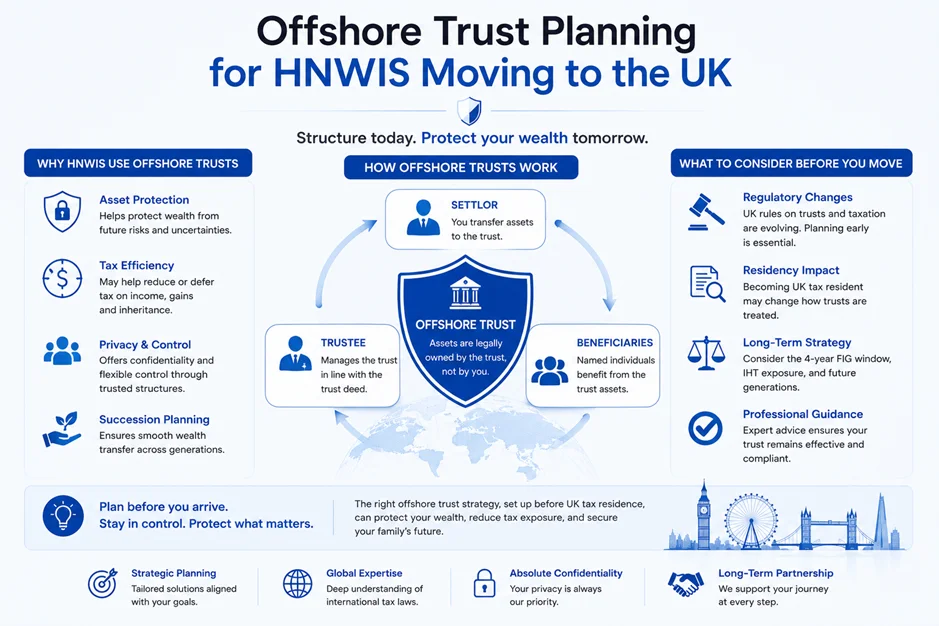
Offshore Trust Planning for HNWIs Moving to the UK
In the past, offshore trust planning was at the heart of non-dom tax work. Under the old rules, offshore trusts could protect overseas assets from UK tax for many years. The rules have changed a lot.
How the rules have shifted
Trust protections have been cut back. During the FIG four-year window, trust structures can still be useful. But after that point, the protections for long-term UK residents have been greatly reduced.
When trusts may still help
- Passing on family wealth across more than one country
- Protecting assets for future generations
- Holding non-UK assets where UK tax is not the main issue
- Pre-arrival planning for those who plan a long stay in the UK
UK Inheritance Tax Planning for New Residents
This is the area most people do not think about early enough. UK IHT 10-year rule new resident planning is now a key concern for any HNWI moving to the UK for the long term.
The ten-year rule for long term residents
From April 2025, where you were born no longer decides your UK inheritance tax position. Instead, if you have been a UK resident for ten or more of the last twenty tax years, your whole worldwide estate falls into the UK inheritance tax net.
The rate is 40 percent above the nil rate band, which is currently 325,000 pounds for one person. That applies to assets all over the world. For someone with large overseas wealth, the exposure can be very large indeed.
Can QNUPS help?
QNUPS UK IHT pension planning stands for Qualifying Non-UK Pension Schemes. Assets held in a qualifying scheme may sit outside your estate for inheritance tax. This is a specialist area. You need proper advice before using it.
Overseas Workday Relief for New UK Arrivals
Overseas workday relief for UK new arrivals is open to people who qualify during the FIG period. If you work partly in the UK and partly abroad, relief may apply to the part of your pay that relates to work done outside the UK.
Who may qualify
- New UK arrivals who have claimed FIG relief
- Employees who genuinely work overseas as part of their role
- People who can show a clear split of their working days
Good records are essential. HMRC will want to see a log of workdays, where duties were done, and how pay was split. Set this up from your very first day in the UK.
Relocating a Business to the UK
One of the most common questions in any relocation business in the UK situation is whether the overseas business will be treated as UK-based once the owner arrives here.
Central management and control risk
If you run an overseas company and you make big decisions from the UK, HMRC may say the company is run from the UK. If that happens, it could be treated as a UK resident for tax. That means UK tax on its profits worldwide.
The fix is good governance. Hold board meetings in the right country. Make decisions there and write them down. Make sure local directors play a real role in running the business.
UK Property Tax Planning Before You Move
Should you buy property before or after arrival? This question comes up in almost every UK property tax planning talk we have.
Buying before you become a UK resident does not avoid stamp duty. SDLT applies to all UK property deals, no matter where you live. Annual Tax on Enveloped Dwellings, known as ATED, applies to properties held in companies above a set value.
Personal versus company ownership
Holding a UK home through a company is usually a bad idea for tax. ATED, higher SDLT rates, and the loss of private residence relief all apply. For most people, owning a home in their own name is the better option.
High-Net-Worth Individual UK Relocation Checklist
- Check that you meet the ten-year non-residence test for FIG
- Review how many days you have spent in the UK in the past two years
- Look at assets with big, unrealised gains and plan before you arrive
- Move clean capital into its own accounts before you come to the UK
- Review how your overseas company is run to check the control risk
- Get source of funds papers ready before any large UK transfers
- Take advice on any offshore trusts before you become UK resident
- Understand the ten-year IHT clock and plan around it early
- If you work overseas, check if Overseas Workday Relief applies to you
- Get advice on the best way to own UK property before you buy
Frequently Asked Questions
Yes. Spending too many days here, especially when you also have ties like a family member or a home, can make you a UK resident without you planning for it. Always get advice before you spend more time in the UK.
After the four-year window, the UK FIG regime 4-year window planning transition is critical. From year five, you pay UK tax on your worldwide income and gains like any other UK resident. Planning for that shift should start well before year four ends.
Yes, but how you manage it matters a lot. If you make key decisions from the UK, HMRC may say the company is UK-based. Good structure and proper governance can manage that risk.
Not without advice first. The structure, the timing, and how you plan to use the property all affect your tax position. Pre-arrival planning helps you find the best approach before you commit to anything.
Yes, in time. Under the UK long term resident IHT worldwide assets rules, once you have been UK resident for ten of the last twenty tax years, your full worldwide estate falls into the UK inheritance tax net. Early planning using pension structures and other tools can help reduce that over time.
Conclusion
If you are planning to move to the UK, the best thing you can do right now is get proper advice. Do it before you make any money moves. Do it before you spend too much time here. Do it before you lock in any structure.
The choices that protect your wealth are rarely made after arrival. They are made in the months before, with clear thinking and the right guidance.
At Lanop, we work with high-net-worth individuals and global families going through exactly this process. We help clients know their residency position, plan how wealth comes into the UK, set up business interests correctly, and prepare for the long-term tax picture, not just the first four years.
If you would like to talk through your own situation, we welcome an early conversation. The sooner we speak, the more options you will have.
Contact Lanop Today!