

Introduction
Every year, thousands of UK businesses fail. Not because they are unprofitable, but because they run out of cash at the wrong time.
No matter how well your business is doing, tax bills, payroll runs, and late-paying customers still must be dealt with. They will not wait.

This guide will help you build a realistic cash flow forecast and prepare for challenges specific to UK businesses. That includes NIC changes, Making Tax Digital, and HMRC deadlines.
What Is Cash Flow Forecasting and Why Is It Different from Your Profit and Loss?
Your profit and loss account tells you whether your business is making money. Your cash flow forecast tells you whether your business can survive for the next ninety days. These are not the same questions.
Confusing the two is one of the most expensive mistakes a UK business owner can make. So let us be clear about what each one does.
Profit is an accounting concept. It matches revenue to the period in which it was earned and costs to the period in which they were incurred, regardless of when the money moves.
Cash flow is more direct. It is the money that lands in your bank account, minus the money that leaves it, on the exact dates those movements happen. A cash flow forecast projects those movements forward in time. It shows you, week by week or month by month, what your bank balance will look like before it happens, while you still have time to act.
Why a Profitable Business Can Still Run Out of Money
Here is a scenario that plays out regularly. A limited company generates £400,000 in annual revenue, shows a healthy net profit on paper, and still cannot meet its VAT payment in January.
This is not unusual. It is one of the most common patterns seen when businesses first enter financial distress. So how does it happen?
You raise an invoice in October. Your client pays 60-day terms, so the cash arrives in December. Your VAT quarter runs from October to December, and payment to HMRC is due by 7 February.
But your November payroll, December supplier invoices, and loan repayment have already used up your reserves. The invoice money arrived. It just filled a gap that already existed. Profit does not protect you from timing. Only a forecast does.
Cash Flow Forecast vs Cash Flow Statement
A cash flow statement is a historical document. Your accountant prepares it as part of your year-end accounts. It shows how cash moved through your business during a past period and helps you understand what happened.
The cash flow forecast is different. It looks forward, projecting inflows and outflows across a future period. That is typically 13 weeks, 6 months, or 12 months.
For day-to-day management, tax planning, and HMRC compliance, the forecast is the document that matters most.
For sole traders and partnerships, Self Assessment payments on account fall on 31 January and 31 July each year, per GOV.UK Self-Assessment deadlines guidance.
None of these dates move. None of them cares whether you had a slow trading month.
Why Cash Flow Forecasting Matters for UK SMEs Right Now
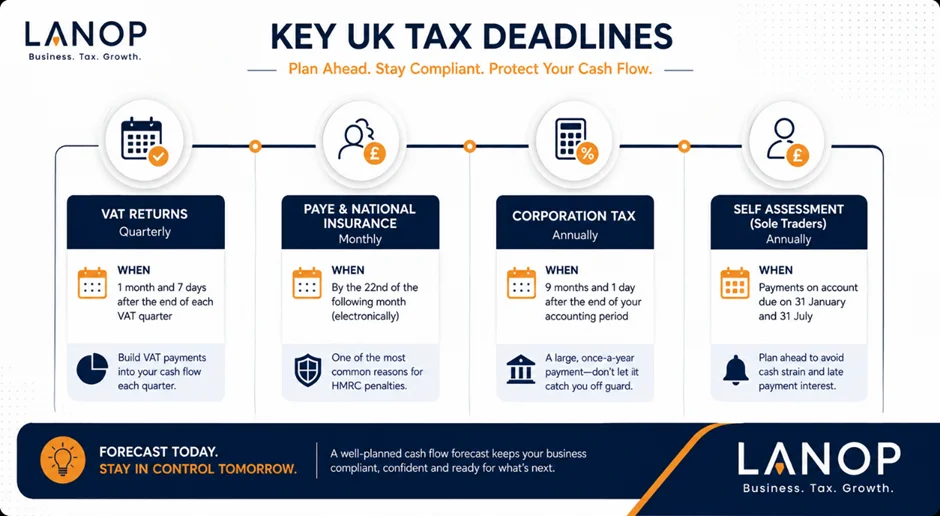
The UK tax calendar creates predictable cash demands. They hit small businesses at set intervals throughout the year. If those intervals are not built into your forecast, they will catch you off guard.
HMRC does not accept surprise as a reason for late payment. So here are the key dates every UK SME forecast must include:
- VAT is due one month and seven days after the end of each VAT quarter, per HMRC’s VAT returns guidance.
- PAYE and National Insurance are due on the 22nd of the following month for electronic payment, per HMRC’s PAYE payment guidance.
- Corporation Tax is due nine months and one day after the end of your accounting period, per HMRC’s Corporation Tax payment guidance.
- For sole traders and partnerships, Self-Assessment payments on account fall on 31 January and 31 July each year, per GOV.UK Self-Assessment deadlines guidance.
None of these dates moves. None of them cares whether you had a slow trading month.
What the Data Shows About UK SME Cash Flow Failure
Research published in late 2025 by Novuna Business Cash Flow found that a third of surveyed UK SMEs could not correctly define cash flow. This is despite 82% of them reporting difficulties with it.
The Federation of Small Businesses has consistently found that over half of small businesses experience late payment from clients. The knock-on effect falls directly on their ability to meet their own obligations.
HMRC is routinely the largest creditor in the UK for business insolvency cases. A business that fails to forecast its tax obligations does not fail because it was unprofitable. It fails because it spent money it was holding on behalf of HMRC.
Why Lenders and HMRC Want to See a Forecast
When you apply for a bank loan, overdraft facility, or government-backed finance, the lender will ask for a cash flow forecast. When you apply to HMRC for a Time to Pay arrangement, HMRC will assess your forecast before agreeing to the terms.
When you seek external investment, any serious investor will look at your forecast before your pitch deck.
A cash flow forecast is not just an internal tool. It is the document that determines whether third parties, including HMRC, will extend the trust and flexibility you need when trading conditions get tight.
What a UK Cash Flow Forecast Should Actually Include
Most forecasts fail not because of calculation errors, but because key lines are missing. Here is what needs to be in yours.
Income Lines
Your income rows must show when money enters your bank account. Not when you raise the invoice, and not the net-of-VAT figure.
If you are VAT-registered and invoiced on 30-day terms, the cash from a sale made in October will appear in your November bank statement. Your forecast must show November, not October.
For VAT-registered businesses, income should be entered as the gross amount including VAT. You are collecting that VAT on behalf of HMRC, but until you pay it over, it sits in your account. It looks like a working capital. It is not.
Getting this right is the difference between knowing your real cash position and fooling yourself with a number that includes a liability.
Fixed Outgoings
Fixed costs go into your forecast first, every month, without exception. These are the costs that do not drop when revenue drops.
Think salaries, employer National Insurance contributions, rent, loan repayments, insurance premiums, and recurring software subscriptions. They define the floor of your monthly cash requirement.
From April 2025, the employer NIC rate increased to 15%, with the secondary threshold reduced to £5,000 per year, as confirmed in HMRC’s employer National Insurance guidance. If your forecast still uses the old rate of 13.8%, your payroll outflow is understated and needs to be corrected now.
Variable Outgoings
Variable costs move with revenue. So, express them as a percentage of sales rather than a fixed monthly figure. Cost of goods sold, delivery and fulfilment costs, transaction fees, and sales commissions all belong here.
If your gross margin is 60%, your variable costs are roughly 40% of each revenue row. Expressing them this way means your forecast adjusts automatically when you model different revenue scenarios.
It also helps you spot margin problems early. If your forecast turns negative at a 55% margin but works at 60%, you know exactly where the danger line sits.
The Tax Rows Most Forecasts Leave Blank
This is where most UK SME forecasts fail. Tax obligations are neither variable costs nor fixed monthly outgoings. They are large, infrequent, and precisely dated liabilities. They must appear as individual line items on the exact month they fall due.
The dates every UK business must include are as follows:
- VAT payment is due one month and seven days after the end of each VAT quarter.
- PAYE and National Insurance are due on the 22nd of the following month for electronic payment.
- Corporation Tax is due nine months and one day after the end of your accounting period.
- Self-Assessment payments on account for sole traders are due on 31 January and 31 July each year.
If these rows are not in your forecast, you do not have a cash flow forecast. You have an invoice tracker. Understanding your full statutory compliance obligations, from VAT to Corporation Tax, is the first step toward accurately forecasting them.
Owner Drawings and Dividends
If you are a sole trader, your personal drawings are a cash outflow. They do not appear as a business cost in your P&L. Still, they absolutely appear in your forecast. Leaving them out makes your forecast look healthier than your bank account by exactly the amount you are paying yourself.
For limited company directors paying themselves through salary and dividends, both must appear in the forecast on the dates they are actually paid.
A director taking a £50,000 dividend in March creates a large one-month cash outflow unrelated to trading performance. Your forecast must reflect this.
How to Build a Cash Flow Forecast Step by Step
Most UK SMEs run into trouble not from a lack of profit, but from the gap between when cash comes in and when they need to pay taxes, meet payroll, and pay suppliers.
Many growing businesses do not get enough warnings of cash pressures. By the time cash becomes critical, the window for making good decisions has already closed.
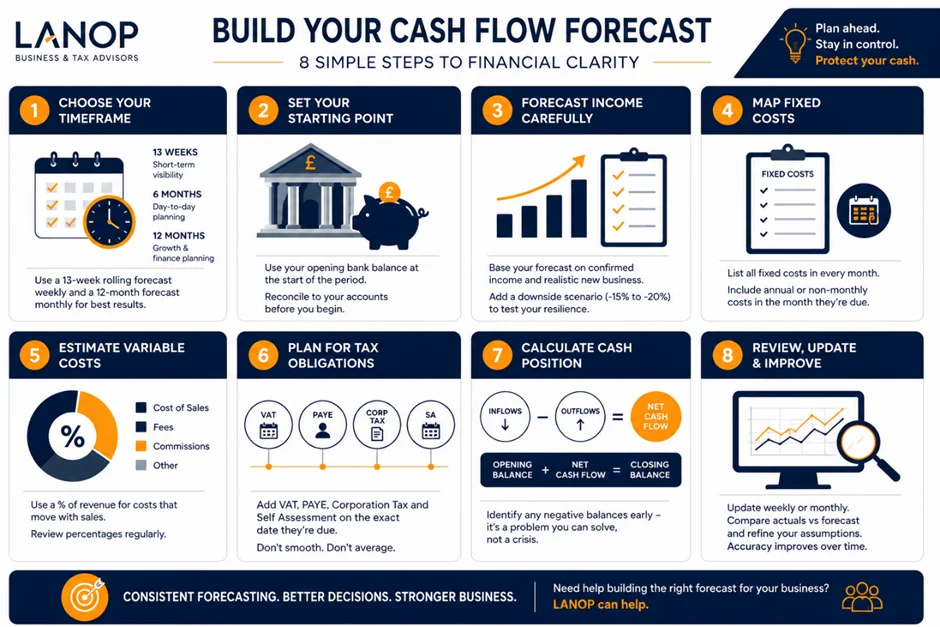
A structured cash flow forecast changes this. It lets you spot potential cash shortages early, clearly understand your financial position, and make informed decisions before a crisis hits.
Whether you build a simple monthly forecast or a rolling 13-week model, the key is consistency and regular updates. These matter more than the level of detail.
How to Handle VAT in a Cash Flow Forecast
If your business is VAT-registered, all income should be entered as the gross amount, including VAT. The net figure belongs to your P&L. The gross figure belongs in your cash flow forecast.
VAT does not belong to your fixed or variable outgoings. It belongs in a dedicated tax row set at the exact month the payment falls due.
For a quarterly return covering January to March, the payment date is 7 May. That row appears once in May. Not spread across January, February, and March.
VAT Scheme Variations
Under the cash accounting scheme, VAT becomes payable only when your customers pay you, as set out in HMRC’s VAT cash accounting scheme guidance. Your VAT liability tracks real receipts, not invoiced sales. This reduces the risk of paying VAT on invoices that are not yet settled.
Under the flat rate scheme, you pay a fixed percentage of your gross turnover to HMRC. You do not account for input and output VAT separately, as described in HMRC’s VAT flat rate scheme guidance. Apply your flat-rate percentage to gross income each quarter and show the payment in the correct month.
Under annual accounting, you make advance payments throughout the year based on your previous year’s liability, with a balancing payment at the end, per HMRC’s VAT annual accounting scheme guidance. These advance payments must appear as fixed outflows. The balancing payment should be modeled separately.
If your business regularly reclaims VAT, model any expected refund carefully. HMRC typically processes refunds within 30 days, but delays do happen. Do not forecast the refund in the same month as the return submission.
The Most Common Cash Flow Forecasting Mistakes
The most damaging mistake is treating the forecast as something you build once and file. A forecast that is not updated regularly shows you a future that no longer exists.
The most common numerical error is entering income in the month it is invoiced rather than the month it is received. Large corporate clients typically pay on 45 to 60-day terms. Government and public-sector contracts often run for 60 to 90 days. If you invoice in January and record that income in January, your forecast will show cash you will not receive until March.
Every forecast should include a downside scenario, typically 15 to 20% below the base case on income, with costs held constant. If your business cannot survive the downside, you need to know that now.
Annual costs create one-month spikes in outflows that monthly averages hide entirely. An annual professional indemnity premium of £3,600 is due in a single payment within one month. Your forecast must show that, not a smooth £300 per month.
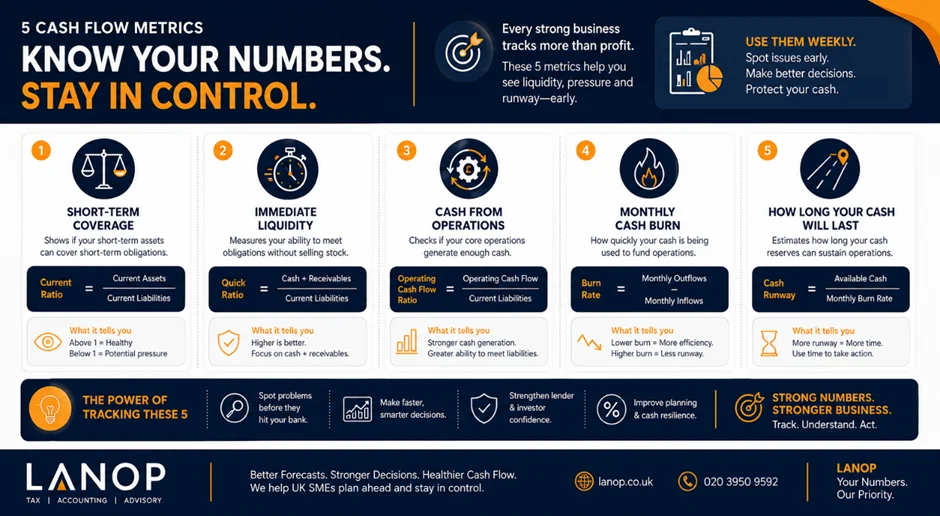
Key Cash Flow Ratios for UK SMEs
Several key cash flow ratios can give you a clear picture of whether your business has liquidity issues, is financially unstable, or has the capacity to cover short-term obligations. Monitoring them alongside your forecast helps you make quicker and better decisions.
Budget Versus Cash Flow Forecast
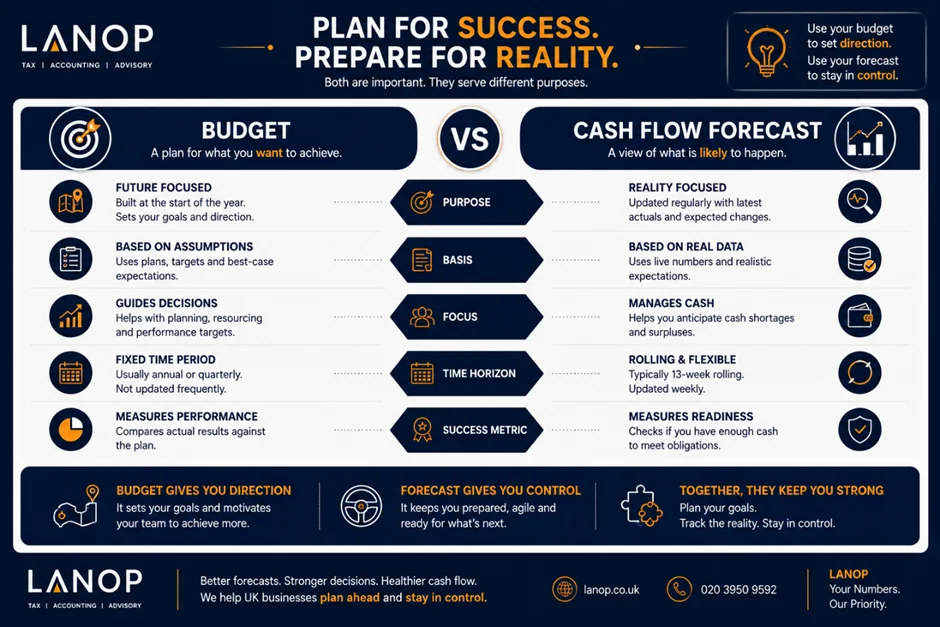
Budgets help you set financial targets. Cash flow forecasts help you track what is realistically likely to happen to your cash position. They serve different purposes, and you need both.
Turning Your Forecast into Action
A forecast is only useful if it changes what you do. If it shows a cash deficit three months ahead, the problem is rare that the business is unprofitable. More often, it comes down to slow collections, poorly timed supplier payments, or fixed costs that have quietly grown.
Send invoices promptly and set clear payment terms. Use your accounting software to chase unpaid invoices at 7, 14, and 30 days. Negotiate extended payment terms with suppliers before you need them, not after.
If the forecast shows a cash surplus and a supplier offers a 2-5% discount for early payment, check out your upcoming tax obligations before committing.
Seasonal businesses should use strong trading months to build reserves for tax liabilities and quieter periods. Review fixed costs every quarter. Small reductions across several cost lines will often do more for monthly cash than one large cut elsewhere.
And if your forecast shows a shortfall that you cannot cover with reserves, approach your lender or HMRC before the deadline arrives. The options available to a business that plans are much better than those available to one already in default.
The 13-Week Rolling Forecast
A 13-week rolling cash flow forecast tracks weekly cash movements and helps you see whether your business can meet upcoming obligations, such as payroll and supplier payments, in the weeks ahead.
Lenders, financial turnaround professionals, and insolvency practitioners favour this format because it picks up cash flow problems sooner than a monthly forecast can. Spotting an issue in week five is far better than discovering it in month two.
Businesses with seasonal revenue, slow-paying customers, low working capital, or ongoing pressure from HMRC will benefit most from this level of detail.
The main advantage of the 13-week rolling model is the speed. Each week, projected figures are replaced with actual results, the forecast is extended by one more week, and any emerging cash shortages can be addressed before they become critical.
In most cases, a rolling 13-week forecast updated regularly with simple figures will outperform complex software that is only open occasionally.
How Making Tax Digital Affects Your Forecast from April 2026
Making Tax Digital for Income Tax Self-Assessment comes into force on 6 April 2026. It applies to sole traders and landlords with a qualifying gross income above £50,000 in the 2024 to 2025 tax year, as confirmed in HMRC’s MTD for Income Tax guidance.
The threshold drops to £30,000 in April 2027 and £20,000 in April 2028.
The most important thing to understand is this: the quarterly updates required under MTD are a reporting obligation, not a payment trigger. Payment dates do not change. Self Assessment payments on account remain due on 31 January and 31 July. Your forecast should continue to show payments only in January and July.
In the 2026 to 2027 tax year, affected taxpayers will complete their final paper-based Self-Assessment return for 2025 to 2026 at the same time as submitting their first MTD quarterly updates. The January 2027 payment will include the balancing payment for 2025 to 2026 and the first payment on account for 2026 to 2027.
Sole traders approaching the threshold should model this now, not in December 2026.
MTD-compatible software such as Xero, QuickBooks, and FreeAgent keeps live transaction-level records throughout the year. A forecast built on this data reflects what is happening in your business, not last quarter’s management accounts.
What Happens If You Cannot Pay HMRC
A Time to Pay arrangement is an agreement with HMRC to spread overdue tax payments over time, typically up to 12 months, as described in HMRC’s guidance on difficulties paying HMRC. It covers VAT, PAYE, Corporation Tax, and Self-Assessment liabilities.
HMRC looks at three things when assessing an application: your compliance history, whether the repayment plan is realistic, and whether you made contact before or after enforcement action started.
A forecast showing conservative income, correctly dated tax obligations, and a clear surplus for instalments is what makes your application credible.
HMRC’s late payment interest rate currently stands at 7.5%, as published in HMRC’s rates and allowances guidance. A business with £50,000 of overdue Corporation Tax on a 12-month arrangement will pay around £3,750 in interest on top of the tax itself. This amount must be included in the forecast you submit with the application.
Businesses that contact HMRC before a deadline, or very shortly after missing one, reach an agreement more often and on better terms. Those who wait for HMRC to make first contact have far fewer options.
Once statutory demand has been served, the choices narrow fast. Once a winding-up petition has been issued, a Time to Pay arrangement is no longer available.
The April 2025 Employer NIC Changes
From 6 April 2025, the employer NIC rate increased from 13.8% to 15%. At the same time, the secondary threshold dropped from £9,100 to £5,000 per year, as confirmed in HMRC’s employer National Insurance guidance. Any forecast built before April 2025 and not updated since is understating payroll outflows.
For an employee earning £30,000 per year, the monthly employer at NIC under the new rates is £312.50. Under the old rates, it was £240.35. Across a team of ten, the additional annual cost exceeds £8,600.
The Employment Allowance increased from £5,000 to £10,500 from April 2025. The previous £100,000 eligibility cap was also removed, as set out in HMRC’s Employment Allowance guidance. Apply this as a reduction to employer NIC outflows from the start of the tax year.
Note that single-director limited companies, where the director is the only employee liable for secondary Class 1 NICs, do not qualify.
From April 2027, most benefits in kind will be payrolled in real time, replacing the annual P11D process, as confirmed in HMRC’s guidance on payrolling employees’ taxable benefits. Class 1A NICs currently paid annually by 22 July will instead be paid monthly through payroll. Businesses providing company cars or private medical insurance should model this timing shift in their 2027 to 2028 forecast before it arrives.
Choosing the Right Forecasting Tool
For a sole trader or small limited company with straightforward income streams, a well-built Excel or Google Sheets model is enough. It is clear, flexible, and costs nothing beyond the time needed to maintain it.
The case for dedicated software grows when manual data entry is no longer sustainable. Float connects directly with Xero, QuickBooks, and FreeAgent and is built specifically for SME cash flow visibility.
Futrli, now part of the Sage ecosystem, provides daily cash flow projections and confidence scoring on forecast accuracy. Xero’s built-in Analytics provides a 7- and 30-day short-term cash view at no extra cost for existing users, though it is not a full substitute for a proper forecasting model.
Any tool you choose should connect to your accounting software via a live bank feed. It should appear on HMRC’s list of compatible MTD software if you are above the qualifying threshold. And it should let you model at least a base case and a downside scenario without having to rebuild the model from scratch.
Construction businesses should look at specialist tools such as Coins, Eque2, or BuildSmart. These handle retention payments, payment applications, and CIS deductions natively. For a construction subcontractor, the lag between completing work and receiving payment, net of CIS deductions, can run from 60 to 90 days. Generic SME tools will not capture this accurately without extensive manual adjustment.
Download Our Free UK SME Cash Flow Forecasting Templates
Designed for VAT-registered businesses, sole traders, and growing limited companies to help manage and forecast cash flow effectively.
Download TemplateHow Lanop Supports UK SMEs With Cash Flow Forecasting
Most cash flow problems we see at Lanop are not caused by poor trading. They are caused by forecasts built on stale figures, or forecasts that were never built at all.
We work directly with your Xero, QuickBooks, or FreeAgent data to build models that reflect your actual current position, not last year’s accounts.
Forecasting at Lanop sits alongside live tax planning. Dividend timing, Corporation Tax reserves, and VAT scheme decisions are all shaped by the forecast, not handled as separate conversations.
Clients use Lanop-prepared forecasts to support bank finance applications, negotiate HMRC Time to Pay arrangements, and make growth decisions with real confidence. You can see how this works across different business types in our client case studies.
If you are a sole trader, a limited company director, or an SME owner and your forecast is out of date or does not exist, now is the right time to fix that. Visit lanop.co.uk to speak with an advisor before a gap in your forecast becomes a gap in your bank account.
Conclusion
Forecasting your cash flow gives you early warning signs of potential problems, so you can act before they grow into something bigger.
To create your own cash flow forecast, follow these basic steps:
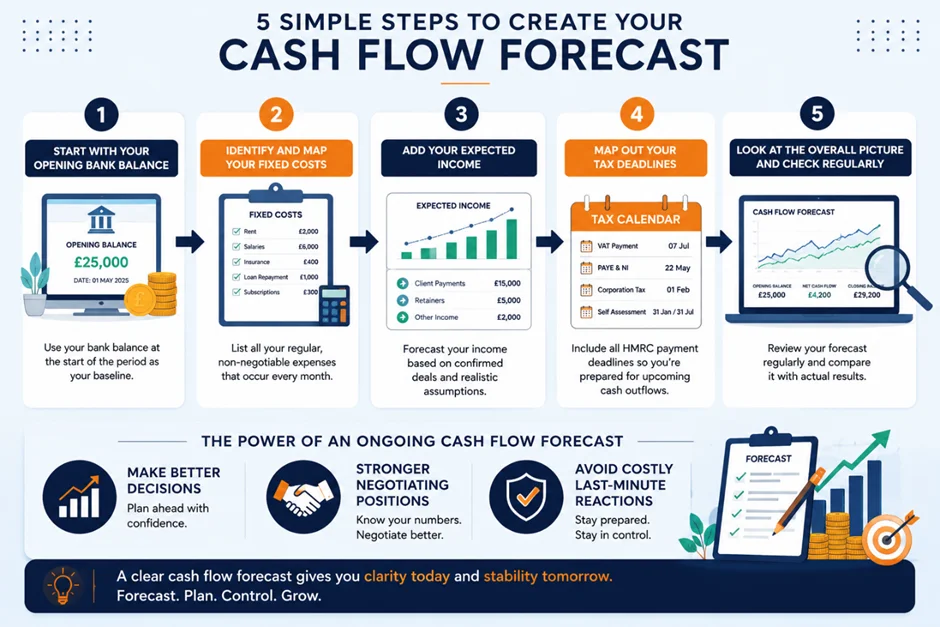
If your cash flow forecast is stale, inaccurate, or nonexistent, start rebuilding it today. And if you would like help with preparing forecasts or advice on tax, forecasting, or cash flow management, please get in touch with the Lanop team.
FAQs:
The direct method records actual cash inflows and outflows as they occur. This makes it best suited for short-term forecasting. The indirect method starts from net profit and adjusts for non-cash items, which suits longer-term strategic planning. Our accounting for managers service covers both approaches in the context of business decision-making.
Yes. Growth requires upfront spending on stock, staffing, and fulfilment before revenue arrives. Your forecast must clearly model this gap. Otherwise, rising sales can hide a worsening cash position.
Working capital is the difference between short-term assets, such as cash, stock, and unpaid invoices, and what you owe suppliers. Ignoring it will overstate your available cash, especially during periods of growth or seasonal stock buildup.
Overdrafts, revolving credit, invoice finance, and short-term working capital loans are the most common options. The earlier your forecast flags the gap, the better the terms you are likely to get.
Start with confirmed fixed costs, then build revenue only from signed contracts or realistic market comparisons, never targets. Cut your income assumptions by 20-30% and treat the first three months as a stress test. Our free downloadable guides include practical templates to help you get started.