
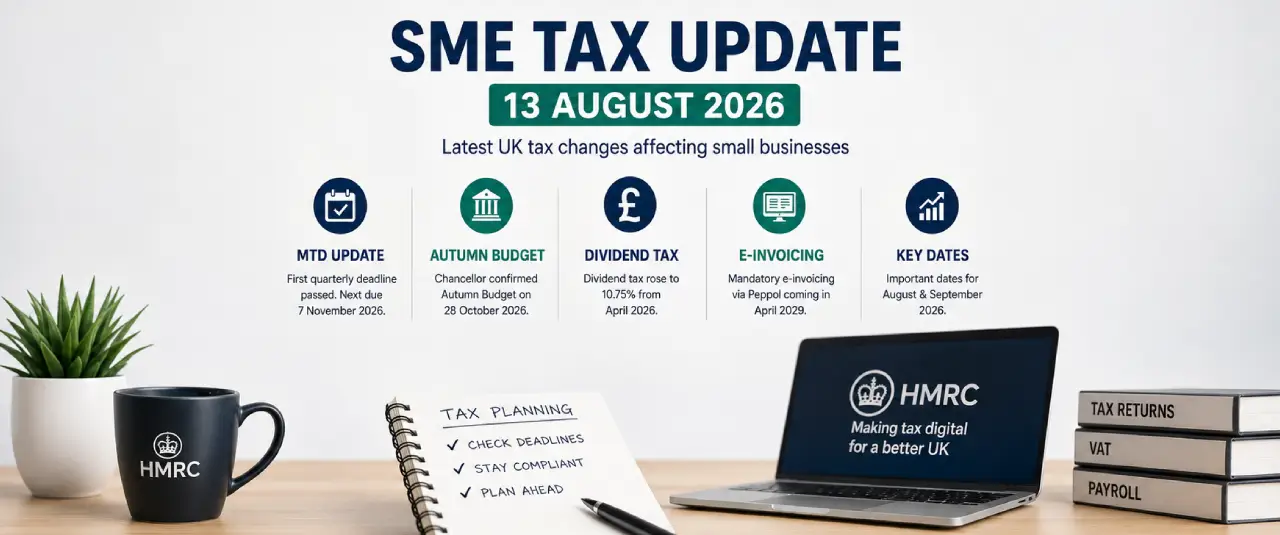
Tax-related activity is plentiful in August. There is a new UK Prime Minister, the Budget date is known to be in October, the first MTD quarter deadline has been passed, and a host of consultations are coming to an end which will define how businesses will pay taxes in the future.
Here is what small business owners need to know right now.
Key headlines this month:
- The first MTD quarterly deadline passed on 7 August. If you missed it, you still need to file before your Final Declaration
- Chancellor John Healey has confirmed the Autumn Budget for 28 October 2026, with tax changes for businesses expected
- Dividend tax rose to 10.75% from April 2026, directly affecting directors taking income through dividends
- Mandatory e-invoicing via the Peppol framework is coming in 2029, with the full roadmap due at the October Budget
Making Tax Digital: The Deadline Has Passed. Now What?
What happened on 7 August
The first quarterly MTD return in respect of Income Tax was due on 7 August 2026. It included income and expenses during 6 April to 5 July 2026 for sole proprietors and landlords who have gross income exceeding £50,000.
For those who submitted on time, the next deadline is 7 November 2026.
If you missed the 7 August deadline
Missing it does not make it disappear. All four quarterly updates must be filed before your Final Declaration can be completed. A missed update sits as an outstanding obligation and blocks the end-of-year process.
HMRC confirmed no penalty points will be issued for late quarterly updates during the 2026 to 2027 tax year. That grace applies to points, not to the submission itself. You still have to file it.
What is coming next in MTD
The threshold drops to £30,000 from April 2027. Eligibility for that wave is determined by 2025 to 2026 gross income, a tax year that has already ended. If you earn above £30,000 from self-employment or property combined, April 2027 is your start date.
From April 2028, the threshold falls to £20,000. Full details on Making Tax Digital for sole traders and landlords are on our site.
The October Budget: What We Know and What Is Speculation
What is confirmed
It is noted by Chancellor John Healey that the Autumn Budget of 2026 will be delivered on 28th October 2026. It is for the first time that Chancellor John Healey will deliver the budget after being made the Chancellor by the Prime Minister, Andy Burnham in July 2026.
One confirmed measure already announced: VAT on household electricity will be removed from October 2026. The government estimates this will save households around £45 per year. For businesses, this does not directly reduce operating costs as business electricity already sits outside domestic VAT relief.
Business rates for pubs, social clubs and live music venues are being reduced. A £2 cap on single bus fares in England arrives from January 2027.
What is speculation
Much of what is being discussed about the Budget is not confirmed policy. Tax commentators and economists have raised the possibility of changes to income tax, capital gains tax, property taxation and wealth-related levies. None of these are confirmed.
The NIESR flagged that Andy Burnham’s government spending commitments will require either additional revenue or real-terms departmental cuts. That pressure is real. But reacting to speculation before 28 October is not a useful tax planning approach.
The message from advisers consistently: wait for the Budget. Make decisions on confirmed law.
Dividend Tax Has Already Gone Up
The change that came in on 6 April 2026
The standard dividend tax rate increased from 8.75% to 10.75% for the 2026 to 2027 tax year. This was confirmed in the Autumn Budget 2025.
For directors of limited companies who take income partly as salary and partly as dividends, the increase has a direct effect on take-home pay. The higher rate on dividends above the basic rate band also went up.
What this means for director-shareholders
If you have not revisited your salary and dividend split since this change came in, it is worth doing. The optimal split between salary and dividends shifts when dividend rates change, particularly for those whose total income puts them into the higher rate band.
Reviewing your corporation tax position alongside your personal income structure makes more sense now than leaving it until January.
E-Invoicing: Coming in 2029, But Plan Now
What has been confirmed
On 23 June 2026, the UK government confirmed that the Peppol framework will serve as the interoperability network for mandatory business-to-business e-invoicing from April 2029.
Peppol is an international standard that allows different accounting systems to exchange invoice data directly, without going through a central government platform. HMRC confirmed invoices will flow through software providers, not a government hub.
The mandate initially targets VAT invoices for B2B and business-to-government transactions. A full implementation roadmap will be published at the November 2026 Budget.
What this means for small businesses now
No immediate action is required. The 2029 deadline gives reasonable preparation time.
However, for businesses that are using manual invoicing, emailed PDF files which have no structure, or billing via, the process of switching will be more challenging than for companies that have cloud accounting software installed. The time to prepare is now, not 2028.
Electronic Sales Suppression: HMRC’s Consultation Closes 18 August
What HMRC is proposing
HMRC has launched a consultation regarding the introduction of mandatory software standards for Electronic Point of Sale (EPS) and Point of Sale (POS) systems. This is intended to prevent the manipulation of electronic sales records in order to minimize the turnover recorded and hence the tax liability of the business.
The consultation closes on 18 August 2026.
Who needs to pay attention
This is directly relevant to retail, hospitality, market trading, and any business processing card or cash payments through a till or EPOS system. If your sector is cash-heavy or high-volume in transactions, the proposed software standards will affect the systems you can legally use.
Timely Payments: The Self Assessment Change Being Consulted On
What is proposed
HMRC is consulting on a “Timely Payments” model for Self Assessment taxpayers. The proposal would move more of a taxpayer’s annual liability into PAYE collection throughout the year, reducing the size of the January and July balancing payments.
For business owners and sole traders who also have PAYE income, this could significantly change cash flow planning.
When this might happen
April 2029 is the earliest possible implementation date. The consultation is still open and the proposal is at an early stage. But it is the direction of travel: HMRC wants tax collected closer to when it is earned, not in two large chunks annually.
Interest Relief: HMRC’s Guidance Has Changed
What HMRC updated
HMRC recently updated its Business Income Manual to cast doubt on the deductibility of interest on borrowing used to fund capital withdrawals from a business, even where the proprietor’s capital account remains in credit.
This is a technical but material change. For sole traders and partnerships that have taken capital withdrawals and funded them through borrowing, the interest previously claimed as a deductible business expense may no longer be allowable under HMRC’s current interpretation.
What to do
Should your company borrow for withdrawing capital and deducting interest thereon as allowable expenditure, such an arrangement needs reconsideration. This manual update from the HMRC is not changing any legislation; however, it shows what HMRC will do if asked about these deductions.
Key Dates for August and September 2026
- 18 August : HMRC Electronic Sales Suppression consultation closes
- 31 August : P11D forms for 2025 to 2026 due for employers reporting benefits in kind
- 7 November : Second MTD quarterly update deadline (covering 6 July to 5 October 2026)
- 28 October : Autumn Budget 2026
- 31 January 2027 : Self Assessment deadline for 2025 to 2026 tax year
Lanop’s team keeps small businesses current on HMRC changes as they happen, not just at year end. If any of the updates above affect your business and you want to talk through what they mean in practice, get in touch today. You can also find guidance on self assessment, VAT, payroll and corporation tax on our site.