
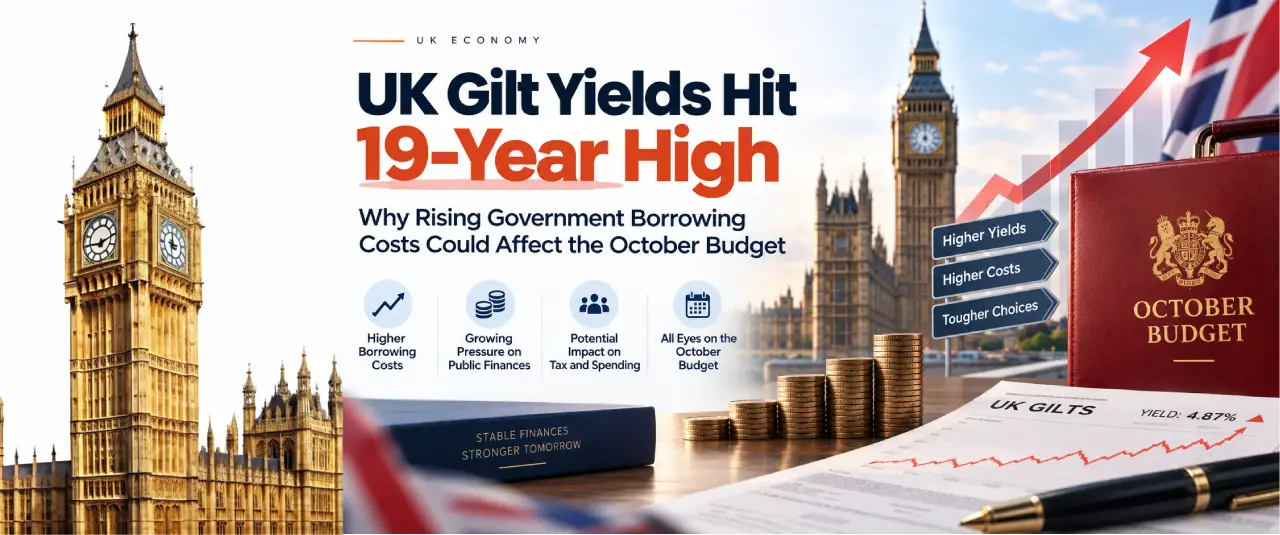
UK government borrowing costs have climbed to their highest level since the global financial crisis, adding fresh pressure to the public finances weeks before the Budget on 28 October 2026.
The 10-year gilt’s yield on 2nd September hit its highest point since August 2007, at 5.294%. Five-year yields also climbed to a five-year high for the first time since September 2023, with 30-year borrowing rates briefly climbing to a three-decade low for the first time in nearly three decades.
Bonds issued by the government to fund government expenses are known as gilts. In times of increased production, the government is typically forced to pay more for new borrowing and to refinance existing debt. The immediate concern is therefore not simply a movement in financial markets. It is the effect that persistently higher yields could have on the Chancellor’s room to make tax and spending decisions.
“Higher borrowing costs leave the Chancellor with less room to balance tax, spending and investment priorities.”
Why Borrowing Costs Have Risen
The latest move was part of a wider bond sell-off worldwide. A renewed conflict in the Gulf led to an ongoing upward trend in oil prices, adding to worries that inflation might stay high and interest rates may remain elevated.
Investors are also less keen on Government spending plans because of UK-specific fiscal problems, and doubts about the credibility of Government borrowing. After the Prime Minister’s assurance that the Government would stick to its fiscal principles, yields eased, but stayed at historically high levels.
The Bank of England has in the past indicated that long-term yields are influenced by several factors, such as the interest rates it expects, inflation, and the extra return on investment it expects for longer-term debt.
Less Room for Budget Choices
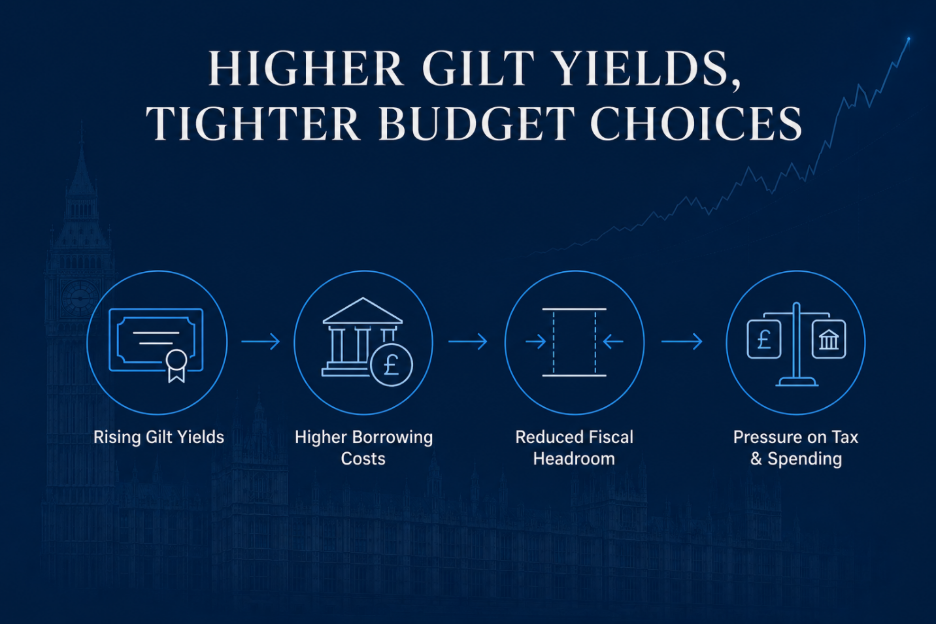
Higher yields do not increase the interest cost of every outstanding gilt immediately because much of the government’s debt carries a fixed rate. However, the effect builds as new borrowing is undertaken and maturing debt is refinanced.
Market economists cited by Reuters estimated that higher interest costs may have reduced the Chancellor’s fiscal headroom from £23.6 billion at the Spring Statement to approximately £13 billion. This illustrates how market movements can narrow the government’s room for manoeuvre ahead of the Budget.
Fact-check Note: The estimated £13 billion of remaining fiscal headroom is an external calculation reported by Reuters. It is not an official OBR forecast. The OBR’s updated economic and fiscal forecast will be published alongside the Budget on 28 October.
The Office for National Statistics reported that public sector borrowing reached £56.7 billion in the financial year to July 2026. Although this was £6 billion lower than during the same period last year, it was still £2.3 billion above the Office for Budget Responsibility’s forecast. Public sector net debt was provisionally estimated at 94.1% of GDP at the end of July.
What Businesses Should Watch
The Budget could involve difficult choices if the OBR concludes that debt-interest costs have materially weakened the fiscal outlook. Businesses should therefore monitor:
- Possible changes to business taxes, investment incentives or reliefs;
- Spending reductions affecting public contracts and local services;
- Higher financing costs for loans, property and investment;
- Any revisions to economic growth or inflation forecasts.
No specific tax increase or spending cut has yet been confirmed. Businesses should avoid acting on speculation, but scenario planning before the Budget would be sensible.
Preparing Before 28 October
Companies should review cash flow, borrowing arrangements, planned investment and exposure to possible tax changes. Decisions should remain flexible until the Budget documents and accompanying OBR forecast are published.
Lanop can help businesses assess how confirmed Budget measures affect tax liabilities, investment decisions and financial forecasts. Advice based on the final legislation and each company’s circumstances will be more reliable than reacting to market headlines alone.
Speak to our team to contact us for tailored Budget guidance.