
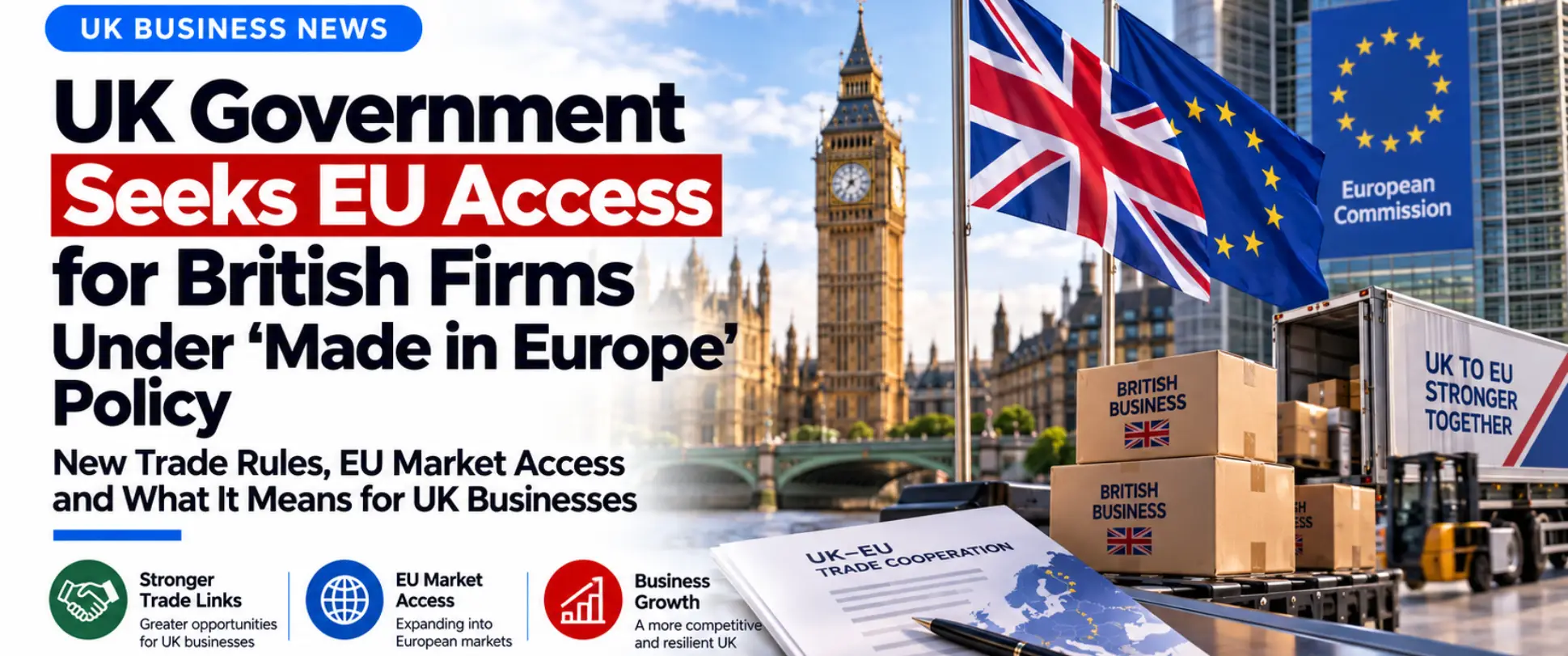
The UK Government is pushing for British companies to receive better treatment under the European Union’s proposed “Made in Europe” rules, as concerns grow over what the policy could mean for manufacturers with supply chains and customers across Europe.
This is especially true in the automotive industry, where UK and EU firms remain closely intertwined despite Brexit.
The European Commission published its Industrial Accelerator Act on 4 March 2026. This proposed legislation is designed to boost European manufacturing and stimulate demand for products made in Europe, including cars, steel, aluminium, cement, and net zero technologies.
| At a Glance | |
| EU proposal published | 4 March 2026 |
| Main policy | Industrial Accelerator Act |
| Areas affected | Cars, steel, aluminium, cement and net zero technologies |
| UK position | Seeking recognition for British products |
| Current status | Still under negotiation |
Why is the UK concerned?
Britain’s difficulty lies in how the proposed rules would favour certain products manufactured or assembled inside the EU.
The Commission wants “Made in EU” and low carbon requirements to play a greater role in selected public procurement contracts and public support schemes. For UK limited companies competing for business in Europe, the detail of those rules could make a considerable difference.
On 18 September, Reuters reported that Chancellor John Healey was preparing to raise the matter with EU finance ministers in Dublin. The UK wants to avoid fresh barriers for businesses operating through European supply chains and is seeking inclusion within the new framework.
This is not the first time the Government has raised the issue.
French President Emmanuel Macron and Prime Minister Andy Burnham discussed the strategy earlier this month. The PM said the plans would create difficulties for British business. Both leaders agreed on the need for a solution that safeguarded common interests.
Car manufacturers are looking closely
The automotive industry has been among the most vocal critics of the current proposal. When the plan was revealed, the Society of Motor Manufacturers and Traders (SMMT) warned that strict EU assembly and eligibility rules could work against UK-made vehicles and components.
Its concern is significant because the UK and EU automotive markets remain deeply linked. SMMT estimates the trading relationship is worth almost £70 billion a year, moving through logistics and distribution networks built without internal borders in mind.
In April, the organisation called for UK-built vehicles, components and batteries to receive equivalent treatment across relevant parts of the Industrial Accelerator Act. It argued that weakening the relationship would create costs on both sides of the Channel, including added customs clearance friction, rather than benefiting European manufacturers alone.
The UK–EU automotive trading relationship is worth almost £70 billion a year, according to SMMT estimates.
What does this mean for British businesses?
Nothing changes immediately.
The Industrial Accelerator Act is still a proposal. The European Parliament and the Council of the European Union must negotiate it before adopting it. The final rules may therefore differ from the version currently on the table.
That said, companies with substantial European operations should follow the negotiations closely, particularly where they already hold EU VAT registrations or trade through a local entity.
The questions are practical ones. Could a UK manufactured product qualify for an EU backed incentive? Would local content requirements affect where components are sourced? Could European procurement rules favour a competitor whose product is assembled inside the EU or make a European business registration commercially worthwhile?
For manufacturers making long term investment decisions, those details matter, and they often surface in group structuring and holding company reviews long before they appear in the accounts.
Key Facts — What Businesses Should Watch
▪ Changes to European content and assembly requirements
▪ Eligibility for incentives and public support, alongside existing UK reliefs such as R&D tax credits
▪ Treatment of UK-manufactured components
▪ Procurement rules affecting major customers
▪ Any UK–EU agreement reached before the legislation is finalised, and its effect on corporate tax positions
What happens next?
The next stage will be negotiation.
For the UK, the objective is not simply access to the European market, which British companies already have under existing trading arrangements. The more immediate question is whether UK goods can receive comparable treatment when the EU introduces new incentives and industrial support measures.
That distinction will determine how significant the “Made in Europe” policy ultimately becomes for British manufacturers and how much weight it carries in tax planning and statutory compliance decisions over the next two years.
How LANOP Can Help
For businesses operating internationally, changes in trade and industrial policy can have wider consequences for VAT, supply chains, business structures, and cross-border planning.
LANOP Business & Tax Advisors work with businesses to understand the tax and financial implications of operating across different markets and to plan for regulatory changes that may affect their commercial decisions. Our virtual finance director service supports companies that need board-level financial input without a full-time hire.
Get in touch with our team to discuss how the Industrial Accelerator Act could affect your business or explore our full range of accounting and tax services.