

Could moving to Greece cut your tax bill, or create unexpected costs? That question sits behind most enquiries about Greece Article 5A.
The rule lets new Greek tax residents pay one fixed charge on their foreign income. The charge is €100,000 a year. In return, you invest at least €500,000 in Greece. If you live in the UK, HMRC adds another layer. This guide shows how the rules work, what they cost, and where they can go wrong.
Quick Answer: Greece Article 5A lets qualifying new tax residents pay €100,000 a year on all foreign-source income for up to 15 years. You must not have been a Greek tax resident in seven of the last eight years. You must also invest €500,000 in Greece within three years of applying. Each relative costs €20,000.
What changed in 2026? Law 5313/2026 removed the fixed 31 March application date. AADE Decision A.1147/2026, dated 17 July and corrected in August, set the new process. Payment is now a single installment due in December.

What Is Greece Article 5A and How Does the €100,000 Flat Tax Work?
Article 5A is a Greek tax regime for newcomers with large incomes abroad. You pay a fixed €100,000 each year, no matter how much you earn overseas. The Greek tax authority, AADE, says it aims to attract capital and jobs.
Advisers call it the Greece 100000 flat tax. It is the best-known Greek tax regime for wealthy individuals. You first become a Greek tax resident. Article 5A then changes how Greece taxes your income abroad.
What Income Does Greece’s Flat Tax Cover?
The Greek flat tax covers income that arises outside Greece. Think foreign dividends, interest, gains, and rent. You do not have to declare that income on your Greek return.
Income earned in Greece follows ordinary Greek rules.
How Long Can You Benefit from Article 5A?
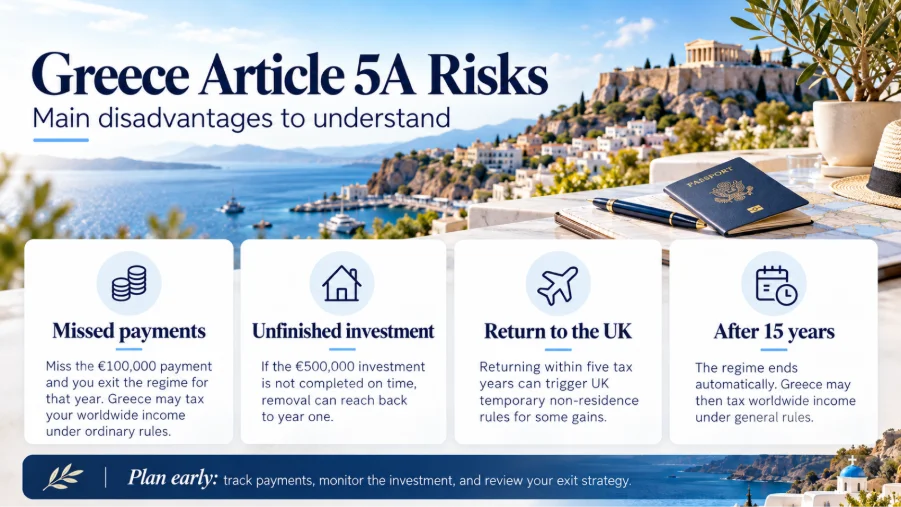
The Greece flat tax duration is 15 tax years in total. The regime then ends automatically, and AADE cannot extend it.
Article 5A is not the Golden Visa. That is an immigration permit with separate rules.
Who Qualifies for Greece Article 5A in 2026?
You qualify if you pass two tests. You were not a Greek tax resident in seven of the previous eight years, and you invest at least €500,000 in Greece.
What Are the Greece Article 5A Eligibility Requirements?
The Greece Article 5A requirements are short but strict. AADE checks its own records for the residence test. First-time applicants for a Greek tax number need no extra proof.
Otherwise, you may need a certificate of residence or a copy of your tax return for the missing years. Nationality does not matter.
Do You Need to Live in Greece for 183 Days?
Not always, but you must first become a Greek tax resident. Greece tax residency requirements come from Article 4 of the Income Tax Code. Broadly, you qualify if you spend more than 183 days in Greece in 12 months. You can also qualify if your home or main life interests sit there.
So, 183 days is one route, not the only one. AADE treats residence as separate from your application. Keep a lease, bills, and travel records.
What Are the €500,000 Investment Requirements for Article 5A?
You must invest at least €500,000 in Greece. This sits apart from the annual tax. It is the heaviest of the Greek flat tax requirements, so plan it early.
Which Investments Qualify for Greece’s Flat Tax?
AADE lists four broad types: Greek real estate, Greek businesses, transferable securities, and shares or units in Greece-based entities. You can invest yourself. A spouse, parent, or child can invest on your behalf. So can a company in which you hold a majority.
The 2020 ministerial decision also applies the holding period and reporting rules. When you apply, you must show that you moved the €500,000 into a Greek bank account.
What Happens If You Cannot Complete the Investment?
You have three years from your application date. Ask AADE to confirm completion within six months of finishing.
If you miss it, AADE removes you from the regime and returns you to your first year. Greece then taxes your worldwide income under ordinary rules. Your Greek tax still cannot fall below €100,000 a year. Payments already made are not refunded.
What Foreign Income Is Covered by Greece’s €100,000 Flat Tax?
The Greece flat tax foreign income rule is broad. Almost everything that arises outside Greece sits inside the €100,000. Greek source income stays outside it.
Are Foreign Dividends and Capital Gains Covered?
Yes, if the income arises abroad. Greece’s flat tax dividends from overseas companies fall inside the payment. So do Greece flat tax capital gains on foreign assets, such as shares in a UK company.
Greek dividends and gains on Greek assets follow normal rules.
What Happens to Overseas Rental Income, Pensions and Employment Income?
Foreign rent and foreign pensions count as foreign-source income. So does pay for work you carry out abroad. Pay for work you do in Greece does not. Rent from a Greek property does not either, and for UK landlords this is worth reviewing alongside your wider landlord accounting position.
Can Other Countries Still Tax Your Foreign Income?
Yes. Many investors miss this point. Greece gives no credit for tax you pay abroad on covered income. A 15% withholding tax overseas is therefore a real extra cost. The €100,000 settles Greek tax only.
How Much Does Greece Article 5A Really Cost?
The headline figure is €100,000 a year, plus €20,000 per relative. The true cost also includes your investment and foreign tax.
What Is the Total Annual Flat Tax Cost?
The Greece flat tax cost is due in one installment, by the last working day of December. You cannot pay in parts or offset it against other Greek tax. Before 2026, the date fell in July. Add investment costs, such as purchase taxes and legal fees.
How Much Does Article 5A Cost for Family Members?
The Greece flat tax cost for family members is €20,000 per relative. Relatives are your spouse and direct-line family. Each needs a request and written consent.
Unmarried minor children living with you are different. Greece treats them as sharing your residence. They need no application and owe no €20,000. At 18, they can ask to join if they have foreign income.
When Is the €100,000 Flat Tax Financially Worthwhile?
The main benefits of Greece’s flat tax are certainty, no declaration of covered foreign income, and no Greek inheritance or gift tax on foreign movable assets. But certainty is not always cheap.
Take a hypothetical example. You earn €750,000 a year from overseas dividends. The flat tax equals about 13% of that income. Now suppose your dividends already suffer 15% tax at source. That is €112,500, and Greece gives no credit. Your total becomes €212,500, or about 28%.
Greek law taxes some investment income lightly. Compare each income stream under both systems, ideally as part of wider tax planning before you commit.
How to Apply for Greece Article 5A in 2026
The Greece flat tax application process now follows AADE Decision A.1147/2026. Apply to AADE’s tax service canter, called KEFODE, in Attica or Thessaloniki. In practice, the steps run like this:
- Become a Greek tax resident and note your arrival date.
- Get a Greek tax number and open a Greek bank account.
- Move at least €500,000 into that account.
- Collect residence evidence, with apostilles and translations.
- Submit through my AADE, or by post, courier, or in person.
- Add missing papers by 31 October of that year.
- AADE decides within 60 days, by the end of November at the latest.
- Pay by the last working day of December.
What Documents Are Required for an Article 5A Application?
Expect to provide the application, proof of the €500,000 transfer, and evidence of residence for years AADE cannot verify. Relatives need proof of the relationship and written consent.
Foreign documents usually need an apostille and certified translations. Start early, because overseas authorities can be slow.
What Is the Greece Flat Tax Application Deadline?
The Greece flat tax deadline is 30 September of your arrival year or the year after. If you became a tax resident by 2 July, you may apply in either year. If you arrived after 2 July, you apply for the following year.
What Happens If You Miss the Application Deadline?
As of 8 October 2026, the 30 September 2026 deadline has passed. If you arrived in 2026, you may still have until 30 September 2027. If you arrived earlier, both windows may already have closed.
Do not assume AADE will accept a late filing. Check your exact dates with an adviser.
Can UK Residents Benefit from Greece Article 5A?
Yes, but Greek approval does not end your UK tax residence. The Greece flat tax for UK residents works only if you actually leave the UK for tax purposes. Greece decides who is a Greek resident. HMRC decides who a UK resident is. Both can claim you at once.
Can HMRC Still Tax You After Moving to Greece?
In some cases, yes. HMRC taxes non-residents on UK-source income, such as UK rent and UK property gains, which will usually still need reporting through Self Assessment.
How Do UK Tax Residency and Double Taxation Rules Apply?
UK residence depends on the Statutory Residence Test. It has automatic overseas tests, automatic UK tests, and a ties test. In the year you leave, split-year treatment may apply. If both countries treat you as resident, the UK-Greece tax treaty tie-breaker decides, based on your permanent home and personal ties. Treaty relief for people on lump sum regimes is not guaranteed, so check it first.
Staying UK resident does not help. Since April 2025, UK residents pay tax on foreign income as it arises. Only qualifying new arrivals get four years of relief.
What Happens If You Keep a UK Home or Business?
A UK home available to you can pull you back into UK residence and weaken your treaty position.
Inheritance tax needs care too. The UK keeps a tail of three to ten years after you leave. Greece exempts foreign movable assets, but UK inheritance tax may still apply during that tail. Our inheritance tax planning and estate planning team can model this for you.
What Happens to Your UK Company, Investments and Property?
Your UK company stays a UK company. What changes is how you take money out and where you run it.
Can You Own and Manage a UK Limited Company from Greece?
You can own shares from Greece. Dividends you receive are your income as a shareholder. The UK limited company still pays UK corporation tax on its profits.
Managing the company from Greece carries more risk. Greek authorities could argue that control sits there, or that you created a permanent establishment, a document where key decisions happen. Our offshore and international accounting team can help with reporting.
How Are UK Dividends, Property Income and Investments Treated?
UK dividend rates rose on 6 April 2026 to 10.75% and 35.75% for basic and higher rate payers. But temporary non-residence rules also tightened from 6 April 2026. If you return within five years, the UK can tax some income and gains from your time abroad.
UK rental income stays taxable in the UK. Property income rates rise to 22%, 42% and 47% from April 2027. Existing ISAs keep their status, but non-residents cannot add new money.
Is Greece’s €100,000 Flat Tax Right for You?
It suits a narrow group. Total tax, residence, income source, and investment risk decide.
Who Is Most Likely to Benefit from Article 5A?
Greece flat tax eligibility matters, but fit matters more. The regime tends to suit:
- Wealthy investors with large foreign income that is taxed lightly at source
- UK entrepreneurs whose overseas companies pay sizeable dividends
- Families planning a long-term life in Greece
When Might the Greek Flat Tax Not Be Worthwhile?
Think twice if any of these apply:
- Your foreign income is modest, so €100,000 takes a large share.
- You cannot or will not lock €500,000 into Greek assets.
- You expect to return to the UK within a few years.
Is Greece Article 5A the Right Tax Strategy for You?
Article 5A suits investors with large foreign income, real plans to live in Greece, and money ready to invest. It suits fewer people than the headline suggests.
If you are a resident of the UK, you need to consider your HMRC position before relocating. Relocation does not automatically cancel UK tax obligations. Consider your full tax obligations, including not only the €100,000 but also your foreign withholding tax obligations and your UK investment and exit tax rules. Analyse these in conjunction with your income and investment situation.
The importance of cross-border advice is greatest if you have any interests in a UK company, UK property, or a sizable estate.
Relocating to Greece? Our team can analyse your UK tax situation, evaluate your income and investments and assess any cross-border tax issues for you. Contact us today to speak to our team before you make any major decisions.
Frequently Asked Questions
Yes. Property is one option. Shares in Greek companies and Greek listed securities can also qualify. You still need €500,000 of qualifying investment, completed within three years.
Possibly, if the gains count as foreign-source income; where a crypto gain arises is a question of fact. Take advice before you sell.
Not for income covered by the flat tax. You still declare Greek-source income as normal. Keep records for UK filings.
No. Each relative costs €20,000 and needs a request plus consent. Unmarried minor children living with you are covered without a fee. Their own foreign income needs a separate request.