
Business Setup in Saudi Arabia for UK Companies and Investors
Saudi Arabia is opening new doors for foreign investors and UK businesses looking to expand. But entering a new market involves more than registering a company. You need to understand foreign ownership rules, secure the right approvals, and prepare for local tax obligations. Lanop helps you assess your options, plan your investment, and manage the financial requirements of establishing a business in Saudi Arabia.
- Choose the right business structure and ownership model.
- Plan company registration, licensing, tax and accounting together.
- Keep your UK and Saudi business obligations aligned.

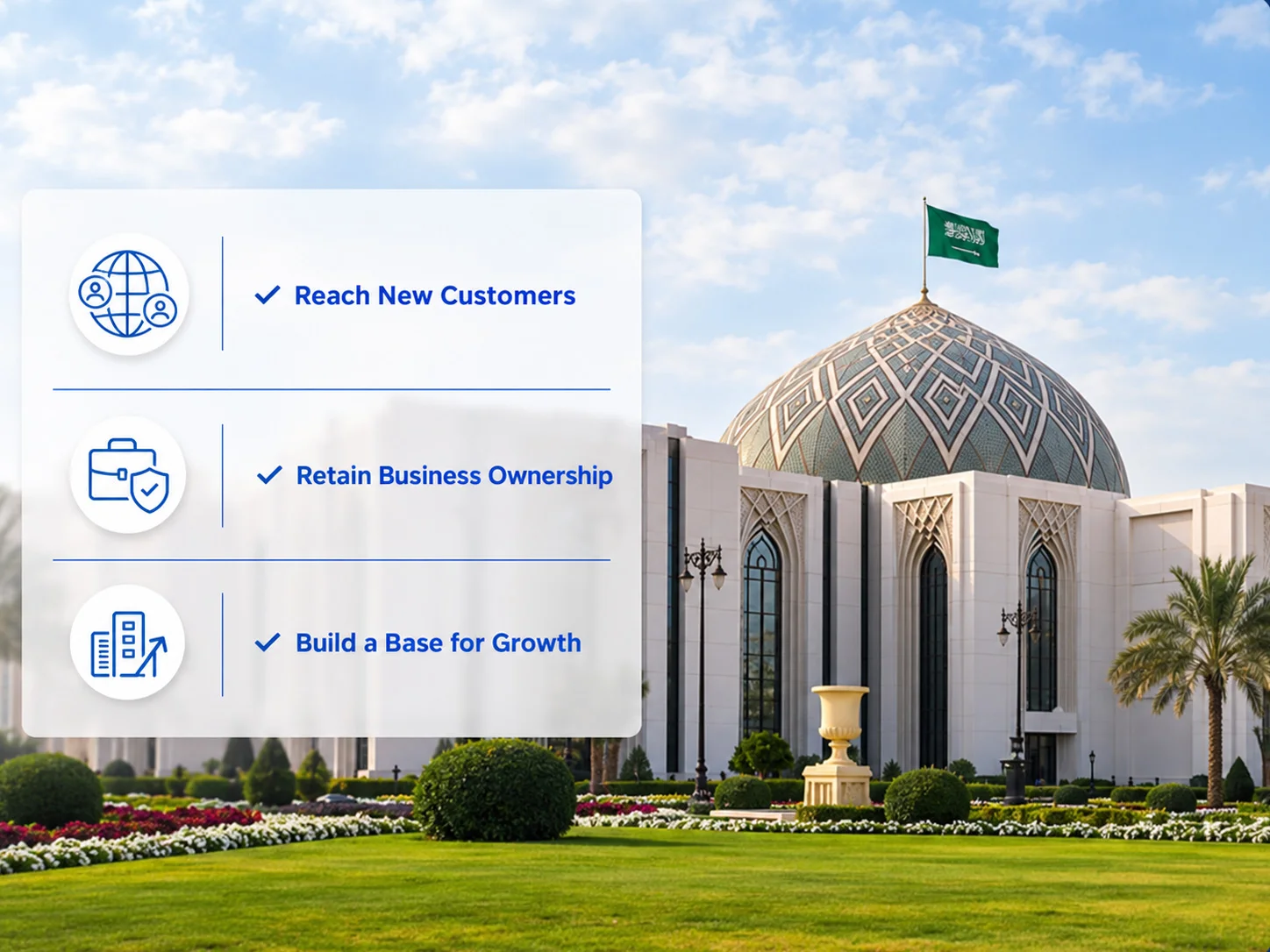
Why Saudi Arabia Deserves a Place in Your Business Expansion Plans
1. Reach New Customers in a Growing Economy
Saudi Arabia’s Vision 2030 is opening doors in technology, tourism, healthcare, logistics, and infrastructure. If you run a UK business, a local setup can put you closer to Saudi customers and new contracts. Demand for specialist services is also rising. Being on the ground helps you build relationships and respond quickly to what the market needs.
2. Expand Without Giving Up Business Ownership
Many sectors allow 100% foreign ownership. That means eligible UK investors can set up and control their own Saudi company, with no local shareholder to answer to. You make the business decisions. Some activities do come with restrictions or investment conditions, so check those before you commit.
3. Establish a Local Base for Long-Term Growth
A Saudi base puts you near regional clients, suppliers, and commercial partners. The country’s location and transport links also make it easier to trade across the Gulf. If you want more than one-off projects, a local presence can help you build lasting customer relationships and plan your next stage of growth.
How Lanop Helps Businesses in France
Explained in 60 Seconds.
Before You Invest in Saudi Arabia: 5 Things Worth Checking
Saudi Arabia offers real growth potential, but setting up a company takes careful planning. These five checks can help you avoid costly mistakes.
What Changes When You Start Trading in Saudi Arabia?
Running a Saudi business brings new tax, payroll, and reporting duties, especially if you operate in the UK.
Saudi Arabia vs UK: What Changes for Your Business?
SAUDI ARABIA BUSINESS ENVIRONMENT
20% Corporate Income Tax
Standard rate on applicable non-Saudi ownership interests.
- 15% standard VAT on taxable supplies.
- Zakat may apply to qualifying Saudi or GCC ownership.
- Certain overseas payments may attract withholding tax.
- Local accounting, e-invoicing and tax filing rules apply.
UK BUSINESS ENVIRONMENT
19%–25% Corporation Tax
UK companies must consider overseas profits and cross-border tax exposure.
- UK-resident companies are generally taxed on worldwide profits.
- Saudi branch profits may remain subject to UK tax unless an exemption applies.
- UK–Saudi tax treaty relief may reduce double taxation.
- Saudi subsidiaries may trigger UK group reporting and controlled foreign company rules.
What Does Our Saudi Business Setup Service Cover?
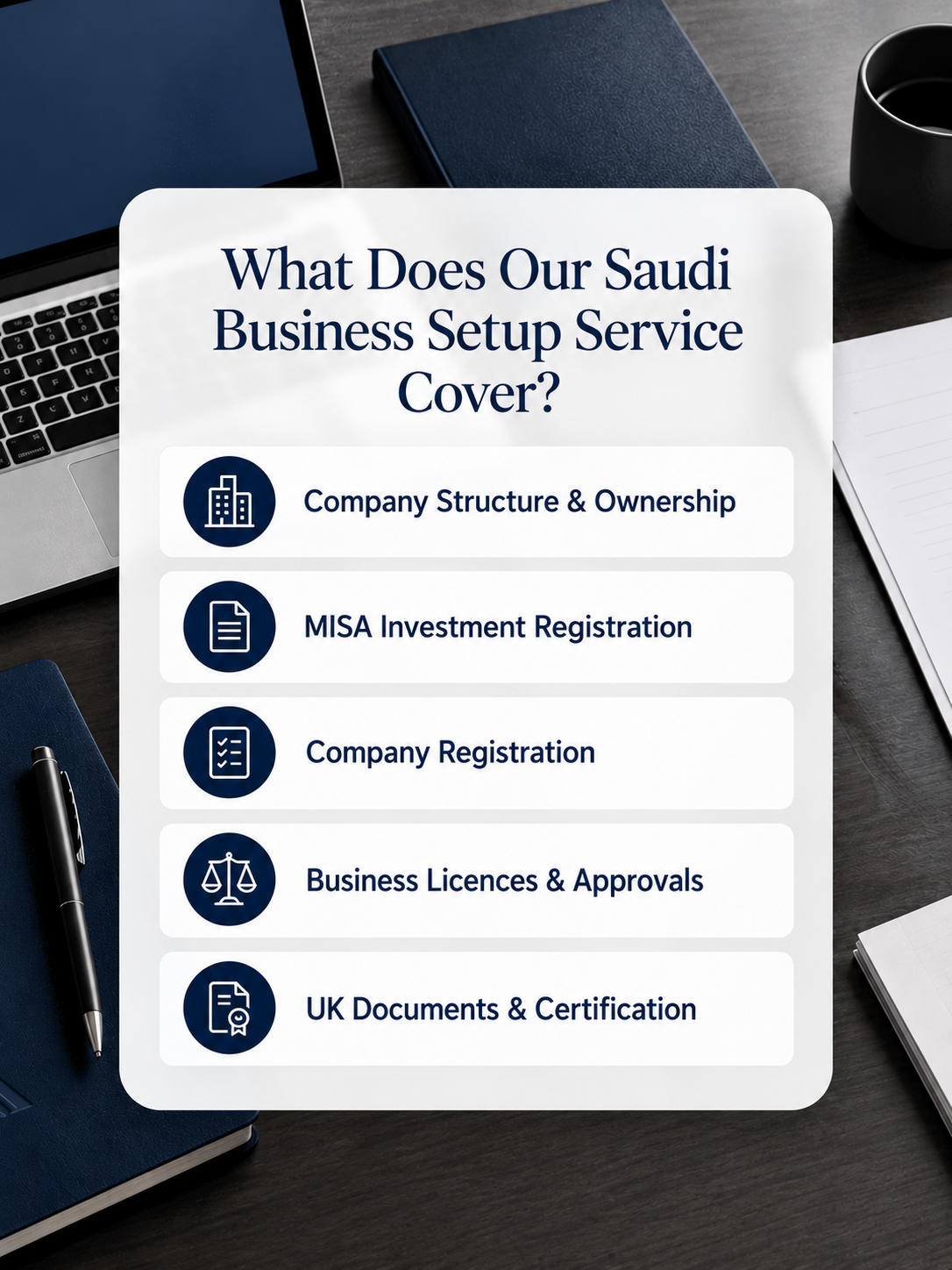
Are you planning to establish an LLC, branch, or subsidiary in Saudi Arabia? We can help you compare various structures and evaluate the requirements for foreign ownership.
Foreign investors may need to register with MISA before forming a company. We help you check eligibility, prepare the required documents, and understand the registration process.
For your Saudi business to be properly set up, you need the appropriate documentation for legal and commercial registration. We guide you through the requirements, from shareholder details to company formation paperwork.
Every business activity has its own approval requirements. Our team helps you identify the business licences, permits, and sector-specific approvals that may apply to your activities in Saudi Arabia.
Setting up through a UK company may require certified corporate records and financial statements. We help you identify and organise the documents needed for your Saudi application.
You may need a registered Saudi address and a local business bank account. We help you understand the premises, identification, and banking documents required for your business setup.
The cost of setting up a business in Saudi Arabia goes beyond registration fees. We help you plan for capital requirements, licences, office expenses, and initial operating costs.
Your ownership and activities affect your Saudi tax obligations. We help you assess corporate income tax, Zakat, VAT registration, and the records your business must maintain.
Keeping your UK business while expanding into Saudi Arabia raises new tax questions. We help you review cross-border payments, profit reporting, and potential double taxation issues.
Moving to Saudi Arabia or hiring local staff brings further requirements. We help you understand residency, payroll, Saudisation, and ongoing reporting needs, coordinating specialist support where required.
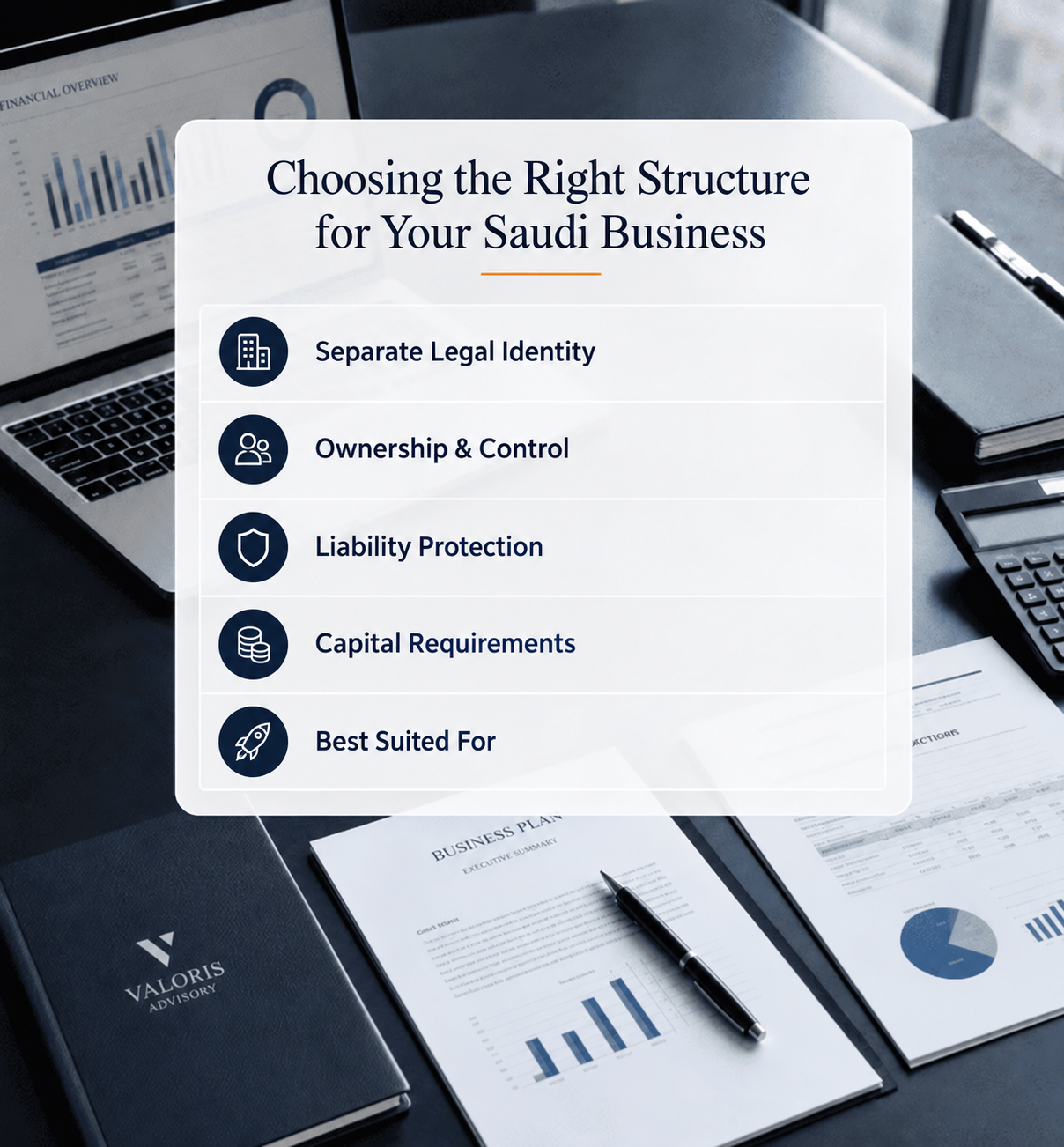
Choosing the Right Structure for Your Saudi Business
A Saudi LLC is a separate legal company. It can operate independently or serve as a subsidiary of your existing UK business.
Eligible foreign individuals and UK companies can own 100% of a Saudi LLC. Ownership rights depend on the business activity and applicable investment rules.
Shareholders are generally liable only up to their capital contributions. This helps protect personal or parent-company assets, subject to legal exceptions.
There is no fixed minimum capital for every Saudi LLC. Some activities require specific investment amounts or financial conditions before approval.
Ideal for UK entrepreneurs establishing a new business or UK companies seeking a separate Saudi subsidiary for long-term growth.
A Saudi branch operates as part of your existing UK company. It has no separate legal identity, unlike a Saudi LLC.
Your UK parent company retains full control of the branch. Business decisions, management, and financial responsibilities remain linked to the parent company.
Your UK company remains directly responsible for the branch's debts and obligations. There is no separate corporate liability shield.
Capital requirements depend on your approved business activities and investment conditions. Certain sectors may require additional funds or regulatory approvals.
Suitable for established UK companies expanding directly into Saudi Arabia without creating a separate subsidiary, subject to relevant registration requirements.
How Lanop Takes Your Saudi Business from Planning to Operation
Phase 1 Includes
- 1We start with your goals, your investment plans, and the Saudi market opportunities that suit them.
- 2Next comes a look at your UK company. Should you set up an LLC, a subsidiary, or a branch?
- 3We check if you’re eligible for foreign ownership, plus any activity restrictions and capital requirements.
- 4Before you invest, you’ll know the likely setup costs and how UK and Saudi tax rules apply.
PURPOSE:
To help you choose the right way into Saudi Arabia before you commit your time, money, or team.
Phase 2 Includes
- 1Your UK company documents need certification and Arabic translations, so we prepare those first.
- 2We then handle MISA investment registration, commercial registration, and any licences your business needs.
- 3Saudi Arabia also expects a registered address and a bank account. Some sectors need extra approvals too.
- 4You’ll have a plan for corporate tax, Zakat, VAT registration, and your first accounting needs.
PURPOSE:
To move your business through each registration and approval step, with as few delays as possible.
Phase 3 Includes
- 1If you’re relocating, we map out the residency and work authorisation options.
- 2Hiring locally brings payroll, social insurance, and Saudisation duties. We help you prepare for each.
- 3Your bookkeeping, e-invoicing, tax filings, and financial reports get set up properly from day one.
- 4Payments between the UK and Saudi Arabia, transfer pricing, and ongoing cross-border tax duties are reviewed as well.
PURPOSE:
To get your Saudi business running while you keep finances and compliance under control.
Who Should Consider Establishing a Business in Saudi Arabia?
Saudi Arabia is rapidly changing its economy. Large development projects, growing industry, and private investment are driving the shift. For UK businesses, the real question is where their expertise, products, or capital match actual demand.
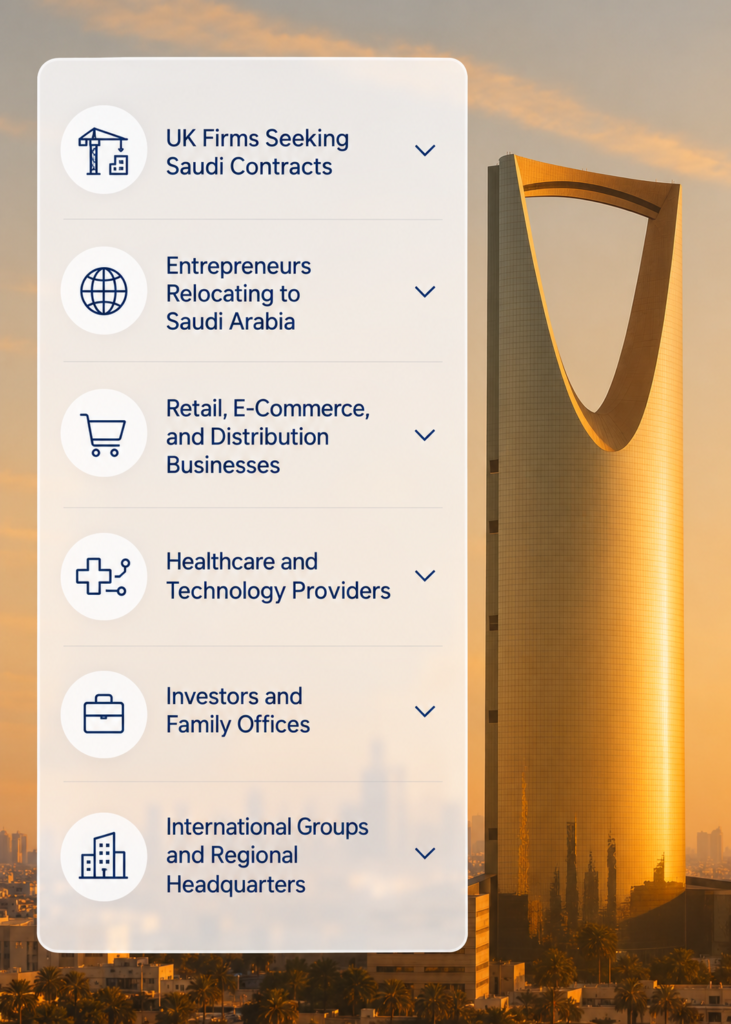
Best for: Engineering, construction, infrastructure, and project management firms.
Saudi projects often ask for local delivery, local staff, and local suppliers. Having a presence in the country makes it easier to bid for contracts and run projects on the ground. You can also deal with clients directly. Tender rules still apply, though.
Best for: UK business owners, independent founders, and high-net-worth entrepreneurs.
Moving to run a business in Saudi Arabia isn’t just about setting up a company. Start with your residency status. Then look at how the business will be managed while you’re there, and what the move means for your UK tax position.
Best for: UK retailers, consumer brands, online sellers, and importers.
Selling into Saudi Arabia can mean product approvals, Arabic labelling, customs registration, and local fulfilment. Sort these out early. If you don’t, you risk delays, unexpected costs, and stock sitting at customs.
Best for: Healthcare operators, medical technology companies, software firms, and digital service providers.
Saudi Arabia is expanding its healthcare services and digital infrastructure. If you’re a UK firm entering these markets, check sector licences, data protection rules, and professional approvals before you offer any services.
Best for: High-net-worth individuals, private investors, and family-owned investment groups.
Buying into a Saudi company? Check what you’re getting before you pay. Go through the accounts. Confirm who really owns the business, what debts it carries, and whether its licences are current. A solid due diligence review won’t remove all risk, but it will show you where the risks sit.
Best for: Established UK companies and multinational groups managing operations across the Gulf.
Some groups use Saudi Arabia as the centre for regional management, procurement, and corporate teams. If the Regional Headquarters programme interests you, read its rules first. Eligibility, licensing, and operating requirements are all set out there, and they could shape your whole plan.
FAQs: Business Setup in Saudi Arabia from the UK
Can a foreigner start a business in Saudi Arabia?
Yes, foreign investors can. You’ll need to meet the investment rules and make sure your sector is open to foreign ownership. How you apply depends on who is investing: a foreign company or an individual.
Can I own 100% of a business in Saudi Arabia?
Often, yes. Many approved activities allow full foreign ownership, so you don’t need a Saudi shareholder. But not every sector works this way. Some set minimum investment amounts, add restrictions, or require a local participant.
Do I need a Saudi partner to set up a company?
Not always. Plenty of foreign-owned companies operate on their own. What decides it is your business activity, your investment category, and the regulations that cover both.
Should I set up a Saudi LLC or open a foreign branch?
A Saudi LLC is a separate legal entity, and it generally caps what shareholders can lose. A branch is different. It’s an extension of your overseas parent company, not a standalone business. So the better fit comes down to ownership, risk, and where you want to take the business next.
Can I start a small business or online business in Saudi Arabia?
Yes, as long as your activity and investment route meet Saudi requirements. Online sellers may also need to follow e-commerce rules, protect consumers, and hold the right commercial registrations. Running a small foreign-owned venture? Check your eligibility and capital requirements before anything else.
How do I register a business in Saudi Arabia?
Start by confirming your business activity and investment eligibility. Foreign investors generally complete MISA investment registration, establish the legal entity, obtain commercial registration, and secure any additional sector approvals before trading.
How much does it cost to set up a business in Saudi Arabia?
There is no fixed setup cost for every business. Your budget depends on the activity, company structure, registration fees, required capital, office space, and professional services. Ongoing operating costs should also be included.
How do I get a business licence in Saudi Arabia?
First, identify the activity you intend to carry out. Complete the applicable investment and commercial registration steps, then obtain any sector-specific licences. A commercial registration alone may not authorise every business activity.
How long does company formation take in Saudi Arabia?
MISA lists an estimated 10 working days for its standard investment registration service. However, full company formation can take longer due to document checks, commercial registration, banking, and sector approvals.
What business taxes apply in Saudi Arabia?
A general 20% corporate income tax applies to relevant non-Saudi ownership interests, while Zakat may apply to qualifying ownership. Standard VAT is 15%, with mandatory registration generally triggered at SAR 375,000 in annual taxable supplies. Special rules and exceptions apply.
Can I set up a Saudi business while living in the UK?
Yes, you can. If you’re an eligible overseas investor, you can complete some of the registration steps online. You’ll still need to sort out banking, local representation, and how the business will run day to day. And owning a Saudi company doesn’t mean you have to move there.
How can Lanop help UK investors set up a business in Saudi Arabia?
We help you look at your options before you commit. That includes company structures, foreign ownership rules, registration steps, and setup costs. We also walk you through tax planning and your financial duties, so you feel ready to start trading in Saudi Arabia.
Does Lanop provide ongoing tax and accounting support after company formation?
Yes. We can help you plan your bookkeeping, VAT, financial reporting, and UK–Saudi tax duties. We look at both markets together, so our support doesn’t stop once your company is registered.
Will my UK company face double taxation after Saudi expansion?
It depends on how you set up your Saudi operations and where your profits arise. The UK–Saudi double taxation treaty may give you some relief. But you’ll need to check how it applies to your branches, subsidiaries, and cross-border payments.
Do UK company documents need Arabic translation for Saudi registration?
Often, yes. Some applications ask for authenticated UK company records, financial statements, and Arabic translations of your supporting documents. The rules change depending on your registration route. Before you apply, check which language and certification process the authorities accept.