
A lot of UK expats feel stuck. They know they need to move. But they worry about HMRC. They wonder if Cyprus is safe. And they have no idea where to start.
The good news is that the Cyprus non-dom tax regime is still one of the best options in 2026. It is legal. It is well-structured. And it can work very well for the right person.
But it only works if you do it properly.
This guide walks you through the 17-year rule, the Cyprus 60-day rule, how your income gets taxed, what HMRC can do, and whether Cyprus still makes sense for you. What Is the Cyprus Non-Dom Tax Regime?
What Is the Cyprus Non-Dom Tax Regime?
What Non-Dom Status Means in Cyprus
Non-dom status in Cyprus splits two things apart. Where do you live? And where your roots are. You can live in Cyprus and pay tax there without being classed as a permanent local. That gap is where the big tax perks come in.
Most UK expats have no ties to Cyprus at all. That means they can get non-dom Cyprus status quickly.
Tax Residency vs Domicile: What Is the Difference?
Tax residency is about where you live. It is about your day count and your home.
Domicile goes deeper. It is about your roots. Your family links. Your long-term plans.
You can be a Cyprus tax resident and still not be domiciled there. That is the core of the Cyprus non-dom regime. It is why the tax rules are so favourable.
Why UK Expats Choose the Cyprus Non-Dom Regime ?
The UK has cut back its own non-dom rules sharply in recent years. Many people who used to benefit have lost their tax breaks. Cyprus non-dom rules are still clear and stable. Foreign passive income, such as share payouts and interest, can be fully tax-free. For business owners and investors, that is a big win.
Key Tax Benefits of Cyprus Non-Dom Status
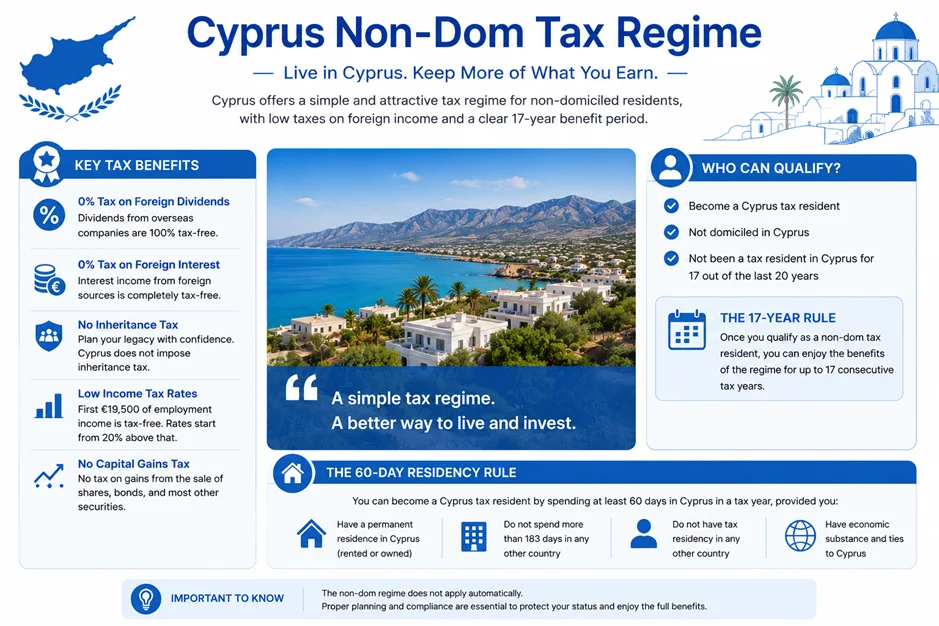
- 0% tax on foreign share payouts (dividends)
- 0% tax on foreign interest income
- No inheritance tax in Cyprus
- No wealth tax
- The first EUR 19,500 of income is tax-free
- Income tax on Cyprus work income starts at 20% above EUR 19,500
- No capital gains tax on most shares and bonds
Who Can Qualify for Cyprus Non-Dom Status
You can qualify if you become a Cyprus tax resident and have not lived in Cyprus for 17 of the last 20 years. Most UK expats meet this test with ease. You have no Cyprus roots. You just need to set up your stay the right way.
Cyprus Non-Dom Tax Benefits in 2026
Tax-Free Foreign Dividends
This is the top perk of the Cyprus non-dom dividend rule. Foreign share payouts are fully free of tax. You pay no income tax. You pay no defence tax either. If you own shares in UK or global firms, those payouts reach you with no Cyprus tax bill.
Tax on Foreign Interest Income
The same rule applies to interest. Cyprus non-dom tax on foreign interest is zero. Interest from savings, bonds, or other foreign assets is free from the defence tax. This is a big saving if you have a large portfolio.
Cyprus Non-Dom Tax on Foreign Income
The Cyprus non-dom foreign income rules need care.
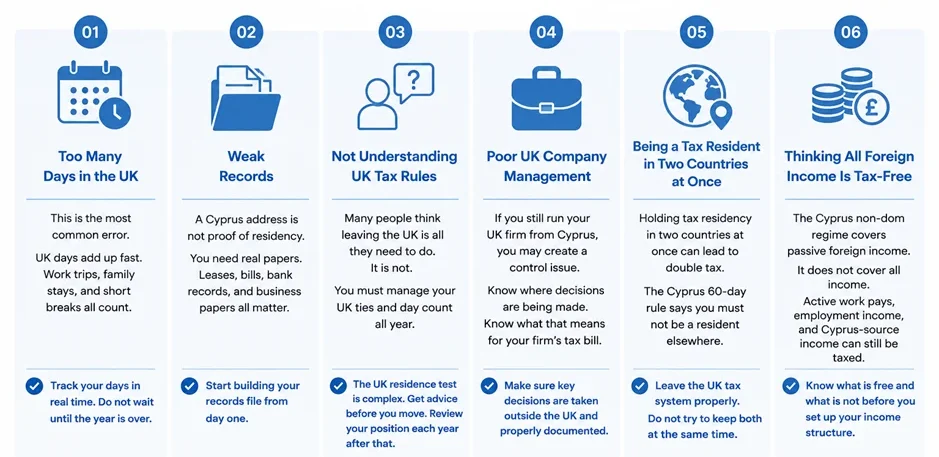
Passive income from abroad, such as payouts and interest, is usually tax-free. But income from work abroad or an active business may not be. Always get advice on your own income type. The rules depend on your exact setup. Proactive tax planning before you move can save you from costly mistakes later.
Capital Gains Tax Rules for Non-Doms
Cyprus does not tax gains from selling shares, bonds, or other paper assets. That is a huge plus for investors. Property is a different story. Gains on Cyprus land and homes can be taxed. But gains on land you own abroad are usually outside the Cyprus tax net.
What Income Is Still Taxable in Cyprus
Not all income is free. Here is what can still come with a tax bill:
- Pay from a Cyprus job
- Self-employed income earned in Cyprus
- Rent from Cyprus homes or land
- Cyprus business profits, taxed at 12.5%
Cyprus Defence Tax Explained
Cyprus non-dom status means you do not pay the Special Defence Contribution. This tax applies to payouts and interest for those who are long-term locals. Non-doms skip it. That is one of the main draws for people moving to Cyprus from abroad.
How the Cyprus Non-Dom Dividend Rule Works
When you get a foreign payout as a Cyprus non-dom, two things happen. It is free from Cyprus income tax. It is also free from the defence tax.
The result is a zero-tax bill on that income. Simple and clean, when done right.
Cyprus Non-Dom Duration: The 17 Year Rule
How Long Cyprus Non-Dom Status Lasts Long Cyprus Non-Dom Status Lasts
The Cyprus non-dom status lasts for 17 years. Once you qualify, you can use the regime for up to 17 years in a row. That is a long window. It gives you time to grow wealth, take out profits, and plan your money in a smart way.
What Happens After 17 Years
Once the 17 years are up, you may lose non-dom status. The defence tax break ends too. This means foreign payouts and interest may become taxable in Cyprus. Plan well before this date. Getting inheritance tax planning in place early can protect what you have built before the window closes.
Can the Cyprus Non-Dom Status Be Renewed?
There is no set renewal process right now. But if you leave Cyprus, stay away for a while, and come back later, you may be able to reset your position. This is a tricky area. Get expert advice before banking on this option.
Cyprus 60 Day Rule Explained for UK Expats
What Is the Cyprus 60 Day Rule?
The Cyprus 60 day rule lets you become a Cyprus tax resident by spending just 60 days a year there. Most countries need 183 days.
That makes Cyprus one of the most open and easy tax bases in Europe. But 60 days is the floor, not the whole story.
What You Need to Qualify Under the 60 Day Rule
To use the Cyprus tax residency 60-day path, you must meet all of these at the same time:
- Stay at least 60 days in Cyprus in the tax year
- Do not spend more than 183 days in any one other country
- Do not be a tax resident in any other country
- Have a proper home in Cyprus, rented or owned
- Have a job, a business, or other real work activity in Cyprus
Things That Can Disqualify You
Spending more than 183 days in one other country will end your claim. That includes the UK. Being a tax resident in another country at the same time also breaks the rules. All tests must pass in the same tax year.
How Cyprus Shows You Are a Tax Resident
Cyprus gives you a Tax Resident Card when you apply. This is a key piece of paper.
It proves your status to other tax bodies like HMRC. You will likely need it when you leave the UK tax system for good.
The Biggest Mistake UK Expats Make
Why 60 Days Alone Is Not Enough
Many UK expats think that meeting the Cyprus 60-day rule ends their UK tax. It does not.
Cyprus tax status and UK non-tax status are two different things. They follow different rules. You must deal with both.
The UK Residence Test
The UK has its own test to decide if you are still a UK taxpayer. It works on its own. It does not care where else you live.
You can hold a Cyprus Tax Resident Card and still owe UK tax. That is a very costly place to be.
UK Ties That Keep You in the UK Tax Net
The UK test uses ties. Each tie you hold lets HMRC counts more of your UK days against you.
- Family tie: your spouse or young kids stay in the UK
- Home tie: you have a UK home that is still open to you
- Work tie: you do 40 or more days of work in the UK
- 90-day tie: you spent 90 or more UK days in either of the past two years
Family, Home, and Work Tie Risks
If your partner stays in the UK, or you keep a UK home, or you work in the UK often, you may have one or more ties.
More ties mean fewer UK days before you trigger UK tax. Many people do not see this risk coming.
The Five-Year Rule for People Who Leave the UK
If you leave the UK but return within five years, HMRC may still tax some gains and income that arose while you were away.
This catches people who leave, cash out, then come back. It does not work the way they think.
Split Year Rules for UK Expats
If you leave the UK mid-year, you may be able to split the year. Part of it counts as UK resident. Part counts as non-resident.
This can help. But the year you leave needs to be handled with care. Getting your self-assessment tax return filed correctly in the year you leave is one of the most important steps you can take.
Can HMRC Challenge Your Cyprus Tax Status?
Why HMRC Raises Questions
HMRC does look into residency claims. It is more likely to do so when the move seems to be only about tax, or when the person keeps spending a lot of time in the UK.
High earners and business owners get more attention. HMRC has teams just for this work.
How to Show You Have Really Moved
A real move means your life has changed. Not just your postal address.
HMRC looks at your social life, your work, your family ties, and where you spend time. If your life still looks the same as before, that is a red flag.
Records UK Expats Should Keep
- Cyprus lease or property purchase papers
- Bank records showing real Cyprus activity
- Cyprus utility bills
- Cyprus work or business papers
- Travel records and boarding passes
- Your Cyprus Tax Resident Card
- Proof of Cyprus social or community ties
Cyprus Non-Dom Tax on UK and Foreign Income
Are UK Share Payouts Tax-Free in Cyprus?
If you own shares in a UK firm, the payouts are seen as foreign income in Cyprus. Under Cyprus non-dom status, they may be free from Cyprus tax. But the UK may still hold back some tax on them, based on your setup. The UK and Cyprus have a tax treaty. How it applies to you depends on your own case.
How Cyprus Taxes Foreign Investment Income
Foreign passive income, such as payouts, interest, and some fees, is usually free under the Cyprus non-dom tax regime. Active income from abroad may not be. The key question is whether you earn it passively or through your own direct work.
Rental Income from Overseas Property
Rent from homes you own abroad is usually free from Cyprus tax under the non-dom regime. But you may still owe tax in the country where the home sits. Always check the local rules there.
Cyprus Tax Rules for Remote Workers
Remote workers who set up a Cyprus firm and bill clients abroad may still pay Cyprus income tax on their pay. The non-dom rules mainly cover passive income. Pay from active work through a Cyprus firm can still be taxed. But rates are low, and the tax-free band helps.
UK Pensions in Cyprus
The UK and Cyprus tax treaty covers pension income. UK state and public pensions are usually taxed in the UK. Private pensions may be taxable in Cyprus, often at a flat 5% above a set level.
Get advice on your pension type before you make any moves.
Crypto and Investment Income
Cyprus does not charge tax on gains from selling crypto or shares right now. This makes it a strong base for crypto holders and active investors.
But the global rules around crypto are still changing. What works today may shift. Keep up to date. Our Specialist crypto accountants can help you time disposals and structure your holdings before and after you move.
Can You Keep a UK Company While Living in Cyprus?
Central Control Risks
This is one of the most vital issues for UK business owners who move to Cyprus. HMRC looks at where a firm is run from to decide where it pays tax.
If you make all the calls from Cyprus, HMRC may say the firm is now a Cyprus firm. If the UK team still runs things, it stays a UK firm no matter where you live.
UK Company Tax Issues
A UK firm whose key decisions are still made in the UK will still pay UK company tax. Moving to Cyprus as a person does not shift the firm’s tax position.
The firm is taxed where it is run from. That is the rule. Leaving the UK as a business owner without sorting the control question first is one of the most expensive mistakes you can make.
Fixed Base Risks
If you run a foreign firm from Cyprus, Cyprus may say it has a fixed base there. That can mean the firm owes Cyprus tax on its profits.
This depends on how you work and where decisions are made. Get advice early.
Director Location and Decision Risks
If you are the only director and make all calls from Cyprus, control may follow you. But if UK staff or other directors run the firm, the UK tax position may hold.
Get advice before you change anything about how your firm is run. Group structuring can help you separate control, ownership, and operations in a way that holds up under scrutiny.
Taking Dividends as a UK Expat in Cyprus
Once you are a Cyprus non-dom, payouts from your UK firm that you receive in Cyprus may be free from Cyprus tax. But the UK may still hold some back at source.
The UK and Cyprus tax treaty sets the rate. How it works for you depends on your own case.
Should UK Business Owners Move Their Firm to Cyprus?
Some owners move their firm to Cyprus when they move. Cyprus charges just 12.5% company tax. That is one of the lowest rates in the EU.
This is a big step. It needs careful work around contracts, staff, and bank accounts.
Cyprus non-Dom vs Dubai vs Malta for UK Expats
| Criteria | Cyprus Non-Dom | Dubai (UAE) | Malta Non-Dom |
|---|---|---|---|
| Min Stay | 60 days per year | No minimum stay (visa needed) | 90 days per year |
| Foreign Payouts | 0% tax (non-dom) | 0% tax | 0% if not remitted |
| Foreign Income | Exempt (non-dom) | Exempt | Taxed if remitted |
| Company Tax | 12.5% | 9% (from 2023) | 35% with refund |
| Non-Dom Time Limit | Up to 17 years | No set limit | No set limit |
| Property Needed | Yes (rented is fine) | Not required | Yes (qualifying type) |
| EU Member | Yes | No | Yes |
| HMRC Scrutiny | Moderate | High | Moderate |
Step by Step Guide to Getting Cyprus Non-Dom Status
FAQs:
Is Cyprus non-dom legal?
Yes. Fully legal. The Cyprus non-dom regime is a formal part of the Cyprus tax law. If you meet the rules, the tax breaks are real and valid.
What happens after 17 years?
After the 17-year limit ends, you may lose non-dom status. The defence tax break ends too. Foreign payouts and interest may then be taxed in Cyprus. Plan for this date well in advance.
Can I spend more than 60 days in Cyprus?
Yes. 60 days is the floor, not the cap. Many people spend 150 to 200 days a year in Cyprus. The key limit is not going over 183 days in any one other country.
Is Cyprus better than Dubai?
It depends. Dubai has zero income tax and no min stay. But you need a visa and you lose EU access. Cyprus works better for people who want EU rights, a real home base, and the option to stay in Europe.
Can a whole family apply?
Each person must set up their own Cyprus tax status. One person’s status does not cover their family. But if both spouses move and meet all the rules, both can get non-dom status in their own right.
Final Thoughts: Get This Right from the Start
The Cyprus non-dom tax regime is a strong option. But it only works when you do it right. The 60-day rule sounds easy. The full picture takes more work.
When done right, Cyprus gives you one of the best tax bases in Europe in 2026. Low tax on foreign income. A flexible min stay. Full EU access. A stable legal frame. And up to 17 years of tax breaks.
At Lanop, we help UK expats, business owners, and investors build fully legal, tax-smart setups abroad. Whether you are new to Cyprus or checking an old structure, our team can help you move forward with confidence.
Contact us today for a personal consultation before you make any changes to your tax position.