

A UK employee hears that Greece will tax only half their pay. A freelancer wonders if the same deal covers them. A company owner asks whether the plan survives a move abroad. The answer sits inside Greece Article 5C, a Greek income tax rule for new residents. It can cut your tax sharply, but only if your job, history, and paperwork all fit. This guide covers who qualifies, what you could save in 2026, and where UK tax can still trip you up.
Quick answer: Article 5C exempts 50% of Greek employment or sole trader income from income tax for seven tax years. You need to move your tax residence to Greece and have been non-resident for five of the previous six years. You also have to come from the EU, EEA or a qualifying treaty country, and promise to stay for two years.
What Is Greece Article 5C and How Does the 50% Tax Exemption Work?
Article 5C lets new Greek tax residents keep half of their Greek work income out of Greek income tax. The relief runs for seven tax years, and you can’t extend it. It covers income earned in Greece, not everything you earn worldwide.
What Income Qualifies for Article 5C?
Only two kinds of income count. One is pay from employment in Greece. The other is profit from a business you run as a sole trader in Greece.
The exemption also removes the deemed income Greek rules add for your home and your cars, no matter how many cars you own.
Everything else follows the normal rules. Dividends, interest, rent and investment gains don’t become half exempt. Foreign earnings with no link to work done in Greece stay outside the scheme too.
Does Article 5C Reduce Your Total Tax Bill by 50%?
No. Half of your qualifying income is exempt, and the other half is taxed at normal progressive rates. “50 percent exempt” sounds like a halved bill, yet the real effect is usually bigger.
Think about which half disappears. The exempt portion would have landed in your highest tax bands, so removing it cuts the bill by more than 50%. The tables below show by how much.
A few costs won’t shrink at all. Social Security, VAT, and business running costs carry on as before.
Who Is Eligible for Greece Article 5C in 2026?
You qualify only if you meet every condition at the same time. Greek tax officers check each one, so test yourself before you move rather than after.
What Are the Main Article 5C Eligibility Requirements?
Article 5C eligibility in Greece comes down to four points. The Article 5C requirements in Greece are:
- You were not a Greek tax resident for at least five of the six years before you moved.
- You move your tax residence from an EU or EEA country, or from a country that has a tax cooperation agreement with Greece. The UK and Greece have a double taxation convention but confirm this point with the tax office.
- You work in Greece through a Greek employer, through the Greek branch of a foreign company, or as a sole trader.
- You declare that you’ll stay in Greece for at least two years.
You may read in older guides that the job must be newly created. A Greek law firm’s 2026 summary says Law 5222/2025 removed that rule. Check the current wording on the AADE Article 5C page before you trust either version.
Can Employees, Entrepreneurs and Freelancers Qualify?
The Greece tax incentive for employees needs a real Greek link. A Greece Article 5C employee works for a company in Greece, or for the Greek branch of a foreign firm. Payroll and contracts should make that obvious, which is where a dedicated payroll team becomes valuable.
The Greece tax incentive for entrepreneurs is aimed at sole traders. A Greece Article 5C entrepreneur registers the business in Greece and starts trading there. For these people, the start date is the day the business begins.
Freelancers with foreign clients can apply too, if the income comes from work carried on in Greece. Each case needs its own check, and our accountants for consultants see this kind of cross-border arrangement regularly.
There’s also a newer route. Since 2026, workers who move to serve the Greek State under public payroll rules can apply, under AADE Decision A.1096/2026.
Can UK Nationals and Returning Greek Citizens Apply?
Nationality doesn’t decide anything here. A British citizen and a Greek citizen face the same tests: past tax residence, work in Greece, and the two-year pledge.
Greeks coming home often qualify because they’ve spent years abroad. They still have to prove it.
British citizens generally need a valid residence route as well. The Greek tax regime for UK nationals doesn’t replace immigration permission, so handle the two as separate jobs.
How Much Tax Can You Save Under Article 5C in 2026?
The savings can be big. How big depends on your income, your family situation, and whether you’re employed or self-employed.
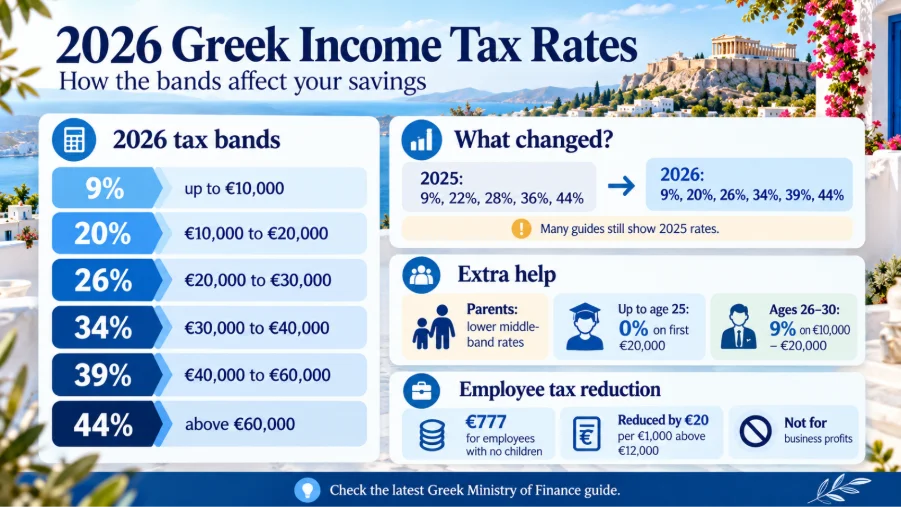
Article 5C Tax Savings Examples
Here’s what the Greek 50 percent tax relief could mean for an employee.
| Qualifying income | Exempt (50%) | Taxable income | Tax without 5C | Tax with 5C | Saving |
| €30,000 | €15,000 | €15,000 | €5,083 | €1,183 | €3,900 |
| €60,000 | €30,000 | €30,000 | €16,700 | €5,083 | €11,617 |
| €100,000 | €50,000 | €50,000 | €34,300 | €12,800 | €21,500 |
The assumptions behind the table matter. The person is single, has no children, is over 30, and works the full year. Taxable pay equals the figure shown, so social security is ignored. The €777 reduction is worked out on income after the exemption. Read the table as an illustration, not a quote.
So, what does a €60,000 salary cost in Greek income tax for 2026? About €16,700 without Article 5C, and about €5,083 with it. Across the three examples, income tax falls by between 63% and 77%.
Business owners should expect less. A sole trader gets no €777 reduction, so on €60,000 of taxable profit, tax on the taxable half comes to €5,500. Greece also applies a minimum presumed income to self-employed people, which means the profit you actually made may not be the figure that gets taxed.
What Taxes and Costs Still Apply?
Saving income tax isn’t the same as taking home more. Several costs stay put:
- EFKA social security. Employees pay 13.37% of gross pay and employers pay 21.79%, up to a monthly ceiling of €7,761.94 in 2026.
- Freelancer contributions. Self-employed people pay fixed monthly amounts for pension and healthcare, and the 2026 categories went up from 1 January.
- VAT. The standard rate is 24%, and how it applies depends on where your clients are.
- Business costs. You’ll need an accountant, compliant invoicing, and advance tax payments on profits, supported by solid bookkeeping.
Put all of this into your budget before comparing Greece with your current UK pay. Net income tells the real story. Headline tax rates don’t.
Can UK Employees and Business Owners Claim Greece’s 50% Tax Exemption?
Some can, but it’s not automatic. This is where most UK readers get caught, so the next four sections are worth reading slowly. The Greece 5C tax exemption for UK residents works only when the work itself is tied to Greece.
Can You Work Remotely for a UK Employer Under Article 5C?
Not by default. If your only employer is a UK company with no Greek presence, you don’t meet the employer condition. Working from a Greek flat for a London firm won’t cut it.
There are routes worth exploring, though. Your employer could open a Greek branch or subsidiary and put you on its payroll. Some people ask whether an employer of record could fill that gap. It depends on the contract and the facts, so get specialist advice before leaning on it.
Your employer also needs to think about Greek payroll duties and the risk of creating a taxable presence in Greece. UK remote workers should have that conversation before they pack, not after. Employers weighing a Greek branch may also want to look at group structuring options.
Can You Keep Your UK Limited Company After Moving to Greece?
You can keep it, but a move abroad raises the risk. Three issues come up.
First, salary and dividends are treated differently. Article 5C covers employment and business income. Dividends from your own UK limited company fall outside it.
Second, where the company counts as resident can change. HMRC’s notes say a UK company managed and controlled in Greece counts as a Greek resident for the convention. If it’s managed in both countries, it falls outside the convention. Greek company tax is 22%.
Third, directors working from Greece may create a Greek permanent establishment. Look into this before you change how the company is run.
Can UK Freelancers Qualify While Working with International Clients?
They can, but they need to prepare. You have to register as a sole trader in Greece and run real activity from there. Hold on to contracts, invoices, and proof of where you do the work.
Foreign business clients aren’t a barrier by themselves. What matters is whether the income comes from your activity in Greece. A thin paper business won’t satisfy that.
Will You Still Pay UK Tax After Becoming a Greek Tax Resident?
Possibly. Moving to Greece doesn’t end your UK position on its own. The Statutory Residence Test decides whether you remain a UK resident for the year. Split-year treatment may apply in the year you leave, but only if you meet its conditions.
Even once you’ve gone, UK source income such as UK rent can stay taxable in the UK and will usually still need to be reported through Self Assessment. For UK landlords, our landlord accounting service can help you stay on top of this.
Then there’s the treaty trap. HMRC’s notes on the UK and Greece convention, updated in August 2026, say an individual resident in both countries is treated as resident of neither for the convention. Treaty relief may then be off the table. The safer plan is a clean exit from UK residence, not a hope that the treaty will sort out an overlap.
Picture a hypothetical project manager who moves in March but keeps a UK home and spends many days back in Britain. She could end up resident in both countries, with no treaty tie-breaker to help her.
How to Apply for Greece Article 5C in 2026
Applications go through AADE’s online service. Most problems come from poor preparation, so it’s worth getting your paperwork in order first.
What Documents Are Required?
Collect these before you log in:
- Evidence of your previous tax residence, such as a certificate from your former tax authority
- Your Greek tax number (AFM) and TAXISnet login
- Your passport and, if needed, your residence permit
- Your employment contract or proof that your business has started
- Proof of a Greek address
- Your declaration that you’ll stay at least two years
Greek legal commentary reports that supporting documents are due within about 60 days of filing. Confirm the current window with AADE.
How Do You Apply Through my AADE?
- Get your AFM and TAXISnet credentials.
- Secure your qualifying job or register your business.
- Gather proof of past tax residence and Greek work.
- Open the Article 5C service in my AADE and enter your details.
- State your previous tax residence and your two-year pledge.
- Upload supporting documents and answer any follow-up requests.
- Keep the decision letter for payroll and your tax return.
What if Your Application Is Rejected or Delayed?
The usual culprits are missing proof of residence history, an employer that doesn’t meet the test, and a misread start date. Read the decision carefully before you react.
AADE lists taxpayer rights to a prior hearing and to an administrative or legal appeal. If you disagree with a refusal, get a qualified adviser to review it quickly.
What Is the Greece Article 5C Application Deadline in 2026?
The Greece Article 5C deadline hinges on one date: 2 July. Your start date decides which year you can claim first.
When Must Employees and Entrepreneurs Apply?
If you start work or trading on or before 2 July, apply by the end of that same year. You’re assessed for that year. If you start after 2 July, apply by the end of the following year, and you’re assessed for the following year.
A worked case makes it clearer. Start on 15 June 2026 and your deadline is 31 December 2026, with relief for 2026. Start on 1 September 2026 and your deadline is 31 December 2027, with relief from 2027. Older guides quote a 31 March deadline. AADE’s current page doesn’t use it, so go with the official page.
Can You Apply After Moving to Greece?
Yes, though it costs you. If you started by 2 July, you may still apply during the following year. Relief then begins in that later year, so you lose the first one.
Miss every window and relief may not be available at all. Ask AADE or an adviser before you assume a late filing can be fixed.
What Happens if You Change Jobs, Stop Trading or Leave Greece?
The scheme puts up with change, but only to a point. Gaps are the main danger.
Can You Change Employers Without Losing Article 5C?
Generally, yes. AADE says relief ends if you stop working in Greece for more than twelve months. A move between qualifying employers with no long gap shouldn’t end it. Just make sure the new employer meets the conditions too.
What Happens if You Close Your Business or Leave Greece Early?
If your employment or business stops for more than twelve months, relief ends from the tax year it stopped. The same happens if you no longer meet a condition, including the work link and the two-year pledge.
After that, normal Greek rates apply. They apply when the seven years run out, too. A €60,000 earner would go from about €5,083 back to about €16,700, so plan for that cliff, ideally as part of wider tax planning.

How Lanop Can Help with UK and Greece Tax Planning
Moving abroad is a UK tax event and a Greek one. Lanop is a UK accounting and tax firm, and we can help you look at the UK side before you commit.
We can help you review:
- Whether you’ll stay UK resident and what leaving requires
- How your UK company and salary arrangements fit a move
- Possible double taxation and ongoing UK reporting duties, supported by our wider international and offshore accounting experience
- How to coordinate with qualified Greek advisers, who must handle Greek filings
Conclusion: Is Greece Article 5C Right for You in 2026?
Article 5C can make a big difference, but it favors people who plan ahead. The move-to-Greece tax benefits are real if you meet the rules, and empty if you don’t. Where you start decides what to do next.
- UK employees: Confirm that a Greek employer or branch will hire you before you relocate. A UK-only contract is the most common reason people fail the test.
- Entrepreneurs and freelancers: Check Greek registration, which income qualifies, and the full tax and contribution cost. Compare net income, not tax rates.
- UK limited company owners: Review company residence and permanent establishment risk first, before you change your salary or management arrangements.
- People already living in Greece: Check your prior residence history, your start date, and the deadline. Don’t assume relief is still open.
Whichever group you’re in, five steps apply:
- Confirm your eligibility against the AADE conditions.
- Compare realistic after-tax outcomes, including EFKA and VAT.
- Identify your deadline using the 2 July rule.
- Review your UK and Greek compliance duties.
- Take professional advice before you act.
No article can promise approval or a set saving. A careful plan gets you as close as possible to both.
Planning to move from the UK to Greece? Lanop can help you review your UK tax position, understand cross-border obligations, and plan your next steps. Contact our team before you make important residency or business decisions and book a free consultation to talk through your options.
Frequently Asked Questions
Each person is tested on their own facts. Both spouses must meet every condition, including past residence and qualifying work. A partner who doesn’t work in Greece won’t benefit from the exemption.
Usually not, if you were a Greek tax resident for five of the last six years. Recent arrivals may still qualify if they meet every condition and apply on time. Check your dates and your start of work first.
No. The visa gives you the right to live in Greece. The tax exemption is a separate application to AADE with its own conditions, so apply for each on its own merits.
Sometimes. AADE allows 5C alongside 5A or 5B if the conditions for each are met when the application is accepted. Articles 5A and 5B can’t be used together. Ask an adviser which mix applies to you.
Normal Greek income tax applies to all your income from the next tax year. The relief can’t be renewed. Plan for the higher bill early and review your pay or business structure well before year seven.