
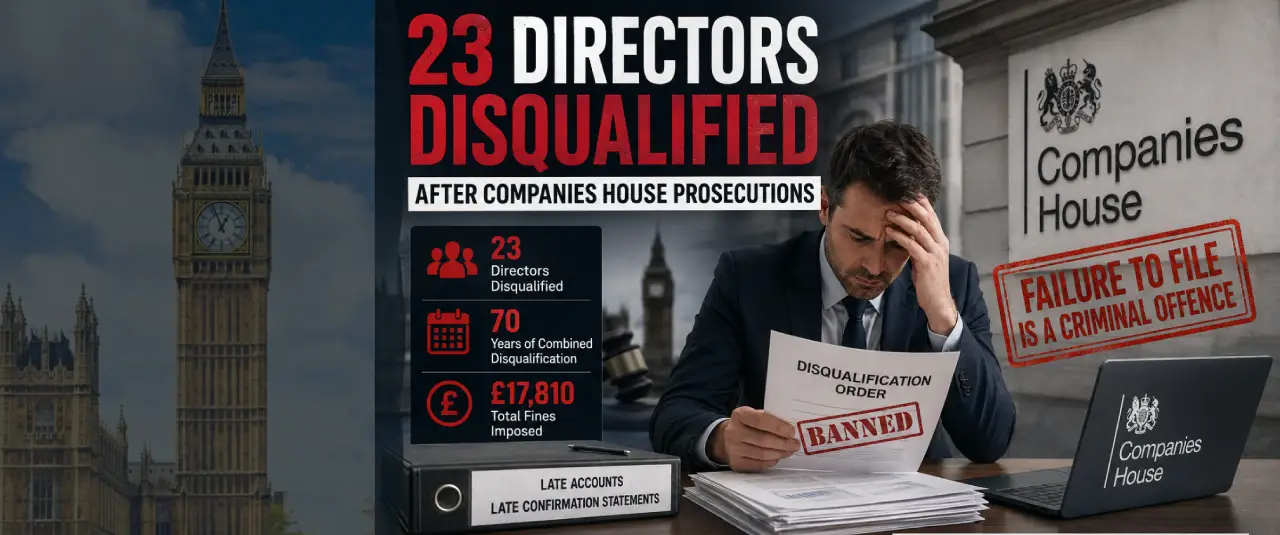
In the first half of 2026, 23 company directors were disqualified by Companies House for multiple instances of late filing of company documents. It represents a change in attitude from the Registrar towards late filers, and late accounts and confirmation statements are now a personal risk.
The bans followed criminal convictions for persistent or serious filing failures. The combined 70 years of disqualification across the 23 directors, ranging from six months to five years each, was imposed alongside a £17,810 fine.
For directors, the lesson is straightforward. A missed Companies House deadline is not only a company problem. Once the failures continue, the consequences can move beyond penalties on the business to prosecution and action against the directors themselves.
From Missed Filings to 70 Years of Disqualification
Between January and June 2026, Companies House prosecuted hundreds of directors for non-filing offences. Of these, 23 were disqualified, the penalty given for the most persistent and serious cases.
The £17,810 fine imposed on that group comprised £15,600 for late accounts and £2,200 for late confirmation statements. The quarterly figures show how widespread the problem is. From January to March 2026, 360 directors of 332 companies were found guilty of committing offences: 355 for accounts and 157 for confirmation statements.
Why Directors Can’t Treat Filing as Someone Else’s Job
Every company is obliged by the Companies Act 2006 to prepare annual accounts and to submit a confirmation statement annually.
The directors are personally responsible for their timely delivery. It is no different when an accountant, bookkeeper, or in-house finance team actually files the paperwork. It may make it easier, but it does not eliminate the legal responsibilities of being a director.
So oversight matters. Directors need to know when their accounts and confirmation statements are due and have the information ready in good time to prepare them.
When Late Accounts Become a Personal Enforcement Issue
When accounts are filed late, Companies House charges the company an automatic penalty. According to GOV.UK guidance, the amount depends on how late the accounts are and on whether the company is private or public.
Repeated failure is more serious. Not delivering accounts is itself a criminal offence, and every director of the company can be prosecuted for it.
In persistent or serious cases, Companies House can impose financial penalties or bring criminal charges. The recent disqualifications show the end point: a director losing the right to hold the role.
Get Ahead of Your Next Companies House Deadline
Ensure that your Companies House record is up to date, rather than waiting until a deadline is expired. Have a glance at the next accounts date, verify the confirmation statement due date and deal with any outstanding accounts as soon as possible.
Up-to-date books help as well, since accurate records lead to accurate submissions and reduce the risk of last-minute problems.
Lanop Business & Tax Advisors can help companies with their accounting records, annual accounts and ongoing Companies House compliance, whether you are a new startup or an established limited company. If you are not fully confident about an upcoming deadline, or you already have outstanding filings, an early review can help get things back under control before the situation worsens.
The trials carry one clear message: filing is part of a director’s core responsibilities, not paperwork that can be postponed indefinitely.