

Finance chiefs at some of the UK’s biggest companies are turning their attention to costs. Inflation, interest rates and pricey borrowing are still weighing on their minds.
According to Deloitte’s latest UK CFO Survey, 68% of those asked now see cost cutting as a strong priority for the next 12 months. Last quarter, the figure was 53%. That’s quite a jump in three months.
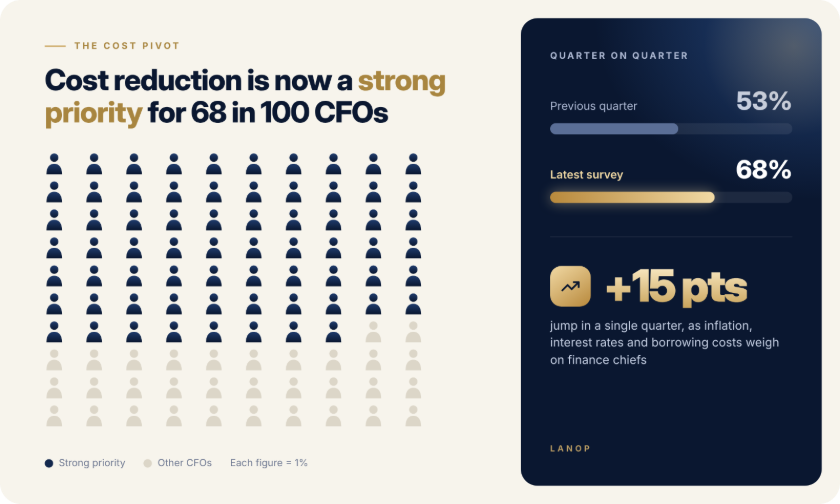
Deloitte ran the survey between 17 September and 1 October 2026. It spoke to 66 finance leaders, including CFOs from 12 FTSE 100 and 25 FTSE 250 companies.
So the results tell us how large UK businesses are feeling. They don’t reflect every finance director or every small firm in the country.
Why Are Finance Chiefs Becoming More Cautious?
Big firms are bracing for a harder year. CFOs now think inflation will sit at 3.4% a year from now. Back in the last survey, they were expecting 3.0%.
They also see the Bank of England’s main rate reaching 4.0% over the same period. These are the guesses of the people who took part, though. They aren’t official forecasts, and nobody can promise they’ll come true.
More CFOs now describe credit as costly, too. The share saying so hasn’t been this high for two and a half years.
If loans cost is higher, it’s more difficult. It becomes more difficult to launch new investments, pay out daily cash flows (also known as working capital), and continue to realize growth plans.
KEY TAKEAWAY
Large UK companies are playing it safer. With money worries and global political risks still hanging around, keeping costs down now comes before growth.
Who Does This News Apply To?
Deloitte only surveyed big UK firms. Even so, the same pressures could matter to:
- SMEs looking over their running costs and cash reserves.
- Firms planning to borrow, or to refinance debt they already hold.
- Employers weighing up hiring, pay or investment.
- Directors putting together budgets and financial forecasts.
- Suppliers that depend heavily on contracts with larger firms.
Think about it from the supplier’s side. A large customer who wants to reduce the budget can request reductions in price terms, delay action, or examine more closely in its supply chain.
However, it was an impact that smaller suppliers felt, although no one had asked to fill out the survey.
What Could Happen If Businesses Ignore These Signals?
The survey doesn’t bring in any new legal or tax rules. But firms that ignore changes in costs, credit and how customers behave may end up making decisions on old assumptions.
If costs climb faster than planned, margins get squeezed. Cash reserves can start to run thin as well.
Some firms may also commit to hiring, borrowing or investment before checking they can keep paying for it.
None of this means slashing every budget in a hurry. Lose key staff, systems or services without knowing what they’re worth to you, and you could weaken the business and store up bigger problems later.
What Should Businesses Do Now?
Use the survey as a reason to look at your own numbers. What works for a FTSE 100 company won’t always work for yours. A few practical steps:
- Update your cash-flow forecasts, and be cautious with your assumptions.
- Sort essential costs from the spending you could live without.
- Check your borrowing terms and any refinancing due soon.
- Spot which customers or suppliers you lean on too much. This is known as concentration risk.
- Ask whether planned investment is still affordable.
- Compare actual results against your budget more often.
What you want is careful cost control, not cuts made without a plan.
Why Businesses Can Trust Lanop to Help
HOW LANOP HELPS
Lanop advises UK businesses in financial reporting, cash-flow forecasting, budgeting and planning over the longer-term. This means that directors will be able to make decisions on the basis of their figures, and not just the headlines.
We review your costs, margins, funding needs and future commitments side by side. From there, we can help you see where savings make sense and where it’s still worth investing.
No one is claiming that all businesses should cease to expand. The survey is just one indication of the value of having solid numbers, realistic projections and a solid financial plan in front of your next big decision.