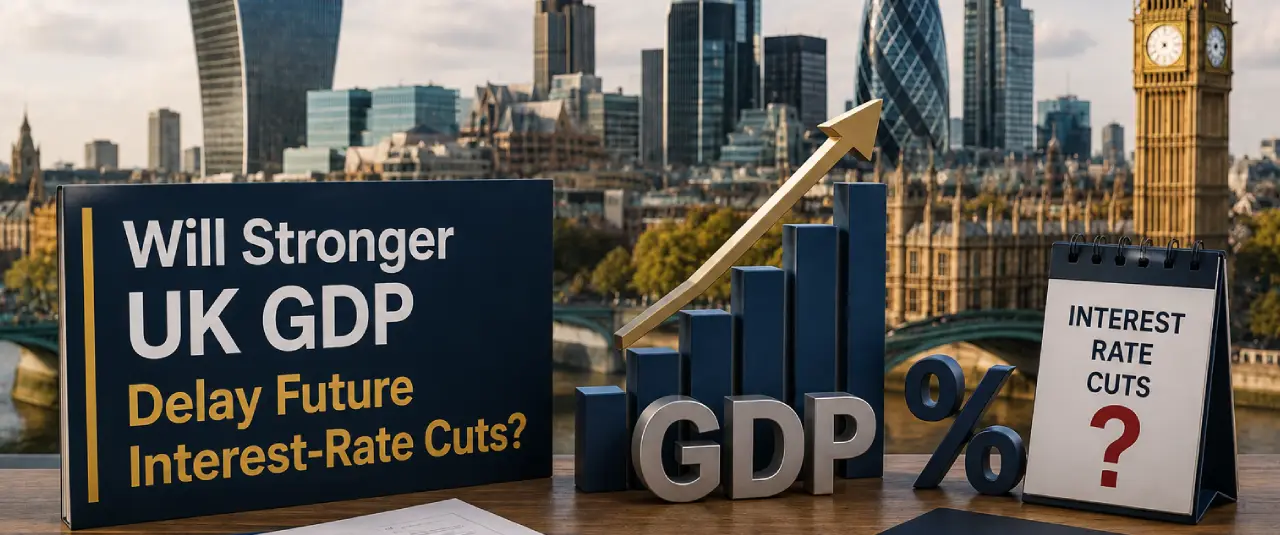
Stronger-than-expected UK economic growth has raised fresh questions about when the Bank of England will cut interest rates.
The UK economy grew by 0.3% in June 2026, pushing overall gross domestic product (GDP) up by 0.4% in the second quarter. The services sector led this performance with a 0.4% rise in June. These figures show that the UK economy is far more resilient than analysts predicted.
A growing economy is welcome news. However, it creates a tricky situation for businesses waiting for lower borrowing costs.
The Bank of England base rate currently sits at 3.75%. Policymakers remain deeply divided over what to do next. At its latest meeting, the Monetary Policy Committee (MPC) voted 6–3 to keep rates unchanged. Three members voted to raise the rate to 4.0%.
Why Stronger GDP Could Delay Rate Cuts
Central banks use interest rates to manage demand and curb inflation. When the economy weakens, central banks cut rates so businesses and consumers can borrow and spend more easily.
Stronger GDP growth removes the immediate need for that support.
Bank of England Chief Economist Huw Pill noted that recent economic strength supports keeping interest rates higher. He was one of the three MPC members who voted for an immediate rate increase.
However, this does not rule out future rate cuts. Recent economic reports show mixed signals:
- Cooling Job Market: Unemployment holds at 4.9%.
- Slower Wage Growth: Private-sector pay growth slowed to 2.8%.
- Fewer Job Openings: Total job vacancies fell to 707,000.
The Bank of England must now weigh solid economic growth against a slowing labour market and lingering inflation risks.
What This Means for UK Businesses
Uncertainty is currently the biggest challenge for business owners, company directors, and corporate borrowers.
Companies should not count on immediate interest rate relief. Waiting for lower borrowing costs before reviewing current debt, refinancing agreements, or expansion plans could expose your business if rates stay high.
Higher financing costs directly impact your bottom line by:
- Reducing daily cash flow.
- Increasing the cost of existing variable-rate debt.
- Limiting the capital you can invest back into business growth.
Stronger economic growth makes proactive financial planning essential for every UK company.
Action Steps for Business Owners
Businesses should build their financial strategy around today’s interest rates rather than relying on future cuts.
- Review Your Cash Flow: Examine your current debt obligations, refinancing dates, and planned capital investments against today’s borrowing costs, using up-to-date bookkeeping to keep the numbers accurate.
- Run Scenario Tests: Check how your cash reserves hold up if the base rate stays at 3.75% for another 6 to 12 months.
- Optimize Tax Efficiency: Align your tax planning with your wider corporate strategy to protect working capital and cash reserves.
How Lanop Business and Tax Advisors Can Help
Strong GDP growth makes the Bank of England’s next move harder to predict. Fortunately, your business does not need to predict interest rates to prepare for them.
We help UK business owners and directors build resilient financial strategies. Our advisors specialize in:
- Practical cash-flow forecasting
- Corporate tax planning
- Strategic debt and investment reviews
Do not build your business strategy around temporary rate assumptions. Contact Lanop today to secure your financial plan under current market conditions, book a free consultation with one of our advisors.