You checked your numbers. Turnover dropped below £88,000. So, you think you can just stop charging VAT. That’s the first mistake.
HMRC does not cancel your VAT registration on its own. You must ask. You can do this in writing or online. Then you wait. Until HMRC says yes in writing, you keep charging VAT as before. Even if your own numbers look fine to you.
Here’s the part most guides skip. Say you sell to the public. Say you don’t lower your prices. HMRC can say no to your request. Why? Drop VAT off your invoices without dropping your prices, and your old total just becomes your new turnover figure. That can push you straight back over the line, on paper. You haven’t even left yet. You end up asking to leave a system that, by HMRC’s own maths, you never really left.
Add a wait time that has crept well past the “three weeks” you’ll read on most pages. Cancelling your VAT registration is messier than it looks. Here is what is involved, step by step.
What deregistering for VAT means
Deregistering for VAT means HMRC takes you off the VAT register. You stop charging VAT on sales. You stop claiming VAT back on what you buy. You stop sending in VAT returns. But it’s not a clean switch. It doesn’t happen overnight.
You still owe one last return. You may owe VAT on stock you’re holding. You need to keep records for six years after. The work doesn’t end the day you apply. It ends a while later, once HMRC confirms.
The £88,000 threshold, explained simply
Two numbers matter here. They are not the same. You must register once your taxable turnover passes the VAT registration threshold of £90,000. That’s checked over any rolling 12-month run, not a tax year. You can ask to deregister if you can satisfy HMRC that your taxable turnover in the next 12 months will not exceed £88,000.
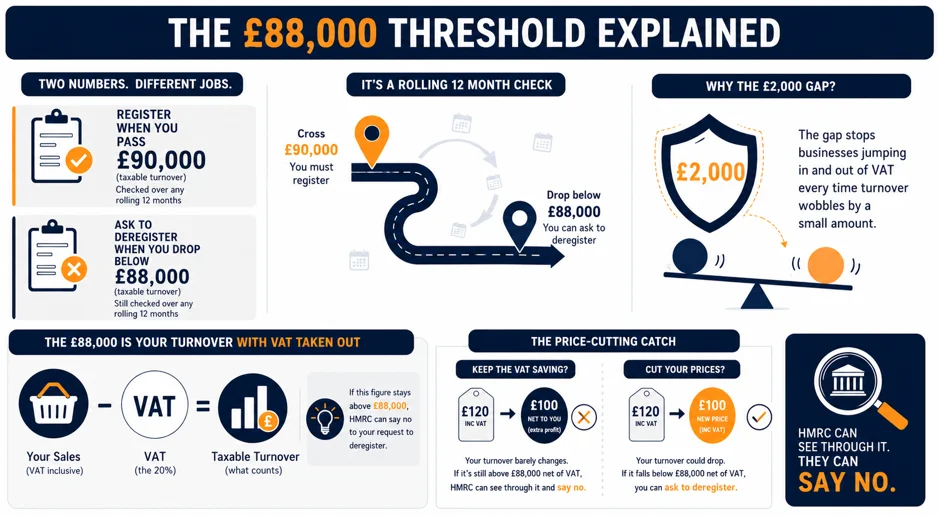
The £2,000 gap is there on purpose. It stops businesses jumping in and out of the VAT system every time turnover wobbles by a small amount.
That £88,000 figure is your turnover with VAT taken out. This is where the price-cutting catch comes in. HMRC’s own guidance, VAT Notice 700/11, says they won’t say yes if your turnover would still sit above the limit once you stop charging VAT. In plain terms, if you sell to the public and plan to keep the VAT saving extra profit, rather than cut your prices, your sales figures barely move. HMRC can see through that, and they can say no.
Can you deregister for VAT, and when must you
Yes, you can ask to deregister for VAT. In some cases, you must. The reasons split into two groups.
You must cancel your registration if any of these apply to you:
- You have stopped trading completely, with no plan to sell again.
- You only make VAT exempt sales now.
- You sold the business, and the buyer is not taking over your VAT number.
- Your legal structure changed. For example, you went from sole trader to limited company.
- You are joining a VAT group, where one number covers every member.
You can choose to deregister if your turnover for the next 12 months should stay below £88,000. You need to show HMRC why you believe that. A lost contract, shorter opening hours, or a real drop in trade are the kind of proof HMRC wants to see.
How to deregister for VAT step by step
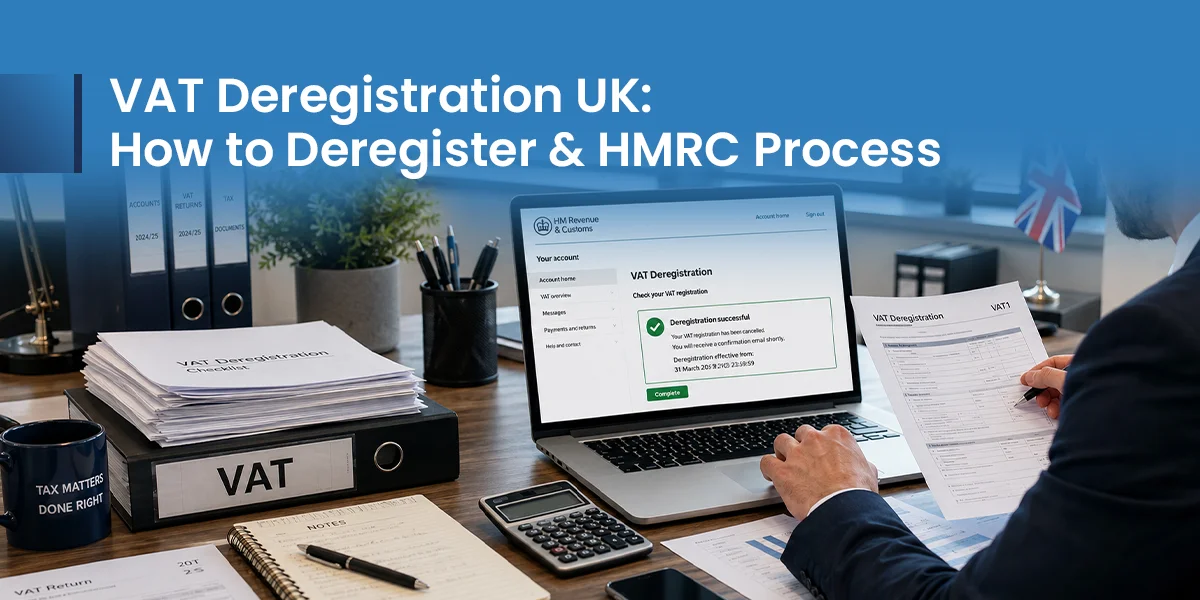
Most businesses cancel their VAT registration online. You do this through your Government Gateway account. Here is the usual process.
- Sign in to your VAT online account with your Government Gateway details.
- Pick the option to cancel your VAT registration.
- Give the reason for cancelling, and the date you want it to start.
- Check your business details, then send off the request.
- Wait for HMRC’s written reply. This sets your official cancellation date.
You can also apply by post if you’d rather not go online. Some cases need the paper route anyway. That brings us to the form most people have never heard of, until they need it.
The VAT7 form, and when you need it
Form VAT7 is the paper form for cancelling your VAT registration. You fill it in online, print it, then post it to the address shown on the form. HMRC points most people toward the online service. It’s faster and easier to track. Still, VAT7 has its place.
You’ll likely need it if you can’t use the online service. Or if HMRC asks for it directly. Or where your legal setup is changing, and the VAT number isn’t moving to a new owner. If you’re selling your business and the buyer keeps the same VAT number, you use form VAT68 instead. You don’t need VAT7 at all in that case.
How long HMRC takes to confirm
This is where a lot of pages online are simply out of date. Older guides quote a wait of about three weeks. Right now, GOV.UK says it can take up to 40 working days. That’s longer in busy periods. Forty working days is closer to eight weeks than three.
Until that reply lands, with your official cancellation date, you’re still VAT registered. Keep charging VAT. Keep sending in returns if one falls due. Don’t drop your VAT number off invoices early. If HMRC later decides you shouldn’t have cancelled, they’ll put you back on the register. You’ll owe any VAT you should have charged in the meantime.
What happens to stock and assets you still hold
Search “deregister for vat assets” and you’ll see why this trips people up. The rule is easy to miss. When you cancel, HMRC treats stock and gear you’re still holding as if you’d sold it. Even though you haven’t. This is called a deemed supply.
You only need to deal with this if you claimed VAT back when you bought the items. And the total VAT owed on them now is more than £1,000. Below that, you can ignore it. Above it, you add the VAT to your final return.
Here’s a simple example. You hold £6,000 of unsold stock, with VAT taken out. You claimed the VAT back when you bought it. At 20%, that’s £1,200 of VAT. That’s over the £1,000 line, so it goes on your final return. Office gear, computers, and vans you claimed VAT on count too. Trademarks, goodwill, and other things you can’t touch are usually left out of this sum.
Deregistering from the Flat Rate Scheme
If you use the Flat Rate Scheme, cancelling your VAT registration has its own quirk worth knowing. HMRC treats you as leaving the scheme the day before your VAT cancellation date kicks in, not the same day.
If you’re unsure the Flat Rate Scheme still fits, compare VAT schemes before you decide.
Want to leave just the Flat Rate Scheme, but stay VAT registered? That’s a different request entirely. You write to HMRC with your name, your signature, your VAT number, and your business details. You don’t use a VAT7 for this. There’s no separate “deregister for flat rate VAT” form. It’s a letter, sent by post or email. HMRC confirms your leaving date once it’s been dealt with.
Where Making Tax Digital fits in
People searching “deregister for vat mtd” usually want to know if MTD still applies once they leave. Once HMRC confirms your cancellation, your Making Tax Digital duties for VAT come to an end. Until that confirmation arrives, your Making Tax Digital VAT returns still need to go in on time. You no longer need to keep digital VAT records through MTD software. You don’t need to send VAT returns that way either. You still need to keep your records, digital or on paper, for six years, in case HMRC has questions later.
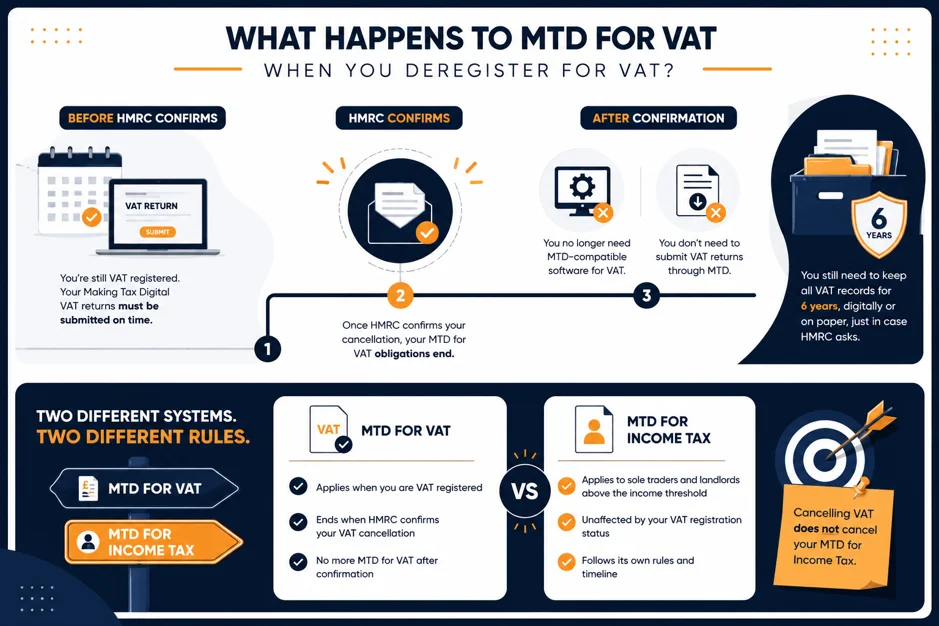
Worth flagging here, since this gets searched a lot. MTD for VAT and MTD for Income Tax are two separate things. Cancelling your VAT registration does not let you off MTD for Income Tax. That rule applies if you’re a sole trader or landlord above a set income level. The two systems run on their own rules and their own dates.
Who finds this harder than it looks
A few groups run into more trouble than the standard advice suggests.
- Shops and other businesses that sell to the public. This comes back to the price-cutting catch from earlier. If your margins won’t stretch to lower prices, getting HMRC to agree can be a real fight.
- Businesses that claim back a lot of VAT. Think of firms buying lots of stock, gear, or materials. Deregistering removes that claim entirely. That can cost more than the admin you save. A review from small business accounting services can show which way the numbers favour you.
- Sole traders moving into a limited company. This often means working with both sole trader accountants and limited company accountants during the switch. The VAT number doesn’t just carry across on its own. You either cancel the old one and register the new one, or move the number using form VAT68, if both sides agree to it.
- Seasonal or up-and-down businesses, where turnover dips for a quarter or two, then climbs back up. HMRC may decide the dip won’t last, and say no. Or they say yes, then make you register again a few months later anyway.
- Sellers based abroad with stock stored in the UK. The usual £90,000 line doesn’t apply to you at all. You’re often asked to register from your very first sale here, no matter how small. That means cancelling is rarely on the table while you keep trading here. International accounting services can help you stay compliant across borders.
What can go wrong
A handful of real, common problems crop up repeatedly.
- Getting put back on the register. If HMRC later decides your turnover dip wasn’t going to last, they can put you back on. They can backdate any VAT you should have charged in the meantime.
- Missing the 30 day window. Say you have to deregister, because you stopped trading, for example. You get 30 days to tell HMRC. Miss it, and a penalty can follow.
- Leaving your VAT number on invoices and your website. Old invoice templates and website footers are easy to forget. Customers can check VAT numbers online. A cancelled number still showing up makes for an awkward chat.
- Cash flow shocks on the final return. If you use cash accounting day to day, your final return still must count unpaid invoices as if they’d been paid. That can mean paying VAT on cash you haven’t been given yet.
- No backdating. You can’t ask HMRC to cancel your registration from a date earlier than when you applied. Even if you genuinely should have cancelled months before.
- Capital Goods Scheme adjustments. If you own pricier items, like a property or big computer equipment, the VAT on it may sit under the Capital Goods Scheme. That scheme can still ask for an adjustment after you’ve left the register. It’s easy to miss, and it catches out businesses with land or buildings most of all.
Final Thoughts
Deregistering for VAT touches your pricing, your final return, and sometimes a VAT bill on the way out. Getting the timing and the paperwork right matters more than it first looks. If you’d rather have someone check your numbers, handle the request, and work out what your final return should cover, Lanop’s VAT and HMRC compliance team can take the job off your hands. They’ll tell you straight if it’s even the right move. You can book a free consultation to talk it through first.
VAT rules, limits, and HMRC wait times shift more often than people expect. Check GOV.UK, or speak to an advisor, before you act on any figures here.
Frequently Asked Questions
Yes. Most people do this through their VAT online account, with their Government Gateway login. It’s the route HMRC prefers, and the fastest way to track your request.
Yes. If your turnover climbs back over £90,000, you must complete VAT registration again. You can also choose to register on your own, at any point. You’ll normally get a new VAT reference, but in some re-registration situations, HMRC can give back an old VAT reference.
HMRC currently says it can take up to 40 working days to confirm. It can run longer in busy periods. Keep charging VAT until you have written proof of your cancellation date.
You can still claim back VAT on business buys made while you were registered. This is true even if the invoice turns up after your cancellation date, as long as it relates to your time as a VAT registered business.
You stop charging VAT. You send one final return, covering up to your cancellation date. You pay any VAT due on stock and gear over the £1,000 line. You keep your records for six years.
No. HMRC does not charge you to cancel your VAT registration, whether you do it online or by post. Any cost comes from the VAT you may owe on stock or assets, not from the application itself.