Best Accounting Software for Manufacturing Businesses (UK Guide)
Running a factory is not like running a retail shop. You buy raw materials. You turn them into products. Then…
April 2025 was a quiet watershed for British wealth planning. The UK scrapped its non-dom regime. Two centuries of remittance basis taxation, gone.
Most of the coverage focused on what was lost. Not enough of it focused on what was still available.
Malta’s non-dom system never changed. It has been running since the 1940s, largely untouched. It is built on the same principles that the UK just abandoned. If you’re a British national thinking seriously about where you’re taxed in 2026, that matters. For a broader picture of how the abolition has reshaped decision-making for UK high-net-worth individuals, see our guide on what UK HNWIs are doing after non-dom abolition.
This isn’t a puff piece for Malta. It’s a plain guide to how the system works, who it suits, and where people get it wrong.
April 2025 was a quiet watershed for British wealth planning. The UK scrapped its non-dom regime. Two centuries of remittance basis taxation, gone.
Most of the coverage focused on what was lost. Not enough of it focused on what was still available.
Malta’s non-dom system never changed. It has been running since the 1940s, largely untouched. It is built on the same principles that the UK just abandoned. If you’re a British national thinking seriously about where you’re taxed in 2026, that matters. For a broader picture of how the abolition has reshaped decision-making for UK high-net-worth individuals, see our guide on what UK HNWIs are doing after non-dom abolition.
This isn’t a puff piece for Malta. It’s a plain guide to how the system works, who it suits, and where people get it wrong.
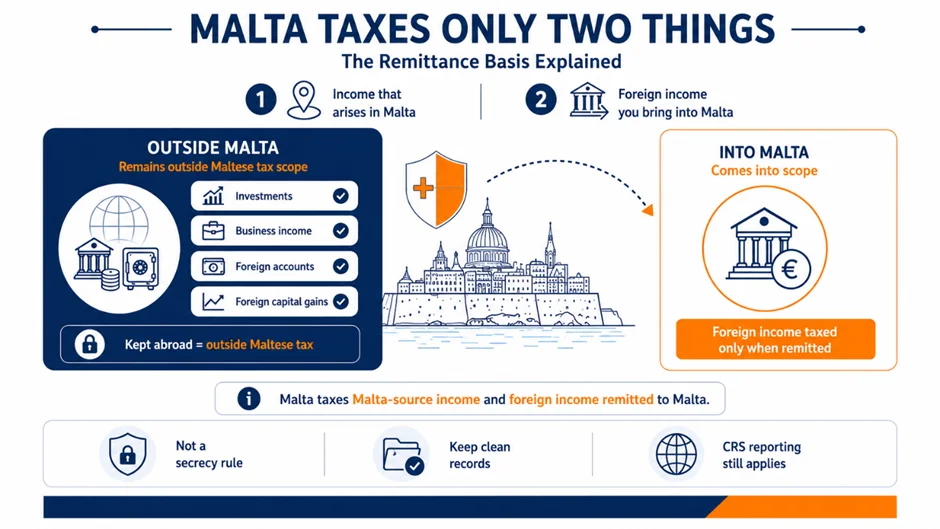
Remittance means transferred. If your Swiss investment account pays you €80,000 in dividends and you leave them there, Malta doesn’t tax them. If you move €30,000 of that into your Maltese bank account to pay rent, Malta taxes that €30,000.
The offshore balance stays clean from a Maltese tax perspective. But it should not be treated as hidden or outside international reporting rules.
In practice, remittance can extend beyond a simple bank transfer. Paying Maltese rent from an offshore account, using an overseas credit card for Malta living costs, or asking someone else to pay your Maltese bills, all of these can raise remittance questions. Get advice before using offshore income to fund life in Malta indirectly.
This is why clean bank accounts matter. Foreign capital, income, and capital gains should each be kept in their own accounts, with clear records. If you mix everything before moving money to Malta, it becomes very hard to prove what you remitted. That can turn a simple tax position into an expensive argument.
Book a free consultation with our Malta business specialists and receive tailored advice on company formation, tax planning, VAT registration, banking, and ongoing compliance. We'll help you establish a strong foundation for success in Malta and across the European market.
Here’s something even some advisers gloss over. Foreign capital gains are fully exempt in Malta. Not exempt unless remitted. Exempt entirely, regardless of whether you bring in the money.
Sell a French property. Sell a portfolio of US equities. Move the proceeds to Malta. No Maltese capital gains tax.
For someone with large unrealised gains built over years of investing, this is genuinely useful.
But the timing still matters. Malta may not tax the foreign gain, but the UK can. It depends on when you sell, whether the asset is UK property-rich, and whether temporary non-residence rules apply. Selling before you leave, shortly after you leave, or after a clean break from UK residence can each produce very different results. Plan before you sell.
Non-dom status doesn’t exist on its own. You need to be a tax resident in Malta first. The standard route is spending 183 days or more in Malta during the tax year. It’s a clean line.
Malta can also look at your overall ties to the island, which gives some flexibility. But 183 days is the safest target. Most advisers will tell you to plan around it.
There is no simple “60-day rule” for UK nationals to rely on as a shortcut. If you don’t hit 183 days, the test becomes much more fact-based. Malta will look at your home, personal ties, economic links, and your overall pattern of life.
Substance matters too. A serious Malta move requires real evidence: a lease or property purchase, utility bills, a local bank account, health insurance, travel records, and day-count logs. HMRC may also look closely at whether your UK exit was genuine, especially after the 2025 non-dom changes.
This is where a lot of people get confused. Residency and domicile are not the same thing.
Domicile is your permanent legal home in a deeper, legal sense. For most British nationals, that’s the UK by origin. Moving to Malta doesn’t change it. To acquire a Maltese domicile of choice, you need clear evidence of intent to settle there permanently. Very few people actually do that.
So as long as you stay UK-domiciled, you’re a non-dom in Malta. That can continue long-term, as long as your facts support it.
There’s no Maltese version of the old UK deemed domicile rule, the one that used to catch you after 15 years and force you into worldwide taxation. Malta has no such timer. But don’t treat that casually. If your facts show a permanent intention to remain in Malta, domicile analysis can shift. Talk to a specialist before you move.
The GRP was designed for non-EU nationals who want a clear, flat-rate tax position in Malta. Foreign income brought into Malta is taxed at 15%. The minimum annual tax is €15,000, regardless of how much you remit.
Property rules apply. If you’re renting, the minimum is €9,600 per year in most areas. Buying requires at least €275,000. Lower thresholds can apply in Gozo or south Malta, but always check the latest programme rules before applying.
The numbers are simple. Remit €100,000 in a year, pay €15,000 in tax. Remit €400,000, pay €60,000. No bands. No clawbacks.
For UK nationals working out what tax residency looks like after non-dom abolition, the GRP is usually the first thing to consider.
One thing often missed: GRP applicants must hold appropriate health insurance. Build that cost in from day one, especially if you’re moving with a partner or family.
Also worth noting: the GRP is not just a rate you write on a tax return. It is a formal tax status with eligibility conditions, property rules, and ongoing compliance requirements. Treat it accordingly.
The MPRP works differently. It’s a residence programme, not a tax programme. It gives you permanent residence rights in Malta and access to the Schengen short-stay area. It does not give automatic EU citizenship or the right to live anywhere in the EU. Tax treatment still depends on whether you set up Maltese tax residency and non-dom status separately.
It costs more. The minimum property purchase is €375,000, held for 5 years. Rental starts at €14,000 per year. Add government fees and NGO contributions, and the rental route comes to roughly €169,000 upfront.
The MPRP suits people who want to settle properly and bring their family. Spouses, dependent children, and dependent parents or grandparents can usually be included, subject to programme rules and proof of dependency.
The key difference is that GRP is mainly a tax route. MPRP is mainly an immigration and residence route. Having residence rights does not mean you are correctly registered as a Maltese tax resident or that you are properly claiming the remittance basis. Those steps are separate.
Budget for medical insurance, due diligence, property costs and ongoing compliance on top of the headline investment figure.
Outside the GRP, Malta’s standard non-dom route has a minimum annual tax of €5,000. But this only kicks in once your foreign income goes above €35,000. Below that, there is no minimum.
That’s genuinely useful for retirees on modest incomes. A British national with a UK state pension, some rental income and a bit of savings interest might stay well under the threshold. Careful remittance planning can keep the Maltese tax bill very low.
For higher earners on the standard route, the picture changes. Remitted foreign income is taxed at Malta’s progressive rates, which go up to 35%. At that level, controlling what you remit and when becomes the whole planning exercise.
The simple version: the standard route works well for modest, controlled remittances. The GRP works better when you want certainty and expect to bring in larger amounts each year.
The table below is illustrative only. It uses 2026 single individual rates and assumes no deductions, credits or other income. Married and parent rates can shift the break-even point slightly.
Here’s something even some advisers gloss over. Foreign capital gains are fully exempt in Malta. Not exempt unless remitted. Exempt entirely, regardless of whether you bring in the money.
Sell a French property. Sell a portfolio of US equities. Move the proceeds to Malta. No Maltese capital gains tax.
For someone with large unrealised gains built over years of investing, this is genuinely useful.
But the timing still matters. Malta may not tax the foreign gain, but the UK can. It depends on when you sell, whether the asset is UK property-rich, and whether temporary non-residence rules apply. Selling before you leave, shortly after you leave, or after a clean break from UK residence can each produce very different results. Plan before you sell.
| Remitted Foreign Income | GRP Tax (15% Flat) | Standard Route Tax | Better Option |
|---|---|---|---|
| Under €35,000 | Not applicable (GRP minimum €15,000) | No minimum tax | Standard |
| €50,000 | €15,000 (minimum) | Approx. €9,100 | Standard |
| €70,000 | €15,000 | Approx. €15,100 | Broadly similar |
| €80,000 | €15,000 | Approx. €18,600 | GRP |
| €100,000 | €15,000 | Approx. €25,600 | GRP |
| €150,000 | €22,500 | Approx. €43,100 | GRP |
| €250,000 | €37,500 | Approx. €78,100 | GRP |
As the table shows, the GRP tends to become more efficient once annual remittances pass roughly €70,000 to €75,000. Below that, the standard route often produces a lower bill. Above it, the GRP’s flat 15% position becomes much more attractive
Malta has neither. No inheritance tax. No estate tax. No gift tax. No wealth tax.
For UK nationals used to planning around 40% IHT on worldwide assets, this is genuine relief. It’s not a marketing line. It’s a fact of Maltese tax law. For those still carrying UK IHT exposure, our inheritance tax planning service outlines the key strategies available before and after a move.
But the UK still has a long reach. Since 2025, British nationals who have been UK residents for 10 of the last 20 years remain exposed to UK IHT on worldwide assets. That exposure can follow you for up to 10 years after leaving.
The UK has now moved from a domicile-based IHT system to a long-term residence system. If you were a UK resident for 10 of the previous 20 tax years, you are treated as a long-term UK resident. The IHT tail after leaving can last up to 10 tax years, depending on your history.
Malta sorts its side. It won’t sort London’s. If you have UK property, UK assets or UK trusts still caught by HMRC rules, that needs its own planning thread running in parallel.
This question comes up a lot with British HNWIs. Here’s the honest answer.
Dubai wins on raw tax efficiency. No income tax. No CGT. No inheritance taxes. The 10-year Golden Visa, available with property valued at around AED 2 million, has made long-term settlement is much more viable. If you genuinely don’t need to be in Europe and the Gulf lifestyle works for you, Dubai can make sense.
But ‘tax-efficient on paper’ is not the full picture.
The UAE is not in the EU. Schengen access is not included. Business owners with European clients, family or company structures, face real practical frictions that don’t show up in a rate comparison. Malta’s legal system has mixed civil and common law roots, with English widely used in business. That familiarity can matter when things go wrong.
Malta’s rates are not zero. But with careful remittance management, the effective rate on foreign investment income can be very modest. Capital gains on foreign assets are untouched even if you bring the money in. The €5,000 minimum tax is, for most HNWIs, a trivial cost.
The honest position: Dubai wins on raw numbers. Malta wins if you want EU proximity, Schengen access, English-speaking infrastructure and legal frameworks that feel familiar.
One more thing worth knowing: Maltese banks can be slow and document-heavy. If you have offshore companies, trusts or complex wealth, build in extra time for account opening, source-of-funds checks and compliance review.
There is a double tax treaty between the UK and Malta. It matters a lot for UK nationals still receiving income from Britain.
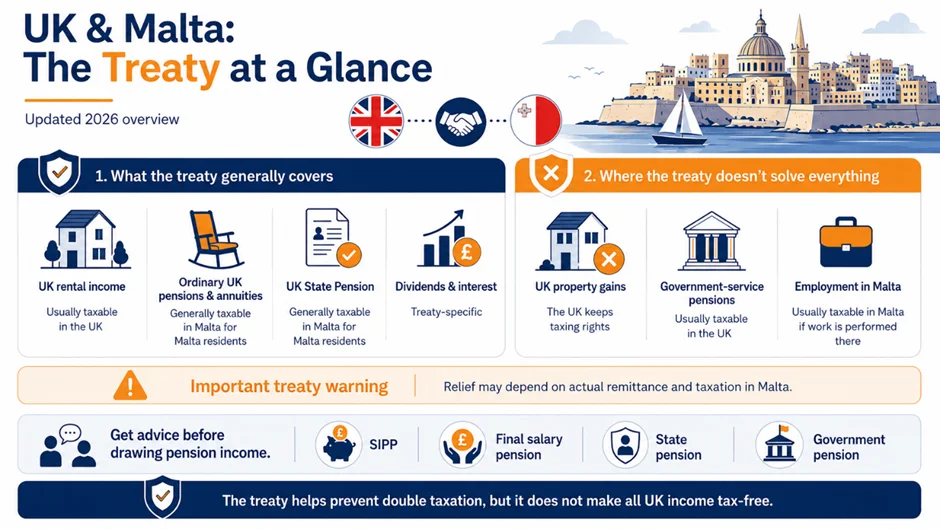
The treaty determines which country has the first claim to different types of income. UK rental income will usually stay taxable in the UK, because it comes from UK property. UK dividends, interest and pension income each need separate treaty analysis. There is no single blanket answer.
Pensions are especially important. Ordinary UK pensions and annuities paid to a Malta resident are generally taxable in Malta under the treaty, not in the UK. UK government service pensions are the main exception. They usually stay taxable in the UK, unless specific treaty conditions apply.
There is also a limitation point. Where Malta taxes only income remitted, UK treaty relief may depend on whether that income is received and taxed in Malta. A pension paid into Malta and declared there is very different from a pension left offshore and assumed to be tax-free everywhere. Get advice before the first drawdown.
Where the treaty doesn’t help: UK property gains. HMRC keeps full taxing rights on those, wherever you live. And if you left the UK within the last five years, temporary non-residence rules could catch gains you thought you’d left behind.
Sort the treaty position before you commit to a move. It will save expensive surprises later.
This part is under-discussed. It matters more than most people realise.
When you leave the UK, HMRC doesn’t just take your word for it. The Statutory Residence Test checks how many days you spend in the UK after leaving, whether you still have a UK home available to you, your employment ties and your family connections. Our detailed guide to exiting walks through the full process, including split-year treatment and the most common compliance mistakes.
Fail the test, and you’re still a UK tax resident, even if Malta considers you resident there.
The consequences are serious. You end up subject to UK worldwide taxation while also paying tax in Malta, with treaty relief covering some but not all of the overlap.
The practical fix is sequencing. Don’t move first and then guess your UK position afterwards. Model the departure year in advance. Look at expected UK days, available accommodation, workdays, family ties, split-year treatment, UK-source income, and any planned asset sales.
British nationals who have been non-UK residents for at least 10 consecutive years can now use the Foreign Income and Gains regime for their first four years back in the UK. That gives 100% exemption on foreign income and gains during that window, even if remitted to the UK.
It is a generous provision. It is also time-limited. If you are in the first or second year of your FIG period, start thinking now about what will happen when it ends.
Former UK non-doms with offshore income built up before April 2025 can remit it to the UK at 12% during this and next tax year, rising to 15% in 2027/28. That is the Temporary Repatriation Facility.
Using it before you move to Malta could be the most efficient way to clear historic offshore funds while rates are still low. Once you’re a Malta tax resident, the calculation changes.
For anyone leaving UK tax residency with significant offshore or UK-source assets, the order of steps matters enormously. Here is a sensible checklist:
A Maltese residence card is not a tax document. It shows you have the right to live in Malta. It does not make you a Malta tax resident, nor does it establish non-dom status.
You need to register separately with the Commissioner for Revenue and make the non-dom declaration. Many people skip this, leaving themselves with a documentation gap.
The fix is simple. Once you are resident, register with the Maltese tax authorities. Keep written proof of registration. Make sure your non-dom and remittance position is correctly shown in your first Maltese tax filings.
The remittance basis only works if you can trace exactly what you remitted. If you pool offshore income, capital, and gains in a single account before moving money to Malta, you will struggle to prove which category of funds you transferred.
Here’s a practical example. If an account holds old capital, current-year dividends, and proceeds from a foreign share sale, a transfer from that account to Malta is difficult to classify. “Some of everything” is not a good answer when the tax authorities ask. Clean, separate accounts prevent that problem entirely.
If you work in Malta, income from that work is taxable in Malta, regardless of where your employer or client is based. A British consultant billing a UK company while sitting in a Valletta office is earning Malta-source income. The remittance basis does not change that.
The same applies to digital work. If you physically perform services from Malta, the source and treaty position needs a proper review. It is not enough to say the client or bank account is outside Malta.
UK departure compliance and HMRC residency analysis should happen before the move, not after. The year you leave is the most complex tax year most movers will face. Loose ends mean two tax authorities, two filing obligations, and a difficult reconciliation. It is also worth understanding what HMRC checks when wealthy individuals leave the UK, as investigators increasingly scrutinise departure-year activity and overseas account movements.
Malta has public healthcare, but you should not assume you can arrive and rely on it as you would with the NHS. GRP and MPRP routes generally require appropriate private health insurance. For older applicants, families or people with pre-existing conditions, this can become a real and significant cost.
Tax is not the only contribution system to think about. If you work as an employee or self-employed person in Malta, Maltese social security contributions may apply. Employees fall under Class 1. Self-employed people fall under Class 2.
UK nationals should also check whether continuing voluntary UK National Insurance contributions makes sense to protect their UK State Pension entitlement.
Opening a Maltese bank account takes time. Banks will ask for proof of address, residence status, tax ID numbers, source of wealth, source of funds and details on any offshore structures you hold. Prepare your banking file before you need funds to move.
For entrepreneurs, Malta is not just a personal non-dom story. Malta’s corporate tax system can also be attractive when structured correctly.
The headline corporate rate is 35%. But Malta’s shareholder refund system can significantly reduce the effective tax burden. For trading profits, an effective rate of around 5% after refunds is often discussed.
That should not be treated as automatic. A company structure needs a real commercial purpose, proper management and control analysis, substance, banking support, VAT review, transfer pricing awareness, and treaty analysis. If a business is still effectively run from the UK, HMRC may challenge where it is really managed.
For business owners, the right question is not simply: can I move to Malta? It is: where is the individual resident, where is the company managed, where are the profits generated, and where do the people actually do the work? Our international and offshore accounting services cover exactly this kind of cross-border corporate analysis.
Malta’s non-dom regime works well for a specific set of profiles.
It suits British nationals who hold most of their wealth offshore and in foreign investment portfolios. It suits retirees with a mix of UK pension income and overseas savings, who can control what they remit year by year. It suits business owners whose companies earn income outside Malta and can leave most of their profits in non-Maltese structures.
It works less well for people whose main income will come from physically working in Malta. And it works poorly for anyone who plans to remit most of their foreign income on a regular basis, since they will hit Malta’s progressive rates quickly.
It also works poorly for paper-only moves. The strongest Malta cases are those where the tax position, lifestyle, banking, healthcare, residence evidence, and UK exit story all point in the same direction.
Malta’s non-dom system has been running since the 1940s. It survived EU accession, the financial crisis, and years of international pressure for tax reform. The UK abolished its version. Malta didn’t.
That’s not an accident. It is a deliberate policy choice from a small EU country that knows what attracts internationally mobile wealth.
But the system rewards careful planning. Getting residency, domicile, UK exit compliance and remittance structure all aligned takes real work. Miss one piece and the others can fall apart.
The headline looks good: EU residence, English-speaking infrastructure, remittance-based taxation, no Maltese wealth tax, and no Maltese inheritance tax. The full picture is more detailed: CRS reporting, healthcare insurance, bank due diligence, treaty limits, UK IHT tails and remittance records all need to be handled properly.
The team at Lanop specialises in cross-border planning with Malta, whether you are a UK national considering whether it is a tax residency base or a UK resident who is not sure whether their position is set up correctly in Malta. You can also submit or check your UK tax returns, as you may have fulfilments there as well as in your country. It’s better to have a thorough discussion before committing. Call Lanop today to get started!
Possibly, yes. You might still have obligations to file in the UK if you earn UK income from renting out property, property gains, company income or trust interests.
Yes, typically; however, your bank may require fresh tax residency information, a Maltese address, proof of tax ID, and source of funds.
Not automatically. Income or gains from ISAs may be taxed differently from those from funds remitted to Malta, as ISAs are UK tax wrappers.
Maybe, if they are a “clean” capital. Records must be provided that the amount of money is not commingled with foreign income or taxable gains.
Taxing rights may be determined under the UK-Malta treaty; however, you may still have UK and Malaysian tax returns and need advice on the treaty.
Explore more articles on this topic to deepen your understanding and discover helpful insights.
Running a factory is not like running a retail shop. You buy raw materials. You turn them into products. Then…
Introduction Most charities do not pick bad software on purpose. They use what is familiar, what is cheap, or what…
Picking the best accounting software for sole trader life matters more now. Making Tax Digital for Income Tax (MTD for…
Aurangzaib Chawla is a UK-based tax advisor and Managing Partner at Lanop Business & Tax Advisors.
With nearly two decades of experience, he supports individuals, landlords, and SMEs with proactive tax planning and compliance. Known for simplifying complex tax legislation, Zaib helps clients minimise liabilities while building sustainable, tax-efficient strategies for long-term success.
Aurangzaib Chawla is a UK-based tax advisor and Managing Partner at Lanop Business & Tax Advisors. With nearly two decades of experience, he supports individuals, landlords, and SMEs with proactive tax planning and compliance. Known for simplifying complex tax legislation, Zaib helps clients minimise liabilities while building sustainable, tax-efficient strategies for long-term success.
Let’s talk through your options, no jargon, no pressure.
EXCELLENT Based on 121 reviews Posted on Google Treadwell's BooksTrustindex verifies that the original source of the review is Google. We're a small company in business for 23 years. We've been with Lanop for over a year now. From the outset they listened carefully to our somewhat complex bookkeeping needs (we sell products and services with different tax codes); they've provided a tailored solution that they execute with precision and in a timely manner. We hired them to provide combined bookkeeping, payroll and accountancy service, and they're a dream to work with on all aspects. They are careful and conscientious, and never last minute. Excellent measured responses when I ring up with questions - always so friendly, too. The price is very reasonable, not least given the high standard of service and the peace of mind we have. Top drawer.Posted on Google Rob HolroydTrustindex verifies that the original source of the review is Google. I'm in the early stages of a startup and got in touch with Lanop, who looked to be very knowledgeable in my niche. I booked a 30-minute consultation with Muhammad, who was great and understood all the challenges i'd be facing and what direction i need to go. I was very impressed with his advice, and i came away with confidence and reassurance that this is someone i need to be working with as i scale up.Posted on Google Soliu FataiTrustindex verifies that the original source of the review is Google. The Free 30 mins call was exactly what I needed to understand my situation better and the team was really helpful in providing advise and recommending next step. I look forward to working with them long termPosted on Google Andrew BurtonTrustindex verifies that the original source of the review is Google. It has been an absolute pleasure working with Lanop. Excellent!Posted on Google Amanda RibeiroTrustindex verifies that the original source of the review is Google. I reached out to Zaib with some business and visa compliance related questions. Zaib was extremely kind and efficient in sharing his knowledge to my specific circumnstance and beyond helpful with helping us understand how to set up our business and ensure we were being tax efficient. Thanks, Zaib and team.Posted on Google Lindsay TeskeTrustindex verifies that the original source of the review is Google. I was so lost in the woods with taxes and accounts, and on top of that, I had a limited company I was eager to get off my hands. Lanop was fabulous from start to finish and got everything taken care of. I went from being a bundle of nerves about anything financial to feeling totally at ease. I never thought I'd see the day! Everything occurred in a timely manner and I was always updated on everything that was going on, which was lovely. I was also quoted really fairly for everything as well! Above all else, Lanop gave me incredible peace of mind. If you work with them, you'll certainly be in good hands.Posted on Google Dub StationTrustindex verifies that the original source of the review is Google. Had a great meeting with Mohammad. Cleared up all questions we had surrounding “Gift with Reservation of Benefits”. Very calm and clear communicator. Thank you.Posted on Google E BTrustindex verifies that the original source of the review is Google. Very happy to recommend Lanop accountants at 389 Upper Richmond Road. They were very communicative, helpful and efficient.Posted on Google DiamantinoTrustindex verifies that the original source of the review is Google. I am a new owner to a company and they have really helped in supporting me in the startup of my businessPosted on Google Gurmehar BhasinTrustindex verifies that the original source of the review is Google. Excellent service, timely delivery, and response are a few words that describe Lanop tax advisors at best. I had seamless communication with Florentina, and Sohaib. They both accommodated me well and it was a hassle free experience overall. Quick resolution too! Highly recommend their services.
Thinking About Starting a Business in Malta?
Enter Your Name & Email Address for a Free Consultation