

Many people now own property in more than one country. A flat in the UK. A home in Spain. A buy-to-let in Dubai. Each one can be a smart move. But only if the tax side is handled well.
Tax drag builds up slowly. You may pay tax on the same rent twice. You may face large capital gains bill you did not plan for. Rules in two countries can clash when assets are passed on. Most investors see the full picture only once the damage is done.
This guide covers the key ideas behind cross-border property tax planning. It explains the main ways to hold property, the most common errors, and the key questions to ask before you buy.
What Is Cross-Border Property Wealth and Why Does Structure Matter?
What cross-border property ownership means
Cross border property tax issues come up when you own property in more than one country. You might be a UK buyer with a flat in France. You might be a non-resident who holds a UK rental. Or you may have moved abroad but still own a UK property.
How you own a property affects a lot. It shapes how income is taxed. It shapes what happens when you sell. It also shapes what your family receives when you die.
The right setup protects your return. The wrong one quietly eats into it.
What tax drag means in international property ownership
Tax drag is the slow loss of return caused by a poor tax setup. It is rarely one large bill. It tends to be a series of small losses. Rent taxed in two places. A gains rate that was too high. A relief you did not claim.
Over time, these small losses grow. Most investors see this only once the damage is already done.
Why ownership structure affects long-term wealth
The same property, held in your own name versus held through a real estate holding company structure, can lead to very different tax bills.
The gap shows on income. It shows on sale. It shows on death. Getting the right setup from the start costs far less than fixing a poor one later.
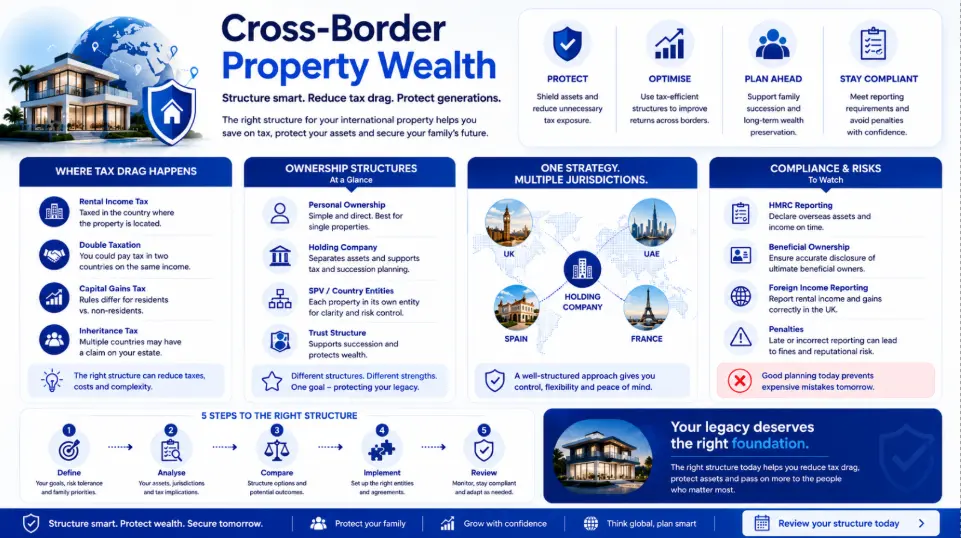
What Creates Tax Drag in International Property Portfolios?
Cross-border rental income taxation
Cross border rental income tax is often the first surprise for people who buy abroad. If you are a UK resident with a property in France or Spain, the rent is usually taxed where the property sits. It may also be taxable in the UK.
Without a plan, you can end up paying tax on the same income twice. This is one of the most common and costly issues for cross-border investors.
Double taxation and tax treaty complications
The UK has tax treaties with many countries. These include Spain, France, Italy, and the UAE. The treaties can help prevent double taxation on property income. But they do not act on their own.
The relief you get depends on how you hold the asset. It depends on the type of income. And it depends on whether you claim the right relief at the right time.
Many investors assume a treaty protects them fully. It usually does not. Misreading a treaty is one of the costliest errors in cross-border ownership.
Capital gains taxes across jurisdictions
Non-resident CGT on UK property sale has applied to overseas owners since 2019. If a non-resident sells a UK property, any gain is subject to UK capital gains tax.
That same gain may also be taxed in the owner’s home country. How these two charges interact is key to know before you sell.
Inheritance and succession taxes
Property inheritance tax in the UK is an area most investors leave too late. UK inheritance tax can apply to UK assets even when the owner lives overseas.
Overseas properties may also carry local succession taxes. These can clash with UK rules. Without a plan, a large part of family wealth can be lost at the point of transfer.
Hidden costs that reduce real estate returns
A poor setup creates other costs, too. Higher loan rates through the wrong legal entity. Complex accounts across multiple filings. Fines for missed reports. Limits on refinancing.
These costs rarely appear in an initial model. But they are real. And they add up over time.
International Property Ownership Structures Explained
Personal ownership
Owning property in your own name is simple. It is also often the most costly option from a tax point of view. Income is taxed at your personal rate. Gains fall under personal CGT. On death, the asset forms part of your estate.
For one property with modest income, this may work. For a growing portfolio, it usually does not.
Real estate holding company structure
A real estate holding company structure lets rental income sit inside a company. That income is taxed at the corporation tax rate. In the UK, this is currently 25 percent for profits above 250,000 pounds.
You can draw income from the company in a way that suits your own tax position. This works well for higher rate taxpayers with more than one property. But the setup needs care, and you will need a clear exit plan for when you eventually sell.
International property holding structures and SPVs
A Special Purpose Vehicle, or SPV, is a separate legal entity set up to hold one property. International property holding structures that use SPVs keep each asset separate.
This limits the risk to just that one asset. It also makes it easier to sell or refinance one property without affecting the others. SPVs work well when more than one investor is involved, or when a property carries development risk.
Real estate fund structures
A real estate fund structure is used on a larger scale. It typically involves three or more investors who pool their money into one vehicle. Funds can access assets and tax treatment not open to individual buyers.
They also carry higher setup and running costs. They are not the right fit for everyone.
Trust structures for succession planning
Trusts are mainly used for succession and asset protection. Placing property in a trust can take it outside your estate over time. It lets you decide who gets what, and when.
The tax rules around trusts are complex. Trustees carry legal duties. But used well, a trust is one of the most effective tools for passing wealth to the next generation.
Which Property Ownership Structure Fits Your Situation?
The right choice depends on where you live, how many properties you hold, your income level, and your long-term goals. The table below is a starting point. It is not a personal recommendation.
| Structure | Best For | Liability Risk | CGT Treatment |
|---|---|---|---|
| Personal Ownership | 1 to 2 properties | Full personal liability | Yes, at personal rate |
| Ltd / Holding Co | Portfolios, rental income | Low with proper setup | Corp tax rate (25%) |
| SPV | Single asset, joint investors | Ring fenced per asset | Corp tax rate |
| Real Estate Fund | Large portfolios, 3 or more investors | Regulated, low personal risk | Fund level treatment |
| Trust | Succession, family wealth | Complex, trustee liability | Trustee rate applies |
| Offshore Structure | Non-UK residents, complex needs | High compliance burden | Depends on residency |
Real-World Cross-Border Property Scenarios
UK resident buying property in Dubai
UAE property, UK tax implications, and ownership often catch buyers off guard. Dubai has no income tax or capital gains tax on property.
But if you are a UK tax resident, your worldwide income must be reported to HMRC. This includes rent from Dubai. The UK and UAE have a tax treaty, but it does not remove the UK tax charge for UK residents.
You pay no tax in Dubai. But you still owe tax in the UK. How you own the asset can change the outcome.
UK resident with property in Spain and the UK
Spain, France, Italy UK property double tax treaty rules mean you can often offset Spanish rental tax against your UK liability.
But many investors file two separate returns without linking them. The result is a higher tax bill than needed. It can also cause issues on both sides of the border.
Non-residents buying UK property
Buying UK property as a non-resident tax guide highlights a few key charges. A 2 percent Stamp Duty surcharge applies to non-residents. Income tax applies on UK rental income. Non-resident CGT applies on any future sale.
Non-resident landlords must also sign up with HMRC under the Non-Resident Landlord Scheme. The UK non-resident property tax picture is wider than most buyers expect. It pays to know it before you complete the purchase.
Relocating abroad while keeping UK property
Moving out of the UK does not end your UK tax duties on UK property. Rental income stays subject to UK income tax. On sale, CGT still applies.
If you spend too many days in the UK after moving, the Statutory Residence Test can affect your tax position. The year you leave tends to be the most complex. Get advice before you go, not after.
Offshore Property Structures, Benefits, Risks and Common Misconceptions
How offshore ownership structures work
Property tax structuring offshore usually means holding property through a company in a low or zero tax location. Common examples are Jersey, the Isle of Man, or the Cayman Islands.
The setup can offer benefits around deferred gains, succession, and mobility. But it comes with real running costs. These setups must be properly kept up to stay within the rules.
Offshore company ownership and ATED considerations
Offshore company UK property ATED 2026 is a live issue. The Annual Tax on Enveloped Dwellings, or ATED, applies to UK residential properties worth more than 500,000 pounds. It applies to any company that holds the asset, including offshore ones. The annual charges can be large.
ATED relief is available in some cases. One example is where the property is let on a commercial basis. But the relief must be claimed each year correctly. Weigh the cost against the benefit before going down this route.
Cross-Border Property Compliance Requirements for UK Investors
HMRC overseas reporting obligations
Foreign property rental income UK tax return must be filed each year if you are a UK tax resident. This covers all overseas properties, even where income has already been taxed abroad.
The Self-Assessment return has a section for overseas income. All figures must be converted to sterling at the correct rate.
Beneficial ownership disclosure requirements
HMRC register of overseas entities UBO compliance is now a legal duty. Since 2023, overseas companies, partnerships, and trusts that own UK land must register with Companies House. They must name the people who own or control them.
Failure to register carries criminal penalties. This is not a rule that can be ignored.
Foreign property income reporting obligations
Overseas property UK tax implications on the reporting side include annual Self-Assessment filing. They may also include local country returns where required. In some cases, further reporting applies to investors in fund or holding setups.
Non-disclosure is not a strategy. HMRC is actively working to find it.
Penalties for non-compliance
HMRC has increased its focus on offshore income in recent years. Fines for unreported overseas income can reach 200 percent of the tax owed in serious cases.
The Worldwide Disclosure Facility is still open. Those who want to put past issues right before HMRC makes contact can use it. Acting early is always the better choice.
Common Mistakes That Increase Tax Drag
- Buying in your own name without thinking about future income or growth plans
- Assuming a double tax treaty removes all liability. It usually reduces it, not removes it.
- Failing to report rental income in both countries when the rules require it
- Offshore company UK property ATED 2026 charges being missed at the purchase stage
- Picking a setup that works today but causes problems on sale or death
- Holding property with others without a clear co-ownership agreement in place
- Changing the setup after purchase, which can trigger a disposal and a tax charge
- Missing the Stamp Duty Land Tax surcharge as a non-resident buyer
- Missing beneficial ownership reporting deadlines with Companies House
How to Build a Long-Term Cross-Border Property Wealth Strategy
Structuring for tax efficiency
Tax-efficient property ownership in the UK starts at the point of purchase. The goal is not to pay no tax at all. The goal is to avoid paying more than you legally owe.
Choosing the right setup from day one costs far less than fixing a poor one later. Work with advisers who know both UK tax rules and the rules of the country where the property sits. One side of the picture is not enough.
Structuring for family succession
Succession planning is often left until it is too late. Real estate wealth structure with inheritance in mind usually means a trust or a company where shares, not the property itself, can be passed on.
This can reduce inheritance tax. It also allows wealth to move to the next generation over time, rather than all at once.
Structuring for asset protection
Asset protection means keeping each property and its liabilities separate from your personal finances. SPVs and holding companies are the main tools used here.
If one asset creates a legal claim, the others stay protected. This matters most when properties are let on a commercial basis or carry development risk.
Structuring for future flexibility
Circumstances change. A setup that works well today may become a problem if you move country, go through a divorce, or bring in new partners. International property holding structure design should allow the asset to be sold, refinanced, or transferred without a large, unexpected tax charge.
Building flexibility in from day one is far cheaper than adding it later.
Frequently Asked Questions
Yes. The UK is part of the Common Reporting Standard, or CRS. This allows the automatic sharing of financial data across more than 100 countries. HMRC receives this data from banks and financial firms abroad.
Since 2023, overseas companies that own UK land must also register with Companies House and name their beneficial owners.
If you are a UK tax resident, yes. UK residents pay tax on their worldwide income. That includes rent from properties abroad. Tax paid in the other country may reduce your UK bill under a treaty. But the income must still appear on your UK Self-Assessment return each year.
Double taxation on property income relief is available through the relevant tax treaty. You can usually claim a credit for tax already paid overseas. This reduces, but does not always remove, the UK liability. The relief must be actively claimed and used in the right way.
The best structure for foreign property in the UK depends on your situation. Personal ownership suits small portfolios. Companies and SPVs suit larger ones. Trusts are used for succession. The right answer depends on your residency, income, and goals. There is no single answer that fits everyone.
Non-resident CGT on UK property sale applies to UK residential property sales since 2015 and commercial property since 2019. Non-residents must report and pay any CGT within 60 days of completing a UK property sale.
What to Do Next
Cross-border property can build real wealth. But only if the setup is right from the start. The investors who keep the most are not always those with the most assets. They are the ones who planned early, not late.
UK property wealth structuring is not a one-time decision. It needs reviewing as rules change, as your residency changes, and as your goals shift. A setup that worked five years ago may not serve you well today.
A review of your cross-border property position covers both what you hold and how you hold it. That is often the most useful step you can take. At Lanop, we work with UK residents, non-residents, and international investors to review property setups, assess tax exposure, and build long-term plans. If you want to know where your current position stands, get in touch to arrange an initial call.