
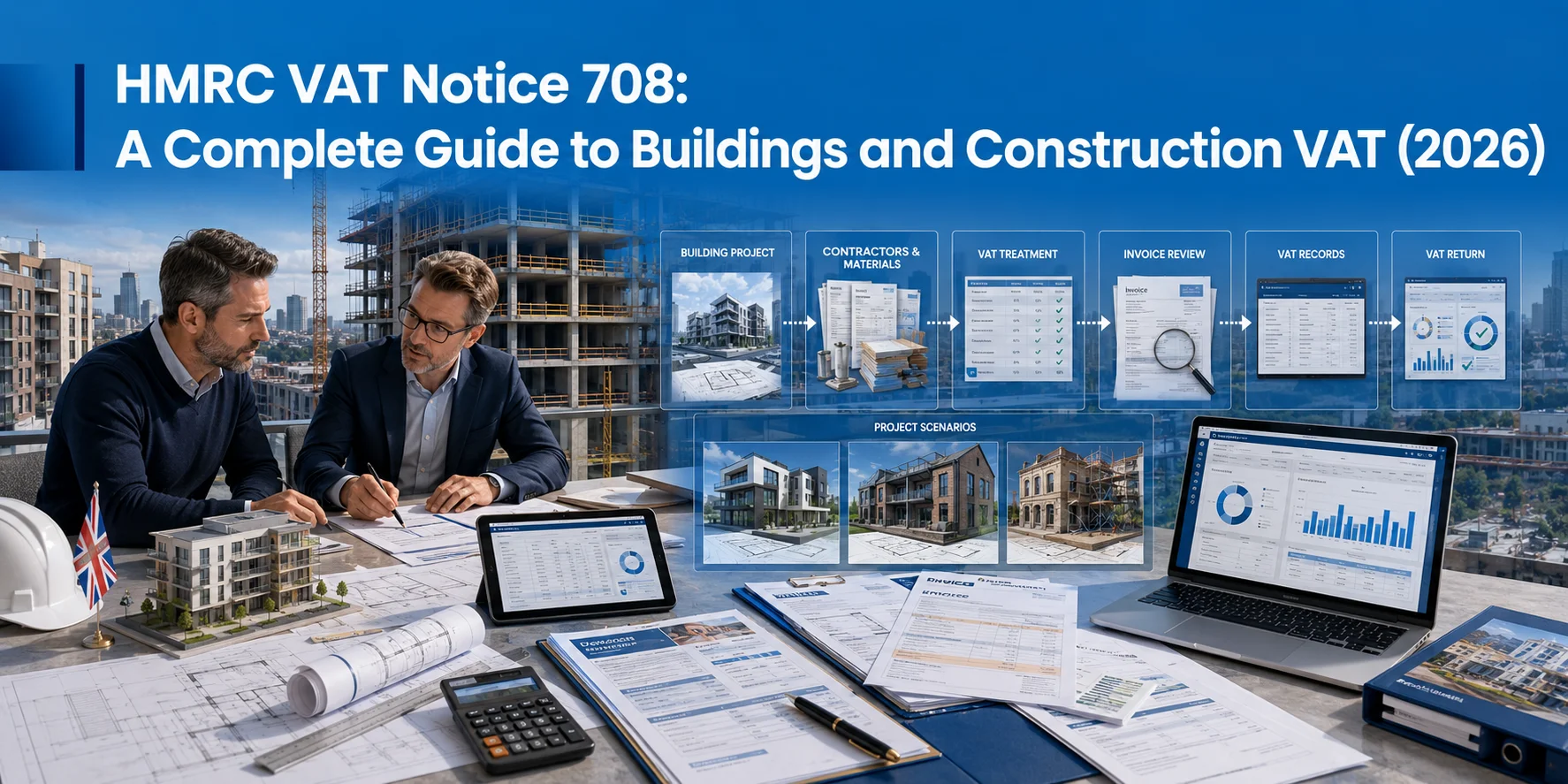
Construction VAT is confusing. Even skilled builders get it wrong. One job can carry three VAT rates at once. A wrong rate costs money. Charge too little, and you owe HMRC the gap. Charge too much, and you may lose the job. That’s why VAT Notice 708 matters. It’s HMRC’s rulebook for VAT on building work. It sets your invoice rate: 0%, 5%, or 20%.
This guide breaks down VAT Notice 708 in plain terms. You’ll see how the rules work. You’ll see which rate fits your job. And you’ll learn how to stay safe if HMRC asks questions.
What Is HMRC VAT Notice 708?
VAT Notice 708 is HMRC’s guide to VAT on UK buildings and construction. It covers builders, developers, contractors, charities, housing bodies, and self-builders. Depending on the supply, the VAT treatment may be zero rated (0%), reduced rated (5%), standard rated (20%), exempt, or outside the scope of VAT. Good evidence and correct invoices are key.
In short, VAT Notice 708 tells you how to charge VAT on building work and materials. HMRC treats construction as standard rated by default. The notice lists the exceptions to that rule.
What does VAT Notice 708 cover?
The notice covers new builds, conversions, renovations, extensions, repairs, and demolition. It also covers materials, labour, certificates, and the DIY housebuilder scheme.
Who must comply with VAT Notice 708?
VAT rules are relevant to anyone supplying building work, but only VAT-registered businesses charge VAT. VAT-registered builders, subcontractors, developers, and other firms must apply the correct treatment to the supplies they make.
Is VAT Notice 708 legally binding?
VAT Notice 708 is HMRC guidance, but some parts have force of law. In particular, the certificates in sections 18.1 and 18.2 have force of law under Note 12, Group 5, Schedule 8 of the VAT Act 1994. Where a certificate is required, it must contain the prescribed information and declaration.
Recent HMRC VAT Notice 708 Updates Relevant in 2026
The VAT Notice 708 page itself was last updated on 26 June 2025, when HMRC clarified wording in paragraphs 7.6 and 8.4. On 24 January 2024, HMRC updated sections 18.1 and 18.2 to confirm that the certificates have force of law under Note 12, Group 5, Schedule 8 of the VAT Act 1994.
For 2026, HMRC’s separate VAT Tertiary Legislation for land, buildings and construction was updated on 1 April 2026. DIY housebuilder claims can be made online or using form VAT431NB; for buildings completed on or after 5 December 2023, a single claim must generally be made within six months of completion.
Use the current HMRC guidance and certificate requirements when you invoice or prepare a claim. A certificate is only needed in specified cases, and HMRC allows a customer to create its own certificate if it contains the same required information and declaration.
UK construction VAT rules touch more people than you’d think. Here’s who leans on this guide most, and why it matters to them.
Who Should Use VAT Notice 708?
HMRC VAT Notice 708 is relevant to far more than large construction companies. Anyone involved in building, renovating, developing, or managing property may need to apply these rules. Understanding how the guidance affects your role can help you charge the correct VAT rate, avoid costly mistakes, and stay compliant with HMRC requirements.
Builders
Builders rely on VAT Notice 708 to determine whether labour and materials should be charged at 0%, 5%, or 20% VAT. Applying the wrong rate can reduce profit margins, create disputes with clients, and lead to HMRC assessments. Whether you’re constructing a new home or completing a renovation, understanding the correct VAT treatment before invoicing is essential.
Contractors and Subcontractors
Contractors and subcontractors must apply the correct VAT treatment throughout a project. On larger developments involving multiple trades, one incorrect VAT decision can affect every invoice in the supply chain. Following the guidance helps ensure consistent billing and reduces the risk of costly corrections later.
Property Developers
For developers, VAT has a direct impact on project profitability. HMRC VAT Notice 708 explains when new builds, conversions, and qualifying developments can benefit from zero-rated or reduced-rate VAT. Getting these rules right from the planning stage helps protect margins and prevents unexpected tax liabilities.
Self-Build Homeowners
Most self-builders only deal with construction VAT once, making the process unfamiliar. VAT Notice 708 helps explain when VAT paid on eligible building materials can be reclaimed through the DIY Housebuilders’ Scheme. Missing the required evidence or claim deadline could mean losing the opportunity to recover thousands of pounds in VAT.
Property Investors and Landlords
Investors and landlords renovating older properties or converting commercial buildings into homes need to understand when the 5% reduced VAT rate applies. Correctly identifying qualifying projects can significantly reduce refurbishment costs and improve the overall return on investment.
Housing Associations
Housing associations often manage large residential developments and conversion projects. Applying the correct VAT treatment across multiple properties helps maintain compliance, reduces administrative errors, and supports efficient project management.
Charities
Certain buildings used solely for relevant charitable or residential purposes may qualify for zero-rated VAT. However, charities must meet HMRC’s conditions and provide the correct certification. Understanding these requirements before construction begins helps avoid disputes and protects valuable project funding.
Accountants
Accountants play a key role in helping construction businesses apply the correct VAT treatment and submit accurate VAT returns. Because construction VAT rules are complex and frequently reviewed by HMRC, identifying potential issues early can prevent expensive corrections and penalties.
VAT Advisers
Complex developments, mixed-use buildings, charity projects, and large-scale conversions often require specialist advice. VAT advisers review contracts, project structures, and supporting documentation before work begins to reduce compliance risks. At Lanop, our team helps businesses apply the correct VAT treatment from the outset, giving clients greater confidence before the first invoice is issued.
How Construction VAT Works in the UK
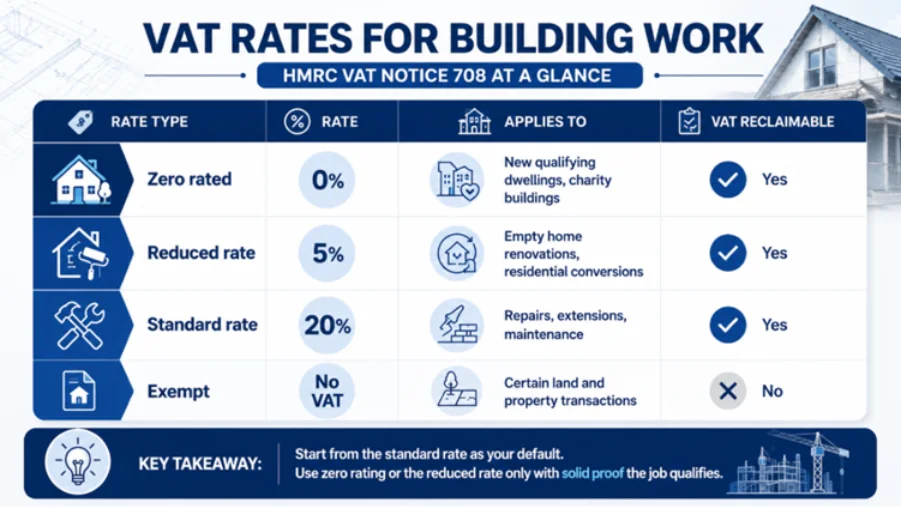
Most construction VAT decisions in this guide fall into four common treatments. The exact treatment depends on the supply, the building, and whether the conditions in HMRC guidance are met.
- Zero rated VAT: 0% charged, but you can often claim back input VAT.
- Reduced rate VAT: 5% charged on qualifying conversions and renovations.
- Standard rate VAT: 20% charged on most repairs, upkeep, and general building work.
- VAT exemption: no VAT charged, and you usually can’t claim back input VAT.
How to Determine the Correct VAT Rate for Building Work
Ask three things before your invoice. What type of building is this? What work is being done? What proof do you have?
Use this simple path:
- Is this a brand-new home or charity building? Check zero rating first.
- Is this a qualifying conversion or an empty home fix-up? Check the 5% rate.
- Is this a repair, extension, or general upgrade? The standard rate almost always applies.
- Does the building mix commercial and qualifying residential areas? Apportion the charge on a fair and reasonable basis and apply the correct VAT treatment to each part.
VAT Domestic Reverse Charge for Construction Services
From 1 March 2021, the VAT domestic reverse charge can apply to standard- and reduced-rated building and construction services between UK VAT-registered businesses where the payment is reported under the Construction Industry Scheme (CIS). It does not apply to zero-rated construction services.
When the reverse charge applies, the supplier does not charge the customer VAT in the normal way. Instead, the customer accounts for the VAT on its own VAT Return. Exceptions and special rules apply, including for end users and some services supplied on their own, so the HMRC reverse-charge guidance should be checked before invoicing.
Zero-Rated Construction Under VAT Notice 708
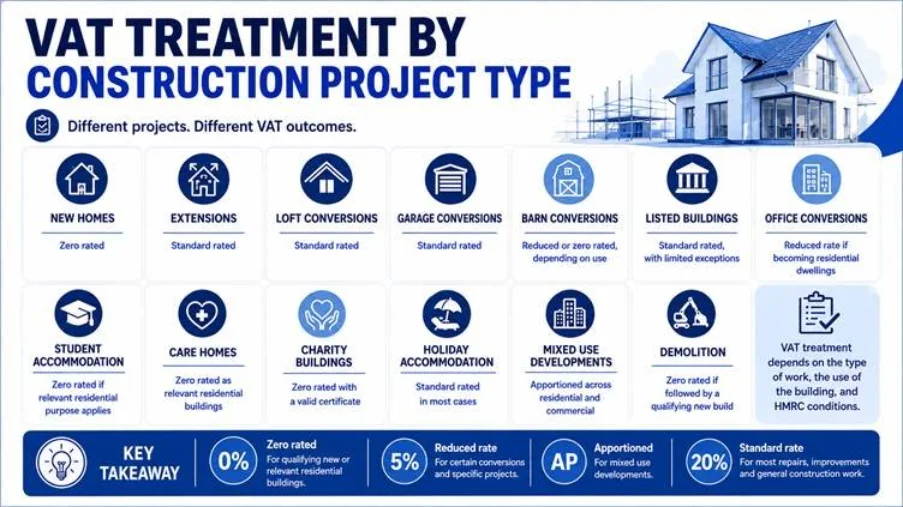
Zero rated VAT applies only where HMRC’s conditions are met. This includes qualifying new dwellings, certain buildings intended solely for a relevant residential purpose, and certain buildings intended solely for a relevant charitable purpose.
Labour on qualifying construction can be zero rated. Building materials supplied and incorporated by the builder can also follow the zero rate, but only if they meet HMRC’s definition of ‘building materials’.
Proof matters. Keep planning consent and completion evidence, a certificate where HMRC requires one, and records showing that the work meets the qualifying construction conditions rather than being ordinary work to an existing building.
Common Mistake: A ‘granny’ annexe is not automatically zero rated. HMRC says it will not qualify as a dwelling if it cannot be used or disposed of separately from the main house. Shared electricity or water alone does not decide the issue.
Reduced-Rate Construction Under VAT Notice 708
The 5% reduced rate applies only to specified work. It can apply to qualifying residential conversions, including certain conversions that change the number of dwellings or convert non-residential premises into dwellings, and to qualifying renovations or alterations of residential premises that have not been lived in for at least two years before work starts.
Qualifying work to long-empty residential premises can receive the 5% rate. You may need to prove that the premises were not lived in during the two years immediately before work started. Council Tax, Electoral Roll, utility records, or other reliable evidence can support the claim.
Routine refits and general improvements do not qualify just because they are residential. If the specific reduced-rate conditions are not met, or cannot be supported by evidence where evidence is required, the work is normally standard rated.
Standard-Rated Construction Work
Most repairs, routine maintenance, extensions to existing dwellings, and professional services such as architects and surveyors are standard rated at 20%, unless a specific VAT relief applies.
Landscaping, drives, fences, and other external works are often standard rated, but not always. Certain works can qualify for zero rating when they are closely connected with the construction of a qualifying building, such as specified soft landscaping or access works carried out as part of the qualifying construction. Check the detailed conditions rather than assuming a rate.
VAT on Building Materials and Construction Services
When a builder supplies and incorporates goods into a building, qualifying ‘building materials’ normally follow the VAT rate of the qualifying building service. Goods that do not meet HMRC’s building-material definition remain standard rated even where the service is zero rated; special rules apply to reduced-rated work.
Materials you buy yourself work differently. A homeowner buying materials directly from a retailer normally pays 20% VAT. A qualifying DIY housebuilder may later reclaim VAT on eligible materials through the DIY scheme, subject to the scheme conditions.
Some goods do not count as ‘building materials’ for these reliefs. Carpets, many household appliances, and most furniture remain standard rated even when supplied in connection with qualifying construction work.
Construction VAT Certificates and Required Documentation
Certificates are required only for specified qualifying supplies. A contractor or developer needs a valid certificate for zero- or reduced-rated supplies connected with a building used solely for a relevant residential purpose, and for zero-rated supplies connected with a building used solely for a relevant charitable purpose. No certificate is required for supplies connected with ordinary qualifying dwellings under HMRC’s dwelling rules, and holding a certificate does not by itself make a supply qualify for relief.
Keep these records:
- Signed certificates from the customer, where required
- Planning permission papers
- Building sign-off certificates
- Invoices that show the right VAT rate and why
- Proof of empty periods, like council tax records
- Letters that confirm charity or home use
Keep records for at least six years. That’s the standard rule for VAT. Digital storage under Making Tax Digital makes this easier.
Common Construction VAT Mistakes That Lead to HMRC Penalties
These repeat errors can lead to VAT assessments, interest, and penalties:
- Charging the wrong VAT rate from the start
- Missing a required certificate or using one that lacks the required information or declaration
- Missing proof for an empty home claim
- Treating an extension like a new build
- Writing invoice notes that don’t match the work done
- Failing to split mixed use jobs the right way
- Assuming self-bought materials share the labour rate
Each error is easy to dodge. A quick check before you send the invoice does the job.
HMRC Construction VAT Compliance and Inspections
During a VAT compliance check, HMRC may review certificates, invoices, planning documents, completion evidence, and other records that support the VAT treatment. You should be able to explain why each rate or relief was applied.
If the records do not support the VAT treatment, HMRC can assess underdeclared VAT and may charge interest and penalties. A consistent audit trail is therefore more important than relying on assumptions about similar projects.
Prepare with a clear paper trail on every job. Store certificates next to invoices. And check your VAT choice before work starts, not after. If HMRC does open a formal check, having support through an HMRC tax investigation makes the process far less stressful.
Construction VAT Penalties and How to Avoid Them
Penalties for VAT return errors depend on the behaviour behind the inaccuracy. Careless or deliberate errors can be penalised, while an error made despite taking reasonable care is not penalised. Late payment interest can also apply where VAT was not paid by the due date.
If you find an error, correct it promptly using HMRC’s VAT error-correction rules. Telling HMRC about a careless error before you have reason to believe they have found it can reduce the penalty.
Best practice is simple: check the VAT rate before you invoice. Don’t wait for a client query or an HMRC letter to force your hand.
Can You Reclaim VAT on Building Work?
VAT-registered builders and developers can generally deduct input tax on costs that relate to taxable supplies, including zero-rated supplies, subject to the normal input-tax, partial-exemption, and blocked-input-tax rules.
Qualifying self-builders can claim through the DIY scheme. For buildings completed on or after 5 December 2023, the single claim must generally be submitted within six months of completion, with the required evidence.
Charities do not automatically recover VAT just because a building qualifies for zero rating. Zero rating can remove VAT from qualifying construction supplies, while recovery of VAT on other costs depends on the charity’s VAT status and whether those costs relate to taxable business activities.
Homeowners doing a general refit usually can’t claim VAT back. This counts as private spend, not business spend.
Practical Construction VAT Examples
Example 1: Builder constructing a new house
VAT rate: Zero rated, if HMRC’s qualifying new-dwelling conditions are met. Reason: qualifying construction of a new dwelling. HMRC treatment: qualifying construction services and qualifying building materials supplied and incorporated by the builder can be zero rated. Common mistake: treating every post-completion or separately supplied service as zero rated; the work must fall within the qualifying construction rules.
Example 2: Homeowner extending their kitchen
VAT rate: Standard rated. Reason: it’s an extension to an existing home, not a new build. HMRC treatment: full 20% applies to labour and materials. Common mistake: thinking nearby new-build work shares the zero rate.
Example 3: Developer converting offices into flats
VAT rate: Reduced rate on qualifying conversion services. Reason: converting non-residential offices into dwellings can qualify under the conversion rules. HMRC treatment: 5% VAT on qualifying services, with a fair and reasonable apportionment where part of the building remains commercial. Common mistake: applying the 5% rate to non-qualifying commercial areas.
Example 4: Owner renovating a home empty for three years
VAT rate: Reduced rate, if the conditions are met. Reason: the dwelling was not lived in during the two years immediately before work started. HMRC treatment: 5% VAT on qualifying renovation or alteration services. Common mistake: failing to retain reliable evidence of the empty period.
Construction VAT Checklist Before You Invoice
Run through this list before every invoice goes out:
- Confirm the exact project type and its rules
- Pick the correct VAT rate for that work
- Check if a certificate is needed, and that the wording is current
- Gather your papers, including planning permission
- Check the invoice wording matches the work done
- File and store records for at least six years
Key Takeaway: A five-minute check before you invoice costs far less than fixing an HMRC penalty later.
When Should You Seek Professional Construction VAT Advice?
DIY VAT calls get risky as a job grows in size or scope. Mixed use jobs, charity projects, and big developments all carry higher stakes.
Complex conversions, disputed empty home claims, and multi-phase builds are where errors sneak in unnoticed.
This is where expert VAT advice earns its cost back many times over. At Lanop, our team checks contracts, certificates, and project setups before you invoice. That way, you charge the right rate the first time. And you dodge disputes with HMRC later.
Frequently Asked Questions
VAT Notice 708 is HMRC’s official guidance explaining how VAT applies to buildings and construction work in the UK. It covers when building work and building materials can be zero rated or reduced rated, when standard rating applies, and when sales or leases of buildings may be zero rated, standard rated, exempt, or outside the scope of VAT.
VAT Notice 708 applies to builders, contractors, subcontractors, property developers, self-build homeowners, charities, housing associations, and anyone involved in construction projects where VAT rules affect labour, materials, or property development.
Zero-rated VAT can apply to qualifying construction of new dwellings, certain buildings intended solely for a relevant residential purpose, and certain buildings intended solely for a relevant charitable purpose. The detailed HMRC conditions must be met and, where required, supported by a valid certificate and other evidence.
The 5% reduced VAT rate can apply to specified residential conversions and to qualifying renovations or alterations of residential premises that have not been lived in for at least two years before the work starts. The exact conditions vary by project, and businesses should retain evidence supporting the reduced-rate treatment.
Charging too little VAT can result in HMRC assessing the underdeclared tax, with late payment interest and, where the error is careless or deliberate, a possible penalty. Charging too much VAT also needs to be corrected properly. Checking the VAT treatment before issuing an invoice helps avoid costly corrections and disputes.
Conclusion
The right VAT choice comes down to three things. The type of work. The proof you hold. And how closely you follow HMRC’s rules.
Check your project before you invoice. Don’t wait until a client asks about the rate or HMRC opens a review. A quick check now saves a costly fix later.
Expert advice cuts your risk of penalties, disputes, and lost profit on your next job. It also gives you confidence when HMRC does come asking.
Ready to get your construction VAT right, every time? Talk to Lanop Business and Tax Advisors. Our team supports builders, developers, contractors, and self-builders with VAT registration, compliance reviews, HMRC support, VAT returns, and ongoing construction accounting guidance. Contact us today and invoice your next project with confidence.