
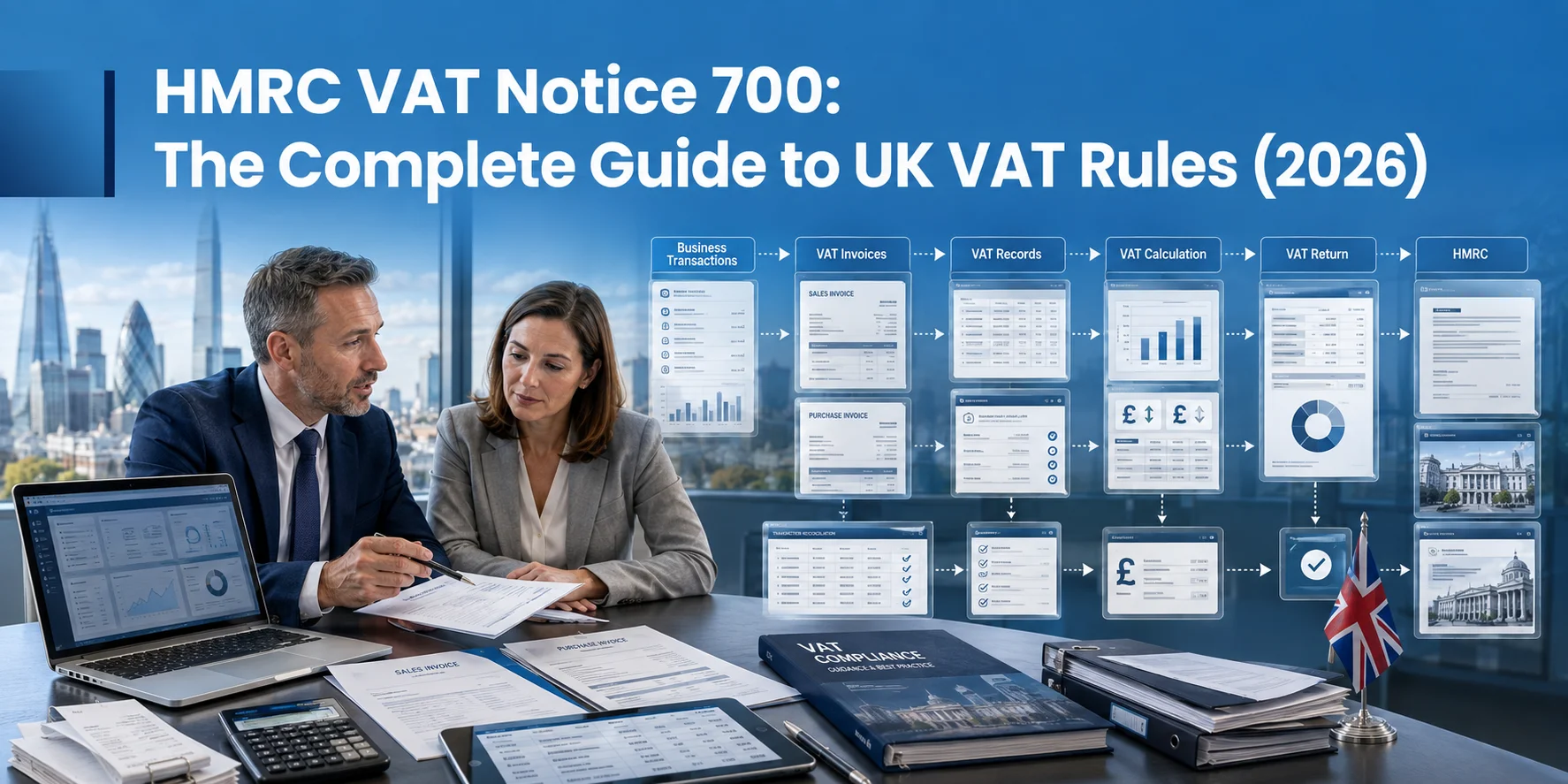
VAT Notice 700 is HMRC’s master guide to VAT in the UK. It covers registration. It covers charging VAT. It also covers filing returns and reclaiming VAT on business costs.
This guide is for anyone who finds VAT Notice 700 hard to use alone. That includes sole traders nearing the threshold. It includes companies setting up VAT for the first time. It also includes finance teams who just want to check they’ve got the basics right.
In 2026, the registration threshold stays at £90,000. HMRC’s late payment penalties have gone up. Making Tax Digital applies to VAT-registered businesses unless exempt. This guide walks through what changed. It also tells you what to do about it.
Think of this as a consultation, not legislation. Every section ends with a clear next step.
What Is HMRC VAT Notice 700?
What Is VAT Notice 700?
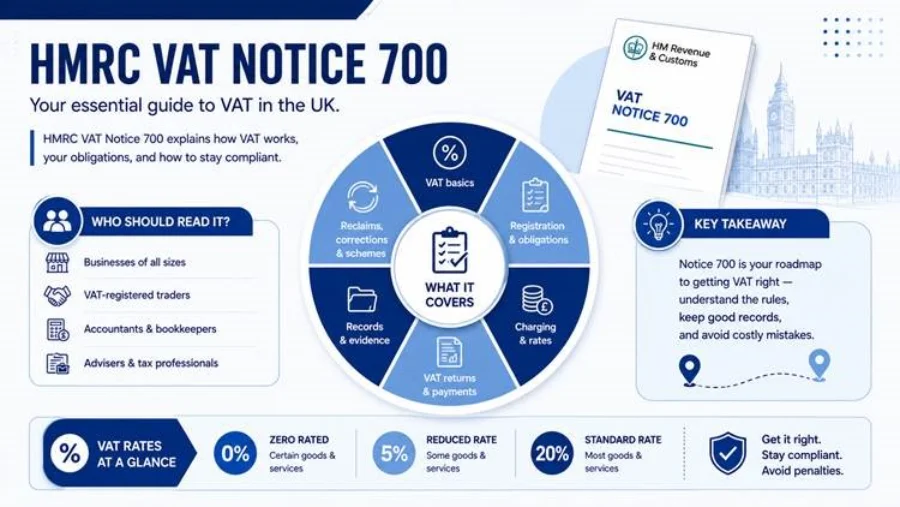
VAT Notice 700, also known as notice 700 the VAT guide, is HMRC’s general guide to VAT. It explains how VAT applies to most UK businesses. It walks you from registration through to your first return. It isn’t law itself. It’s simply HMRC’s explanation of the law.
Who Should Follow VAT Notice 700?
Any VAT registered business should know this notice. Businesses considering VAT registration should also use it as a reference point, including sole traders, limited companies, partnerships, contractors and online sellers.
Why VAT Notice 700 Matters for UK Businesses
VAT mistakes come with a price. Whether it’s applying the wrong VAT rate, missing a deadline, or making an incorrect claim, HMRC can add penalties and interest. That’s why VAT Notice 700 matters. It is HMRC’s main VAT reference guide and helps businesses understand VAT returns, records and compliance.
VAT Notice 700 vs UK VAT Legislation
VAT Notice 700 explains HMRC’s view of the law. It isn’t legally binding on its own. The underlying VAT legislation is. HMRC guidance shows how the rules work in practice, but legislation takes priority. For unusual or high value transactions, get a specific check done first.
Latest HMRC Updates to VAT Notice 700 (2026)
- The registration threshold remains at £90,000. Deregistration is £88,000. Both have applied since 1 April 2024 and remain current in 2026.
- Late payment penalties from April 2025 remain in place. That’s 3% of unpaid VAT at day 15. Another 3% at day 30. Then 10% a year from day 31.
- As at August 2026, late payment interest is 7.75%, calculated at the Bank of England base rate plus 4%.
Understanding the UK VAT System Before Using VAT Notice 700
How VAT Works, Output VAT and Input VAT
VAT is a tax on most goods and services. Registered businesses charge output VAT on sales. They pay input VAT on purchases. Each period, you pay HMRC the difference. Or you claim a refund if input VAT is higher.
Taxable, Zero-Rated, Exempt and Outside-the-Scope Supplies
| Supply type | VAT rate | Counts toward £90,000 threshold? |
|---|---|---|
| Standard rated | 20% | Yes |
| Reduced rated | 5% | Yes |
| Zero rated | 0% | Yes |
| Exempt | No VAT | No |
| Outside the scope | Not a VAT supply | No |
When VAT Becomes Chargeable
VAT becomes due at the “tax point”. This varies by transaction. It is usually the date of supply, the VAT invoice date, or an earlier payment date. The tax point decides which VAT period the transaction belongs to.
Common VAT Terms Every Business Should Know
Taxable turnover is the sales figure that counts toward registration. Tax point is the date VAT falls due. Partial exemption applies when a business makes both taxable and exempt supplies.
VAT Registration Rules Explained
Who Must Register, and When Voluntary Registration Makes Sense
You must register once taxable turnover goes over £90,000 in any rolling 12-month period. Check this at the end of each month; it doesn’t follow your accounting year. You must also register if you expect taxable turnover to exceed £90,000 in the next 30 days alone.
Voluntary registration can suit businesses selling mainly to VAT-registered customers that can fully reclaim the VAT. It may suit you less where customers cannot reclaim it, such as many consumers, because VAT can increase the effective price or reduce your margin.
Current VAT Registration Thresholds
Registration is £90,000. Deregistration is £88,000. This applies where a registered business has lower taxable turnover. Both figures have applied since 1 April 2024 and remain current in 2026.
Late and Backdated VAT Registration
Miss the 30-day notification deadline, and HMRC can backdate registration and collect VAT from the date you should have registered. A failure-to-notify penalty may also apply. Its amount depends on potential lost revenue, your behaviour and your disclosure. An unprompted disclosure can reduce the penalty.
Cancelling VAT Registration
You can apply to deregister once taxable turnover falls below £88,000, or if you stop trading. HMRC usually confirms cancellation within 40 working days, though it can take longer. You’ll still need to complete the final VAT obligations.
VAT Notice 700/1 and VAT Notice 700/11 Explained
VAT Notice 700/1 covers who must register, the thresholds, and how to notify HMRC. Read this first if you’re near the threshold. VAT Notice 700/11 covers cancelling registration. It also covers VAT on any assets you still hold when you deregister.
Charging VAT Correctly
VAT Rates and When to Charge Them
Most goods and services are standard rated at 20%. Some, like home energy, are reduced rated at 5%. Others, including most food, are zero rated. Always check the specific item against HMRC’s categories. Don’t just assume from similar products. VAT is charged at the tax point, using whichever rate applies on that date.
Issuing VAT Invoices Correctly
A full VAT invoice needs a unique number, issue date, tax point, supplier and customer details, VAT number, a description of the supply, net amounts, VAT rates and total VAT. Simplified invoices have different rules.
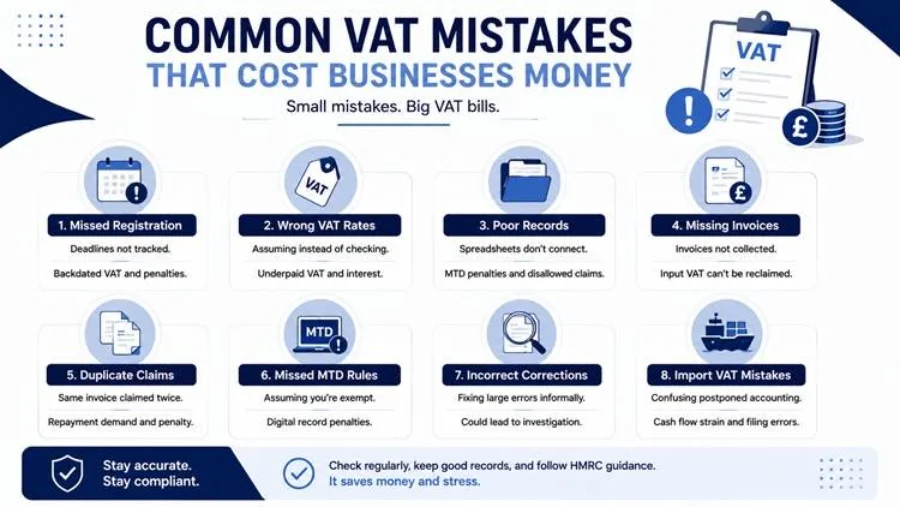
Common Mistake: Sending invoices with no VAT breakdown. This can stop your customer reclaiming input VAT. It can also flag your own records during a check.
Common VAT Charging Mistakes
- Charging VAT on exempt sales.
- Using the wrong rate for mixed supplies.
- Forgetting VAT on delivery charges.
- Missing the VAT number on invoices.
VAT Returns and Making Tax Digital
How VAT Returns Work
Most businesses file quarterly. Some file monthly, others annually. Each return reports three things. The output VAT you charged. The input VAT you reclaimed. And the net amount owed to or from HMRC.
Completing a VAT Return Step by Step
- Total your sales and output VAT.
- Total your purchases and input VAT.
- Work out the difference.
- Check your figures against your digital records.
- Submit through MTD compatible software.
- Pay any VAT owed by the deadline.
VAT Return Boxes and Deadlines
The return has nine boxes. They cover output VAT, input VAT, net VAT due, and total sales and purchases. Box 5 shows what you owe, or what you can reclaim. Returns and payment are usually due one month and seven days after your VAT period ends. Mark this date well. Miss this, and you’ll pick up penalty points, even on a nil return.
Correcting Returns and Digital Record-Keeping
Errors of £10,000 or less can usually be fixed on your next return. Errors between £10,000 and £50,000 can also be adjusted if they do not exceed 1% of box 6. Other errors must be reported separately to HMRC online or in writing; VAT652 is no longer used. VAT businesses subject to MTD must keep digital records, ideally through bookkeeping linked to VAT software. Required digital links must be kept. Exempt businesses follow HMRC’s alternative filing rules.
VAT Notice 700/12, 700/21 and 700/22 Explained
VAT Notice 700/12 explains each return box. VAT Notice 700/21 covers record keeping. VAT Notice 700/22: Making Tax Digital for VAT covers digital records and software. MTD applies to VAT-registered businesses unless exempt.
Reclaiming VAT Correctly
When Input VAT Can Be Reclaimed
You can reclaim VAT on purchases used for taxable business activities. You’ll need a valid VAT invoice. The cost also can’t be personal.
Usually qualifies: stock and materials, business equipment, professional services and genuine business travel.
Usually does not qualify: client entertainment, costs linked to exempt supplies, personal expenses and most cars.
Reclaiming Without an Invoice, Vehicles and Mixed Expenses
HMRC can sometimes accept alternative documentary evidence if a valid VAT invoice is unavailable, but this is discretionary. Try to get a replacement invoice first. VAT on cars is usually blocked unless strict business-only or other qualifying conditions are met. For mixed business and personal costs, reclaim only the business share.
VAT on Imports, Exports and International Trade
Import, Export and Postponed VAT Accounting
Import VAT applies to goods brought into the UK under the import valuation rules. VAT-registered businesses can use postponed VAT accounting to declare and, subject to normal rules, reclaim import VAT on the same return instead of paying it upfront. Exports can usually be zero rated if the conditions are met and valid evidence is kept.
VAT After Brexit and Northern Ireland Rules
Since Brexit, goods moving between Great Britain and the EU are generally imports and exports for VAT and customs. For Northern Ireland, goods moving with the EU generally follow EU VAT rules, while services generally follow UK VAT rules.
International Services and Cross-Border Transactions
VAT on services sold abroad depends on two things. Where your customer belongs, and whether they’re a business or a consumer. This area gets complex fast, so it’s worth a specific check through international and offshore accounting support if you export regularly.
Correcting VAT Errors and Avoiding Penalties
Common Errors and How to Correct Them
Errors often come from wrong VAT rates, transposed figures, missed invoices or duplicate claims. Net errors of £10,000 or less can normally be adjusted on the next return. Errors between £10,000 and £50,000 can also be adjusted if they do not exceed 1% of box 6. Other errors must be reported separately to HMRC online or in writing. VAT652 is no longer used.
Late Filing, Late Payment Penalties and Interest
Late submissions build penalty points. Quarterly filers hit the threshold at 4 points. That triggers a £200 penalty, then £200 for each further late return while at the threshold. Late payment penalties are 3% at day 15, another 3% at day 30, then 10% a year from day 31. As at August 2026, late payment interest is 7.75% from the first overdue day.
Appealing HMRC VAT Penalties
You usually have 30 days to challenge a penalty or accept an HMRC review. A reasonable excuse may lead to cancellation or amendment. VAT Notice 700/45 covers VAT error correction, not late filing or payment penalties.
HMRC VAT Compliance Checks and Audits
Why HMRC Inspects and What It Reviews
HMRC runs compliance checks to verify that VAT Returns and tax treatment are correct. During a check, HMRC may ask to see sales and purchase invoices, VAT Returns, bank statements and the digital records supporting your MTD submissions. The exact scope depends on the issues being checked.
How to Prepare, and What Happens After
- Gather VAT invoices and digital records for the period requested.
- Reconcile your returns against your accounts.
- Note and explain any unusual transactions in advance.
- Bring in an adviser before the meeting, not after.
HMRC confirms its findings in writing. Find an underpayment, and HMRC acts. You’ll usually get a demand for the VAT owed, plus penalty and interest. You still have the right to appeal. Support through an HMRC tax investigation can make this process far less stressful.
Which HMRC VAT Notice Applies to Your Situation?
| Notice | Purpose | Who should use it | Common mistake |
|---|---|---|---|
| VAT Notice 700 | General VAT guide | All VAT registered businesses | Treating it as the only notice needed |
| VAT Notice 700/1 | Who should register | Businesses near the threshold | Registering too late |
| VAT Notice 700/9 | Transfer of a business as a going concern | Businesses buying or selling a business | Missing TOGC conditions |
| VAT Notice 700/11 | Cancelling registration | Businesses closing or under £88,000 | Not accounting for assets on deregistration |
| VAT Notice 700/12 | Completing a VAT Return | Businesses new to filing | Misreading which box a figure belongs in |
| VAT Notice 700/46 | Agricultural flat rate | Qualifying farmers | Eligibility not checked |
| VAT Notice 700/21 | Record keeping | VAT-registered businesses | Missing required records |
| VAT Notice 700/22 | Making Tax Digital for VAT | Businesses subject to MTD | Broken digital links |
| VAT Notice 700/24 | Postage and delivery | Postal and delivery businesses | Wrong VAT treatment |
| VAT Notice 700/34 | Supply of staff | Businesses supplying staff | Wrong staff treatment |
| VAT Notice 700/45 | Correcting VAT errors | Businesses correcting errors | Using VAT652 |
| VAT Notice 700/50 | Default surcharge, historic reference | Businesses with pre-2023 history | Applying old rules to current periods |
| VAT Notice 700/64 | Motoring expenses | Businesses reclaiming vehicle VAT | Claiming VAT on cars incorrectly |
| VAT Notice 700/65 | Business entertainment | Businesses reclaiming entertainment costs | Claiming VAT on client entertainment |
Practical VAT Scenarios for UK Businesses
Registering for the first time: Check your rolling 12-month turnover every month. Register on your own terms near £90,000. Don’t wait to be forced into it.
Correcting an incorrect return: Under the reporting threshold? Adjust it on your current return. Above it? File a formal disclosure with HMRC.
Claiming VAT on expenses: Keep every invoice. Confirm the expense is genuinely for the business. Strip out any personal use first.
Recovering VAT without documentation: Try for a replacement invoice first. Truly can’t get one? Gather secondary evidence and be ready to explain the gap.
Managing VAT for online sales: Track where your customers are based. Treatment differs across UK, EU and international sales, an area where ecommerce accountants can help you stay on top of multiple sales channels.
Buying or selling a business: Check whether it meets the transfer of a going concern conditions under VAT Notice 700/9. If it does, the transfer is generally outside the scope of VAT, so VAT is not normally charged.
Preparing for a compliance check: Reconcile your records early. Gather the documents HMRC has asked for. Bring in an adviser before the first meeting.
HMRC VAT Compliance Checklist for 2026
Before registration: confirm your rolling turnover, decide on voluntary registration, pick your scheme and filing frequency.
Before charging VAT: confirm the correct rate, set up compliant invoice templates, update your pricing.
Before filing returns: reconcile your records, check figures against your MTD software, confirm your deadline.
Before reclaiming VAT: hold a valid invoice for every claim, separate out personal use, exclude blocked categories.
Before an inspection: gather your invoices and digital records, reconcile returns against accounts, prepare explanations for anything unusual.
Frequently Asked Questions
No. VAT Notice 700 is HMRC’s guidance on how it applies UK VAT law in practice. The legally binding rules are set out in VAT legislation, while the notice helps businesses understand and comply with those rules.
Start with VAT Notice 700, as it explains the core VAT rules for most businesses. Then refer to specific notices, such as VAT Notice 700/1 for VAT registration, VAT Notice 700/12 for completing VAT Returns, or VAT Notice 700/22 for Making Tax Digital, depending on your situation.
Yes. Small VAT errors can usually be corrected on your next VAT Return, provided they meet HMRC’s error correction rules. Larger or more significant errors may need to be reported directly to HMRC using the appropriate correction process.
If you register after you should have, HMRC may require you to pay VAT from the date you became liable to register. You could also face penalties and interest, although these may be reduced if you notify HMRC voluntarily and cooperate fully.
Making Tax Digital for VAT applies to VAT-registered businesses unless exempt. Businesses within MTD must keep digital VAT records and submit VAT Returns using compatible software, whatever their turnover. HMRC allows exemptions where digital use is not reasonable or practical.
So, check the bank’s policy before you move. Set up backups before any account is limited.
Conclusion
VAT Notice 700 gives you the framework. But your next step depends on where your business stands right now.
Approaching £90,000 in turnover? Register on time. Don’t wait for HMRC to catch up with you. Already registered? Focus on clean digital records, and returns that reconcile first time, every time.
Made an error? Deal with it now. Prompt correction and disclosure can reduce penalties and interest compared with delaying. Facing a compliance check? Prepare early. Good records and clear explanations matter throughout the process.
VAT compliance isn’t a once-a-year task. Review your VAT position every month. Most of the problems in this guide simply stop happening.
Work With Lanop on Your VAT Compliance
VAT rules change. Deadlines don’t move. Getting it wrong costs real money. Maybe you need help registering for VAT. Maybe it’s setting up Making Tax Digital, preparing accurate returns, fixing past errors, or handling an HMRC compliance check. Whatever it is, Lanop‘s team works through it with you.
Contact us at Lanop today and put your VAT compliance on solid ground before HMRC has reason to look twice, book a free consultation with one of our chartered accountants.