
Your estate may be worth more than you think. House prices have risen. Investments have grown. Many UK families are now in a tax territory they did not plan for. In 2026, the rules are stricter. Key tax-free bands are frozen. And more changes are on the way.
This guide covers the key tools for family wealth planning in the UK. We look at tax thresholds, gifting, trusts, and long-term strategies. By the end, you will know your options and the steps to take next.
Why Family Wealth Planning Matters More in 2026
The Wealth Transfer Challenge
The UK is in the middle of a huge shift. Trillions of pounds will move between families over the next 20 years. Tax receipts keep rising. The IHT allowance 2026 is frozen until at least 2030. As house prices and share values go up, more estates get drawn into the tax net each year.
Why Wealth Fails Across Generations
Most family wealth does not last. Around 70% is gone by the second generation. By the third, that figure is close to 90%. Tax is not always the cause. Poor planning, family disputes, and weak money skills all play a part. Good family wealth succession planning deals with all of these. Not just the tax.
Risks Families Often Miss
- Leaving the seven-year gifting clock too late
- Wills that have not been updated after big life events
- Gifts that trigger a capital gains tax charge
- Care costs reducing what the estate is worth
- No plan in place if a child goes through a divorce
How Family Wealth Planning Works
What It Covers
Family wealth management goes beyond tax. It covers wills, powers of attorney, trusts, business succession, and family governance. Each part links to the others. A strong plan ties them all together.
Wills, Trusts and Tax Planning
A clear will sets out your wishes. A trust gives you control over when and how assets pass. Tax planning keeps more of your wealth in the family. These do not work in isolation. They need to be built as one joined-up plan.
When to Get Advice
If your estate is above the combined nil rate band planning thresholds, or if you own a business, property portfolio, or large investments, speak to a family wealth adviser. The more complex your assets, the more value good advice adds.

UK Inheritance Tax Rules and Allowances in 2026
The Main Tax-Free Amounts
Inheritance tax (IHT) is charged at 40% on the part of your estate above the tax-free threshold.
Two main allowances apply:
- Nil Rate Band (NRB): £325,000 per person
- Residence Nil Rate Band (RNRB): £175,000 per person, when a family home passes to direct children or grandchildren
A married couple can add both together. That gives a potential tax-free total of £1 million.
How the Bands Work
The residence nil rate band tapers for estates worth more than £2 million. It drops by £1 for every £2 over that level. Large estates may lose this relief in full. Both bands are frozen until at least 2030. That freeze quietly pulls more estates into the tax net as values grow.
What Forms Part of an Estate
- Property, including buy-to-let and holiday homes
- Cash and ISA savings
- Shares and investment accounts
- Business assets, unless relief applies
- Unused pension funds from April 2027 onwards
- Life covers not held inside a trust
The Impact on Large Estates
An estate worth £2 million could face an IHT bill of around £400,000 before any reliefs.
Good use of gifts, trusts, and exemptions can cut that bill by a large amount. The exact savings depend on your own setup.
Giving Wealth Now vs Leaving It Later
Why Giving During Your Lifetime Helps
Passing assets now reduces the size of your estate. Gifts that last seven years leave your estate for good. This is the core of any family wealth transfer plan.
You also get to see your family benefit while you are still here.
Why Some People Wait
Keeping assets in your estate gives you control. Your family also gets a tax uplift on death, which cuts capital gains tax when they later sell.
The Risk of Acting Too Soon
Giving away too much too fast can leave you short. Care bills, rising prices, and surprise costs are real risks. Do not give away assets you may need to take back.
When Waiting Makes More Sense
- Your own finances are not yet settled
- A family member is going through a divorce or money troubles
- The transfer would trigger a large capital gains tax charge
- Business relief makes it more tax-efficient to pass via the estate
Lifetime Gifts and the Seven-Year Rule
How Gifts Work
Most gifts to people are potentially exempt transfers (PETs). If you live for seven years after making the gift, it leaves your estate. Gifts into most types of trusts are taxed at the time they are made.
The Seven-Year Rule Explained
The gifting wealth 7-year rule IHT HNWI is one of the most powerful tools in this area.
A gift made today becomes fully tax-free if you live until 2033. If you die between years three and seven, taper relief cuts the tax charge on a sliding scale.
If You Die Within Seven Years
The gift is added back to your estate for the tax check. IHT may apply. Taper relief kicks in from year three and reduces what is owed.
Gifting Mistakes to Avoid
- Not recording gifts, so the seven-year clock starts too late
- Giving away a home but still living in it rent-free
- Not using the £3,000 annual gift allowance each year
- Ignoring the normal spending from the income exemption
Gifting Cash, Property and Business Assets
- Cash: Simple to give. Qualifies as a PET from day one.
- Property: May trigger capital gains tax. Needs careful thought before transfer.
- Business assets: May qualify for relief at 50% or 100%, so passing via the estate may be more efficient.
How Trusts Can Protect Family Wealth
What Is a Discretionary Trust?
A discretionary trust in the UK lets trustees choose who gets what, and when. That makes it very flexible. Assets held in trust sit outside your estate after seven years. That can lower the IHT bill across the whole family.
Key Benefits of a Trust
- Assets can be shielded from divorce claims and creditor actions
- Wealth can pass to grandchildren, not just your children
- Trustees can manage funds for younger or less experienced family members
- IHT trust planning family wealth: done well, a trust can reduce IHT across more than one generation
What to Watch Out For
Trusts have admin costs and tax filing duties. A discretionary trust faces a charge of up to 6% every ten years on value above the nil rate band.
They need to be set up correctly and reviewed over time. Get professional help.
Trust vs Family Investment Company vs Direct Gifting
| Feature | Direct Gifting | Discretionary Trust | Family Investment Company |
|---|---|---|---|
| IHT reduction | Yes, after 7 years | Yes, after 7 years | Possible over time |
| Retained control | No | Yes, via trustees | Yes, via share structure |
| Asset protection | Low | High | Medium to High |
| Setup complexity | Low | Medium | High |
| Ongoing costs | Low | Medium | Medium to High |
| Income flexibility | No | Yes | Yes |
| Best for | Simple cash transfers | Multi-gen protection | Business owners and investors |
When Direct Gifting Works
Direct gifts work best for cash transfers to adults who are in a stable financial position. Low cost, low fuss.
When a Trust Is a Better Fit
A passing wealth to the next generation trust suits families with younger members, asset protection needs, or goals that stretch across more than one generation.
When a Family Investment Company Makes Sense
A family investment company IHT next generation structure works for business owners and large investment portfolios.
Parents hold voting shares. Children hold growth shares. It moves value across the family over time. Family investment company tax rules are complex, so get specialist advice first.
Protecting Wealth from Divorce, Debts and Disputes
Can Inherited Wealth Be Lost?
Yes. Wealth passed directly to a family member can end up in a divorce settlement if it mixes with joint assets.
Creditors can also make claims on assets held in a child’s name.
How the Right Structure Can Help
Assets held in a trust are not owned by the family member directly. That may shield them from personal financial problems. The level of protection depends on how the trust is set up and how it is used. Always get legal advice on this.
Family Governance
Strong preserving family wealth plans go beyond legal structures. Family meetings, written charters, and money education for the next generation all play a role. Good governance often makes the real difference between wealth that lasts and wealth that does not.
Children or Grandchildren: Who Should You Transfer To?
The Case for Skipping a Generation
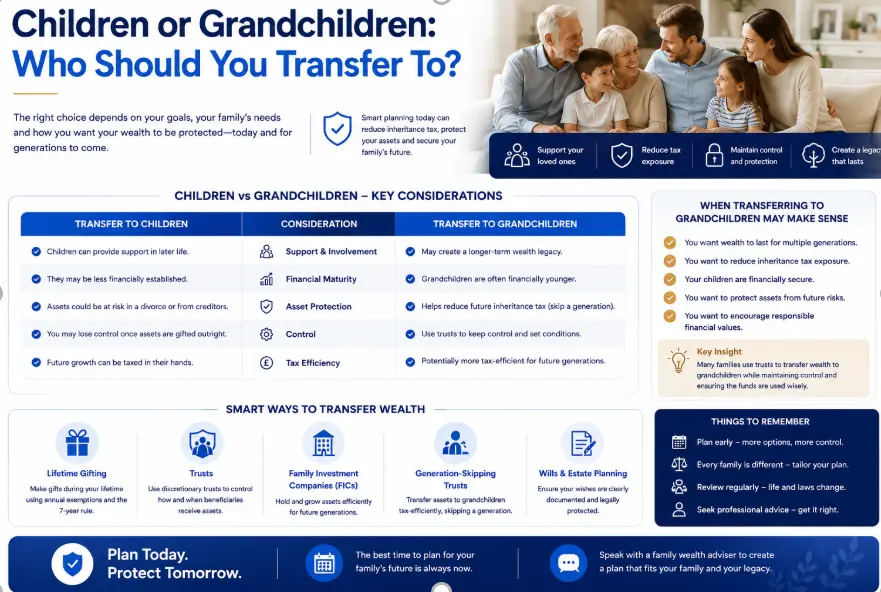
Passing assets to grandchildren instead of children can remove one full round of IHT. A generation-skipping trust grandchildren UK structure makes this possible. This is a key part of generational wealth transfer planning for large family estates.
Benefits and Risks
- Assets skip the middle generation’s taxable estate
- Grandchildren get more time to grow the wealth
- Risk: younger people may not be ready to manage a large sum
- Solution: use a trust to control how and when they access the funds
Key Changes to Watch Beyond 2026
IHT planning before pension changes April 2027: from next April, unused pension funds will likely become part of your estate for IHT. If you rely on your pension as a tax-efficient asset, act now.
Deed of variation UK IHT estate planning: a beneficiary can redirect part of an estate within two years of death. If the funds go to an exempt person or a qualifying trust, IHT may be reduced.
Whole of life policy in trust IHT cover: a whole of life policy written into trust pays a lump sum to cover the IHT bill. The payout sits outside the estate. Many families use this as part of a broader plan. Tax rules keep moving. Review your plan every two to three years at a minimum.
Example: £5 Million Estate Before and After Planning
Take a married couple with a £5 million estate. The family home is worth £1.5 million. The rest is in investments.
| Scenario | No Planning | Gifting Strategy | Trust Plus Gifting |
|---|---|---|---|
| Taxable estate | £5,000,000 | £3,600,000 | £2,800,000 |
| Tax-free threshold | £1,000,000 | £1,000,000 | £1,000,000 |
| Estimated IHT bill | ~£1,600,000 | ~£1,040,000 | ~£720,000 |
| Potential saving | None | ~£560,000 | ~£880,000 |
These numbers are for guidance only. Your outcome depends on your assets, timing, and the reliefs you can use.
Common Mistakes to Avoid
- Starting the seven-year clock too late
- Not putting life cover into a trust
- Missing the pension IHT changes due in April 2027
- Giving away a home but still living there for free
- Setting up a trust without knowing the ongoing tax rules
- Not updating your will after big life changes
- Assuming Business Property Relief stays at its current rate
- Not checking IHT exposure as your assets grow each year
Family Wealth Planning Checklist
- Review your will to make sure it still matches your wishes and family setup
- Check your IHT exposure by looking at your estate against current tax-free amounts
- Start lifetime gifts where it makes sense, to get the seven-year clock running
- Consider a trust if you want to control how assets pass to the next generation
- Look at a Family Investment Company if you have a business or large investment portfolio
- Review your pension before the April 2027 IHT rule changes take effect
- Get expert advice from a qualified adviser who works with high-net-worth clients
Frequently Asked Questions
The nil rate band is £325,000 per person. A couple can combine it with the residence nil rate band. That gives a total of up to £1 million when a family home passes to direct children or grandchildren.
Gifts to people are potentially exempt transfers. If you live seven years after making the gift, it leaves your estate. Taper relief cuts the tax charge if you die between years three and seven.
Yes, if your pension is part of your IHT plan. From April 2027, unused pension funds are likely to become part of your taxable estate. Review your approach well before then.
Long-term tax planning is not something you do once and forget. Your family grows. Asset values change. Tax rules shift. Your plan needs to keep up.
Here is a simple way to think about your next step:
- Estate between £1m and £2m: Use your allowances in full. Write life cover into trust. Start a regular gifting plan.
- Estate above £2m: Look at a trust, a Family Investment Company, or a mix of both.
- Business owners: Business Property Relief may cut your tax bill now. But this relief is under review. Get a succession plan in place today.
- Planning for grandchildren: A generation-skipping trust can remove a full round of IHT from your family’s future.
The families that hold on to wealth across generations are the ones that plan with care, not the ones that leave it to chance. At Lanop, we work with UK high-net-worth families to build practical, tailored wealth transfer plans. To find out what your estate may face and what options are open to you, speak with our team today.